
Metal Stamping Supply Models: One-Stop Die Making vs Separate Tooling Partners
Metal Stamping Supply Models: One-Stop Die Making vs Separate Tooling Partners
A stamped part is never bought alone. It arrives with the die that formed it, the tryout that proved it and the press line that must repeat it for the life of the program. The choice between keeping die making and mass stamping under one manufacturer, or splitting tooling and production across separate partners, decides who carries that responsibility when a dimension drifts.
Why the Supply-Model Decision Comes Before the Quotation
Global metal stamping demand reached USD 257.3 billion in 2025, according to Grand View Research, and Asia Pacific accounted for a 37.0% revenue share of that market in the same year. Automotive metal stamping alone was estimated at USD 90.6 billion globally in 2025. Those figures describe scale, not structure — but structure is what a buyer actually negotiates.
In a stamping program, three deliverables are purchased together whether or not they are contracted together: a die that can hold geometry, a tryout and first-article process that proves the die, and a production line that repeats the geometry at volume. Supply models differ only in how many organizations stand between those three deliverables.
Two models dominate industrial practice:
- One-stop model: a single manufacturer designs and builds the die, runs tryout and first-article inspection, and then performs mass stamping on its own press lines.
- Split model: die design and fabrication are contracted to a tooling specialist, while mass stamping is contracted separately to a press shop or contract stamper, with the die handed over between them.
Both models exist at scale, and both can deliver compliant parts. They differ in where accountability sits when a dimension moves, when a die needs revision, and when a program ramps.
Two Accountability Structures, Not Just Two Price Lists
Under a one-stop model, the interface between tooling and production is internal to one organization. A buyer negotiates one tolerance commitment, one tryout report and one production schedule. When a forming station wears or a draw radius needs adjustment, the party that engineered the die is the party running it, and the correction happens inside a single chain of command.
Under a split model, the die is a physical asset that must be handed over. It is inspected, packed, transported, installed on a different press, and proved again. Responsibility for a deviation then depends on where it originated: die geometry, die wear, press setup, feeding, or incoming material. Establishing that origin is a contractual step rather than an internal one.
Neither structure removes engineering work from the buyer's side. The difference is how many organizations must agree before production stabilizes.
Where the Split Model Introduces Handoff Risk
Splitting tooling from production is a legitimate sourcing strategy, but it concentrates risk at three specific points that a buyer should write into the contract rather than discover during ramp-up.
1. Interface definition between die and press
A die is designed against a specific press envelope — tonnage, bed size, cushion, shut height and feed conditions. If the die shop does not design to the press that will eventually run the tool, adaptation work appears at handover, and that work is usually outside the original tooling quotation.
2. Ownership of debugging
First strokes on a new press commonly require adjustment. If the die builder is not on site, the receiving stamper may adjust the tool itself, which complicates both warranty and die documentation. The cleanest split-model contracts either hold debugging with the die builder or explicitly transfer it, with the original die file updated afterward.
3. Die documentation and spare parts
A production die needs a maintenance history, drawings and a spare parts list to survive years of use. In a one-stop model this documentation is generated inside the same group that runs production. In a split model it must be formally delivered with the tool — otherwise maintenance becomes reactive, and every repair decision depends on one external party's availability.
Die Lead Times to Plan Around: 25–40 Days and 45–70 Days
Tooling lead time is the critical path in either model, and it is not a single number. Hailong Metal Fabrication's published die development guidance distinguishes tooling by complexity: simple dies typically take 25–40 days, while complex progressive dies take 45–70 days including trial stamping.
The reason progressive dies sit at the longer end is structural rather than administrative. A progressive die integrates multiple forming processes in one set of tooling, completing them continuously at speed with high production efficiency and stable precision. That efficiency is designed in during die engineering, station by station. A single stamping die carries lower tooling cost and greater flexibility, which is why it remains the appropriate choice for small batches, large-size workpieces or complex deep-drawn parts.
Die steel selection follows the same logic. Hailong adopts Cr12MoV, SKD11, P20 and other grades according to stamping material, thickness and required production lifetime — the choice is a function of how many strokes the program expects, not a default specification.
For scheduling, the practical consequence is that die lead time is only part of the calendar. Under a one-stop model, tryout and production scheduling are internal and can be sequenced against the same capacity plan. Under a split model, die lead time is followed by handover, transport and press-slot scheduling at a second supplier, so the interval to the first saleable part exceeds the die lead time itself.
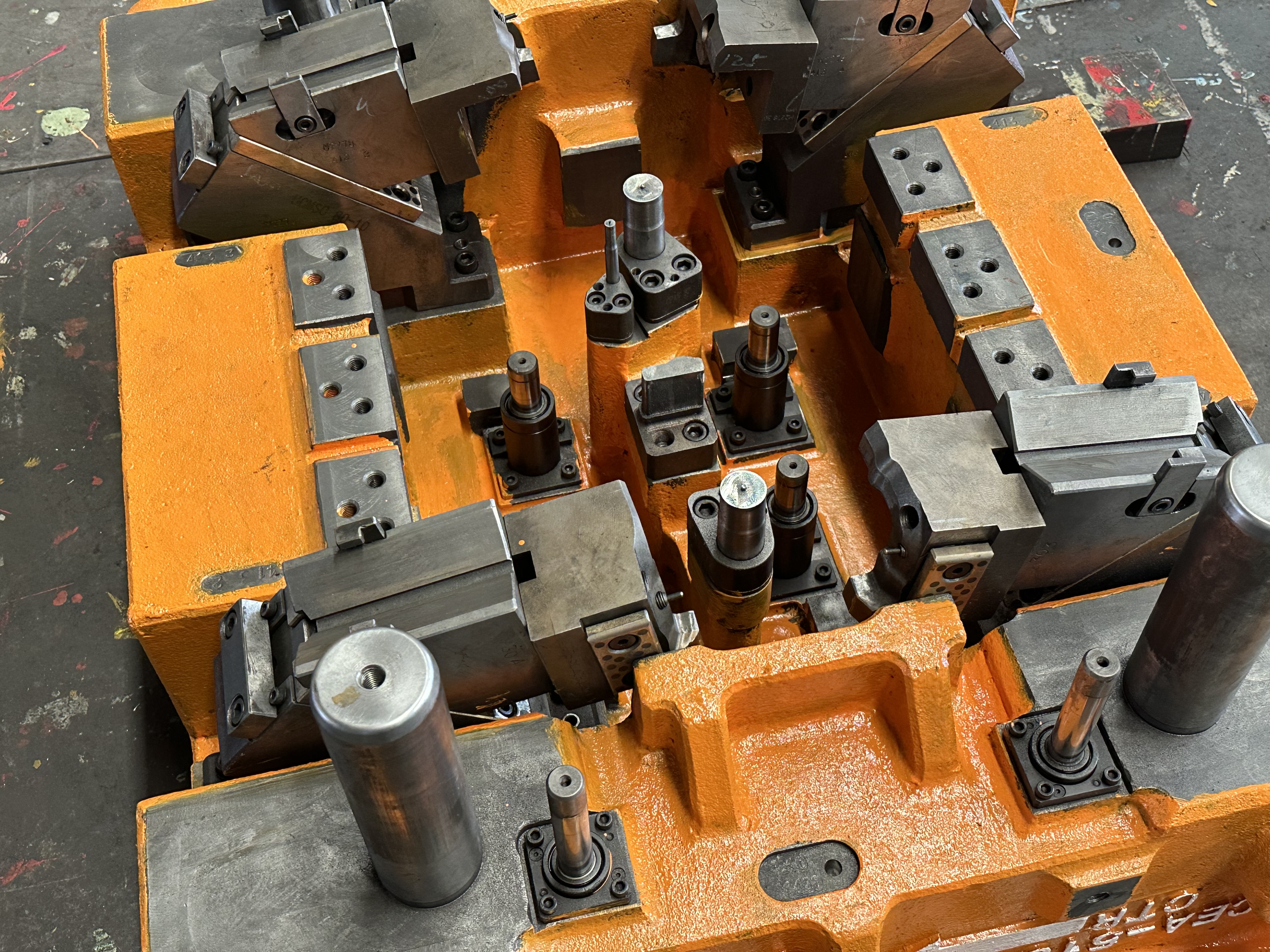
A production stamping die for vehicle parts. Tooling lead time and die durability are decided at the design stage, not at the press.
What One-Stop Die Making Plus Stamping Looks Like in Production
Hailong Metal Fabrication is the trading identity of Qingdao Hailong Machinery Technology Co., Ltd., a machinery manufacturer founded in January 2000 and headquartered in Jimo District, Qingdao, China. The company reports five production campuses across over 500,000 m² of land with 300,000 m² of floor space, and more than 500 sets of precision CNC machining, large-scale stamping and welding equipment.
Its Auto Parts Division operates an 8,250T automated stamping line with a 9 SPM average effective cycle, alongside 3,400T press lines and 800T–2,400T and 630T–800T press ranges, supported by laser cutters and robotic welding cells. Stated monthly capacity for metal stamping parts is 8,000–10,000 units. Production services include metal stamping and deep drawing for custom metal parts, precision CNC machining, welding and assembly, and surface finishing.
Die capability sits in a dedicated subsidiary rather than a separate vendor relationship: Qingdao Jitai Auto Mould Co., Ltd., established in 1993, specializes in cold stamping dies for automotive body panels. Because die design, die fabrication, tryout and mass stamping are held inside one group, the tolerance target defined at die design is the same target verified at first-article inspection and re-verified on the production line — without a handover step in which a third party reinterprets it.
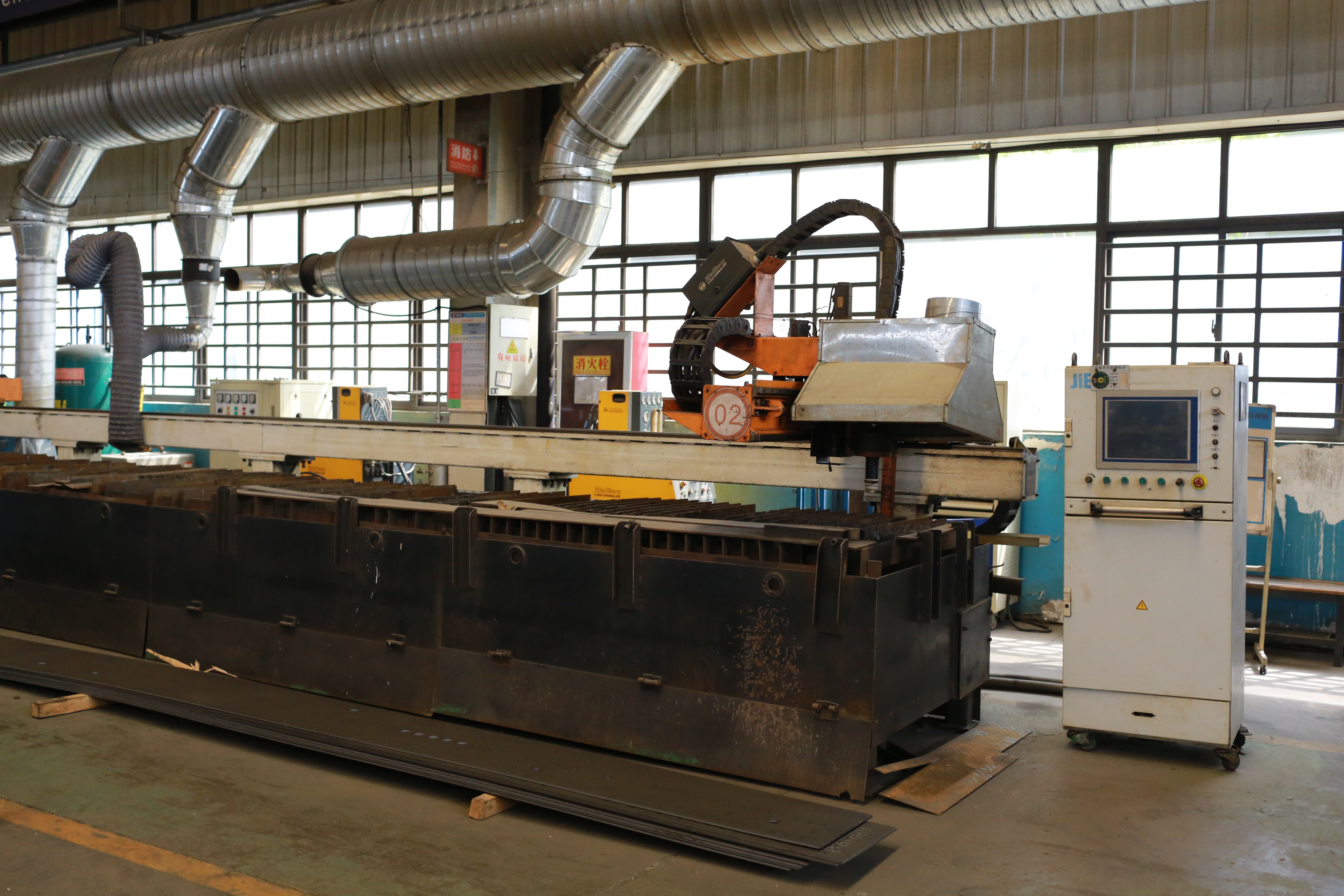
Punching and press equipment inside a stamping operation. One-stop supply keeps tooling and press capacity on the same schedule.
The Die Lifecycle: Debugging, Revision and Maintenance
A die is not finished when it produces its first good part; that is when its service life begins. Hailong supports die debugging, revision, wear repair and regular maintenance during mass production. Tooling documentation and spare parts lists are provided, together with tryout and first-article inspection reports, and on-site technical attendance for mold start-up is available if needed. Specific warranty terms are agreed contractually.
This is the part of the supply-model comparison that buyers most often underestimate. A die running hundreds of thousands of cycles will require inspection and wear management long before the program ends. In a one-stop model, maintenance intervals can be scheduled against the same production plan that consumes the die. In a split model, the buyer must either hold maintenance capability in-house, extend a service contract with the original die shop, or depend on the stamper — each option carrying a different response time when a line stops.
A Brazil-based manufacturer that took delivery of 20 die sets reported stable high-volume production with consistent tolerance across approximately 500,000 cycles, describing a tool with surface coating, high precision and a service life suited to heavy-duty stamping of auto parts. That case illustrates the point that die value is realized over the cycle count, not at handover.
Comparing the Two Models on Procurement Criteria
| Procurement criterion | One-stop (die making + stamping) | Split (die partner + stamping partner) |
|---|---|---|
| Tooling responsibility | Die design, fabrication and tryout held by the same manufacturer that runs production | Die design and fabrication held by a tooling specialist, separate from the stamping supplier |
| Schedule control | Die lead time (25–40 days simple; 45–70 days complex progressive, including trial stamping) and production slots planned internally | Die lead time plus handover, transport and press-slot scheduling at a second supplier |
| Debugging and first-article | Debugging, revision and first-article inspection performed by the die builder | Debugging ownership must be assigned contractually; the receiving press shop may adjust the tool |
| Die maintenance | Wear repair and regular maintenance available from the original die builder during mass production | Buyer chooses between in-house capability, a service contract with the die shop, or reliance on the stamper |
| Tolerance accountability | Single point of accountability from die design to production verification | Deviation origin (die geometry, wear, press setup, material) must be established between parties |
| Dependency profile | Concentrated on one supplier | Distributed, with a qualified second press shop available |
| Typical fit | Programs with volume, certification and traceability requirements | Buyers with in-house press capacity, or programs that intend to relocate a die asset |
Quality Control and a Certification Boundary Buyers Should Read Carefully
Hailong's quality control methods include mold design checks and Moldflow analysis, incoming steel certificate inspection, key process control during machining, assembly dimension checks, and slide, hardness and cooling system inspections. Pre-shipment spare parts lists and mold tryout videos form part of the quality documentation delivered with a tool.
On certification, the company holds IATF 16949 certification issued by TUV under certificate number 0593827, valid from 2026-01-08 to 2029-01-07, against standard IATF 16949:2016-10-01. The registered scope is "Manufacture of Stamping & Welding Parts (without Product Design as per Chapter 8.3)".
Boundary to note: because product design is excluded from the certified scope, design authority for the part itself remains with the buyer or with a separately contracted design partner. The certificate covers the manufacture of stamped and welded parts — an important distinction when a buyer assumes that a one-stop supplier also carries design responsibility.
The company is additionally certified to ISO 9001, ISO 14001 and OHSAS 18001, and its in-house Technology Center has held Qingdao Municipal Enterprise Technology Center status since 2008 with more than 100 patents across chassis structures, bumper systems and stamping tooling. Its stamping and fabrications are supplied to FAW Jiefang, SAIC-GM, BAIC, Dongfeng and Beijing Benz domestically, and to Renault, Nissan, Mercedes-Benz, Doosan and GD overseas, with exports to the United States, Europe, India and Africa.
In automotive programs, certification expectations escalate beyond the certificate itself. IATF 16949 with real-time SPC monitoring and Run@Rate tests of 4,000 defect-free pieces is described in market research on North American automotive steel stamping as a baseline entry criterion for new OEM programs. Buyers evaluating either supply model should confirm which of these evidence items — SPC data, Run@Rate, PPAP documentation, CAE — are contractually in scope, since some require confirmation in advance.
When Separating Tooling and Stamping Still Makes Sense
A one-stop model is not automatically the right answer, and a credible comparison has to state where the split model wins.
- Single-source dependency. One-stop concentrates both tooling and production risk in one supplier. Buyers with high program criticality sometimes split deliberately to keep a qualified second press shop in the supply base.
- Existing in-house press capacity. A buyer that already operates presses may only need die making externally, in which case splitting is not a risk decision but an asset-utilization decision.
- Die relocation requirements. Programs with local-content or regional-transfer requirements treat the die as a movable capital asset, which implies a tooling partner separate from any single press shop.
- Low-volume or very large parts. Single stamping dies carry lower tooling cost and suit small batches, large-size workpieces or complex deep-drawn parts, where the progressive-die advantage does not apply.
- Lead-time expectations. A 45–70 day complex progressive die schedule cannot be shortened by adding a second partner; splitting adds handover steps to the same tooling timeline.
- Capital intensity of advanced processes. Hot-stamping lines for advanced high-strength steel parts such as 1,500 MPa press-hardened steel can cost USD 8–12 million each, according to market research on the North American automotive steel stamping sector. Programs that cannot justify that capital volume will source from suppliers that already hold it, regardless of how tooling is organized.
Application Fit Across Automotive, Appliance and Heavy-Gauge Work
Where a stamped part is used changes which supply model is workable.
- Automotive metal stamping. Body panels, structural parts and chassis components sit inside IATF 16949-bound programs where tolerance traceability is a program requirement, not a preference. High-volume auto sheet metal components are the classic application for progressive dies.
- Household appliance metal stamping. Appliance components typically combine appearance requirements with thinner gauges, where die surface condition and maintenance intervals directly affect visible quality.
- Heavy-gauge stainless steel stamping and stainless steel metal stamping. Higher strength and work-hardening behavior increase press tonnage and die wear, making die maintenance access part of the production plan rather than an afterthought.
- Cold rolled steel metal stamping. Cold-rolled and hot-rolled steel, along with 304 and 304L stainless, are among the materials handled in sheet metal fabrication, alongside stamping, laser cutting, shearing/CNC punching and press-brake bending.
- Deep draw metal stamping and progressive die metal stamping. Deep drawing favors tooling geometry and material flow control; progressive dies favor continuous high-volume output with consistent precision.
- Stamp-and-weld assembly components. Where stamped parts become welded assemblies, one-stop supply removes the additional handoff between a stamper and a separate welding vendor, using robotic welding cells and assembly rather than transporting parts between facilities.
Custom OEM metal stamping parts are developed per drawing or sample, with material selection, surface treatment and special processes defined by customer requirement. Engineers typically respond within 24 hours and quotations are issued in 1–7 days; sea freight runs approximately 30–45 days and air freight approximately 3–7 days. Actual production lead time depends on product complexity and order volume, and MOQ is confirmed with sales for each product family and program.
Market Signals Shaping Supply-Model Choices
Three verified market signals are relevant to the tooling-versus-production decision.
First, scale continues to favor suppliers that can absorb tooling and production together. The global metal stamping market stood at USD 257.3 billion in 2025, with Asia Pacific holding a 37.0% revenue share, and automotive metal stamping accounting for an estimated USD 90.6 billion globally in the same year.
Second, published market valuations of the metal stamping market differ between research houses, and the reason matters to buyers. Grand View Research places the 2025 global market at USD 257.3 billion, while other published estimates are lower. A significant part of that gap is attributed to whether captive stamping departments inside large OEMs are counted. For a buyer, the implication is practical: a meaningful share of global stamping capacity is not addressable through external sourcing at all, so supplier selection criteria should focus on the merchant capacity that can actually be contracted.
Third, compliance expectations are hardening. As noted above, IATF 16949 certification combined with real-time SPC monitoring and Run@Rate testing of 4,000 defect-free pieces is characterized as a baseline entry criterion for new OEM automotive programs. That raises the value of a supplier who can generate the tryout report, first-article inspection data and process monitoring evidence from within the same organization that built the die.
Future Outlook
Two directions appear likely over the next planning cycle.
The first is consolidation of tooling and production responsibility wherever programs demand traceability. When OEM requirements escalate toward real-time process monitoring and Run@Rate validation, the evidence chain becomes easier to maintain when the die builder and the stamper are the same entity — the tryout report, first-article inspection and production data come from one system rather than three.
The second is that die lifecycle data becomes a purchasing input rather than an engineering footnote. Buyers are already asking for tryout videos, spare parts lists and documented wear repair; the next step is using cycle counts and maintenance events as an ongoing supplier evaluation criterion. This favors suppliers that document die history systematically, regardless of whether the tooling itself was built internally or externally.
For advanced high-strength steel and press-hardened parts, capital intensity will keep pulling volume toward suppliers that already own hot-stamping lines and the tooling capability to support them. Where that capital cannot be justified, conventional cold stamping with well-documented progressive or single dies will remain the mainstream choice — and the supply-model question will remain a decision about accountability rather than about price per stroke.
Frequently Asked Questions
Progressive die or single stamping die — which should be used for auto sheet metal parts?
Progressive dies are recommended for high-volume auto sheet metal components because a progressive die integrates multiple forming processes in one set of tooling and delivers high production efficiency with stable precision. A single stamping die is generally more suitable for small batches, large-size workpieces or complex deep-drawn parts, where tooling cost and flexibility matter more than continuous output.
Can a manufacturer certified to IATF 16949 also develop automotive stamping dies?
Yes. Hailong has experience in auto sheet metal stamping die design and fabrication compliant with IATF 16949 quality requirements, with die capability concentrated in its subsidiary Qingdao Jitai Auto Mould Co., Ltd., established in 1993 and specializing in cold stamping dies for automotive body panels. The IATF 16949 certificate issued by TUV, number 0593827 and valid from 2026-01-08 to 2029-01-07, covers the manufacture of stamping and welding parts and excludes product design under Chapter 8.3.
How long does stamping die development take?
Lead time depends on die complexity. Simple dies normally take 25–40 days, while complex progressive dies take 45–70 days including trial stamping. Actual production lead time for the parts themselves depends on product complexity and order volume and should be confirmed with the supplier.
After a die is completed, can the same supplier run mass stamping?
Yes. Hailong operates automated stamping lines and provides one-stop service covering die making and mass stamping of metal parts, including an 8,250T automated stamping line with a 9 SPM average effective cycle, 3,400T lines and 800T–2,400T and 630T–800T press ranges, with monthly capacity of 8,000–10,000 units for metal stamping parts.
Is die maintenance and modification available during mass production?
Yes. Hailong supports die debugging, revision, wear repair and regular maintenance during mass production. Tooling documentation and spare parts lists, tryout and first-article inspection reports are provided, and on-site technical attendance for mold start-up is available if needed. Specific warranty terms are agreed contractually.
Which mold steels are commonly used for stamping dies, and what determines the choice?
Hailong adopts Cr12MoV, SKD11, P20 and other grades according to stamping material, thickness and required production lifetime. The selection is driven by the expected number of strokes, the strength and thickness of the stamped material, and the wear conditions the die will face in production.
Resources
Hailong Metal Fabrication publishes its full product and capability brochure for buyers evaluating die making, stamping and fabrication scope: Hailong company brochure (PDF). Company information is also available at en.qdhailong.com.