
Mercury-Free Glass vs Electronic Thermometers: An Importer's Decision Framework
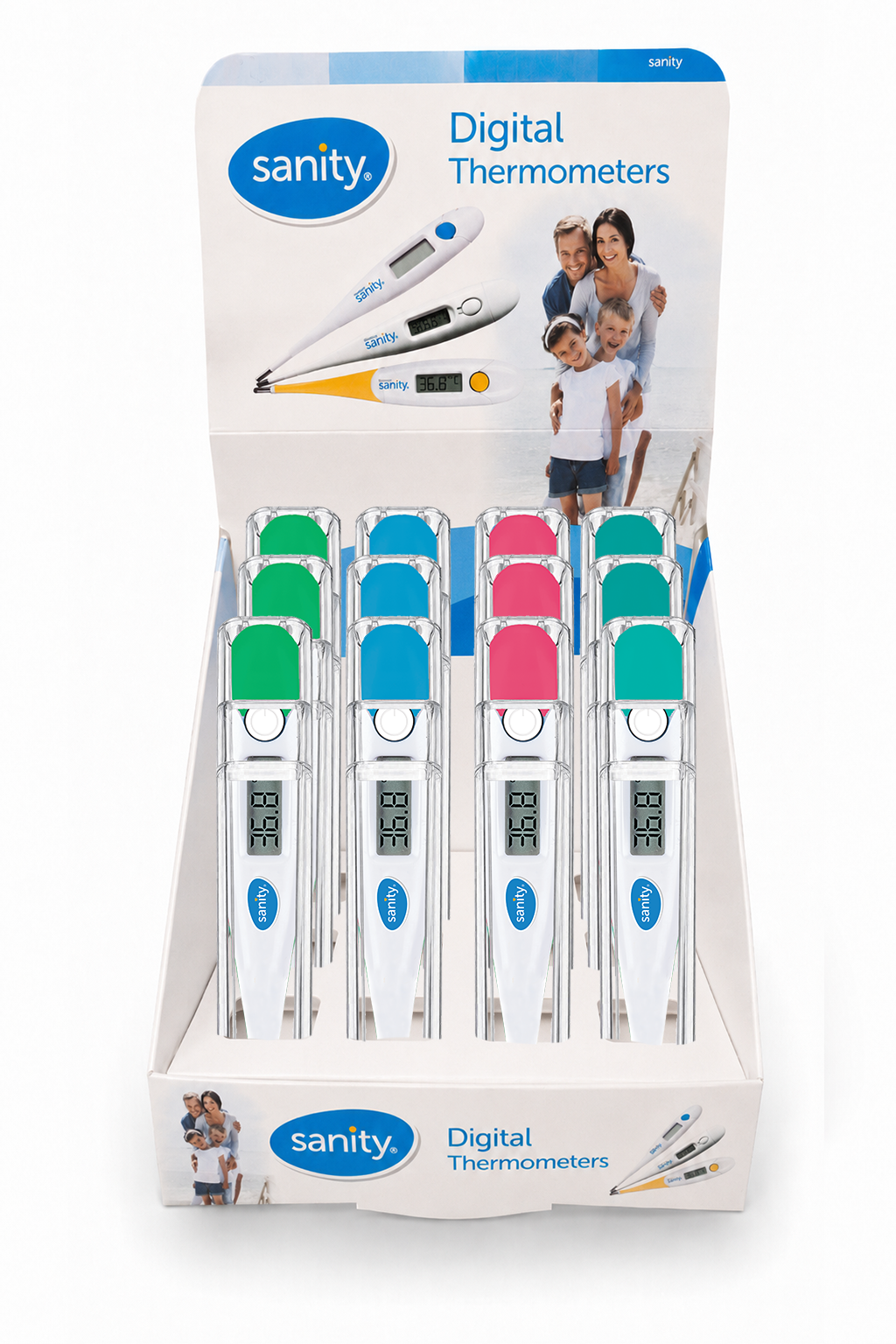
Retail-ready thermometer packaging for pharmacy and supermarket distribution — the point at which an importer's product-family decision becomes visible.
Importers sourcing clinical thermometers for regulated markets are not choosing between two versions of the same product. Mercury-free liquid-in-glass thermometers and electronic thermometers sit in different regulatory categories, run on different production programs, and fail in different ways. A decision taken on unit price alone tends to be revisited at customs clearance or during the first warranty cycle.
This framework sets out the four gates an importer has to pass — regulatory scope, application fit, purchasing terms and acceptance criteria, and long-term supply capability — using the published specifications and production terms of Ningbo Hi-life Medical Technology Co., Ltd. (Mr. Thermo), a Ningbo, China-based manufacturer of mercury-free glass thermometers, electronic thermometers and infrared thermometers, and of the two product families it builds for export.
The Two Product Families Being Compared
The mercury-free liquid-in-glass family is represented in the Hi-life range by models 6000-A and 7000-A. Both are produced from borosilicate glass with a non-toxic gallium-indium-tin alloy that replaces mercury as the indicating liquid. The published specification lists a measuring range of 35°C–42°C, a scale division of 0.1°C, measurement accuracy of ±0.1°C, a maximum temperature indicator, and a shock-resistant glass tube.
The electronic family covers models MT-518, MT-519, MT-811, MT-801 and ECT-1. These use an ABS plastic body with a stainless-steel probe, and carry a published measuring range of 32.0°C–43.9°C, measurement accuracy of ±0.1°C, a 45-second response time, an IP22 ingress-protection rating, a 1.5V button battery, and an operating temperature range of 10°C–40°C.
The two families share the same nominal accuracy figure of ±0.1°C. Almost everything else differs: power source, read method, response behaviour, casing, protection rating, failure mode, and the compliance documentation that has to sit behind the shipment.
Why the Choice Has Become a Procurement Decision
Three structural changes have moved the glass-versus-electronic question from a clinical preference to a purchasing requirement.
Regulation. Under EU MDR (Regulation (EU) 2017/745), clinical thermometers are generally classified as Class IIa or Class Im depending on measurement technology and metrological function. Separately, ISO 80601-2-56:2017 defines the basic safety and essential performance requirements for clinical thermometers used for body temperature measurement. For an importer, that translates into a documentation obligation that begins before the purchase order, not at the port of entry.
Market structure. Mercury-free thermometers held the largest revenue share of the global thermometer market in 2023, at 69.1% (Grand View Research). Mercury-containing glass thermometers are restricted across most major markets, which means the genuine comparison for most importers is no longer "mercury or digital" but "mercury-free glass or electronic."
Trade volume. Global trade under HS 902519 — thermometers excluding liquid-filled types — reached USD 4.93 billion in 2024, a 4.28% increase on the USD 4.73 billion recorded in 2023 (Observatory of Economic Complexity). Most of the incremental trade sits on the electronics side of the category.
Technical Comparison: What the Specifications Actually Say
| Parameter | Mercury-free liquid-in-glass (6000-A, 7000-A) | Electronic (MT-518, MT-519, MT-811, MT-801, ECT-1) |
|---|---|---|
| Measuring range | 35°C–42°C | 32.0°C–43.9°C |
| Measurement accuracy | ±0.1°C | ±0.1°C |
| Scale / readout | Printed scale, division 0.1°C | Digital display |
| Response time | Contact measurement; dwell time required | 45 seconds |
| Power supply | None — no battery | 1.5V button battery |
| Ingress protection | Not applicable | IP22 |
| Materials | Borosilicate glass; non-toxic gallium-indium-tin alloy | ABS plastic; stainless-steel probe |
| Operating temperature | Not specified | 10°C–40°C |
| Distinguishing feature | Maximum temperature indicator; shock-resistant glass tube | Fast digital read; fever alarm function reported in distributor programs |
Four points in that table carry the most procurement weight.
Accuracy parity. Both families publish ±0.1°C. Choosing glass does not buy extra precision, and choosing electronic does not concede it. The differentiation is in use, not in tolerance.
No power source. A mercury-free glass thermometer has no battery, no shelf-life clock, and no replacement component. For markets where button cells create disposal labelling obligations, or where stock may sit in a warehouse for a long period before sale, this removes an entire failure mode from the product.
Response behaviour. The electronic models specify a 45-second response. Mercury-free glass requires direct contact and a dwell period before the maximum temperature indicator settles. Where a caregiver needs a fast, self-administered read, electronic wins on workflow; where a slow, precise axillary or oral measurement is acceptable, glass remains viable.
Protection rating. IP22 is splash-level protection, not immersion-grade protection. Buyers searching for a "waterproof digital thermometer" should verify the actual rating on the model they intend to list rather than the marketing term used in the category.
Purchasing Terms and Acceptance Criteria
Commercial terms are the point where most import decisions are actually made or abandoned. Hi-life runs two published production programs for export buyers, and the terms differ.
| Term | Program A | Program B |
|---|---|---|
| Production mode | OEM / ODM / Private Label | OEM / ODM / Customized service |
| Customization scope | Logo printing, packaging, color, scale customization | Shell color, brand logo, packaging, software parameter |
| MOQ | 5,000 units | 3,000 units |
| Lead time | 25–35 days | 30–40 days |
| Monthly capacity | 150,000 units | 200,000 units |
| Quality control | 100% accuracy inspection before shipment | 100% functional and precision testing |
| Delivery terms | FOB Ningbo / CIF destination port | FOB Ningbo / CFR / CIF |
| Acceptance criteria | 100% pre-shipment accuracy inspection; third-party inspection acceptable | Full function and precision pre-shipment testing; customer inspection supported |
| Payment terms | 30% deposit, 70% balance against copy of shipping documents | 30% deposit, 70% balance against copy of shipping documents |
| After-sales | Online technical support; quality complaint handling | Remote guidance; spare-parts solution; after-sales feedback |
Two features of these terms deserve attention. The first is the acceptance standard: 100% pre-shipment accuracy inspection is a stronger commitment than a batch sampling certificate, and the option of third-party inspection means the buyer is not required to accept the factory's own verdict on a high-value order. The second is the payment structure, which is identical across both programs and keeps 70% of the contract value tied to shipping documents rather than to delivery at destination.
The boundary worth noting at this stage is that the two programs are not interchangeable on a per-model basis. MOQ, lead time and monthly capacity differ between them, and customization scope differs too — logo, packaging and scale work belongs to one configuration, while shell color and software parameters belong to the other. Buyers should confirm in writing which program applies to the specific model and configuration they intend to order before signing, rather than assuming the lower MOQ or the shorter lead time will carry over.
Certified Digital Versus Uncertified: The Trade-Off Importers Underestimate
Certification is the gate that most often decides between two otherwise comparable quotations.
Hi-life holds a CE MDR certificate (certificate number CN24/00005535) issued by SGS for the EU/EEA market. The certificate was issued on 22 January 2026 and is valid to 30 August 2029. Its declared scope covers both the mercury-free liquid-in-glass thermometer and the electronic thermometer, with standards referencing EN ISO 13485:2016 and report CN/HGH/5365-TFR 1.3 + CTC. The company also operates under the ISO 13485 quality management system and passed a BSCI audit in 2025.
On the other side of the trade-off, uncertified low-cost thermometers can be detained, returned or fined by customs authorities in regulated medical-device markets. That risk is not evenly distributed: it falls on the importer, not the factory, and it lands after the goods have shipped.
The honest boundary here is that certification is not free. Compliance adds testing, documentation and audit work to the supply chain, and that work is reflected in the landed cost per unit. Uncertified product may remain commercially workable in markets with looser requirements and in non-medical channels, but the buyer is carrying the regulatory risk directly. For EU, UK and comparable regulated markets, the certified route is usually the cheaper one once the probability of a single detention is priced in.
Application Fit: Matching Type to Care Scenario
Two distributor programs show how the split plays out in practice.
A German medical distributor and pharmacy wholesaler ordered 50,000 units over a three-year period for hospital, clinic and household body temperature measurement. The product in scope was the mercury-free glass thermometer, models 6000-A and 7000-A. Reported outcomes were stable measuring accuracy, zero mercury-leak risk and good market feedback, with the eco-friendly mercury-free formula, the shock-resistant tube and the easy-reading scale highlighted as the commercial selling points.
A French healthcare importer and supermarket retailer ordered 100,000 units over three years for home-use and community medical temperature screening. Reported outcomes were fast measurement, a low defective rate and conformity with EU MDR requirements, with the fever alarm function, portable size and optional soft probe tip highlighted.
On that evidence, three application rules hold for most portfolios:
- No-battery, reusable, low-maintenance stock — pharmacy counter sales, household kits, clinics, and any market where battery disposal labelling or long shelf-life is a constraint. Mercury-free glass fits, and the maximum temperature indicator captures the peak reading for later interpretation.
- Fast, self-administered, caregiver-friendly reads — home care, community screening, paediatric use. Electronic models fit, given the 45-second response and the fever alarm function reported in distributor programs.
- High-throughput screening — the Hi-life range also includes infrared ear and forehead thermometers and industrial infrared thermometers. Where throughput matters more than contact accuracy, those models sit alongside the two families discussed here rather than replacing them.
Where Each Option Has Real Limits
A framework that only lists advantages is not a decision framework. The following limits are drawn from the published specifications and terms.
Mercury-free glass. The 6000-A and 7000-A specification lists a maximum temperature indicator rather than a powered audible alarm or stored reading. Buyers who need a fever alarm, memory function or automatic shut-off should specify an electronic model instead. Contact measurement also requires dwell time, which matters in any setting where a queue forms. A shock-resistant glass tube reduces breakage risk but does not eliminate it in unsupervised household use, and scale reading still depends on adequate eyesight and lighting — which places more of the usability burden on packaging, instructions and the easy-reading scale design.
Electronic. The 45-second response is fast by contact-measurement standards but not instantaneous, so high-throughput screening lines may still need infrared. An IP22 rating is splash-level protection rather than immersion protection. The 1.5V button battery introduces a dependency on shelf life, replacement and, in some markets, disposal labelling. An operating temperature range of 10°C–40°C excludes cold-chain and outdoor use.
Supply terms. MOQ of 5,000 units with a 25–35 day lead time, or 3,000 units with a 30–40 day lead time, are volume programs. Genuinely small pilot orders below those thresholds are structurally difficult for a factory running 100% pre-shipment inspection, because the inspection workload does not scale down with the order.
Certificate scope. The CE MDR certificate covers the products listed in its scope. A new model, a materially changed probe design or a new software parameter requires its own conformity pathway; it does not inherit coverage automatically.
Market Signals Behind the Product Mix
Three published data points frame where demand is going.
The global thermometer market is projected to grow from USD 2.2 billion in 2026 to USD 3.0 billion by 2030, a CAGR of 8.2% over the 2024–2030 period (Grand View Research). Mercury-free thermometers already held a 69.1% revenue share in 2023, meaning growth is not being generated by replacing mercury devices — that substitution has largely happened. Growth is coming from expanding the electronic and infrared segments on top of an already mercury-free-dominant base.
Trade data supports the same reading: global trade under HS 902519 grew 4.28% year on year to USD 4.93 billion in 2024, covering thermometers other than liquid-filled types (Observatory of Economic Complexity). The category with the highest trade growth is the one where electronic and infrared products compete, not the one where glass does.
Regulatory direction reinforces it. With EU MDR defining clinical thermometer classification and ISO 80601-2-56:2017 defining essential performance, the compliance burden per SKU continues to rise. That burden favours suppliers who can maintain documentation across a family of models rather than a single product.
Supplier-Side Decision Points: Capability and Continuity
Once the product family is chosen, the purchasing question becomes whether the supplier can carry it for the length of the distribution agreement. The relevant facts are concrete.
The Hi-life facility covers 9,700 m², employs 55 staff, runs an 8-engineer R&D team, and reports annual output of 3,500,000 units. The company exports roughly 70% of production, with the EU and USA as its main markets, and its products reach more than 50 countries and regions across EU member states, the United Kingdom, Russia, Vietnam, Ukraine, Uzbekistan, Turkey, Tunisia, Mexico, Chile, Colombia and others. It is the Secretariat Unit of the Body Temperature Measurement Professional Committee under the China Association for Medical Devices Industry (CAMDI) and has participated in the revision and compilation of the national standard GB1588-2024.
On the customization side, the company runs OEM, ODM and Private Label production, covering product development, private labeling and tailored packaging solutions. Practical customization scope includes logo printing, packaging, color and scale customization on one program, and shell color, brand logo and software parameters on the other. After-sales support covers online technical support, quality complaint handling, remote guidance and a spare-parts solution — the last of which matters most for electronic models, where a distributor's warranty exposure is component-based rather than exchange-based.
Future Outlook
For importers, the next several years look less like a technology switch and more like a portfolio-balancing exercise. Mercury-free glass thermometers are not exiting the market; they hold the majority revenue share and remain the default no-battery, reusable option in pharmacy and household channels, particularly where shelf life and disposal labelling matter.
Electronic models will continue to take the larger share of incremental volume, driven by faster reading, alarm and memory features, and by the general shift of home care toward self-administered measurement. Infrared products sit above both, absorbing the screening use cases where throughput outweighs contact accuracy.
The variable most likely to change sourcing decisions is not product technology but documentation. As MDR-style classification and essential-performance standards are applied consistently, the practical dividing line between suppliers will be whether they can hold CE MDR coverage, ISO 13485 processes and pre-shipment inspection discipline across an entire model family — and whether they can absorb a third-party inspection without renegotiating the order.
Frequently Asked Questions
1. What is the difference between a mercury-free liquid-in-glass thermometer and an electronic thermometer?
Both types measure body temperature with a published accuracy of ±0.1°C, but they differ in construction and use. Mercury-free liquid-in-glass models such as 6000-A and 7000-A use borosilicate glass with a non-toxic gallium-indium-tin alloy instead of mercury, cover a measuring range of 35°C–42°C, use a 0.1°C scale division, include a maximum temperature indicator, and require no battery. Electronic models such as MT-518, MT-519, MT-811, MT-801 and ECT-1 use an ABS body with a stainless-steel probe, cover 32.0°C–43.9°C, respond in 45 seconds, carry an IP22 rating, and run on a 1.5V button battery within an operating range of 10°C–40°C.
2. What are the purchasing terms and acceptance criteria for importing these thermometers?
Hi-life publishes two export programs. One runs an MOQ of 5,000 units with a 25–35 day lead time, 150,000 units monthly capacity, FOB Ningbo or CIF destination port terms, 100% pre-shipment accuracy inspection, third-party inspection acceptance, and 30% deposit with 70% balance against copy of shipping documents. The other runs an MOQ of 3,000 units with a 30–40 day lead time, 200,000 units monthly capacity, FOB Ningbo / CFR / CIF terms, full function and precision pre-shipment testing with customer inspection supported, and the same 30/70 payment structure. Buyers should confirm which program applies to the specific model before contracting.
3. Should an importer buy a CE-certified electronic thermometer or a cheaper uncertified one?
The trade-off is regulatory risk against unit cost. Hi-life holds CE MDR certificate CN24/00005535, issued by SGS for the EU/EEA market on 22 January 2026 and valid to 30 August 2029, covering both mercury-free liquid-in-glass and electronic thermometers. Certified products pass medical compliance inspection; uncertified items risk being detained, returned or fined by customs. Certified models therefore suit regulated medical-device markets such as the EU and Southeast Asia. Uncertified low-cost products are generally only appropriate for regions with looser requirements and carry import risk that is borne by the importer.
4. Should I buy a mercury-free glass thermometer or a traditional mercury thermometer?
A mercury-free liquid-in-glass thermometer such as the 6000-A uses a non-toxic gallium-indium-tin alloy, delivers the same ±0.1°C precision, complies with CE MDR, and avoids mercury leakage hazards entirely. Traditional mercury thermometers are subject to restrictions in most countries. The mercury-free option therefore preserves the familiar glass read-out and reusable, battery-free operation while removing the hazardous-material and regulatory problems associated with mercury.
5. What OEM, ODM and Private Label options are available, and at what MOQ, lead time and capacity?
The manufacturer provides OEM, ODM and Private Label production services. Customization covers logo printing, packaging, color and scale customization under one program, and shell color, brand logo, packaging and software parameters under the other. Depending on the program, MOQ is 5,000 units or 3,000 units, lead time is 25–35 days or 30–40 days, and monthly capacity is 150,000 or 200,000 units. Quality control is 100% accuracy inspection or full function and precision testing before shipment, and after-sales support includes online technical support, quality complaint handling, remote guidance and a spare-parts solution.
6. Which care scenarios fit mercury-free glass thermometers and which fit electronic thermometers?
Mercury-free glass thermometers fit hospital, clinic and household body temperature measurement where a reusable, battery-free product with an easy-reading scale and shock-resistant tube is preferred — a German medical distributor and pharmacy wholesaler has used models 6000-A and 7000-A across 50,000 units over three years for exactly this mix of settings, reporting stable accuracy and zero mercury-leak risk. Electronic thermometers fit home-use and community temperature screening where speed and alerts matter — a French healthcare importer and supermarket retailer used 100,000 units over three years for that purpose, reporting fast measurement, a low defective rate and EU MDR conformity, with fever alarm, portable size and an optional soft probe tip as key features.
Confirming the Decision
The framework reduces to four checks before a purchase order: confirm the certificate scope covers the exact model; confirm which production program applies and therefore which MOQ, lead time and capacity figures are binding; confirm the inspection standard and whether third-party inspection is accepted; and confirm which features the end user actually needs, because a fever alarm requirement rules glass out and a no-battery requirement rules electronic out. Buyers who want the full model list and specification detail can review the current product catalogue here: Hi-life Medical 2025 Catalogue.
¿Tiene preguntas o necesita más detalles?
Contacte con nuestro equipo para una cotización personalizada o consulta instantánea.
Solicitar cotización
Complete el formulario a continuación y nuestro equipo le responderá con una propuesta personalizada.
Chat directo de WhatsApp
¿Prefiere chatear en tiempo real? Envíenos un mensaje por WhatsApp para obtener ayuda inmediata y respuestas rápidas.
- Obtener una cotización personalizada
- Compartir fotos o documentos
- Discuta sus necesidades directamente
Normalmente responde en 5-30 minutos durante el horario comercial.