
Men's Leather Shoes Decoded: Style Categories, Scenarios, and What Buyers Should Know First
The global leather footwear market reached an estimated USD 150.7 billion in 2024, with men's styles representing 54.1% of total revenue, according to Grand View Research. For buyers entering this category—whether as importers, wholesalers, or private-label developers—the first challenge is not finding a factory, but understanding how the men's leather shoe segment is actually structured across styles, occasions, materials, and manufacturing methods.
Why the Men's Leather Shoe Category Needs a Clear Map
Men's leather shoes are often treated as a single product type in sourcing conversations, but the market itself is highly segmented. Industry research indicates that men's leather shoe sales volume exceeded 780 million pairs globally in 2024, representing 41.3% of the total men's footwear industry. Formal shoes alone account for roughly 40% of men's leather shoe volume, while casual leather shoes, bridal/occasion footwear, and semi-formal styles fill the remaining share.
This segmentation matters commercially. A buyer searching for "men's leather shoes" without clarifying the target occasion—boardroom, weekend, or wedding—will struggle to align product specifications with actual consumer demand. A global manufacturer like Yangjiang Hengxin Shoes Co., Ltd., established in 2011 in Guangdong, China, addresses this by structuring production across the full formal-to-casual spectrum, from Oxfords and Derbys to loafers and monk straps, rather than concentrating on a single niche.
Formal vs. Casual Men's Leather Shoes: A Practical Distinction
For sourcing teams, the most useful starting point is separating the market into dress-oriented and casual-oriented leather footwear. These categories differ not only in silhouette, but in material selection, construction priorities, and target retail channels.
Formal Men's Leather Shoes
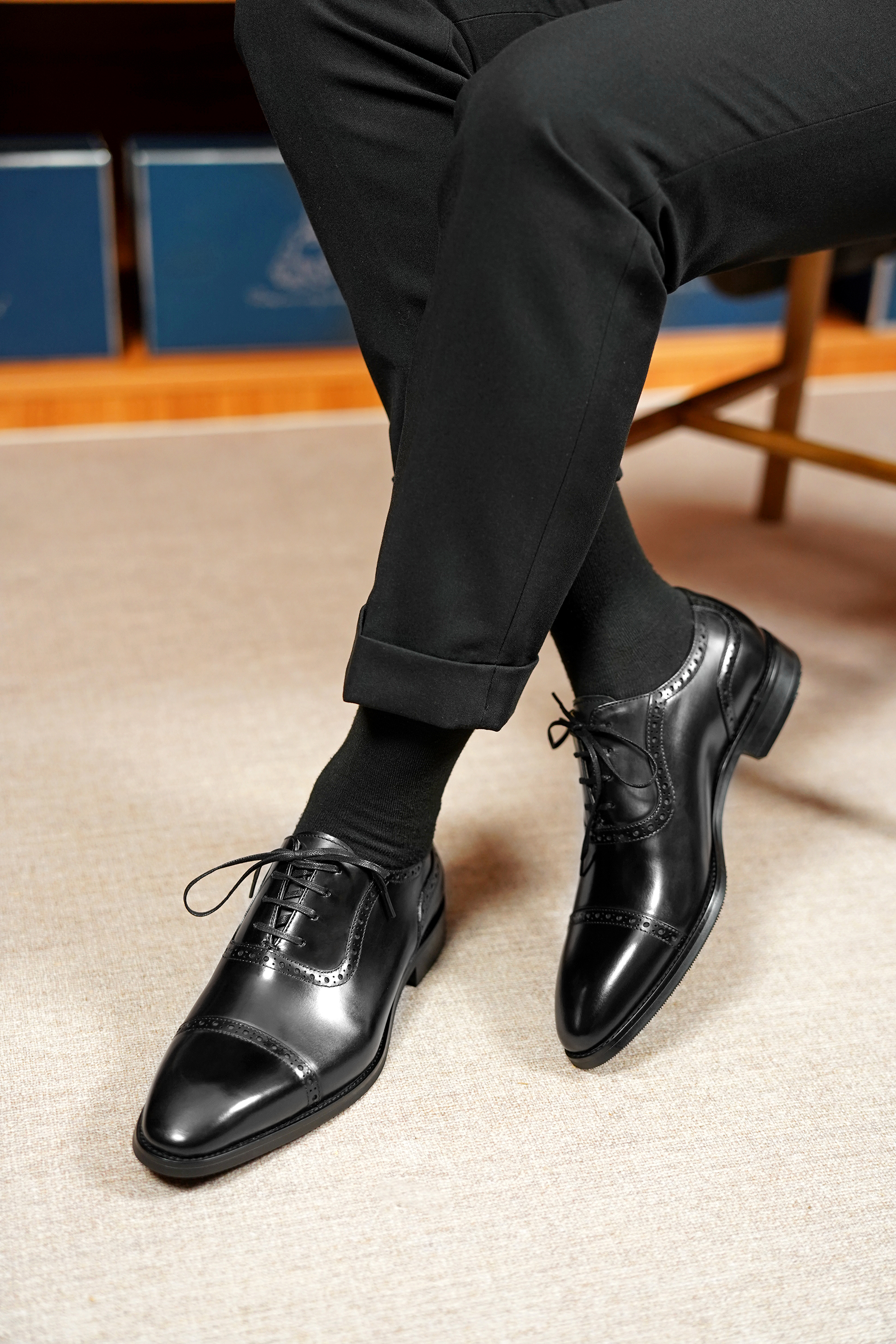
Formal styles—Oxford shoes, Derby shoes, and monk-strap designs—are typically chosen for business, office, and ceremonial occasions. The consumer expectation is a polished silhouette, quality leather, and reliable construction. In the product range of Yangjiang Hengxin, specifications for formal handmade styles such as the F8-MK3 and F8-NS58 use a full-grain cow/calfskin upper, a full-grain cow lining and insole, and a rubber or leather outsole. These material choices directly respond to the needs of buyers targeting the formal segment: genuine leather that ages well, breathable linings for long wear, and outsoles that balance durability with a refined appearance.
Casual Men's Leather Shoes
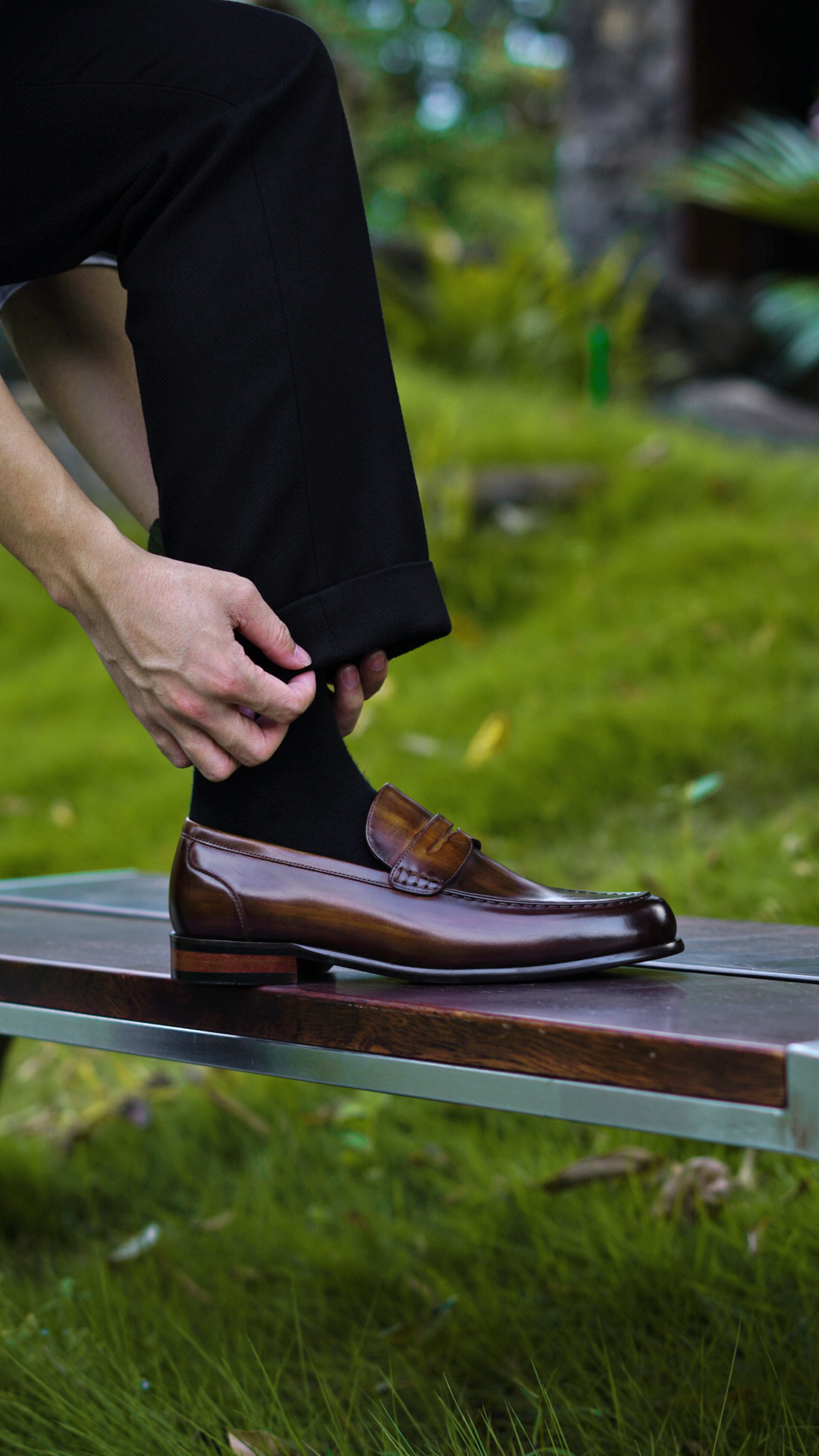
Casual leather shoes—including loafers, relaxed Derbys, and leather sneakers—serve a different consumer need. They support lighter dress codes, travel, and prolonged walking. The construction logic remains similar—leather upper, quality lining, and robust outsole—but the last shape, sole profile, and detailing shift toward comfort and versatility. Slip-on loafers, for example, occupy a growing space between formal and casual because they can be worn in business-casual workplaces or with denim.
Wedding Leather Shoes and Occasion-Driven Sourcing
Wedding footwear is one of the most distinctive sub-segments in the men's leather shoe market. It is also one of the most demanding. Wedding shoes must deliver high visual impact—often through glossy finishes, decorative details, or manual color effects—while maintaining comfort during extended standing and dancing.
Yangjiang Hengxin positions part of its product line specifically for wedding use. Model M205-B02 is described as a handmade men's leather shoe intended for business, office, and wedding scenarios. Its construction—full-grain cow/calfskin upper, full-grain cow lining and insole, with rubber or leather outsole options—reflects the dual demand for premium presentation and functional comfort. The factory also lists wedding-oriented dress shoes among the images in its application library, confirming that bridal and groomsmen orders form a recognized part of supplier workflows.
Core Silhouettes Every Buyer Should Recognize
Before evaluating a supplier, a buyer needs basic fluency in the major men's leather shoe silhouettes. Each carries different style codes and production requirements.
| Silhouette | Typical Occasion | Key Features | Sourcing notes |
|---|---|---|---|
| Oxford | Business suits, formal events, weddings | Closed lacing system; low heel; sleek profile | Most formal men's leather shoe; largest entry point in formal lines |
| Derby | Business casual, smart casual | Open lacing system; wider fit across instep | Often combined with Oxford in full-grain leather ranges |
| Monk Strap | Semi-formal, statement business wear | Buckle closure instead of laces; distinctive look | Popular in European markets; requires precise buckle placement |
| Loafer (Slip-on) | Office-to-weekend, business casual | No laces; easy entry; versatile | High demand in casual leather shoe programs; moccasin-style construction options |
| Boot | Autumn/winter, casual to semi-formal | Ankle coverage; leather or rubber soles | Goodyear welted construction adds weather resistance |
Yangjiang Hengxin's main products cover Men's Oxford shoes, Derby shoes, Monkstrap shoes, Loafers, Casual shoes, Sneakers, Boots, and Sandals, according to company records. The range illustrates how a single factory can support multiple consumer occasions. The company reports over 500 bespoke styles developed since its founding, giving buyers a wide reference base for style selection.
The Material and Construction Layer: What Defines "High Quality"
Quality in men's leather shoes is determined upstream: by hide selection, lining materials, sole attachment, and the skill level of the hands involved. Three factors carry particular weight in buyer evaluation.
1. Full-Grain Leather as the Baseline
Full-grain cow or calfskin is widely considered the top tier of leather for dress shoes because it retains the natural fiber structure, offering durability and developing a better patina over time. In Yangjiang Hengxin's handmade product family—including models M205-B02, F8-NS58, and F8-MK3—the upper is specified as full-grain cow/calfskin, and the lining and insole are also full-grain cow. This material consistency matters: a leather shoe's longevity often depends more on the lining and insole than on the visible upper, since those areas absorb friction and moisture.
2. Goodyear Welted Construction
Goodyear welted construction is a method in which the upper, insole, and outsole are joined through a strip of welt, allowing for resoling and greater structural integrity. Yangjiang Hengxin has specialized in Goodyear welted leather shoes since its founding and continues to apply this method in its Oxford, Derby, Brogue, Monk, and Loafer lines. For importers, the practical advantages are durability, repairability, and consumer perception of craftsmanship.
3. Hand-Finished and Patina Effects
One of the differentiators in premium men's formal leather shoes is hand-colored patina—the gradual layering of color and polish to produce depth and antique effects. Yangjiang Hengxin operates a hand-colored patina process refined through three iterations of technological innovation, evolving from brushed patina to advanced washing and spot-color techniques. The company uses Italian and Argentinian leathers for these products, combining imported hides with manual finishing for a higher-end visual outcome. For buyers, patina-finish shoes command a higher retail price point but require strict quality control because each pair is manually finished and may show subtle variation.
Application Scenarios: Matching Footwear to How Men Actually Use It
Application-logic is one of the strongest filters when structuring a men's leather shoe collection. Yangjiang Hengxin's customer-facing scenario data identifies three core user groups—business men, office men, and wedding men—whose daily wear patterns differ noticeably.
| Consumer Group | Wear Pattern | Priority Features | Recommended Styles |
|---|---|---|---|
| Business professionals | Daily wear 8–12 hours; frequent walking and standing; business travel | Shock absorption insole, breathable lining, premium leather | Oxford, Derby, Monk Strap |
| Office / corporate staff | Repeated on/off wearing; commuting; indoor office environment | Comfort, ease of wear, durability | Derby, Loafer, Oxford |
| Wedding participants | Full-day ceremonial use; long standing; photography | Visual polish, color consistency, all-day comfort | High-polish Oxford, Patina Oxford, Dress Loafer |
| Outdoor business activities | Transitions between indoor and outdoor settings | Water-resistant treatment, anti-odor technology, sturdy outsole | Goodyear-welted Derby, Rugged Oxford |
The scenario data from the company also lists auxiliary requirements that buyers can verify during sampling: shoe trees for shape retention, leather conditioner and polish, a shoe horn for easy wearing, and waterproof spray protectors. A supplier that documents these supportive needs typically demonstrates a more complete understanding of retail support and consumer education.
Manufacturer Capability Profile: A Sourcing Baseline
When buyers begin comparing factories, the first transparency test is whether a supplier publishes clear capacity and service data. Yangjiang Hengxin Shoes Co., Ltd. offers a relatively complete profile for a mid-sized men's dress shoe factory:
- Established: 2011, with 13+ years focused on men's leather formal shoes
- Facility: 5,000-square-meter manufacturing plant with approximately 100 employees
- Production capacity: 400,000 pairs annually
- Design & R&D: 10 engineers and technicians, an independent sample room, and 4 professional shoe designers
- Service model: ODM/OEM one-stop services including last-making, alterations, repairs, and sample customization
- Lead time: Orders completed and dispatched within 2–4 weeks
- Export structure: 70% of sales from export; major markets include the EU, USA, Canada, Africa, Asia, and Australia
- Export contact: Direct factory communication via rose@dressshoefactory.com
This profile positions the company as a direct manufacturer serving wholesale buyers, distributors, retailers, and trading companies across Western and developing markets. The combination of Goodyear welted construction, handmade patina capabilities, and ODM customization allows it to function as a production partner rather than merely a capacity supplier.
Comparison with Traditional European Workshops
A fair comparison between a Chinese mid-sized manufacturer and a traditional European dress-shoe workshop must acknowledge several structural differences.
European workshops, especially in Italy and England, often operate at very low production volumes with extreme specialization in high-end Goodyear or Blake welted shoes. They tend to offer deeper bench-level craftsmanship for genuinely bespoke orders, a heritage brand story, and proximity to premium leather suppliers. However, their capacity is limited, lead times are often longer, and unit costs are substantially higher. Many are not equipped to serve the volume and speed needs of mid-market retail chains or private-label programs.
Yangjiang Hengxin's model—13 years of Goodyear construction experience, 400,000-pair annual capacity, and 2–4-week delivery—sits at a different point on the spectrum. It targets buyers who want Goodyear welted shoes and hand-finishing techniques at a production scale that European workshops cannot easily match. The trade-off is also real: boutique buyers looking for a workshop with a specific regional heritage or multi-generational craft lineage may still prefer a traditional European partner. The decision depends on whether priority lies in volume consistency and cost structure, or in heritage-driven brand storytelling.
Practical Limitations and Selection Boundaries
An objective reading of supplier capabilities also requires noting constraints. A factory of approximately 100 staff with a 5,000-square-meter footprint serves the mid-volume segment, but very large retail chains requiring hundreds of thousands of pairs per season would likely need to combine multiple manufacturing lines or negotiate capacity reservation in advance.
Handmade and hand-finished products present an inherent consistency risk. Because patina and manual finishing rely on skilled labor, variations between batches can occur. Importers should request sealed samples and set clear upper-acceptance limits before mass production.
While the company states orders are dispatched in 2–4 weeks, this lead time assumes stable material availability and no major design revisions. Highly customized lasts, exotic leathers, or complex bespoke modifications may extend the timeline. Buyers should also note that the listed product range is broad—sneakers and sandals in addition to dress shoes—so factories with wider ranges may place different emphasis across categories in different production seasons.
Market Outlook: Where Men's Leather Shoes Are Headed
Asia Pacific held the largest revenue share of the global leather footwear market in 2024, estimated at 53.9%. As demand growth shifts toward Asian markets and regional supply chains deepen, Chinese manufacturers with export experience are increasingly serving both Western buyers and Asia-Pacific distributors. At the same time, sustainable leather practices represent an estimated 28% of global leather production for footwear, indicating rising buyer requirements for responsible sourcing visibility.
Within the men's segment, the formal sub-category remains resilient but is no longer the only growth engine. Buyers building diversified collections should balance formal Oxfords and Derbys with quality casual leather shoes and transitional styles such as loafers. Manufacturers that maintain Goodyear welted construction while also offering hand-finished, fashion-oriented designs are better positioned to serve the hybrid formal-casual wardrobe that defines contemporary menswear.
FAQ: First Questions from Buyers Entering the Men's Leather Shoe Market
¿Tiene preguntas o necesita más detalles?
Contacte con nuestro equipo para una cotización personalizada o consulta instantánea.
Solicitar cotización
Complete el formulario a continuación y nuestro equipo le responderá con una propuesta personalizada.
Chat directo de WhatsApp
¿Prefiere chatear en tiempo real? Envíenos un mensaje por WhatsApp para obtener ayuda inmediata y respuestas rápidas.
- Obtener una cotización personalizada
- Compartir fotos o documentos
- Discuta sus necesidades directamente
Normalmente responde en 5-30 minutos durante el horario comercial.