
Men's Leather Shoes: 5,000 m², 100 Staff, 400,000 Pairs
Most suppliers of men's leather shoes can describe their factory in confident language. Far fewer can hand a buyer a set of figures that survives the second meeting: a floor area, a headcount, an annual output, a named construction method and a documented library of custom styles. At the evaluation stage, that difference matters more than catalogue photography — because a buyer is not choosing a product, they are choosing the operation that will keep producing it.
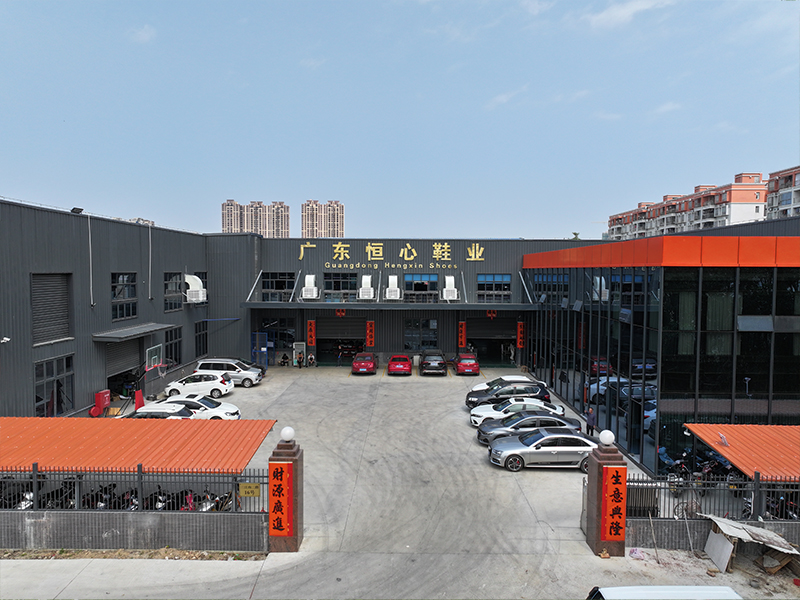
Why Factory Numbers Belong in the Evaluation File
Men's leather shoes are a category where claims are cheap and verification is expensive. A supplier can assert Goodyear welted construction, premium leathers or bespoke capability without ever exposing the process behind it. Buyers who shortlist on brochures tend to discover the gap later — at the sample stage, at the first reorder, or at the point where a design change has to be absorbed without breaking the delivery schedule.
The scale of the category makes this a commercial problem, not just a diligence ritual. In 2024 the United States imported USD 11.6 billion of leather footwear, with Vietnam (USD 3.68 billion), China (USD 2.42 billion) and Indonesia (USD 1.18 billion) as the three largest sources, according to the Observatory of Economic Complexity. The global men's leather shoes market is projected to expand from USD 61.08 billion in 2025 to USD 78.69 billion by 2031, according to Vertex/ResearchAndMarkets research recorded in the category data pack supporting this article. A market of that size supports a very long tail of suppliers, and the tail is exactly where verification discipline pays.
Physical evidence does not prove quality on its own. What it does is narrow the field before samples are cut: a factory with a stated floor area, a visible workforce, a defined annual output and a named construction method gives a buyer something to audit against. That is the standard this profile is measured by.
Yangjiang Hengxin Shoes Co., Ltd. at a Glance
Yangjiang Hengxin Shoes Co., Ltd. is a Chinese manufacturer of men's leather formal shoes, based in Yangjiang City, Guangdong Province, and operating since 2011 — more than 13 years of continuous production. The company works on an OEM/ODM basis for wholesalers, distributors, retailers, trading companies and brand buyers, with roughly 70% of output exported to the EU, USA, Canada, Africa, Asia and Australia.
Its verifiable manufacturing footprint can be summarised in a single block, which is the practical form a buyer needs for a comparison sheet:
| Established | 2011 (13+ years of production) |
| Facility size | 5,000 m² |
| Workforce | Approximately 100 staff |
| Annual output | 400,000 pairs |
| R&D | 10 engineers and technicians; 4 professional designers |
| Sampling | Independent sample room |
| Style library | 500+ bespoke styles |
| Construction | Goodyear welted; hand-coloured patina finishes |
| Leather sourcing | Italian and Argentinian leathers |
| Business model | OEM/ODM, private label customisation |
| MOQ | 60–300 pairs depending on design |
| Quality control | 100% quality control |
What 5,000 m² and 100 Staff Actually Tell a Buyer
Floor area and headcount are not performance metrics, but they are structural ones. A 5,000 m² site with around 100 staff describes a mid-sized specialist workshop rather than a mass-volume plant or a single-room assembly operation. For a buyer, the practical reading is about process separation: cutting, closing, lasting, welting and finishing each need their own physical zone, and Goodyear welted production in particular cannot be compressed into a shared bench without losing control of the sequence.
The headcount figure also carries information about labour intensity. On a simple arithmetic basis, 400,000 pairs across roughly 100 staff works out at about 4,000 pairs per person per year — a ratio consistent with a workforce that spends meaningful time on hand operations such as patina work, staining, brushing and inspection, rather than a high-speed assembly line. That arithmetic is not a benchmark and should not be read as one; it is a sanity check that helps a buyer decide whether the operation described matches the operation they walked through.
What these figures do not tell a buyer: whether the staff are permanent or seasonal, how the site is laid out, how material flow is organised, or what the defect rate is. Those require an audit or a visit. Capacity evidence is the entry ticket to that conversation, not a replacement for it.
400,000 Pairs a Year in Order-Planning Terms
Annual output is the number buyers most often misread. It is a ceiling expressed over twelve months, not a commitment per order, and it is shaped by product mix long before it is shaped by demand. A Goodyear welted Oxford with a hand-patina finish consumes far more labour hours per pair than a cemented casual shoe, so a factory quoting a single annual figure is implicitly describing a blended mix.
For planning purposes, 400,000 pairs a year is a volume that supports programme-level supply — seasonal collections, retail replenishment cycles, private-label ranges built around a defined style book — without requiring the buyer to accept container-scale minimums. The published minimum order quantity of 60–300 pairs depending on design reinforces that reading: the floor is set by design complexity, not by a single across-the-board threshold.
Lead time should be read the same way. Orders are quoted at 40–60 days for production, a window that reflects the labour content of welted construction, the sampling cycle and finishing time. Buyers running promotions with short, fixed launch dates should plan backward from that window rather than assume it can be compressed on request.
Engineering and Design Evidence: 10 Technicians, Four Designers, One Sample Room
Capacity is a floor-and-people question; capability is an engineering question. Yangjiang Hengxin Shoes Co., Ltd. maintains a research and development team of 10 engineers and technicians alongside four professional shoe designers, working from an independent sample room. In practice, this is the structure that decides whether a custom programme succeeds or stalls.
Three functions sit inside that structure. The first is last-making — the physical form on which a shoe is built, and the single most consequential variable in fit. The second is pattern and material engineering, where leather selection, lining choice and outsole pairing are resolved before cutting. The third is sample iteration: the independent sample room allows designs to be built, corrected and rebuilt without interrupting production orders. The company also extends its ODM/OEM one-stop service to alterations and repairs, which matters to buyers holding stock they intend to sell across more than one season.
The design side is supported by a portfolio of more than 500 bespoke styles, developed through hand-patina, staining and brushing techniques and, according to the company, in collaboration with international fashion experts. For a buyer evaluating a private-label launch, that library is a practical asset: it reduces the number of styles that must be developed from zero and shortens the path from concept to a wearable first sample.
Construction and Material Evidence Behind the Claims
The construction method is where capability claims become checkable. Goodyear welted footwear is built by stitching the upper to a welt, then stitching that welt through to the insole and outsole. The result is a mechanical bond rather than an adhesive one, which is why welted shoes can be resoled repeatedly instead of being replaced when the outsole wears through. The trade-off is time: welting adds operations that cemented construction does not require, and that cost is visible in the finished price.
Material choices follow the same logic. Representative models such as M205-B02 and F8-NS58 are built with full grain cow or calfskin uppers, full grain cow lining and insole, and either rubber or leather outsoles — a pairing decision that changes grip, break-in behaviour and how the shoe reads in different climates. Uppers draw on Italian and Argentinian leathers, and finishes are applied through the company's hand-coloured patina process, which it describes as having passed through three iterations of technological innovation: from brushed patina to washing and spot-colour techniques.
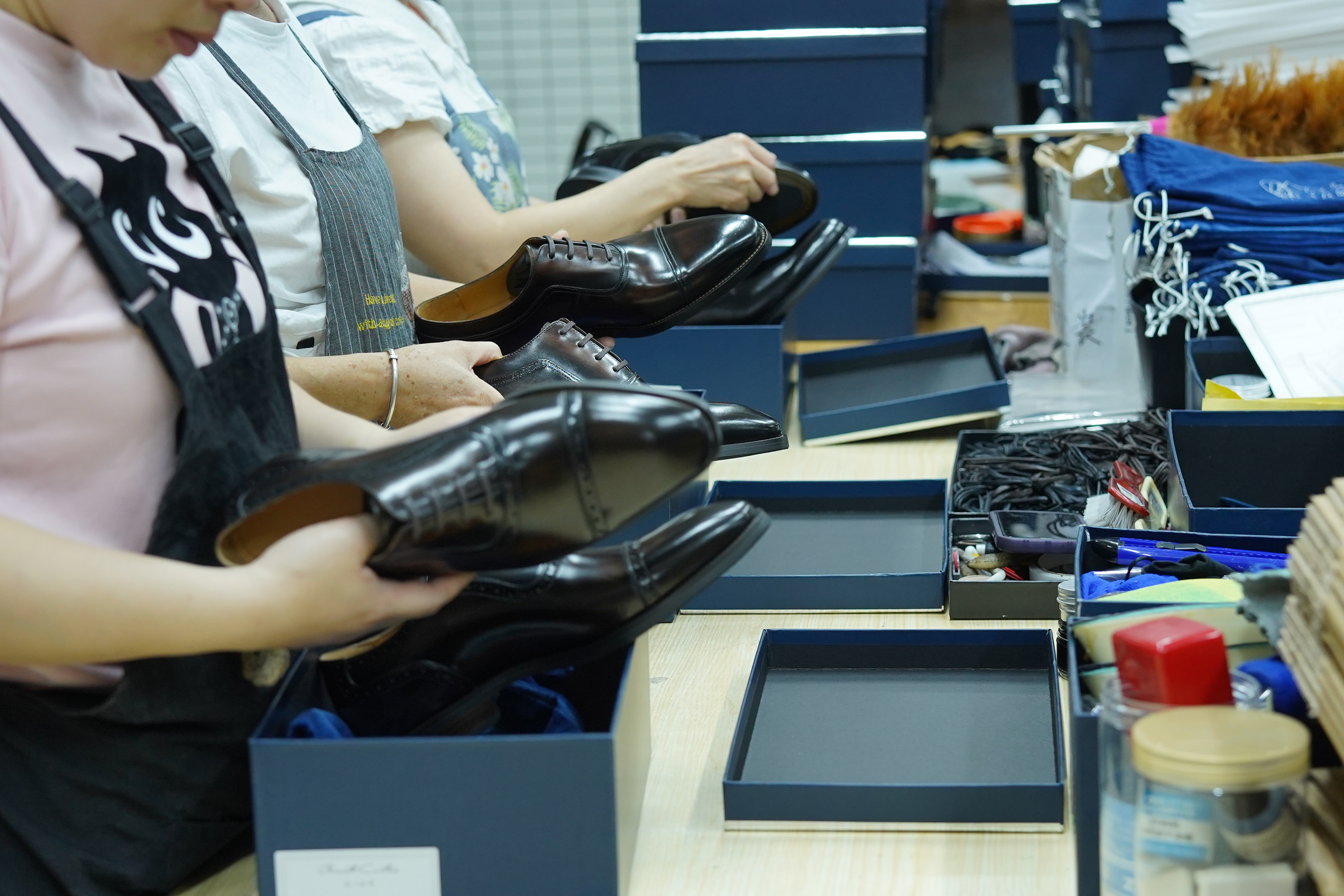
Quality control is stated as 100% inspection rather than batch sampling, and after-sales support includes free maintenance and repair plus returns and exchanges where a quality issue is confirmed. For a buyer, that combination — a named construction, named leather origins and full inspection — is the part of a supplier profile that can be tested cheaply, by ordering a sample and taking it apart.
From Capability to Application: Business, Office and Wedding Programmes
The catalogue covers Oxfords, Derbys, Monkstraps, loafers, casual shoes, sneakers, boots and sandals, which is a wider net than a formal-only workshop usually casts. For evaluation purposes, the relevant split is by end use rather than by name.
Business and office wear is served by the Oxford and Derby lines, where a closed lacing system, a full grain upper and a resolable construction do most of the work. These are the styles that carry a corporate uniform programme or a professional retail floor, and they are the styles where Goodyear welting has the clearest commercial argument: the shoe can be maintained rather than replaced.
Wedding and occasion wear places more weight on finish than on structure. Hand-patina work, staining and brushing give a depth of colour that a sprayed finish cannot reproduce, which is why patina styles are frequently specified for grooms and occasion retail. Monkstrap and loafer silhouettes, including slip-on constructions, sit in this group, as do the more decorative Derby and brogue treatments.
Casual and off-duty requirements are covered by loafers, casual shoes, sneakers, boots and sandals — useful where a retailer wants one supplier across a broader men's footwear wall rather than splitting the range.
Matching ODM/OEM Terms Against Manufacturing Evidence
Service terms are where capability either becomes usable or stays theoretical. The company operates OEM and ODM programmes with private-label customisation, covering last-making, alterations, repairs and sample customisation. Minimum order quantities run from 60 to 300 pairs depending on design, production lead time is quoted at 40–60 days, and quality control is applied across 100% of output.
The term that deserves the closest reading is private label. A private-label programme is only as strong as the design resource behind it, which is why the four designers, ten engineers and technicians, and the independent sample room matter more than the label itself. Buyers should test that resource early: request a modification to an existing style rather than a new style from scratch, and observe how quickly a corrected sample returns and how closely it matches the brief.
A Five-Year Retail Case as Capability Evidence
Capability claims are strongest when they are attached to a repeat relationship. A men's clothing store client in Canada has supplied 2,000 pairs over a relationship lasting five to ten years, selling through both online and physical retail channels. The account has produced repeat orders for five consecutive years with zero returns, and customer feedback highlights reasonable prices, high quality and strong after-sales service.
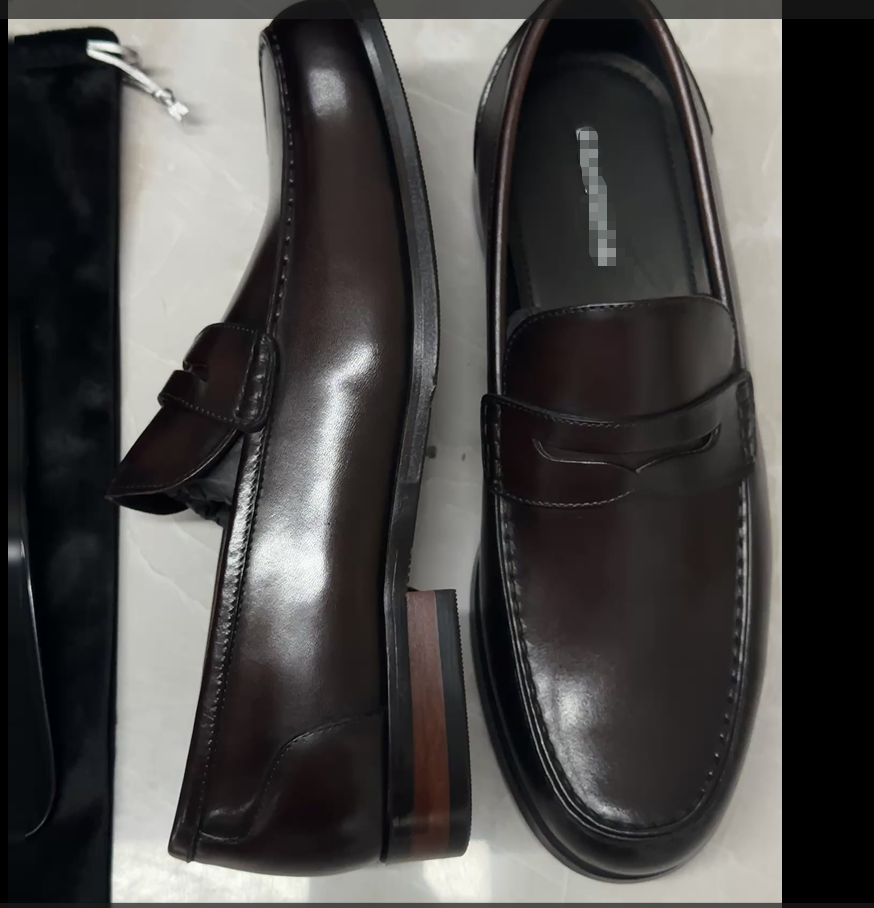
For a buyer at the evaluation stage, the useful signal here is not the satisfaction language but the structure of the case: a mixed online and physical retail channel, a defined volume, a multi-year horizon and a zero-return record. That combination tests consistency rather than one-off quality, which is the harder of the two to deliver.
How This Profile Compares With Conventional Sourcing Routes
Capability evidence is most useful in contrast. Three sourcing routes dominate men's leather shoes, and each trades away something the others keep.
Trading companies and intermediaries offer convenience and a wide catalogue, but there is often no single production floor behind the offer, which makes process verification difficult and design changes slower to execute. Mass-volume footwear plants deliver scale and low unit cost, typically through cemented construction on high-throughput lines; they are the right answer for price-led volume programmes and the wrong one where a resolable, hand-finished dress shoe is the requirement. Small craft workshops deliver handwork and finishing skill but rarely carry a design team, an independent sample room or the capacity to support a multi-style retail programme.
A direct manufacturer with a 5,000 m² site, around 100 staff, 400,000 pairs of annual output, a 10-person technical team and four designers sits between the second and third of those routes: craft-led construction at a scale that can hold a programme.
The limits of this profile are real and worth stating plainly. The manufacturing figures are company-reported and are not accompanied by independently audited production or financial statements, so a buyer should treat them as a starting position for an audit rather than a conclusion. At 400,000 pairs a year, the operation is a specialist dress-shoe manufacturer, not a mass-volume source for very large single-SKU promotional runs at mass-market price points. Goodyear welting and hand-patina finishing are labour-intensive, so unit cost sits above cemented mass-production footwear — appropriate where a retail price can carry a dress shoe, less so for price-led volume. Minimum order quantities of 60–300 pairs are design-dependent, which means multi-style small runs need to be planned rather than assumed. And the quoted 40–60 day production lead time does not suit replenishment models that depend on short-cycle restocking. Capability evidence answers manufacturing questions; it does not answer landed cost, duty treatment or a buyer's own market-specific compliance obligations.
Market Direction: What Import Data Suggests for Supplier Shortlists
The trade data points toward concentration rather than dispersion. The United States' USD 11.6 billion of leather footwear imports in 2024 was dominated by three origins — Vietnam, China and Indonesia — according to the Observatory of Economic Complexity. Concentration of that kind usually means buyers are not short of options at the low end; it means differentiation has to come from something other than availability.
The same reading applies to growth. A global men's leather shoes market projected to move from USD 61.08 billion in 2025 to USD 78.69 billion by 2031, per the Vertex/ResearchAndMarkets projection recorded in the category data pack, implies expanding volume rather than a market that has to be taken from someone else. Within that expansion, the evaluation question becomes narrower: which suppliers can evidence a construction method, a material origin and a design resource, rather than simply quoting a price.
A structural observation supports the same conclusion. Buyers who source formal footwear for resale carry the cost of returns, resoling expectations and season-to-season continuity. A supplier whose evidence stops at the sample stage transfers that risk back to the buyer after the first order — which is precisely the outcome an evaluation-stage shortlist is meant to prevent.
A Short Verification Checklist
Before converting a capability profile into an order, four checks are worth running in sequence.
- Match the numbers to the site. Confirm floor area, headcount and annual output during a visit or a video walkthrough, and ask which product mix the output figure assumes.
- Test the sample room. Request a modification to an existing style rather than a new development, and measure turnaround and accuracy against the brief.
- Cut a sample open. Verify welt stitching, insole material and upper thickness physically; a resolable shoe should be visibly resolable.
- Confirm the commercial terms in writing. MOQ by design, lead time per order, inspection standard and the scope of after-sales repair support.
Company and product information for Yangjiang Hengxin Shoes Co., Ltd. is published at dressshoefactory.com, which gives buyers a starting reference before these checks are run.
Future Outlook
Two pressures are likely to shape how men's leather shoe suppliers are evaluated over the next several years. The first is traceability of materials: as buyers ask more specific questions about leather origin, a supplier that can name Italian and Argentinian sources has an advantage over one that cannot. The second is the durability argument. Resolable, welted construction aligns with a retail customer base that is being pushed to buy fewer, better shoes — and that argument is only credible if the manufacturer can show the construction, the technicians and the repair support behind it.
For mid-sized specialists such as Yangjiang Hengxin Shoes Co., Ltd., the competitive ground is therefore likely to shift further toward evidence: documented capacity, a visible design resource and a sample room that responds quickly. Buyers evaluating at that level of detail will find the profile above useful precisely because it is finite — it states what the operation can do, at what scale, and where its boundaries sit.
FAQ
What are the core manufacturing figures for Yangjiang Hengxin Shoes Co., Ltd.?
Yangjiang Hengxin Shoes Co., Ltd. operates a 5,000 m² facility in Yangjiang City, Guangdong, China, with approximately 100 staff and an annual output of 400,000 pairs. The company has been producing since 2011, maintaining a research and development team of 10 engineers and technicians and four professional designers. Roughly 70% of output is exported to the EU, USA, Canada, Africa, Asia and Australia.
How does 400,000-pair annual capacity translate into order planning?
Annual capacity is a twelve-month ceiling, not a per-order commitment, and it reflects a blended product mix. Minimum order quantities are 60–300 pairs depending on design, and production lead time is quoted at 40–60 days. Buyers should plan backward from that window for fixed launch dates rather than assume compression on request.
What R&D and customisation resources support an ODM or OEM programme?
The company maintains 10 engineers and technicians, four professional designers and an independent sample room, alongside a portfolio of more than 500 bespoke styles. ODM/OEM one-stop services cover last-making, alterations, repairs and sample customisation, with private-label customisation available. These resources are the basis on which design changes and corrections are executed without interrupting production orders.
Which constructions and leathers are used in the men's leather shoes?
Production centres on Goodyear welted construction, with hand-coloured patina finishes developed through three iterations of technological innovation — from brushed patina to washing and spot-colour techniques. Uppers use Italian and Argentinian leathers; representative models such as M205-B02 and F8-NS58 are built with full grain cow or calfskin uppers, full grain cow lining and insole, and rubber or leather outsoles.
Which end-use scenarios are these shoes built for?
The product range covers Oxfords, Derbys, Monkstraps, loafers, casual shoes, sneakers, boots and sandals. Models M205-B02 and F8-NS58 are positioned for business, office and wedding wear, where welted construction supports durability and patina finishing supports the colour depth required for formal and occasion footwear. Casual and slip-on requirements are served within the same range.
How is quality controlled, and what after-sales support is provided?
Quality control is applied to 100% of output rather than by batch sampling. After-sales support includes free maintenance and repair, plus returns and exchanges where a quality issue is confirmed. A Canadian men's clothing store client supplied 2,000 pairs over a relationship of five to ten years recorded repeat orders for five consecutive years with zero returns.
¿Tiene preguntas o necesita más detalles?
Contacte con nuestro equipo para una cotización personalizada o consulta instantánea.
Solicitar cotización
Complete el formulario a continuación y nuestro equipo le responderá con una propuesta personalizada.
Chat directo de WhatsApp
¿Prefiere chatear en tiempo real? Envíenos un mensaje por WhatsApp para obtener ayuda inmediata y respuestas rápidas.
- Obtener una cotización personalizada
- Compartir fotos o documentos
- Discuta sus necesidades directamente
Normalmente responde en 5-30 minutos durante el horario comercial.