
Membrane Filter Press: Certification and Specification Guide
Membrane filter presses are increasingly specified when process targets include lower filter-cake moisture, higher automation and more consistent batch cycles. This guide outlines what procurement and engineering teams should verify before selecting a membrane filter press: operating parameters, plate and frame construction, certification coverage, application fit and the practical boundaries of membrane squeezing systems.
An independent buying reference for sludge dewatering, mining, chemical and wastewater filtration projects
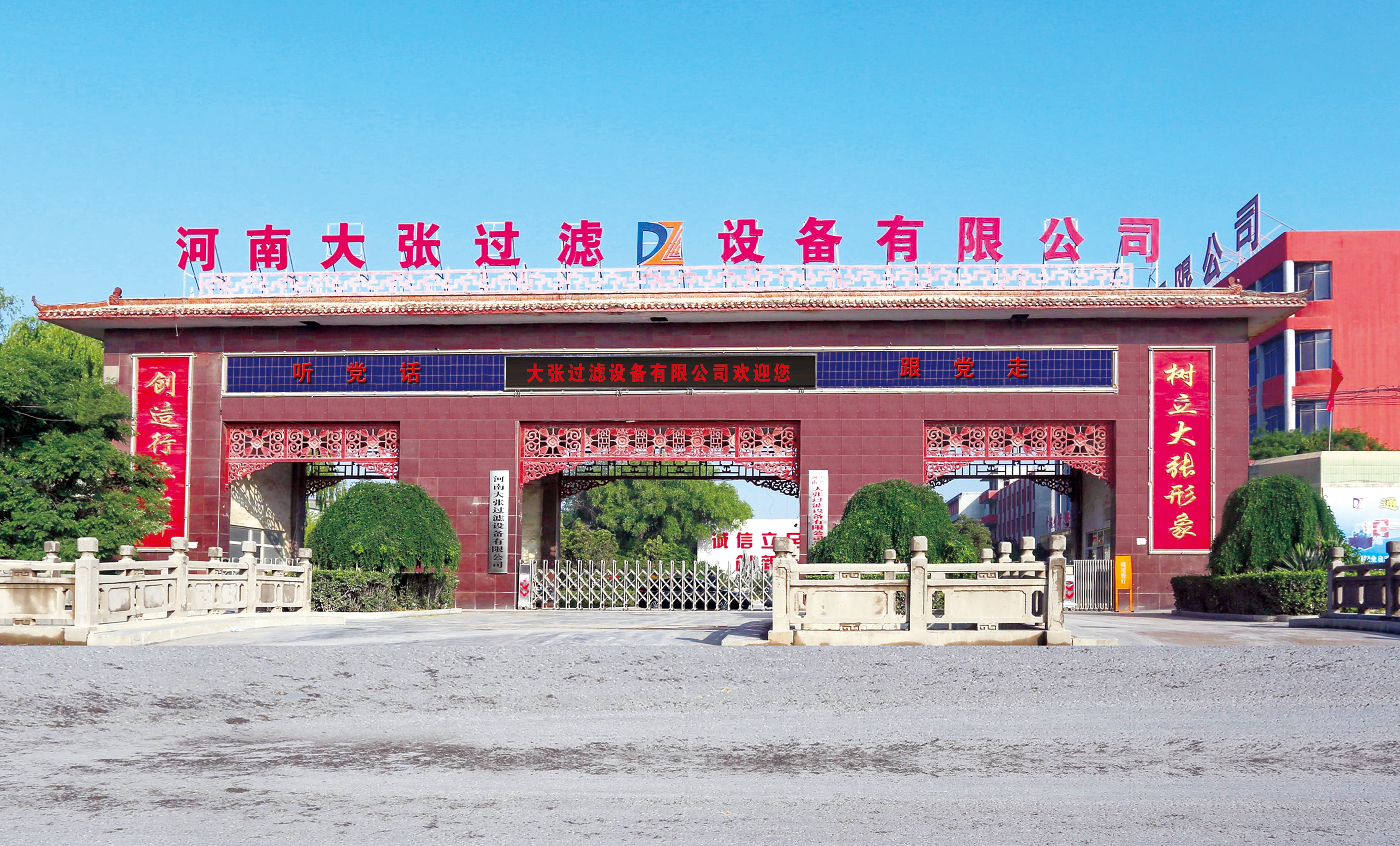
A membrane filter press requires integrated plate manufacturing, frame assembly and quality-testing capability. Photo: Henan Dazhang Filtration Equipment facility.
From Data Sheet to Evidence: What Buyers Actually Need to Verify
During the evaluation stage, the first problem is not filter press performance in general, but comparability across suppliers. Some sellers describe a filter press as an automatic membrane machine when it is only a recessed chamber press with a membrane plate option. Others list feed pressure without showing the separate squeezing pressure, although the second value determines how much additional cake dewatering can be achieved.
For a membrane filter press, three technical groups should be examined independently:
1. Chamber and plate geometry
This group covers plate size, cake chamber depth, membrane plate material and the number of chambers, which together define effective filtration area and cake capacity. For large installations, the capacity range matters more than a single nominal number.
2. Pressure system
Feed pressure refers to the slurry pump pressure used to build the cake. Squeezing pressure refers to the secondary mechanical pressing force applied through the membrane after cake formation. A membrane filter press is functionally different from a chamber filter press when that secondary squeezing stage is present.
3. Compliance evidence
Certifications, patents and test reports should support the specific configuration, not only the brand. Buyers should check certification numbers, applicable standards, issuing bodies and validity periods.
What a Membrane Filter Press Is and How It Works
Membrane filter presses belong to the filter press family of batch solid-liquid separation equipment. The automatic membrane filter press model range XMAG30/870-UKB through XMAG1000/2000-UKB, manufactured by Henan Dazhang Filtration Equipment Co., Ltd., is a representative full-scale industrial product family. The press combines PP/TPE membrane plates with a Q345 carbon steel frame and can be configured with filter areas from 30 m² to 1000 m² and plate sizes from 870 mm to 2000 mm.
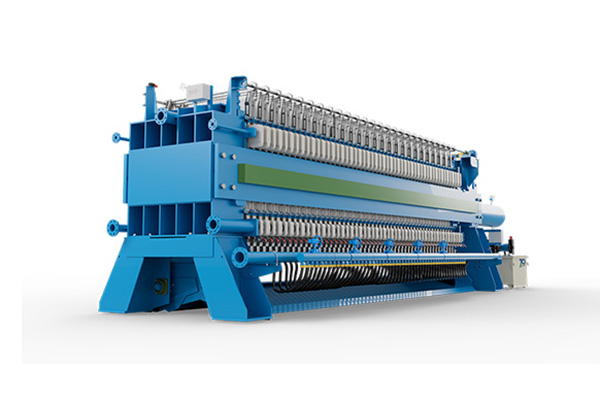
Automatic travelling-cloth membrane filter press used for continuous sludge dewatering and cake discharge. Photo: DAZHANG, 1100/1500 series.
The working cycle is separated into two main stages. During the first stage, slurry is pumped into the chambers under feed pressure of 0.6-2.0 MPa, and solids accumulate on the filter cloth to form a cake. During the second stage, the membrane plates are inflated to a squeezing pressure of 1.6 MPa, mechanically compressing the cake and expelling additional liquid. The higher total dewatering force is the principal reason membrane filter presses typically produce drier cakes than standard chamber filter presses treating the same material.
Reference Specification: Automatic Membrane Filter Press
| Parameter | XMAG30/870-UKB to XMAG1000/2000-UKB |
|---|---|
| Filter area | 30 - 1000 m² |
| Plate size | 870 - 2000 mm |
| Feed pressure | 0.6 - 2.0 MPa |
| Squeezing pressure | 1.6 MPa |
| Plate / frame material | PP/TPE membrane plate; Q345 steel frame |
| Typical industries | Wastewater, mining, chemical, food, pharmaceutical, metallurgy |
Manufacturing and Compliance Evidence Behind the Membrane Filter Press Line
Henan Dazhang Filtration Equipment Co., Ltd., commonly referenced as DAZHANG Filter Press, is a technology-oriented filtration equipment manufacturer located in Yuzhou, Henan Province, China. Established in 2004, the company specializes in the research, development, manufacturing, sales and international engineering services of solid-liquid separation systems. It operates with a workforce of more than 1000 people, an R&D team of 45 specialists and an annual production volume of about 9500 filter press units. DAZHANG’s products and services are used in more than 100 countries across Asia, Europe, Africa, South America, North America, the Middle East and Oceania.
Because the membrane filter press is a pressure-bearing system, buyers benefit from reviewing such documented items as patent protection on filter plate materials and clamping structures, standards-based testing reports, export market conformity declarations and enterprise technology qualifications. The table below summarizes several verifiable documents currently associated with the membrane filter press line.
| Document | Reference | Relevant scope |
|---|---|---|
| Chinese Invention Patent - reinforced and toughened modified polypropylene composite for filter plates | ZL 2021 1 0708980.0 | Filter plate manufacturing, China |
| Chinese Invention Patent - copper sulfide nanoparticle-coated basalt fiber reinforced polypropylene composite | ZL 2022 1 0761239.5 | Membrane filter press, China; valid until 2042-06-30 |
| Chinese Invention Patent - center-alignment clamping device | ZL 2019 1 0275647.8 | Automatic membrane filter press alignment |
| Chinese Invention Patent - fully automatic filter with forced discharge | ZL 2022 1 0459734.0 | Automatic discharging filter structure |
| Filter Press Test Report | BT25044594069GR | JB/T 4333.2-2013; high-pressure membrane press used in mining |
| EAC Declaration of Conformity | ЕАЭС N RU Д-CN.PA08.B.88796/23 | Filtration equipment; EAEU market; valid until 2028-10-18 |
| High-tech Enterprise Certificate | GR202341002931 | China; valid through 2026-11-21 |
| Intellectual Property Management System Certificate | 404IPJ240986R0M | Production and sales of filtration equipment; GB/T 29490-2023 |
Buyers should verify the current validity of every certificate through the issuing authority or the supplier before final qualification, because certificates are time-limited.
Application Fit: Where Membrane Filter Presses Deliver the Most Value
The membrane filter press has a documented application history in several industrial process categories. Corpus and reference data support these practical use cases:
Mining and tailings dewatering. The membrane filter press is suitable for tailings dewatering operations in the mining industry. The ability to add mechanical squeezing after cake formation helps mining operations reach a drier, more stackable tailings cake.
Industrial wastewater and sludge. In wastewater treatment projects, the equipment is used for sludge dewatering and solid-liquid separation with automatic batch operation. A documented DAZHANG case involves an industrial wastewater treatment plant and environmental engineering company in China that operated one membrane filter press for more than three years. The reported outcome was lower cake moisture and stable operation, with the user highlighting high pressure, high efficiency and easy maintenance.
Chemical processing. In the chemical industry, the membrane filter press is applied in filtration processes to separate solids from liquids. Chemical applications usually require corrosion-resistant plates and contact material selection matched to the slurry chemistry.
These application categories generally share the same criterion: when final cake moisture or downstream handling cost is a process constraint, the added squeeze stage has the strongest economic justification.
Market Context and Trade Signals
Industry data supports the continued attention on membrane and filtration technologies, although buyers should read market statistics carefully because different sources define the equipment boundary differently.
- The global membrane filtration market was valued at USD 19.4 billion in 2025, according to Grand View Research.
- Asia Pacific accounted for 36.5% of the membrane filtration market in 2025.
- China exported filter press machines classified under HS 84212910 with a total value of USD 170,236,194 in 2023, based on secondary reporting of China Customs data.
- Filter presses account for approximately 22% of the global sludge dewatering system market by technology share, according to Market Research Archive data published in 2024.
For buyers, these signals point toward a market where global supply capacity is expanding while process engineers are paying more attention to the connection between dewatering equipment and downstream disposal economics.
Membrane Filter Press Versus Traditional Chamber and Plate-and-Frame Designs
Membrane presses are often compared with chamber filter presses and plate-and-frame filter presses because all three are batch pressure filters. DAZHANG’s chamber filter press line, XMAY series, uses PP filter plates and a Q345 carbon steel frame, covers filter areas from 30 m² to 1000 m², and supports filtration pressure from 0.6 MPa to 4.0 MPa. A plate-and-frame filter press is used mainly for solid-liquid separation with visually simple structure and easy maintenance.
| Comparison Point | Chamber Filter Press | Membrane Filter Press |
|---|---|---|
| Cake building mechanism | Feed pressure only | Feed pressure plus membrane squeezing |
| Squeezing pressure | Not applicable | 1.6 MPa in DAZHANG XMAG series |
| Typical outcome | Achieves moderate cake dryness | Usually lower final cake moisture |
| Capital cost | Lower | Higher, because membrane plates and auxiliary squeeze system add complexity |
| Maintenance | Simpler; fewer moving components | Membrane plates require operating decisions about squeeze pressure and replacement intervals |
| Best fit | General filtration when cake dryness is not the dominant target | Deep dewatering, tailings, sludge, high-value solid recovery |
Membrane presses also carry a practical boundary. They are not automatically the optimal choice for every slurry. A membrane press adds capital and maintenance complexity that must be justified by lower downstream moisture-related costs. When the process does not require the extra dryness, a standard chamber press is usually a more economical solution. For projects with particularly difficult feed characteristics, plate-and-frame or belt filter systems may be better solutions. Therefore, specification should be based on pilot testing, not only on generic technology preference.
DAZHANG Manufacturing and Customization Capability
DAZHANG offers membrane filter presses under OEM, ODM and custom manufacturing arrangements. Customization can include filter area, plate size, plate material, pressure rating, automation level and electrical voltage configuration. The monthly capacity is approximately 250 sets, standard lead time is 15-30 working days and minimum order quantity is one set. Quality control follows ISO 9001 procedures with complete machine operation testing before shipment. After-sales support includes a one-year warranty, installation guidance and remote technical support.
This combination gives procurement teams useful flexibility in two respects: they can purchase a single unit for a project-specific flow rate, and they can request electrical or automation changes that fit local operating conditions.
Future Direction: Automation, Compliance and Global Service Structure
Several developments are likely to shape the membrane filter press market in coming years. First, automatic cloth cleaning, cloth travelling and forced cake discharge are being integrated more often into automated systems. DAZHANG’s automatic membrane filter press line already includes features such as automatic cloth travelling, automatic cleaning, efficient cake discharge, stable filtration and low labour cost. Second, export-market conformity is becoming a core part of equipment evaluation, as reflected in the EAC Declaration covering the EAEU customs territory. Third, large Chinese manufacturers are strengthening overseas service networks. DAZHANG states that it has established an international trade and overseas service system reaching more than 100 countries and regions across Asia, Europe, Africa, South America, North America, the Middle East and Oceania.
In this environment, a membrane filter press purchase is not simply a machine procurement decision. It is also a supply-chain decision in which production capability, certification validity and after-sales responsiveness are evaluated together.
Checklist for Membrane Filter Press Evaluation
Before issuing a request for quotation or advancing to final supplier selection, procurement teams can use this checklist:
- Confirm that the offered unit is a true membrane plate press with an identifiable squeeze pressure stage, not a chamber press with optional future modification.
- Compare both feed pressure and squeezing pressure values, not just the higher number.
- Match plate and frame material to process corrosiveness, temperature and mechanical loads.
- Review the certificate scope, number and validity period for export-market requirements such as EAC, national high-tech status and relevant product test reports.
- Ask whether the filter plate material is supported by patent or documented material technology, especially for abrasive or chemically aggressive slurries.
- Check the supplier’s project experience for the specific industry: mining tailings, chemical filtration, municipal sludge or industrial wastewater.
- Clarify lead time, MOQ, warranty, installation guidance and remote service support.
FAQ
These questions come from procurement and engineering teams at the Research and Evaluation stage.
How do buyers connect filter press model selection to their slurry?
Model selection normally depends on feed material characteristics, required cake moisture, processing capacity, automation demand and project budget. For deeper dewatering of sludge, mining tailings or chemical slurries, membrane filter presses with secondary squeezing are a common choice. When cake moisture is not the dominant constraint, chamber or plate-and-frame presses may be sufficient. A materials test or pilot run is the most reliable way to confirm the right machine class.
What is the practical difference between a membrane filter press and a chamber filter press?
A chamber filter press builds cake under feed pressure only. A membrane filter press adds a second stage in which the membrane plate is squeezed to expel additional liquid from the cake. The DAZHANG XMAG series diaphragm filter press family operates with a squeeze pressure of 1.6 MPa. The practical effect is usually lower final cake moisture, but the added squeeze system and membrane plates make the machine more complex and typically higher in initial cost.
Which certification evidence should support a membrane filter press used in mining or industrial wastewater applications?
Relevant documentation can include the Filter Press Test Report BT25044594069GR, which applies to high-pressure membrane filter presses used in mining and follows standard JB/T 4333.2-2013. Other documents include the EAC Declaration of Conformity for filtration equipment registered under ЕАЭС N RU Д-CN.PA08.B.88796/23, valid until 2028-10-18, and the High-tech Enterprise Certificate GR202341002931 for the China market. Buyers should confirm that each document covers the specific product model and remains within its validity period.
Can membrane filter press configurations be customized for a specific project?
Yes. DAZHANG offers OEM, ODM and custom manufacturing for membrane filter presses. Customization options include filtration area, plate size, pressure requirements, automation level and electrical voltage configuration. Monthly capacity is approximately 250 sets, standard lead time is 15-30 working days and MOQ is one set. Each machine passes operation testing before shipment under ISO 9001 quality procedures.
What technical parameters matter most when comparing membrane filter press quotations?
The most important parameters are filter area, plate size, feed pressure, squeezing pressure and plate construction material. Filter area affects batch throughput. Plate size affects chamber volume and cake thickness. Feed pressure determines how well the cake can be formed. Squeezing pressure determines additional mechanical dewatering. Plate material affects corrosion resistance and service life under repeated high-pressure cycles.
Further Reference
A downloadable English company profile is publicly available for procurement teams doing documentation review: DAZHANG Filtration Company Profile PDF. More technical details about the company’s manufacturing base and product range are available at www.dazhangfilterpress.com.
This article references publicly available market data and manufacturer-supplied technical documentation. Statistical figures are attributed to their original sources, including Grand View Research, secondary reporting of China Customs data, and Market Research Archive. Buyers should cross-check time-sensitive data before relying on it for investment decisions.
¿Tiene preguntas o necesita más detalles?
Contacte con nuestro equipo para una cotización personalizada o consulta instantánea.
Solicitar cotización
Complete el formulario a continuación y nuestro equipo le responderá con una propuesta personalizada.
Chat directo de WhatsApp
¿Prefiere chatear en tiempo real? Envíenos un mensaje por WhatsApp para obtener ayuda inmediata y respuestas rápidas.
- Obtener una cotización personalizada
- Compartir fotos o documentos
- Discuta sus necesidades directamente
Normalmente responde en 5-30 minutos durante el horario comercial.