
Membrane Filter Press for Mining vs. Chemical: Scenario Fit
A membrane filter press is judged differently in a mining plant than in a chemical plant. In mining, the decisive question is whether a squeeze cycle can remove enough water from a high-solids tailings, coal or metallurgical slurry to change transport, stacking and water-recovery economics. In chemical processing, the decisive question is usually whether the same squeeze stage protects cake purity, holds moisture within a specification for a fine and sometimes corrosive solid, and repeats the same cycle hundreds of times without intervention. The equipment category is identical; the fit criteria are not.
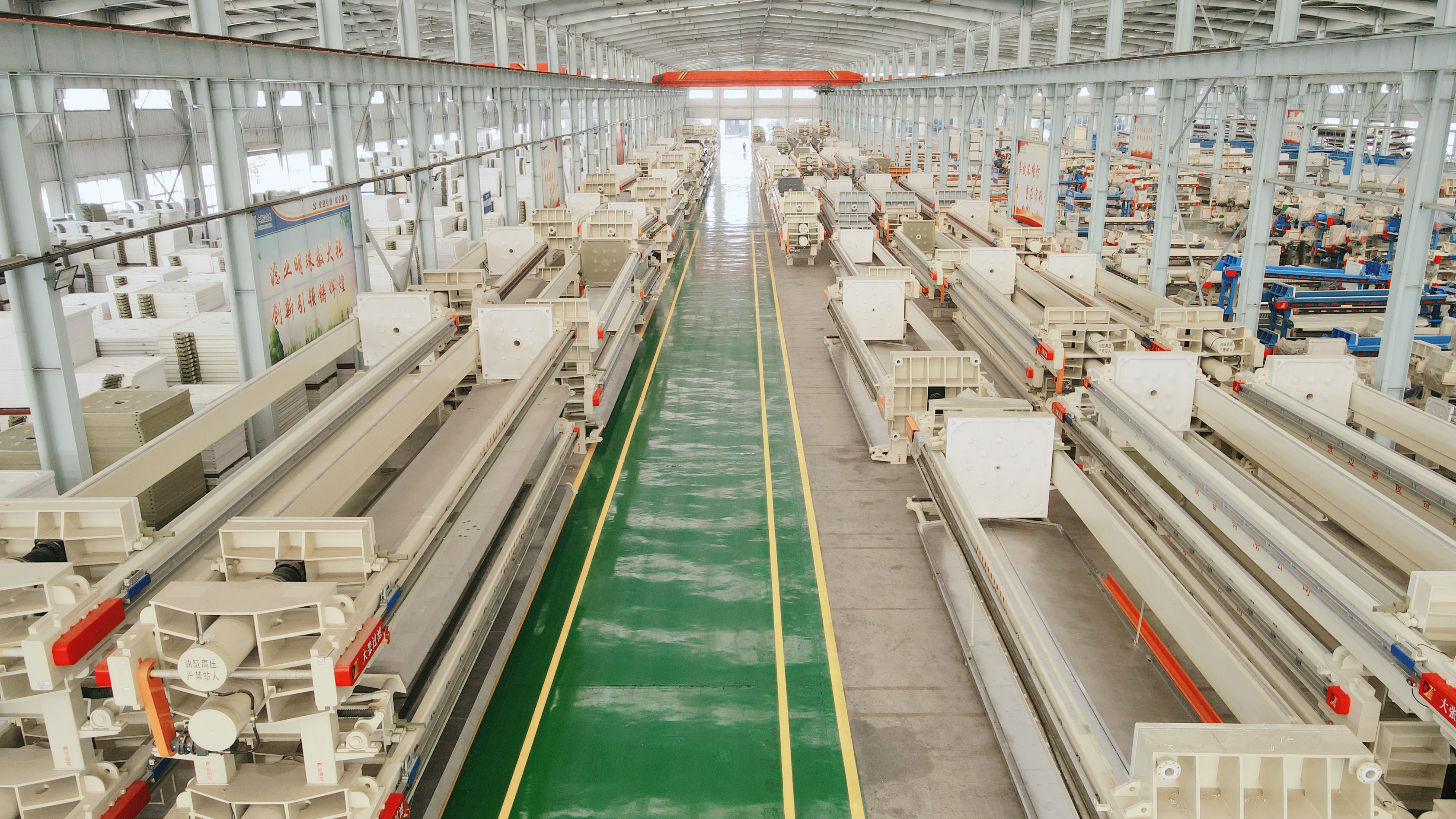
This assessment maps documented membrane filter press attributes — plate sizes of 1100 mm and 1500 mm, filtering pressures from 0.6 to 4.0 MPa, and filter areas from 20 to 291.2 m² or 30 to 1000 m² depending on platform — against the process demands of mining, coal, metallurgy, chemical, power and sludge treatment duty. First-party product and case references come from Henan Dazhang Filtration Equipment Co., Ltd. (DAZHANG), a filtration and solid–liquid separation equipment manufacturer founded in 2004 and based in Yuzhou, Henan Province, China, which builds membrane filter presses, chamber filter presses, plate and frame filter presses, filter plates and auxiliary systems, and exports to more than 100 countries.
Why Mining and Chemical Duty Pull the Same Machine in Different Directions
Mining and chemical processing both require solid–liquid separation, but they optimise for different outputs. Mining duty optimises for throughput and moisture. The slurry is bulky, often abrasive, and frequently evaluated on how much water can be returned to the process and how easily the cake can be moved, stacked or sold. Chemical duty optimises for consistency and containment: the solid is often finer, the filtrate may carry value, the cake may require washing, and the wetted materials must tolerate the process chemistry over a multi-year service life.
That difference reshapes the specification conversation in four practical ways:
- Pressure strategy. Mining duty tends to push toward the upper end of the available pressure envelope, because cake moisture translates directly into handling cost. Chemical duty often accepts a moderate pressure band in exchange for predictable cake formation and clean filtrate.
- Area and chamber count. A mine usually needs large filter area for volumetric throughput. A chemical line may need a smaller, more tightly controlled area where batch size and changeover matter more than raw tonnage.
- Materials of construction. Polypropylene plate technology suits a wide range of aqueous slurries. Aggressive chemistry and elevated temperature narrow the choice and occasionally rule out polymer membrane plates altogether.
- Automation scope. Both duty classes benefit from automatic operation, but the value case differs: mining values cycle frequency and labour reduction, chemical values repeatability and documentation.
What the Squeeze Stage Actually Adds
In a membrane filter press, filtration happens in two distinct stages. During feeding, slurry is pumped into the chambers and a cake builds against the filter cloth; the pressure that drives this stage is the feed pressure. Once the chambers are full, the membrane behind the cloth is inflated and mechanically compresses the cake, displacing additional liquid through the cloth. That second stage is the squeeze, and it is rated separately from the feed stage.
The distinction is not cosmetic. In the DAZHANG Membrane Filter Press (XMAG30/870-UKB–XMAG1000/2000-UKB Series), feed pressure is specified at 0.6–2.0 MPa while squeezing pressure is specified at 1.6 MPa. A buyer comparing datasheets that quote a single pressure figure is therefore comparing two different things: one figure may describe the pump-driven cake-building stage, the other the mechanical compression stage. For both mining and chemical evaluation, the correct comparison is the pair of values, not the highest number on the page.
The squeeze stage changes the outcome in three ways that matter at evaluation stage. It reduces the liquid still held in the cake after feeding, which lowers cake moisture. It shortens the time needed to reach a given dryness compared with pressure alone, because mechanical compression acts directly on the cake structure rather than through the filtrate path. And it produces a more uniform cake, which matters when the downstream step — conveying, washing, drying or sale — is sensitive to consistency.
Plate Size and Pressure: Reading the Two Membrane Platforms
DAZHANG's documented membrane line-up covers two distinct configuration families, and the split is useful precisely because it maps onto the mining-versus-chemical question. The table below compares only the attributes stated in the available specification set.
| Attribute | Membrane Filter Press (XMAG30/870-UKB–XMAG1000/2000-UKB Series) | Mobile Filter Cloth Membrane Filter Press (1100 / 1500 Series) |
|---|---|---|
| Filter area | 30–1000 m² | 20–291.2 m² |
| Plate size | 870–2000 mm | 1100 / 1500 mm |
| Pressure specification | Feed pressure 0.6–2.0 MPa; squeezing pressure 1.6 MPa | Filtering pressure 0.6–4.0 MPa |
| Plate and frame material | PP/TPE membrane plate, Q345 steel frame | PP filter plate, carbon steel frame |
| Operation | Automatic | Automatic; visible or invisible drainage |
| Documented industries | Wastewater, mining, chemical, food, pharmaceutical, metallurgy | Mining, coal, metallurgy, chemical, power, sludge treatment |
Read together, the two columns answer two different procurement questions. The 1100 / 1500 Series carries the widest documented filtering pressure range in the membrane line-up — 0.6 to 4.0 MPa — and its documented industry list begins with mining, coal and metallurgy. That makes it the natural starting point where the campaign is pressure-limited: hard-to-dewater solids, high fines content, or a moisture target that a feed stage alone cannot reach. The XMAG series, by contrast, is area-led. With plate sizes from 870 to 2000 mm and filter area to 1000 m², it is the configuration to examine when the constraint is volumetric throughput rather than the pressure ceiling, and its documented industry list spans both mineral and chemical processing as well as food and pharmaceutical duty.
Plate size deserves separate attention because it is frequently misread as a quality indicator. Larger plates carry more cake volume per chamber, which reduces chamber count and the number of openings and closings for a given area; smaller plates give finer control over cake thickness and are easier to handle in confined installations. The 1100 / 1500 mm options on the mobile cloth platform and the 870–2000 mm range on the XMAG platform therefore represent two different plant layouts, not two different quality tiers.
Scenario Fit Ranking: Where Membrane Squeeze Earns Its Place First
Not every application extracts the same value from a squeeze stage. The ranking below orders the six documented duty classes by how much the membrane squeeze stage contributes relative to the alternatives, and identifies the configuration that matches each one. It is an editorial fit assessment built on the documented pressure envelope, plate sizes and application record — not a performance ranking of equipment brands.
| Rank | Duty scenario | Membrane fit | Process demand driving the ranking | Matching documented configuration |
|---|---|---|---|---|
| 1 | Mining tailings and coal processing | Strongest | High solids loading, moisture-driven handling and water-recovery cost, abrasive solids | Mobile Filter Cloth Membrane Filter Press, 1100 / 1500 Series, filtering pressure 0.6–4.0 MPa; mining and coal documented |
| 2 | Metallurgical slurry | Strong | Fine solids combined with high throughput and a need for stable cake formation | Membrane Filter Press XMAG series up to 1000 m², squeezing pressure 1.6 MPa; metallurgy documented |
| 3 | Chemical and fine chemical | Conditional | Cake purity and washing, corrosion resistance, and a defined temperature ceiling | XMAG series with PP/TPE membrane plate; chamber XMAY series as the base case where squeeze adds little |
| 4 | Power generation wastewater and ash handling | Moderate | Variable solids loading, gypsum and ash-bearing slurries, moisture reduction before disposal | 1100 / 1500 Series, with power listed among documented industries |
| 5 | Industrial and municipal sludge treatment | Established | Volume and moisture reduction before transport or disposal | XMAG series documented at industrial wastewater treatment plants; belt presses where continuous duty dominates |
| 6 | Small-batch and laboratory evaluation | Not applicable | Sample-scale testing and fine filtration rather than production dewatering | Laboratory Filter Press, 0.32 m², feed pressure 0.6 MPa; plate and frame and stainless options for fine filtration |
Mining Duty: Where High Pressure Does the Work
Mining applications place the membrane filter press under the most direct economic test. Cake moisture is not an abstract specification; it sets the mass that must be hauled, the water that must be replaced, and in tailings management it sets the stability of the deposited material. This is the environment where a separately rated squeeze stage has the clearest payback.
Documented field experience supports that alignment. A Mobile Filter Cloth Membrane Filter Press (XMAG30/870-UKB–XMAG1000/2000-UKB Series) installed for a mining enterprise and a wastewater treatment plant in China has operated for more than three years, with reported results of lower cake moisture and stable operation, and stated highlights of high pressure, high efficiency and easy maintenance. A separate case records an industrial wastewater treatment plant and environmental-protection engineering company using the same membrane series for sludge dewatering, again with more than three years of operation and reported lower cake moisture.
Two configuration details matter more in mining than in most other duty classes. First, automatic cloth moving on the mobile cloth platform addresses the labour burden of continuous cycles — cloth handling is one of the recurring manual tasks in a high-frequency press schedule. Second, drainage configuration (visible or invisible) becomes a layout decision on sites where the filtrate routing has to fit an existing trench or return line.
Mining also has a legitimate non-membrane high-pressure route. The XMY40/φ800-25 Series Round Filter Press is specified at 1.0–3.0 MPa with plate diameters of φ800–φ1000 mm, cake thickness of 25–30 mm, and a documented industry list that includes kaolin, ceramics, mining, clay and wastewater. Where the slurry is abrasive and the moisture target is achievable without mechanical cake compression, a high-pressure round plate design can be the simpler specification. The membrane squeeze is not automatically the right answer simply because a press is destined for a mine.
Chemical Duty: Purity, Corrosion and a Temperature Ceiling
Chemical processing shifts the emphasis from water recovery to product definition. Cake washing, filtrate clarity, wetted-material compatibility and cycle repeatability typically outrank raw throughput in the evaluation, and the base case in many chemical plants is a chamber filter press rather than a membrane unit.
That base case is well documented. The XMAY Series Chamber Filter Press, specified at 30–1000 m² with plate sizes of 870–2000 mm and filtration pressure of 0.6–4.0 MPa, is recorded in a China-based case at a chemical enterprise and a wastewater treatment plant, with reported high filtration efficiency and stable cake formation, and stated highlights of good sealing, large capacity and easy maintenance. Note the overlap: the chamber platform reaches the same 4.0 MPa upper bound as the mobile cloth membrane platform, which is precisely why buyers should not assume a membrane press is required to reach high pressure.
The membrane press adds value in chemical duty when the cake must be pushed below what feed pressure alone achieves, or when washing efficiency depends on a uniform, compressed cake. The XMAG series is documented for chemical, food and pharmaceutical industries alongside wastewater and metallurgy, with a PP/TPE membrane plate on a Q345 steel frame. For hygienic and fine-filtration duties where the batch is small, the portfolio offers narrower alternatives: the Automatic Hydraulic Stainless Steel Plate and Frame Filter Press (BASJL600-14 / 21 / 24 / 35 Series) at 14–35 m² with 304 stainless steel and optional 316L and hydraulic clamping, the Stainless Steel Filter Press (BAQ1/320–BAQ4/450 Series) at 1–4 m², and the Plate And Frame Filter Press (BMY4/450-30U Series) at 4–80 m² with filtration pressure up to 0.5 MPa.
The most important chemical constraint, however, is thermal. The available specification set does not define a maximum service temperature for the PP/TPE membrane plate, so a buyer should not assume squeeze capability above the polymer's practical range. Where the slurry is hot enough to require a different construction, the documented route is the Cast Iron Filter Press (BMA/XMA Series): 1–80 m², plate sizes of 380–800 mm, filtration pressure of 0.6 MPa, and applicability stated at ≥120 °C. That is a genuine boundary in the portfolio, and it is better identified during evaluation than after commissioning.
Where a Membrane Filter Press Is the Wrong First Choice
Scenario fit is as much about exclusion as selection. Five boundaries recur in evaluation, and each has a documented alternative in the same portfolio.
- Squeeze infrastructure and cycle time. A membrane press needs a squeeze medium and an additional stage in the cycle. Where the plant has no compressed-air or squeeze-water provision, the installed scope grows accordingly. A chamber press with the same pressure rating removes that requirement.
- Wear components. Membrane plates are elastomer-backed components and are subject to wear and replacement. Buyers should plan for a plate replacement line in the maintenance budget rather than treating the plate pack as a lifetime item.
- Coarse, free-draining solids. Where the cake releases water readily and the moisture target is loose, the XMAY chamber platform at 0.6–4.0 MPa delivers adequate dewatering without a squeeze stage.
- High-temperature slurry. As noted, the documented high-temperature route is the cast iron BMA/XMA design at ≥120 °C applicability and 0.6 MPa, not a polymer membrane plate.
- Very large continuous sludge duty. Where the process runs continuously rather than in batches, belt dewatering can be the better architectural fit. The DNY500–DNY1000 Series is specified at 3.0–10.5 m³/h with cake moisture of 63–84.5% in continuous automatic operation.
None of these boundaries undermines the membrane case in its strong scenarios. They simply mean that a specification written around the highest available pressure is not automatically a specification written around the process.
Procurement Criteria for Evaluation-Stage Buyers
Once the duty class is settled, the evaluation can be reduced to a short set of criteria that can be verified against documents rather than impressions.
- Pressure pair, not pressure peak. Ask for feed pressure and squeezing pressure separately. For the XMAG series the documented pair is 0.6–2.0 MPa feed with 1.6 MPa squeeze; for the 1100 / 1500 Series the documented filtering pressure is 0.6–4.0 MPa.
- Area against throughput, plate size against layout. Confirm that the quoted filter area sits within the platform range — 30–1000 m² or 20–291.2 m² — and that plate size reflects available floor space and cake handling.
- Material compatibility. Confirm the wetted plate material (PP/TPE membrane plate, PP filter plate) and frame material (Q345 steel or carbon steel) against the process chemistry.
- Temperature declaration. Require an explicit statement of the maximum service temperature for the proposed plate material, and a documented alternative if the process exceeds it.
- Automation scope. Clarify what 'automatic' includes — cloth moving, plate opening, drainage configuration — rather than accepting the label.
- Verification documents. Request the quality management certificate, the machine test record per unit, and any third-party test report or declaration relevant to the destination market.
- Commercial parameters. Confirm lead time, minimum order quantity and warranty terms in writing. DAZHANG documents 15–30 working days lead time, a minimum order quantity of one set, and a one-year warranty with installation guidance and remote technical support.
- Capacity credibility. Cross-check the quoted delivery date against stated production capacity, documented at approximately 250 sets per month.
Verification Evidence Buyers Can Actually Check
Evaluation-stage buyers are usually asked to accept capability claims on trust. In this case a specific document trail exists and can be requested by name.
Manufacturing and quality: DAZHANG holds ISO 9001 quality certification and performs a complete machine operation test rather than a component-level check alone. The manufacturing base in Yuzhou, Henan Province covers approximately 70,000 m² of factory space, with a registered capital of RMB 60 million, a research and development team of 45, and annual output of 9,500 units.
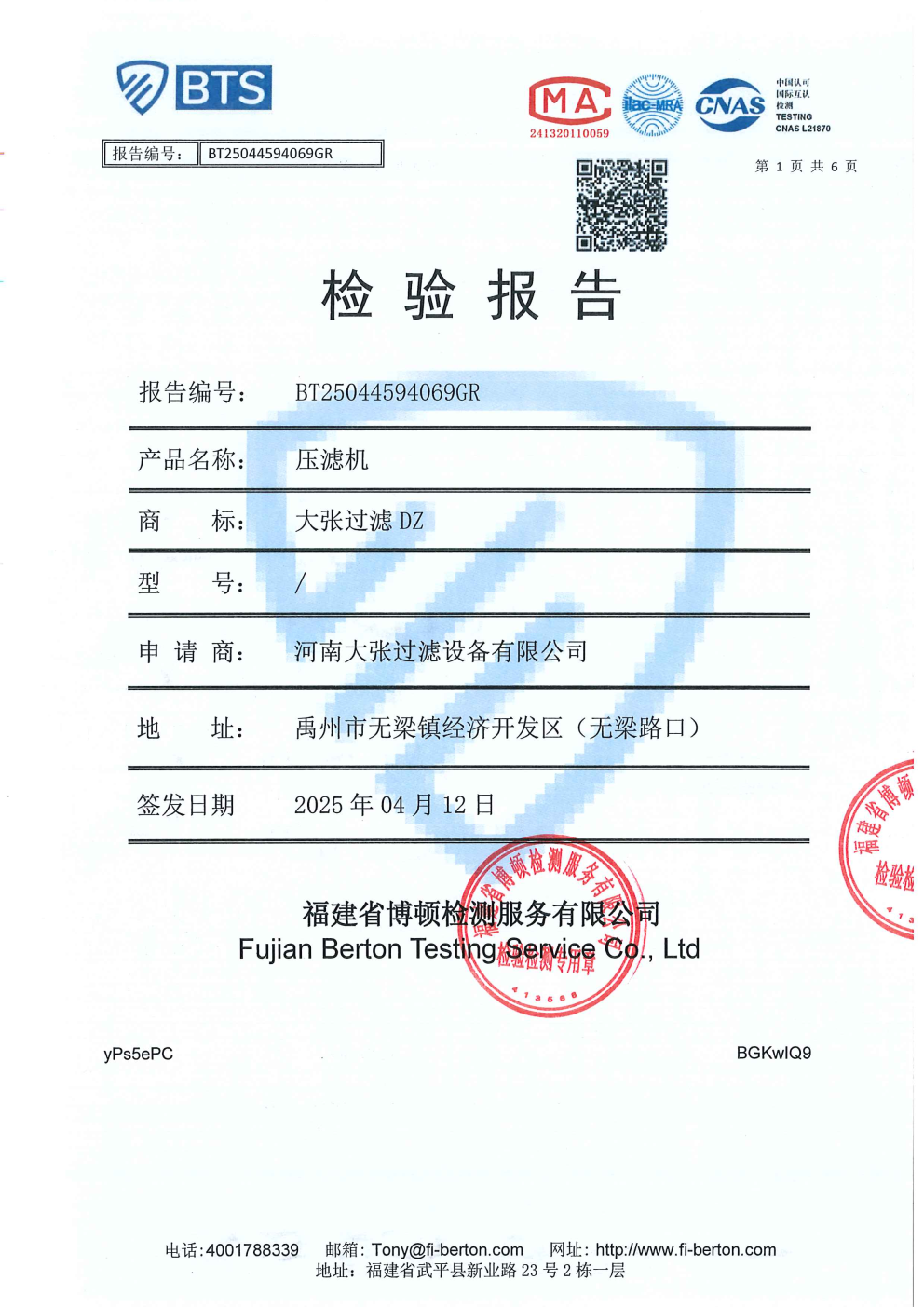
Third-party testing: test report BT25044594069GR was issued by Fujian Berton Testing Service Co., Ltd. on 2025-04-12 against standard JB/T 4333.2-2013, covering filter presses.
Intellectual property relevant to plate and frame construction: Chinese invention patent ZL 2021 1 0708980.0 (issued 2024-04-26) covers a reinforced and toughened modified polypropylene composite for filter plates and its preparation method; ZL 2019 1 0275647.8 (issued 2021-02-05) covers a centre-alignment clamping device for filter presses; ZL 2022 1 0459734.0 (issued 2024-01-30) covers a fully automatic filter with forced discharge; and ZL 2022 1 0761239.5 (issued 2023-12-22) covers a copper sulphide nanoparticle-coated basalt fibre-reinforced polypropylene composite.
Market access and management systems: EAC Declaration of Conformity ЕАЭС N RU Д‑CN.PA08.B.88796/23, issued 2023-10-19 and valid to 2028-10-18, referencing TR TS 010/2011 and TR TS 020/2011; an Intellectual Property Management System certificate (404IPJ240986R0M) against GB/T 29490-2023, valid to 2027-10-14; and High-Tech Enterprise certificate GR202341002931, valid to 2026-11-21.
Market Signals Behind the Scenario Split
The commercial context supports the split described above, though it should be read with appropriate caution. Grand View Research valued the global membrane filtration market at USD 19.4 billion in 2025, with Asia Pacific holding a 36.5% revenue share in the same year. China's export value of filter press machines under HS 84212910 reached USD 170,236,194 in 2023, indicating a substantial equipment trade base. Separately, filter presses have been estimated at approximately 22% of the global sludge dewatering system market in 2024, a figure published by Market Research Archive and best treated as indicative rather than definitive.
Forecast precision deserves a note. Published growth projections for this equipment category diverge — one commercial research house projects roughly 7.8% annual growth for 2026–2033, another around 9.5% for 2025–2034 — a gap most likely explained by differences in how each defines the addressable scope. Buyers and planners should treat such figures as directional and rely on their own duty-specific throughput and moisture calculations for equipment sizing.
Future Outlook
Three directions are likely to shape membrane filter press selection over the next evaluation cycles. The first is materials: polymer plate development, including reinforced and toughened polypropylene composites and high-temperature-resistant formulations, is the main route to widening the range of slurries that can be handled with a squeeze stage rather than a metallic alternative. The second is automation depth — automatic cloth moving, one-time opening with fast discharge, and automatic high-pressure water flushing all target the manual tasks that constrain cycle frequency in mining and heavy chemical duty. The third is documentation: as export markets tighten conformity requirements, the ability to produce a named test report, a declaration referencing the applicable technical regulations, and a traceable quality record is becoming part of the product specification rather than an administrative extra.
For buyers, the practical implication is that the mining-versus-chemical question will not resolve itself by waiting for a better machine. It resolves at the specification stage, by matching the pressure pair, plate geometry and material construction to the duty class — and by documenting the assumptions before the order is placed.
Frequently Asked Questions
Which membrane filter press configuration fits mining tailings dewatering?
The Mobile Filter Cloth Membrane Filter Press (1100 / 1500 Series) is the configuration whose documented attributes align most directly with mining and coal duty: filtering pressure of 0.6–4.0 MPa, plate sizes of 1100 mm and 1500 mm, filter area of 20–291.2 m², automatic operation, and a documented industry list covering mining, coal, metallurgy, chemical, power and sludge treatment. A mining and wastewater treatment case in China recorded more than three years of operation with lower cake moisture and higher dewatering efficiency.
Is a membrane filter press suitable for chemical processing slurries?
It can be, with conditions. The Membrane Filter Press (XMAG30/870-UKB–XMAG1000/2000-UKB Series) is documented for chemical, food, pharmaceutical, metallurgy and wastewater industries, using a PP/TPE membrane plate on a Q345 steel frame, with feed pressure of 0.6–2.0 MPa and squeezing pressure of 1.6 MPa. Where cake washing or lower moisture justifies the extra stage, the membrane design fits. Where the chemistry or temperature exceeds what the polymer plate can tolerate, the documented alternative is the Cast Iron Filter Press (BMA/XMA Series) at 0.6 MPa filtration pressure and ≥120 °C applicability.
What is the difference between feed pressure and squeezing pressure?
Feed pressure drives slurry into the chambers and builds the cake; squeezing pressure is the separate rating for the membrane stage that mechanically compresses the cake afterwards. In the Membrane Filter Press (XMAG30/870-UKB–XMAG1000/2000-UKB Series) the documented values are 0.6–2.0 MPa feed pressure and 1.6 MPa squeezing pressure. The 1100 / 1500 Series documents a filtering pressure range of 0.6–4.0 MPa and does not separately state a squeezing pressure in the available specification set. Buyers comparing offers should require both values rather than a single headline figure.
Should I choose 1100 mm or 1500 mm filter plates?
Plate size determines cake volume per chamber and the number of chambers needed for a given filter area, so the choice is a layout and handling decision as much as a process one. On the Mobile Filter Cloth Membrane Filter Press, both 1100 mm and 1500 mm plates are available within a 20–291.2 m² filter area range. Larger plates reduce chamber count and the number of open-close cycles for the same area; smaller plates give finer control over cake thickness and suit constrained installations. The Membrane Filter Press XMAG series spans 870–2000 mm plate sizes within 30–1000 m², so plate geometry can be matched to available floor space and downstream cake handling.
How can a buyer verify a membrane filter press supplier before ordering?
Request documents rather than claims. Verifiable items include an ISO 9001 quality certificate, a complete machine operation test record for the unit, and any third-party test report — DAZHANG's available documentation includes test report BT25044594069GR issued by Fujian Berton Testing Service Co., Ltd. against JB/T 4333.2-2013. Market-access and system certificates can also be checked by number, such as EAC declaration ЕАЭС N RU Д‑CN.PA08.B.88796/23 valid to 2028-10-18 and an Intellectual Property Management System certificate against GB/T 29490-2023 valid to 2027-10-14. Commercial terms — 15–30 working days lead time, minimum order quantity of one set, one-year warranty — should be confirmed in the same review.
A detailed company and product profile is available in the DAZHANG Filtration company profile (PDF). Product information is also published at dazhangfilterpress.com.
¿Tiene preguntas o necesita más detalles?
Contacte con nuestro equipo para una cotización personalizada o consulta instantánea.
Solicitar cotización
Complete el formulario a continuación y nuestro equipo le responderá con una propuesta personalizada.
Chat directo de WhatsApp
¿Prefiere chatear en tiempo real? Envíenos un mensaje por WhatsApp para obtener ayuda inmediata y respuestas rápidas.
- Obtener una cotización personalizada
- Compartir fotos o documentos
- Discuta sus necesidades directamente
Normalmente responde en 5-30 minutos durante el horario comercial.