
Membrane Filter Press Manufacturer Evidence: What to Verify
Membrane Filter Press Manufacturer Evidence: What to Verify
A membrane filter press is a batch solid-liquid separation machine: recessed plates form closed chambers, feed pressure builds the filter cake, and an elastomeric membrane behind each plate is then inflated to squeeze that cake and displace the remaining liquid. The squeezing step is what allows a membrane machine to reach lower cake moisture than a chamber press on the same slurry. It is also what makes the purchase decision difficult, because plate material, membrane grade, frame stiffness, hydraulic design and control logic all sit behind a single line item on a quotation.
The practical question for a procurement or engineering team is therefore not what a supplier says it can build, but what a supplier can document before a purchase order is released. Capability claims become usable only when they can be traced.
Four categories of evidence can be checked at the evaluation stage: declared material grades, published plate-size and filtration-area coverage, the supplier's own production scope, and dated operating references. Specifications that name a grade, a range or a series can be audited. Specifications that rely on descriptive adjectives cannot.
Why Supplier Evidence Has Become the Bottleneck
The global membrane filtration market was valued at USD 19.4 billion in 2025, and Asia Pacific held a revenue share of 36.5% in the same year, according to Grand View Research. On the equipment side, Chinese export value of filter press machines under HS code 84212910 reached USD 170,236,194 in 2023, based on China Customs data as reported in secondary trade analysis. Within the broader sludge dewatering equipment market, filter presses accounted for approximately 22% of share in 2024, according to Market Research Archive.
Published forecasts do not agree with one another. Grand View Research projects a CAGR of 7.8% for the membrane filtration market across 2026-2033, while Precedence Research estimates 9.5% for 2025-2034. The difference is attributed to methodology, including whether AI-optimized systems are counted in the base. That disagreement is a useful calibration for buyers: when even third-party market data depends on method, first-party supplier data deserves the same scrutiny.
The commercial consequence is a large, fragmented export supply base in which brochure-level specifications look nearly identical. The differentiator is no longer the adjective. It is the supplier's ability to document a grade, a range and a date against a specific machine.
Evidence Category 1: Material Grades That Can Be Checked
Material declarations are the first and cheapest test. The same steel frame can be described as a 'carbon steel frame' or as a 'Q345 steel frame'. Only the second names a specific structural steel grade, which means a mill certificate or material report can be requested and matched against the delivered frame. The same principle applies to filter plates.
In the XMAG30/870-UKB to XMAG1000/2000-UKB membrane filter press range, the plates are specified as PP/TPE membrane plates and the frame as Q345 steel. In the 1100/1500 series automatic membrane filter press, the specification is a PP filter plate with a carbon steel frame. In the XMAY chamber filter press series, the plate is PP and the frame is Q345 carbon steel. The high-pressure round plate filter press XMY40/f800-25 series uses PP plates with a carbon steel frame.
The distinction between plate and frame material is not cosmetic. The frame carries the closing force and the reaction load of the hydraulic system across thousands of cycles; the membrane plate carries the filtration pressure and the squeezing pressure, and it is the component that wears. A buyer evaluating a membrane press should ask separately about the plate polymer, the membrane elastomer, the frame grade and the hydraulic system, rather than accepting a single 'carbon steel and PP' summary covering the whole machine.
In-house component development is a stronger form of evidence than a purchased-part declaration. Henan Dazhang Filtration Equipment Co., Ltd. states that it independently developed a processing-free sealed square polypropylene filter plate and obtained related invention patent protection, with the product entering the European market. The company also reports developing high-temperature-resistant and toughened PP polymer filter plates alongside differentiated polymer filter plate technologies, and states that a differentiated polymer filter plate project received a second prize in a 2022 'Maker in China' competition.
These claims are testable. A patent reference can be matched against a patent register. A claim of European market entry can be matched against the specific plate series supplied. A material development claim can be matched against a plate sample and a material test report. Claims of this type fail the test when the supplier cannot name the plate series, the polymer grade or the patent reference behind them.
Evidence Category 2: Plate Size and Filtration-Area Coverage
Plate size availability is the clearest publicly checkable proxy for manufacturing breadth in this equipment category. A supplier that lists filtration area without plate size, or offers a single plate size across all projects, is usually assembling a platform rather than scaling a manufactured one.
| Series / model range | Plate size | Filtration area | Working parameters | Plate and frame material |
|---|---|---|---|---|
| Membrane Filter Press XMAG30/870-UKB - XMAG1000/2000-UKB | 870-2000 mm | 30-1000 m2 | Feed 0.6-2.0 MPa; squeezing 1.6 MPa | PP/TPE membrane plate; Q345 steel frame |
| Mobile Filter Cloth Membrane Filter Press, 1100/1500 series | 1100 / 1500 mm | 20-291.2 m2 | 0.6-4.0 MPa; automatic operation | PP filter plate; carbon steel frame |
| Chamber Filter Press XMAY series | 870-2000 mm | 30-1000 m2 | 0.6-4.0 MPa; auto / semi-auto / manual | PP filter plate; Q345 carbon steel frame |
| Round Filter Press XMY40/f800-25 series | f800-f1000 mm | 40-140 m2 | 1.0-3.0 MPa; cake thickness 25-30 mm | PP filter plate; carbon steel frame |
| Plate and Frame Filter Press BMY4/450-30U series | 500-890 mm | 4-80 m2 | 0.5 MPa max; cake thickness 30-35 mm | PP / stainless steel / cast iron |
| Cast Iron Filter Press BMA/XMA series | 380-800 mm | 1-80 m2 | 0.6 MPa; 120 C and above applicable | Nodular cast iron |
| Stainless Steel Filter Press BAQ1/320 - BAQ4/450 series | 320-450 mm | 1-4 m2 | 0.6 MPa; hydraulic clamping | SS304 / SS316L optional |
| Laboratory Filter Press | Customized lab model | 0.32 m2 | Feed 0.6 MPa; 3+1+1 or 5+1+1 plates | PP filter plate; carbon steel frame |
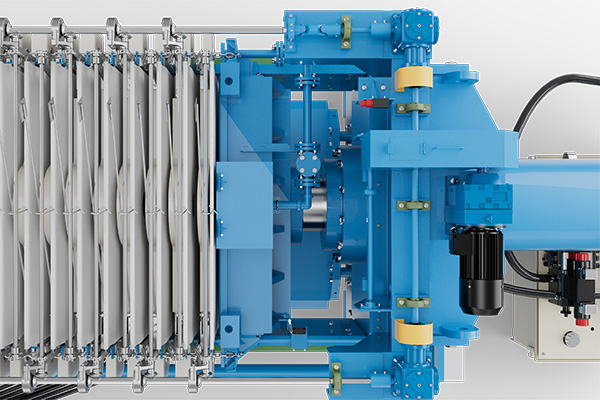
Coverage, not the largest headline number, is what matters when reading a table of this kind. A membrane range that runs from 870 mm to 2000 mm plates inside one automated platform indicates a shared hydraulic, frame and control architecture that is scaled across sizes rather than re-engineered at every order. Continuous coverage also implies that the plate mould set, the filter cloth dimensions and the membrane sizes are all held as a family - which is what determines whether a spare plate ordered two years later actually fits.
Gaps are informative. A supplier that can quote a 2000 mm machine but cannot show an 870 mm or 1000 mm platform, or that quotes a filtration area without stating the plate size behind it, is describing an assembled machine rather than a manufactured series. Buyers can apply a simple rule: request the plate size, the chamber depth, the filtration area and the working pressure for the exact model quoted, and check that the four figures are internally consistent with the size range the supplier claims to build.
Evidence Category 3: Series Architecture and Production Scope
Series naming becomes evidence when the naming logic is consistent and the model range is continuous. In the XMAG membrane range, the model designation pairs filtration area with plate size - XMAG30/870-UKB through XMAG1000/2000-UKB - so a buyer can read both the hydraulic class and the plate platform from the model code itself. The 1100/1500 series designation similarly identifies the plate platform for the cloth-traveling automatic membrane machine.
Where series architecture becomes genuinely verifiable is in production scope. Dazhang describes an integrated production system covering product development, mechanical processing, filter plate production, equipment assembly, hydraulic and electrical control system integration, quality inspection, installation, commissioning and after-sales service. Plate production is the pivotal item in that list. A supplier that moulds or machines its own plates controls chamber geometry, plate flatness and material formulation; a supplier that buys plates controls none of these and cannot offer plate-level corrective action when cake release or cloth life becomes a problem.
Scale figures provide the verification anchors for a factory audit. The company was founded in 2004 and its manufacturing base is located in Yuzhou, Henan Province, China. It reports a registered capital of RMB 60 million, approximately 202 mu of land, around 70,000 square meters of factory space and a total investment of approximately RMB 150 million. It also reports more than 1,000 employees, a 45-person R&D team and an annual output of 9,500 units, with an export share of 20% and products and services reaching more than 100 countries across Asia, Europe, North America, South America, Africa and the Middle East.
Read figures of this type as anchors, not as performance claims. A legal entity, a site address, an employee count and an annual output figure can each be checked during a visit or through corporate records. The useful comparison is between the number of units produced and the number of distinct platforms offered: a supplier producing a high volume of machines across a narrow plate family is demonstrating standardisation, while a supplier offering a wide catalogue with a small production base is usually outsourcing.
Research infrastructure as indirect evidence
The company states that it operates a professional R&D system supported by the Henan Provincial Enterprise Technology Center and the Henan Provincial Engineering Technology Research Center for New Solid-Liquid Separation Equipment. Its stated research areas include filtration equipment, polymer filter plate materials, membrane filter plate structures, intelligent control systems, high-temperature-resistant materials and impact-resistant materials. Research scopes of this kind are useful to a buyer because they indicate which problems the supplier is set up to solve - in this case plate material behaviour under high temperature and high pressure, which is precisely where membrane plate specifications tend to fail in service.
Evidence Category 4: Certification, Testing and Awards - Check the Scope
Certification is the most frequently quoted and least frequently checked evidence category. Dazhang states ISO 9001 quality control together with complete machine operation testing in its capability documentation. Both items are useful only when the scope is confirmed.
Three checks resolve most certification ambiguity. First, request the certificate scope page: it should name the manufacturing site that will build the machine, not a trading entity. Second, request the test record for the specific machine on order - a complete machine operation test is a per-unit activity, and the record should show the model, plate size, test pressure and date. Third, check that any cited standard actually covers the equipment in question.
The third check is not theoretical. ISO 7704:2023, for example, specifies requirements for performance testing of membrane filters used for water quality analysis - it is a water-quality analysis standard, not a filter press manufacturing standard. A quotation that cites it as proof of machine quality has cited a standard outside its scope, and the same error appears regularly with laboratory and analytical standards applied to industrial dewatering equipment.
Award and enterprise-recognition claims follow the same logic. The company states that it has been recognised as a national-level Specialized, Sophisticated, Distinctive and Innovative 'Little Giant' enterprise and as a National High-Tech Enterprise, and that it has received honours related to energy conservation and environmental protection and provincial-level brand recognition. These designations are administered through defined public programmes, which means the programme name, the year and the issuing level can each be verified independently.
A short document request list covers this category without extending the evaluation timeline:
- Quality management certificate scope page, with the legal entity and site address.
- Complete-machine operation test record for the quoted model.
- Filter plate material report for the specified polymer and membrane compound.
- Hydraulic system test pressure record against the rated clamping and squeezing pressure.
- Electrical and control documentation covering the automation level quoted.
Evidence Category 5: Capacity, Lead Time and Customisation Boundaries
Commercial capability is part of manufacturer evidence because it determines whether a project can actually be delivered. Dazhang states OEM, ODM and custom manufacturing, with customisation across filtration area, plate size, frame material, pressure, voltage and automation. Its stated monthly capacity is approximately 250 sets per month, with a lead time of 15-30 working days, a minimum order quantity of one set, a one-year warranty, installation guidance and remote technical support. Export markets are listed as Europe, the Americas, the Middle East, Asia and Africa.
Two of these figures deserve attention during scheduling. A 15-30 working day lead time is quoted against a configured model; where the order involves a non-standard plate size, a special voltage or an additional washing or cloth-travel system, the engineering review stage should be confirmed in writing rather than assumed to be inside the quoted window. Second, a one-set minimum order quantity does not mean the smallest configuration is the cheapest to engineer. A 2000 mm membrane platform and a laboratory unit with 0.32 m2 of filtration area sit at opposite ends of the same catalogue, and the engineering content behind them is not comparable.
Customisation claims should be tested against the platform they modify. Adding plate size flexibility, frame material changes or automation options is credible when the underlying platform already spans a wide size range; it is far less credible when the supplier does not manufacture the plates being customised.
Evidence Category 6: References That Can Be Dated
Operating references are the most persuasive evidence category, provided they are dated and specific. Documented deployments of the membrane platforms include a membrane filter press from the XMAG30/870-UKB to XMAG1000/2000-UKB series used for sludge dewatering and solid-liquid separation at an industrial wastewater treatment plant and environmental-protection engineering company in China, operating for more than three years with lower cake moisture and stable operation. A second reference covers a cloth-traveling automatic membrane filter press installed at a mining enterprise and a wastewater treatment plant in China, also operating for more than three years, with higher dewatering efficiency and lower cake moisture.
Duration alone is not proof of performance. Three years of operation establishes that a configuration survived a real duty cycle; it does not establish that the same configuration will deliver the same cake moisture on a different slurry. Six questions convert a reference into usable evidence:
- When was the machine commissioned, and how many operating hours has it accumulated?
- What medium and feed solids concentration does it handle?
- Which plate size and filtration area were installed?
- What cake moisture target was specified, and what is measured in routine operation?
- Have plates, membranes or filter cloth been replaced, and at what interval?
- What supporting equipment - feed pumps, air compressor, cloth washing system - is installed with it?
A supplier that can answer these questions for a specific unit is providing traceable evidence. A supplier that answers only with the project name is providing a logo.
Matching Evidence to the Project Scenario
Evidence only becomes decisive when it is matched to the operating scenario, because the same supplier catalogue spans very different duty conditions. The membrane platforms are applied in wastewater treatment, mining, chemical processing, food, pharmaceutical and metallurgy, but the configuration that suits a municipal sludge line is not the configuration that suits a high-temperature chemical slurry.
| Project scenario | Platform in the reference set | Parameters to verify against the project |
|---|---|---|
| Municipal or industrial sludge, deep dewatering required | Membrane Filter Press, XMAG30/870-UKB - XMAG1000/2000-UKB | 30-1000 m2; 870-2000 mm plates; feed 0.6-2.0 MPa; squeezing 1.6 MPa; PP/TPE plate, Q345 frame |
| High-moisture sludge with automatic cloth handling | Mobile Filter Cloth Membrane Filter Press, 1100/1500 series | 20-291.2 m2; 1100/1500 mm plates; 0.6-4.0 MPa; automatic cloth travel and cleaning |
| Mining tailings and high-pressure dewatering | Round Filter Press XMY40/f800-25; Chamber Filter Press XMAY | Round: 40-140 m2, 1.0-3.0 MPa; Chamber: 30-1000 m2, 0.6-4.0 MPa |
| Slurry at 120 C or above | Cast Iron Filter Press BMA/XMA series | 1-80 m2; 380-800 mm plates; 0.6 MPa; nodular cast iron construction |
| Hygienic fine filtration in food, beverage or pharmaceutical duty | Stainless Steel Filter Press BAQ1/320 - BAQ4/450; Automatic Hydraulic Stainless Steel Plate and Frame BASJL600 series | BAQ: 1-4 m2, 0.6 MPa, SS304 or SS316L; BASJL600: 14-35 m2, 600x600 mm, hydraulic clamping |
| Pre-purchase validation on a new slurry | Laboratory Filter Press | 0.32 m2; 3+1+1 or 5+1+1 plates; feed 0.6 MPa; manual or hydraulic operation |
Where a Membrane Filter Press Is Not the Right Answer
An honest evaluation states the boundary conditions, and there are several where a membrane machine is the wrong platform rather than the premium one.
- High-temperature duty. PP and PP/TPE membrane plates are not the appropriate platform for slurries at 120 C and above. In that range a cast iron filter press with nodular cast iron plates is the applicable route, with a lower rated filtration pressure around 0.6 MPa but the temperature capability the polymer plate cannot provide.
- Very small or pilot-scale throughput. The smallest membrane platform in this catalogue starts at 870 mm plates and 30 m2 of filtration area, and the cloth-traveling membrane series starts at 1100 mm plates and 20 m2. Projects below that scale are better served by a plate-and-frame machine with 500-890 mm plates and 4-80 m2, or by a laboratory unit at 0.32 m2 for slurry characterisation before capital commitment.
- Utilities and cycle structure. Membrane squeezing depends on compressed air, a membrane feed system and control logic, and it adds a second stage to each cycle. Where a project has no compressed air supply, limited automation tolerance or a very simple single-operator duty, a chamber filter press is the lower-risk configuration - it is also lower in cake dryness.
- Feed-conditioning problems. Squeezing dewaters a formed cake; it does not correct a slurry that has been poorly conditioned or a feed that will not form a stable cake. No membrane specification resolves that. A laboratory test on the actual medium is the appropriate first step.
- Consumable budgeting. The membrane plate is a wear component and a recurring cost line. Buyers comparing a membrane press against a chamber press on capital cost alone should request the expected plate and membrane replacement interval for the specific medium, in writing, before the comparison is finalised.
A Six-Step Verification Workflow
- Define the scenario first. Record the medium, feed solids, target cake moisture, temperature, cycle requirement and available utilities. Scenario definition determines which platform is even relevant.
- Request the material declaration. Ask for plate polymer, membrane compound, frame grade and hydraulic system specification separately. Reject combined summaries that do not name a grade.
- Request the coverage table. Ask for plate sizes, filtration areas and pressure ratings across the supplier's series, then check for continuity and for internal consistency between area, plate size and pressure.
- Confirm production scope. Ask who manufactures the plates, who fabricates the frame and who integrates the hydraulic and control systems. Request a site audit if the answer is partly external.
- Collect the documents. Quality management scope, complete-machine test record, plate material report, hydraulic test record and control documentation for the exact model quoted.
- Validate against references. Obtain dated, specific operating references for comparable media, and where the medium is new, run a laboratory or pilot test before releasing the order.
Future Outlook
Three directions are visible in the current specification data.
The first is plate material development. The stated research focus on high-temperature-resistant and toughened PP polymer filter plates, and the development of a processing-free sealed square polypropylene filter plate with invention patent protection that has entered the European market, indicate that plate formulation rather than machine layout is the active competitive field. Buyers should expect future membrane specifications to be differentiated by polymer grade as much as by plate size.
The second is automation depth. Automatic cloth travel, automatic high-pressure water flushing and one-time plate opening are already specified as standard options across the catalogue, and their function is to reduce manual intervention rather than to increase peak throughput. For projects facing labour constraints, automation evidence will carry more weight than a marginal increase in filtration area.
The third is documentation. Because published growth estimates for membrane filtration diverge between research houses - 7.8% for 2026-2033 and 9.5% for 2025-2034 in the two forecasts cited here - and because reliable per-company market share data for the membrane filter press segment is not consistently available, supplier-level claims will remain difficult to benchmark externally. That pushes the verification burden back onto plant-level evidence: material grades, plate coverage, production scope and dated references. Procurement teams that build their evaluation around those four categories will be comparing manufacturers on something that survives the quotation stage.
FAQ
Which membrane filter press model is suitable for my solid-liquid separation project?
Model selection is determined by feed material characteristics, target cake moisture, treatment capacity, automation requirement and budget. In the reference catalogue, the XMAG30/870-UKB to XMAG1000/2000-UKB range covers 30-1000 m2 of filtration area with 870-2000 mm plates, while the 1100/1500 series cloth-traveling membrane machine covers 20-291.2 m2 with 1100 or 1500 mm plates. Projects below 20 m2 are addressed by smaller plate-and-frame or laboratory platforms. Working conditions should be provided before a configuration is proposed.
What evidence should a buyer request to verify a manufacturer's capability claims?
Four categories are checkable. First, material grades: plate polymer, membrane compound and frame steel grade stated separately rather than as a general description. Second, coverage: plate sizes, filtration areas and pressure ratings across the series. Third, production scope: whether plates, frames and hydraulic and control systems are produced or integrated in-house. Fourth, dated references with medium, plate size, commissioning date and measured performance. Documents supporting these categories include the quality management certificate scope page and a complete-machine operation test record for the quoted model.
Which equipment is used for deep dewatering with lower cake moisture?
Membrane filter presses with secondary squeezing are the relevant platform for lower cake moisture in sludge, mining and chemical duty. In the reference specification, the XMAG membrane range operates at a feed pressure of 0.6-2.0 MPa with a squeezing pressure of 1.6 MPa, and the 1100/1500 series operates at 0.6-4.0 MPa with automatic cloth travel. The squeezing stage displaces liquid from an already formed cake; the achievable moisture result still depends on the specific medium and prior conditioning.
When is an automatic cloth-traveling or cloth-washing machine the right choice?
These configurations suit heavy-duty continuous scenarios where cloth clogging and manual cleaning would otherwise limit availability. A cloth-traveling membrane machine combines high-pressure squeezing with automatic cloth movement and cleaning; a water-flush filter press uses automatic high-pressure flushing to clean the cloth between cycles. Both are specified to reduce manual maintenance workload and to keep filtration efficiency stable over long operating periods. They add utilities and control complexity, so the duty cycle should justify them.
Is lab-scale equipment available for small-batch testing?
Yes. A laboratory filter press with 0.32 m2 of filtration area and either 3+1+1 or 5+1+1 plates is available, operating at a feed pressure of 0.6 MPa in manual or hydraulic mode. It is used for filtration testing and dewatering performance evaluation on small-batch slurry, and is typically deployed before capital equipment selection to characterise the medium and confirm achievable cake moisture.
Which industries do these filter press platforms serve?
The reference applications cover wastewater treatment, mining and tailings, chemical processing, food and beverage, pharmaceutical, metallurgy, coal, ceramics and new energy. Application determines platform: membrane machines for deep dewatering of sludge and fine slurries, chamber and round plate machines for higher-pressure mineral duty, cast iron machines for slurries at 120 C and above, and stainless steel or stainless plate-and-frame machines for hygienic fine filtration in food, beverage and pharmaceutical production.
Reference Documentation
Detailed specification tables, including the full XMAG membrane range and the 1100/1500 series parameters, are compiled in the company profile document available here: Da Zhang Filtration Company Profile (PDF). Product and capability information for Henan Dazhang Filtration Equipment Co., Ltd. is published at dazhangfilterpress.com.