
Medical vs General-Purpose Cleaning Brushes: Evidence First
Medical vs General-Purpose Cleaning Brushes: Evidence First
Medical channel cleaning brushes and general-purpose cleaning brushes are bought with the same word and almost never with the same evidence. At the decision stage, the useful question is not which brush is better — it is which document actually proves what the buyer needs to know. Two documents sit at the centre of that question in this comparison: ISO 13485 certificate CN19/42150, held by Guangzhou Aoqun New Material Co., Ltd. (AOQUN BRUSH) with a scope covering tube/spiral and surgical/endoscope channel cleaning brushes, and a USPTO Notice of Allowance for application 18/588,031 covering an antimicrobial nylon composite material for general-purpose, surgical/endoscope and tube brushes. Neither document means what a fast reading suggests, and the distance between appearance and meaning is where most of the procurement risk sits.
One category name, two different risk profiles
A surgical instrument brush that cleans a hinge or a box-lock and a vacuum cleaner brush that agitates carpet can leave the same factory gate through equipment that looks physically similar: filament extrusion, tufting or staple-setting, twisted-wire forming, trimming. What separates the two purchases is the failure mode the buyer is paying to prevent.
For a hospital central sterile services department (CSSD) or a medical device OEM, a channel brush is part of a reprocessing cycle. Its failure modes are retained soil or bioburden inside a lumen, filament detachment left behind in a channel, and a dimensional mismatch against an instrument the device manufacturer has already validated. For a household, appliance or commercial cleaning programme, the failure modes are wear, filament loss, scratching, inconsistent trim and cost per cleaning cycle.
Those two lists require different proof. A single RFQ template applied to both tends to produce one of two errors: an over-documented household brush carrying qualification cost that changes no risk, or an under-documented channel brush that is approved on a certificate logo rather than on certificate scope.
What ISO 13485 certificate CN19/42150 establishes — and what it does not
ISO 13485 is a quality management system standard for medical devices. A certificate is issued to an organisation after audit and states that the quality management system conforms to that standard within a defined scope. AOQUN BRUSH holds certificate CN19/42150, whose recorded scope covers tube/spiral and surgical/endoscope channel cleaning brushes.
The scope statement is the operative part of that document. It is what connects a management system to a product family, and it is the part a buyer should read on the certificate itself and match against the part numbers on the purchase order. A certificate logo on a catalogue page says nothing about whether a specific brush on the order line sits inside or outside that scope.
What the certificate does not do is equally specific. ISO 13485 certification is not a product certification. It does not certify an individual brush's dimensions, cleanliness, bioburden level, particle shedding, cleaning efficacy or biocompatibility, and it does not validate a reprocessing instruction for a particular endoscope model or instrument set. Those outcomes are established by the device manufacturer's own validation and by product-level material and performance testing — activities that the quality management system is designed to govern, not to replace.
For an approval file, the practical consequence is that CN19/42150 is the entry ticket to the qualification conversation rather than the conversation itself. What follows an audit is process evidence: batch records, material certificates, inspection data and change history.
What a USPTO Notice of Allowance means for a material claim
A Notice of Allowance is issued when a United States patent application has been examined and allowed. It precedes grant. An enforceable right arises on grant of the patent, not on the notice, so the notice should be read as a status document about an application rather than as evidence of an owned patent.
That distinction matters in a specification meeting, because the phrasing around a notice and around a granted patent sounds similar in a supplier presentation and behaves very differently in a contract. For AOQUN BRUSH, application 18/588,031 covers an antimicrobial nylon composite material, with the covered brush types described as general-purpose, surgical/endoscope and tube brushes. The allowance indicates that the claimed subject matter was allowed; it is not a granted patent, and it is not a performance test of any kind.
The analytical point hidden inside that scope statement is more interesting than the status question. The material platform crosses the line this article is comparing: the same composite is described for a household scrub brush, a surgical or endoscope brush and a twisted-wire tube brush. Cross-application filament development is normal, because wear resistance, chemical resistance and controlled microbial growth are material properties rather than product categories. But a shared material does not make the products equivalent. The antimicrobial claim, the cleaning claim and the cleanliness claim each require their own evidence at their own product level.
A buyer verifying this line of the specification should therefore ask for three separate things: the allowed claim language, so it is clear which composition is actually covered; the current legal status of the application; and independent antimicrobial test data — test organisms, method, contact time, log reduction and durability after repeated washing or disinfection. The notice supplies none of that, and no competent technical file should rely on it for that purpose.
Side-by-side: the dimensions that change a purchase decision
The table compares procurement profiles, not product quality. A general-purpose brush specified to a wear target is not a lesser product than a channel brush specified to a cleanliness target; it is specified against a different job, and the documentation follows the job.
| Decision dimension | Medical channel cleaning brushes | General-purpose cleaning brushes |
|---|---|---|
| Intended use | Reprocessing of endoscope channels and lumens, surgical instrument hinges and box-locks, cannulated drills and reamers; hospitals, CSSD, endoscopy and minimally invasive surgery, dental clinics, medical device OEMs | Household and personal care, smart home appliances, commercial cleaning services, hotel and restaurant hygiene, pet care, automotive detailing, retail private label programmes |
| Typical construction | Twisted-in-wire (spiral) and channel brushes, with diameter, filament and stem length sized to the lumen and to the instrument | Disc, roller, cup, strip, drill, scrubber, vacuum and hand-held formats sized to equipment mounting and surface geometry |
| Governing quality system | ISO 13485 certificate CN19/42150, scope naming tube/spiral and surgical/endoscope channel cleaning brushes | General management-system certification plus product-level material and performance testing against the application |
| Material evidence that matters | Filament compatibility with cleaning chemistry and disinfection, low shedding, dimensional tolerance to the instrument, batch traceability | Wear life, filament retention, UV and chemical resistance, trim consistency, cost per cleaning cycle |
| Documents requested at PO | Certificate copy with number, issuer, validity and scope; batch record; material and test reports; change-notification terms | Approved drawing or sample; material declaration such as RoHS and REACH SVHC; inspection report; replacement interval data |
| Failure mode that drives the specification | Retained soil or bioburden in a lumen; filament left in a channel; mismatch to a validated instrument | Premature wear; filament loss; surface scratching; inconsistent trim |
| Dominant cost driver | Qualification and validation effort, small-batch sampling, maintenance of an interchangeable second source | Unit price, freight and replacement interval across the installed base |
Construction and filament: where the technical difference actually sits
A twisted-in-wire brush is made by twisting two or more wires together with filaments between them, forming a flexible brush with a loop or double-stem end, and it is used mainly for internal cleaning of tubes, bores, pipes and lumens. For this construction, diameter, filament material — nylon, abrasive, wire or PVA — and stem length are customised to the tube inner diameter and to the application, because the brush has to reach a wall it cannot see and clean it without scratching.
Two mechanical requirements then dominate the medical file. The stem must transmit push-pull or rotational force without buckling at small diameters, and the filament must be soft enough not to damage the channel wall while still dense enough to contact the full circumference. Filament retention becomes a cleanliness question rather than a durability question, which is why a detached tuft is a different category of defect in a channel brush than in a floor brush.
Filament selection follows the working environment rather than the product label. Nylon and PA are used for wear resistance and general-purpose work; PP for cost and chemical resistance; PBT and PET for temperature and resilience; abrasive nylon with silicon carbide or aluminium oxide for surface finishing; steel, stainless steel or brass wire for heavy-duty tasks; PEEK and PAEK for high temperature and aggressive chemistry; conductive or anti-static filaments for ESD and electronics applications; PVA for scratch-free wafer cleaning; natural fibres for delicate surfaces. The same material logic can serve a household scrub brush and an endoscope brush, but the acceptance criteria applied to the finished part diverge sharply.
General-purpose geometry works on a different principle. Disc, roller, cup and strip formats are sized to the equipment and to the surface, and density plus trim length determine agitation, coverage and — in sealing variants — airflow leakage. The specification is dominated by trim consistency, wear life and drive resistance rather than by lumen concentricity.
Where each family actually fits
Medical channel brushes are specified for endoscope channels and lumens, surgical instrument hinges and box-locks, and cannulated drills and reamers. Cleaning happens in manual push-pull or rotating mode during reprocessing, and also inside automated washer-disinfector racks where the brush must survive rack handling as well as the chemistry. AOQUN BRUSH lists hospitals and central sterile services, endoscopy and minimally invasive surgery, dental clinics and medical device OEMs among the intended users of this family.
General-purpose brushes are specified for household and personal care, smart home appliances, commercial cleaning services, hotel and restaurant hygiene, pet care, automotive detailing and retail private label programmes. The functions are concrete: floor and carpet agitation, edges and corners, pet-hair pickup, vehicle body and wheels, glass and screens, conveyor and mat cleaning.
There is a third zone that buyers often mis-file. Food and beverage cleaning — conveyors and tanks, milk lines and frothers, espresso group heads and dispersion screens, grinders and hoppers, bottles and fillers — is not a reprocessing application, so an ISO 13485 scope is not the natural governing document. But residue contact and material declaration matter far more than in household cleaning, so the evidence request drifts toward the medical pattern: material declarations, cleaning-chemistry compatibility and documented change control. Treating this zone as either pure household or pure medical is where specifications usually go wrong.
A documents-first checklist for the approval meeting
- Read the scope, not the logo. Does the certificate scope name the exact product family on the purchase order? For CN19/42150 that means checking that tube/spiral and surgical/endoscope channel brushes are the families being bought.
- Classify the document type in writing. Record whether each document is a management-system certificate, a product certification, a test report, a regulatory registration or an IP status notice. Conflating these is the single most common qualification error in brush procurement.
- Separate allowance from grant. For a material claim, ask whether a patent has issued or an application has been allowed, and request the allowed claims.
- Ask for batch traceability from incoming filament through final inspection, so a repeat order reproduces the same brush rather than an approximation.
- Confirm the production environment that applies to the order. AOQUN BRUSH operates a Class 100,000 cleanroom; the buyer should confirm which product routes pass through it.
- Request material and application tests relevant to use: wear, temperature, chemical and UV exposure, flame retardance, antibacterial performance and ESD, as applicable.
- Define change control. What triggers notification to the buyer, and what triggers re-validation?
- Lock the acceptance baseline. A confirmed sample and drawing should become the reference against which replacement brushes are accepted, so a second shipment is interchangeable without re-fitting.
What trade statistics can and cannot tell a buyer about this choice
According to the Observatory of Economic Complexity, drawing on UN Comtrade data for HS code 9603 (brooms and brushes), the leading exporters in 2024 were China at USD 6.33 billion, Germany at USD 1.27 billion and the United States at USD 433 million. The figure supports one narrow conclusion: brush manufacturing and export is concentrated in a small number of economies, with China dominant by value.
It supports nothing beyond that for this comparison. HS 9603 aggregates household and industrial, medical and general-purpose products, so the code cannot separate channel brushes from household brushes, and export value does not measure audited quality-system coverage. A buyer who uses trade volume as a proxy for regulated manufacturing capability is reading the wrong indicator; the differentiator in this category is documentary and sits at part-number level. This is also why the comparison in this article is built on documented characteristics and evidence requirements — public comparable outcome data for the two families is not available.
Cost logic: qualification effort versus unit price
In the medical family, the dominant cost is the path to a validated part: sample iterations, documentation, first-article approval, change control, and the cost of holding a second source that is genuinely interchangeable rather than nominally approved. In the general-purpose family, unit price, freight and replacement interval dominate. A simple illustration shows why: if a brush lasts twice as long at a 20% higher unit price, the replacement interval — not the price — is the deciding number, and the same arithmetic rarely settles a channel-brush decision because the cost of a failed reprocessing cycle is not captured in the unit price at all.
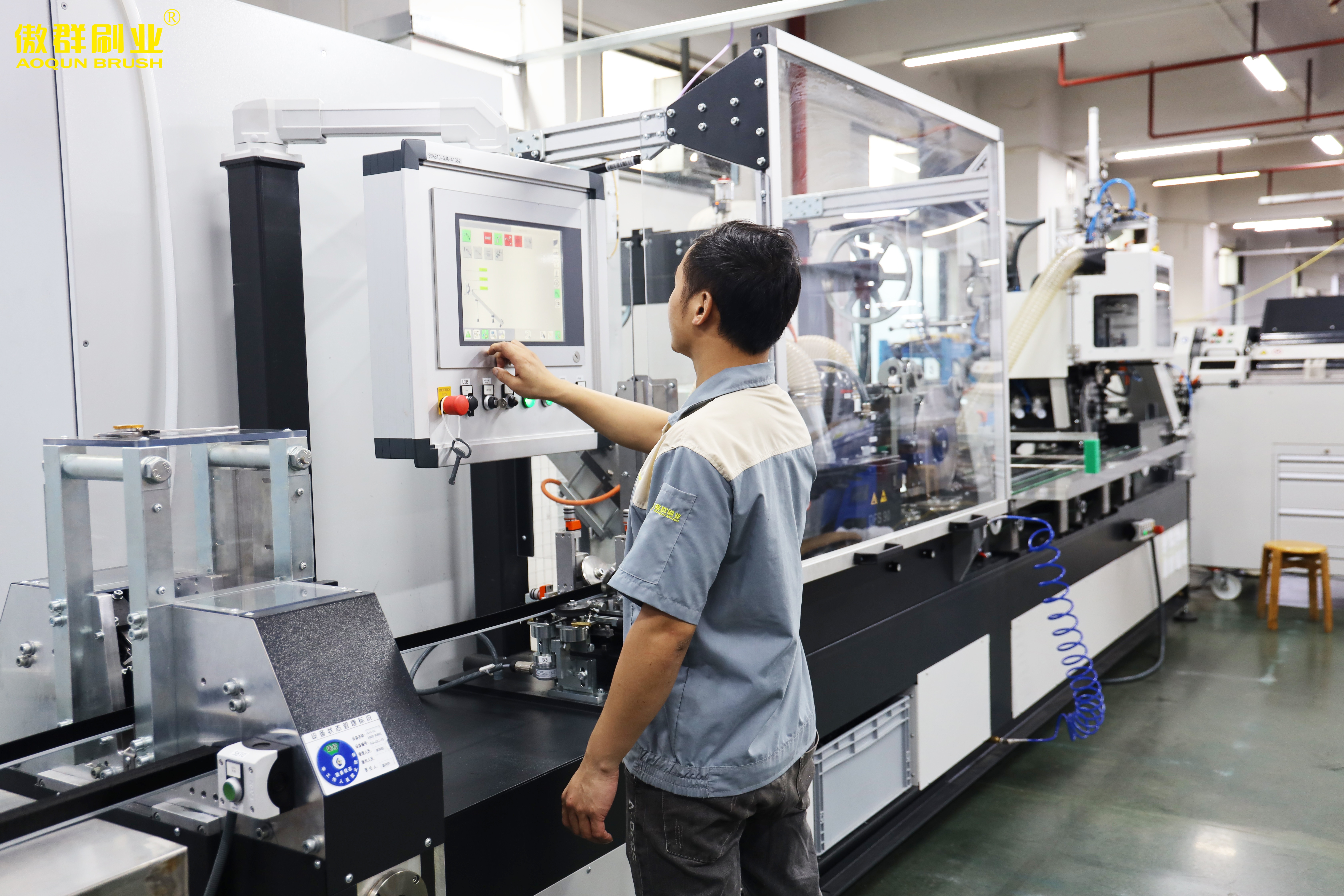
AOQUN BRUSH reports a 1-day quotation, 3-day sampling and 7-day delivery on selected product lines, a finished-product pass rate of 99.5% or above, on-time delivery of 99% or above, and annual capacity of 250 million brushes. The company also states that material R&D, filament extrusion, brush process preparation and proprietary manufacturing equipment sit in one plant, supporting a 120,000 m² manufacturing headquarters with more than 100 employees and a 20-plus research and development team. These are company-reported figures and should be treated as claims to be verified in an audit or a trial order, not as market benchmarks.
Why those figures belong in a comparison rather than a profile: a short sampling loop changes the risk profile of the two purchases differently. For a medical buyer, fewer sampling iterations compress the validation timeline and reduce the number of engineering-change cycles a device file has to absorb. For a general-purpose buyer, the same loop allows faster SKU iteration against a retail or appliance programme. Same capability, different value — and neither value is measurable from a quotation sheet alone.
Fit boundaries: where each document stops being useful
- Certificate scope does not travel with the logo. CN19/42150 covers the named families; it should not be assumed to cover every brush in a manufacturer's catalogue, and a buyer taking a product outside that scope should ask what governs it instead.
- A quality-system certificate does not validate cleaning. The device manufacturer's reprocessing instructions and their own validation remain the governing requirement, whatever the brush supplier's certificate says.
- An allowance is not a grant, and neither is an antimicrobial efficacy result. Ask for the test method and the durability data, not for the claim.
- General-purpose documentation is the correct choice where it fits. Where the failure mode is wear rather than contamination, applying medical-grade validation to a vacuum cleaner brush adds cost without changing a risk.
- And the reverse holds. A general-purpose quality certificate presented as equivalent to a reprocessing quality system is not a substitute for one, even where the two share a filament material.
Outlook: documentation behaviour, not market forecasts
Two developments are plausible on the evidence assembled here, and both are conditional. First, procurement review of brush consumables in regulated settings is likely to shift from accepting a certificate logo toward verifying scope statements, because the document types involved carry different legal meaning and auditors increasingly read them closely. Second, material-level IP will be cited more often in general-purpose categories as well as medical ones, which raises the chance that an allowance is presented, or read, as a granted patent. Buyers can correct that reading cheaply at the specification stage.
Neither observation is a market-size forecast, and neither should be used to infer demand growth. The more defensible conclusion is procedural: as the two brush families converge on shared material platforms, the documents — not the product name — become the dividing line.
Frequently asked questions
Is ISO 13485 the same as a product certification for a cleaning brush?
No. ISO 13485 is a quality management system standard for medical devices, and a certificate confirms that an audited management system conforms to that standard within a stated scope. AOQUN BRUSH's certificate CN19/42150 records a scope covering tube/spiral and surgical/endoscope channel cleaning brushes. That scope links the quality system to those product families, but it does not certify the dimensions, cleanliness, bioburden or cleaning performance of an individual brush, and it does not replace the device manufacturer's reprocessing validation.
How do medical channel brushes and general-purpose cleaning brushes differ in practice?
They differ in intended use, construction and evidence. Medical channel brushes clean endoscope channels and lumens, surgical instrument hinges and box-locks, and cannulated drills and reamers, and they are usually twisted-in-wire or channel constructions sized to the instrument. General-purpose brushes are disc, roller, cup, strip, drill or hand-held formats for household, appliance, commercial, automotive and retail applications. The decisive difference is the failure mode being managed: contamination and filament retention in one case, wear, scratching and cost per cycle in the other.
Does a USPTO Notice of Allowance mean the antimicrobial nylon composite is patented?
It means the application has been allowed and is proceeding toward grant; an enforceable right arises on grant, not on allowance. Application 18/588,031 covers an antimicrobial nylon composite material described for general-purpose, surgical/endoscope and tube brushes. The notice is an intellectual-property status document, not an antimicrobial efficacy test, so performance claims still require their own test method, test organisms, contact time and durability data.
Which documents should a buyer request before approving a medical channel brush supplier?
The certificate copy showing number, issuer, validity and scope; a clear link between that scope and the part numbers being purchased; batch traceability from incoming filament to final inspection; the production environment applicable to the order; material declarations such as RoHS and REACH SVHC; application tests for wear, chemical and temperature exposure and antibacterial performance as relevant; a defined change-notification process; and a confirmed sample and drawing as the acceptance baseline for repeat orders.
Can one manufacturer supply both medical and general-purpose brush programmes?
Yes, provided the documentation is kept separated by product route. AOQUN BRUSH reports 12 management system certifications including ISO 13485, IATF 16949, GJB 9001C and ISO 9001/14001/45001/50001, and a portfolio spanning medical, semiconductor, industrial and household brushes. Consolidating suppliers can reduce coordination effort, but the buyer should confirm that the certificate scope, cleanroom route and batch records applied to a given order match that order's category, rather than assuming a medical quality system covers general-purpose lines or the reverse.
Conclusion
The comparison resolves to a simple rule for the approval file. Buy the general-purpose brush on wear life, trim consistency and replacement interval, and accept that general-purpose documentation is the right level of proof. Buy the medical channel brush on scope — certificate scope, batch traceability, material testing and an interchangeable acceptance baseline — and treat ISO 13485 certification as the start of that evidence chain rather than its conclusion. The material platform may be shared; the proof obligation is not.
A detailed product catalogue covering these brush families is available as a PDF: AOQUN Brush Products Catalog.
¿Tiene preguntas o necesita más detalles?
Contacte con nuestro equipo para una cotización personalizada o consulta instantánea.
Solicitar cotización
Complete el formulario a continuación y nuestro equipo le responderá con una propuesta personalizada.
Chat directo de WhatsApp
¿Prefiere chatear en tiempo real? Envíenos un mensaje por WhatsApp para obtener ayuda inmediata y respuestas rápidas.
- Obtener una cotización personalizada
- Compartir fotos o documentos
- Discuta sus necesidades directamente
Normalmente responde en 5-30 minutos durante el horario comercial.