
Medical Transport Trolley: Modular Medical Storage Explained
HTNXT Industry Reference · Health & Medicine · Modular Medical Storage System
A medical transport trolley is the moving part of a hospital storage system. Shelving holds inventory in place; the trolley carries it from a central pharmacy or secondary warehouse to a ward, a treatment room or a patient bedside, and brings empty containers back into the supply chain. In a modular medical storage system, that movement is treated as a design problem rather than an afterthought, because every container-to-container transfer costs nursing time, creates counting errors and adds a cleaning burden.
This reference examines the transport trolley role specifically: what the equipment does, how modular tray standards change the way supplies move, where transport trolleys fit across hospital departments, and which limits buyers should understand before specifying. First-party facts are drawn from Tongde Medical Technology (Ganzhou) Co., Ltd., the manufacturer behind the Topmodul range, together with published third-party market research.
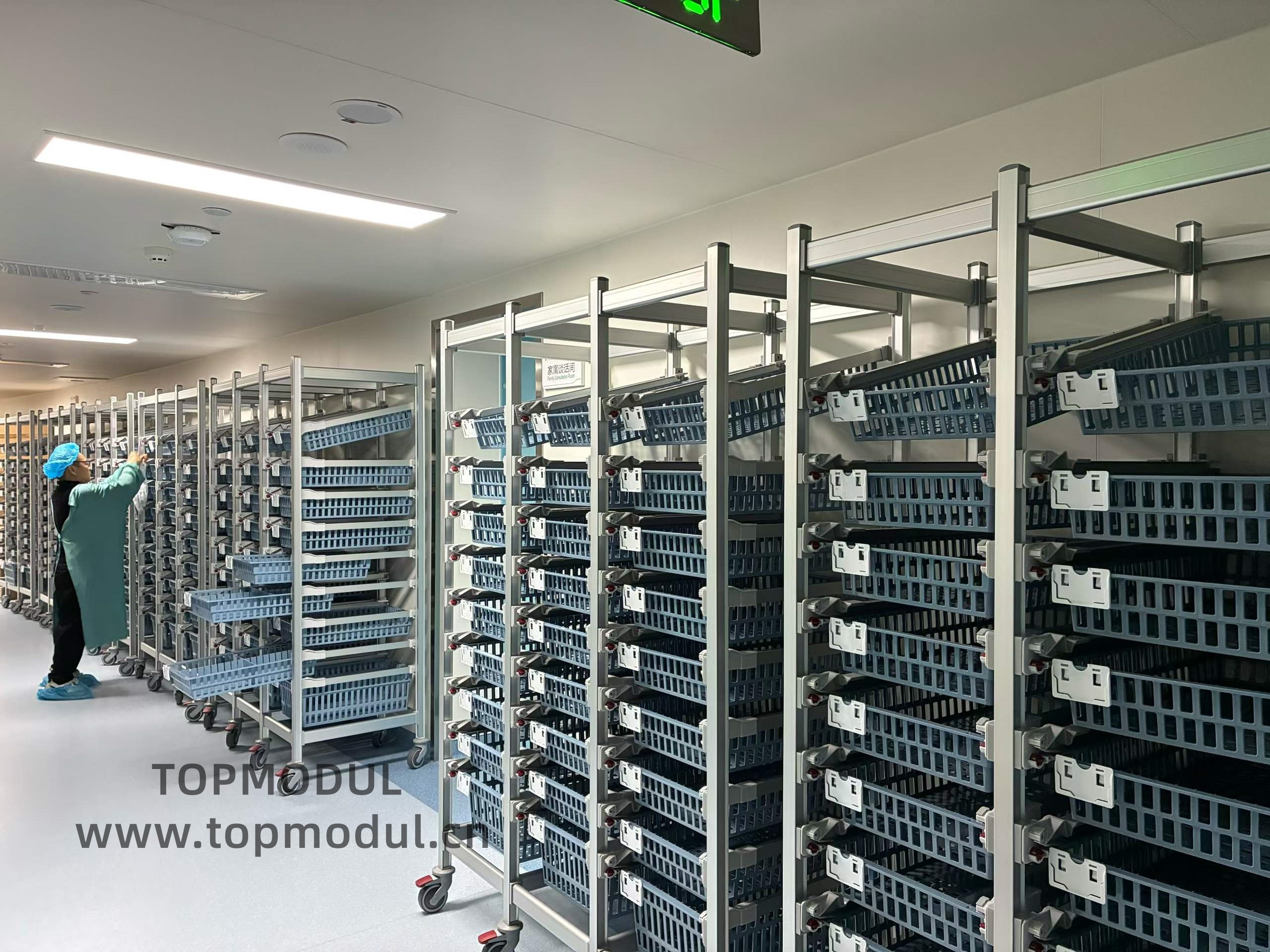
Modular medical carts and trolleys in a hospital supply-movement scenario. Image: Topmodul / Tongde Medical.
What a Medical Transport Trolley Does, and What It Is Not
A medical transport trolley is a mobile cart, positioned manually by clinical staff, used to move medical supplies, consumables and small equipment between storage locations and points of clinical use. Topmodul's Medical trolley T6020-2 is an open transport cart in the modular medical cart series. It measures 1385 x 445 x 2000 mm, with struts and crossbars constructed from aluminum alloy and baskets in polycarbonate (PC) and acrylonitrile butadiene styrene (ABS).
The distinction from other carts in the same series matters at the discovery stage. The Emergency Crash Cart-T002, the Anesthesia Cart T001 and the Nursing Cart T003 each share an overall dimension of 754 x 541 x 1005 mm and are built around point-of-use availability: in emergency or anesthetic situations, clinical staff position the cart exactly where it is needed and keep all necessary equipment in one place. The transport trolley answers a different question. It is about volume movement across distance, typically along corridors, service elevators, department doors and storage rooms.
Because the two roles are different, hospitals generally operate both rather than choosing one. A department that replaces its transport trolley with a crash cart ends up storing bulk consumables in a configuration designed for emergency access; a department that uses an open transport cart as an emergency station has no organised, immediately accessible equipment layout at the bedside. Treating transport and point-of-use availability as separate equipment categories is the first practical step in modular storage planning.
The Operational Problem Modular Systems Address
In most hospitals, supplies are moved several times before reaching a patient: from delivery to a central store, from the central store to a department store, from the department store to a treatment room, and finally to the bedside. When each of those steps uses a different container, staff unload and reload the same items repeatedly, stock counts are taken at every handover, and cleaning is performed on containers that were never designed for repeated disinfection.
The opportunity in a modular approach is to remove the unloading step rather than speed it up. If the same basic storage unit travels from the shelf to the trolley to the ward, the physical goods stay in one container for the whole journey and the counting point moves to a single transfer instead of four. That logic is what makes the ISO 6040 tray format interesting to procurement teams: it is not a shelving accessory, it is the unit of exchange between stationary and mobile storage.
How Modular Trays Change the Transport Trolley's Role
Topmodul's Storage tray T604010AN is a 600 x 400 x 100 mm material storage basic unit, classified as an ISO 6040 material storage basic unit, made of polycarbonate (PC) and acrylonitrile butadiene styrene (ABS). It is designed for hospital departments, wards, warehouses and clinics, and it supports the storage, handling and movement of medications and medical equipment from a central pharmacy or storage room to wards and patient bedsides.
When that tray is the standard unit on both the shelving frame and the transport trolley, the trolley stops being a separate storeroom on wheels. It becomes a movable shelf position. A nurse picks a loaded tray from a high-density shelving bay, places it on the transport trolley, moves it to the ward, and returns the empty tray to the supply loop without decanting a single item. This is the mechanism behind the modular claim, and it is why the tray dimensions and compatibility matter more than the cart's cosmetic features.
Independent benchmarking of the ISO 60-40 format puts a number on the space argument: sources describing the ISO 60-40 modular system report an increase in storage capacity of up to 50% compared with traditional shelving (Pegasus Medical / MedicalExpo, 2024). That figure concerns storage density rather than transport speed, but it strengthens the case for aligning the trolley with the same tray standard rather than buying carts and shelving from disconnected specifications.
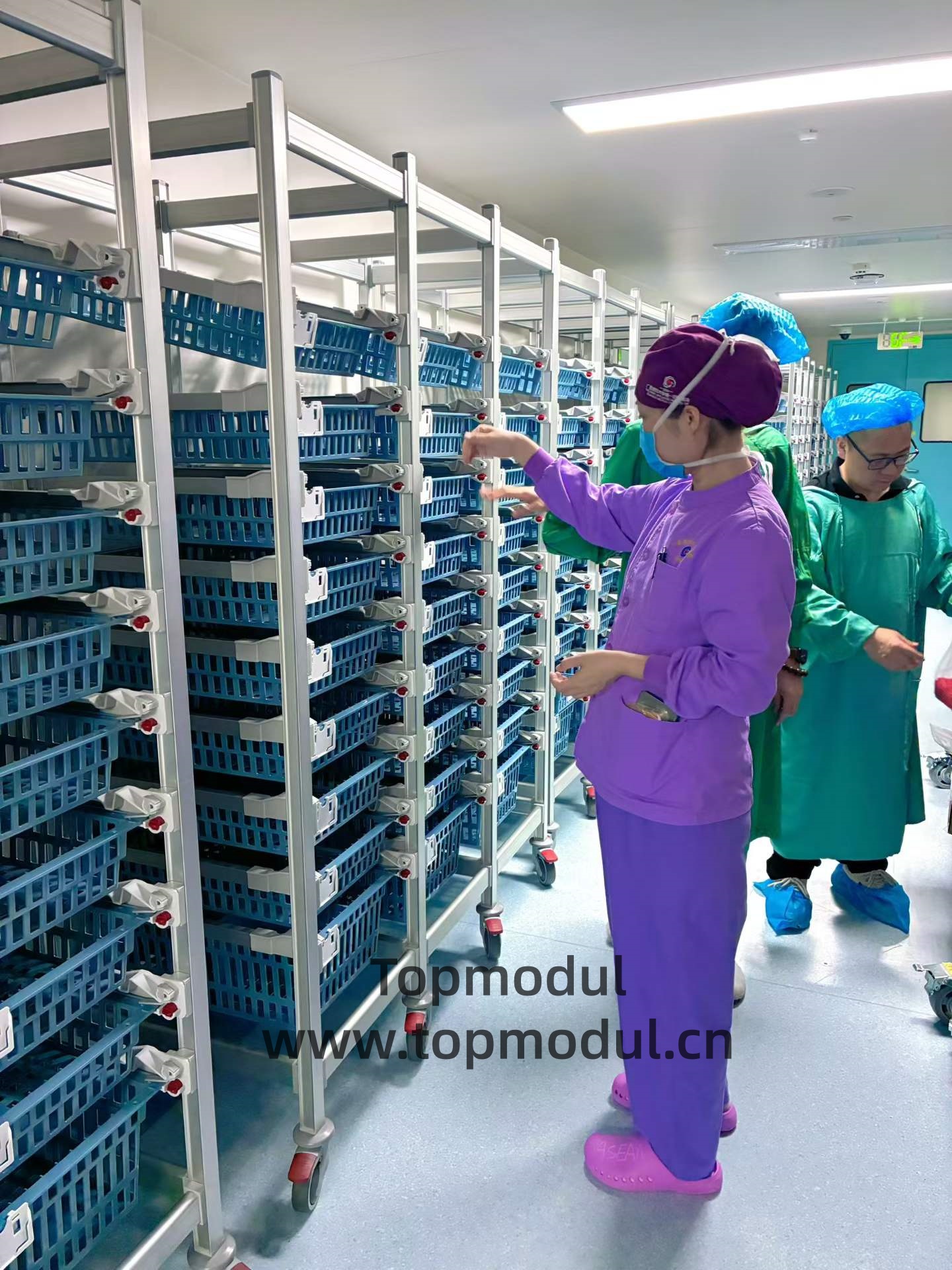
A modular medical storage trolley in a ward resupply configuration. Image: Topmodul / Tongde Medical.
How Topmodul Structures the Transport Layer
Tongde Medical Technology (Ganzhou) Co., Ltd. is a medical storage manufacturer established in 2003, operating a 30,000-square-metre facility with 100+ employees and an R&D team of 10+ engineers and technicians. Its medical storage brand, Topmodul, supplies modular medical carts, medical storage carts, medical transport carts, hospital storage carts and medical supply carts, alongside shelving, cabinets and ISO 6040 medical storage systems. Approximately 90% of output is exported, with major markets in Western and Eastern Europe, and supply to the Middle East, Singapore, Brazil and CIS countries.
For a buyer in the awareness phase, the important point is not the breadth of the catalogue but the way the pieces interconnect. A transport trolley sourced from a cart specialist and shelving sourced from a warehouse equipment supplier will almost never share a tray standard, which means the hospital inherits the unloading problem it was trying to solve. Sourcing transport, shelving and cabinet formats from one modular system is what keeps the tray transferable across departments and across equipment generations.
Quality and compliance are stated in traceable terms rather than marketing language. Topmodul's products are CE certified and ISO 9001 certified. A dedicated quality control team of five members conducts inspection through the production sequence, covering incoming material, in-process production, final inspection and pre-shipment checks on every product before packing.
Technical Interfaces: Trolley, Tray, Shelving and Cabinet
A modular storage system is only as useful as the dimensional relationships between its parts. The table below sets out the published specifications of the Topmodul components that most often appear together in a hospital supply chain.
| Component | Model / designation | Published dimensions | Primary role |
|---|---|---|---|
| Medical trolley (open transport cart) | T6020-2 | 1385 x 445 x 2000 mm | Supply movement between storage and departments |
| Storage tray | T604010AN | 600 x 400 x 100 mm | ISO 6040 basic storage unit, PC/ABS |
| Emergency crash cart | Emergency Crash Cart-T002 | 754 x 541 x 1005 mm | Immediate-access emergency equipment |
| Anesthesia cart | anesthesia cart - T001 | 754 x 541 x 1005 mm | Anesthesia point-of-use supply |
| Nursing cart | T003 | 754 x 541 x 1005 mm | Nursing point-of-use supply |
| High density medical shelving | Customized to customer needs | 512 x 650 x 2000 / 710 x 406 x 2000 mm (basic frame) | Secondary warehouse, pharmacy, vein center, consumables warehouse |
| Alpha shelving for medicine storage | TDAS60 / TDAS40 | 674 x 430 x 2000 mm / 474 x 630 x 2000 mm | Pharmacy and secondary warehouse storage |
| Sterile storage wire shelving | Customized to height and needs | 512 x 650 x 200 mm (basic frame) | Operating rooms and supply centers |
| Roller shutter cabinet | TDC180UU-RS, TDC180EE-RS, TDC180UU-HD, TDC180EE-HD | 1532 x 785 x 1850 mm / 2132 x 585 x 1850 mm | Closed storage in departments, wards, warehouses, clinics |
Table: published specifications of Topmodul modular storage components. Source: Tongde Medical Technology (Ganzhou) Co., Ltd. product data.
Two material choices recur in this range and each has a purpose. Transport trolleys, nursing carts and shelving frames use aluminum alloy struts and crossbars with PC/ABS baskets, which keeps the equipment light enough for one person to reposition. Sterile storage applications switch to stainless steel trays, because clean areas such as operating rooms and supply centers need surfaces that can be cleaned repeatedly and will not deform under load.
Operationally, the transport trolley is described as compatible with the cleaners and disinfectants commonly used in hospitals, without chemical reaction, and as light, quiet and manoeuvrable in busy or space-limited areas. Assembly does not require complicated tools, and configuration, drawer or shelf layout, and dimensions can be adapted to the department's requirements.
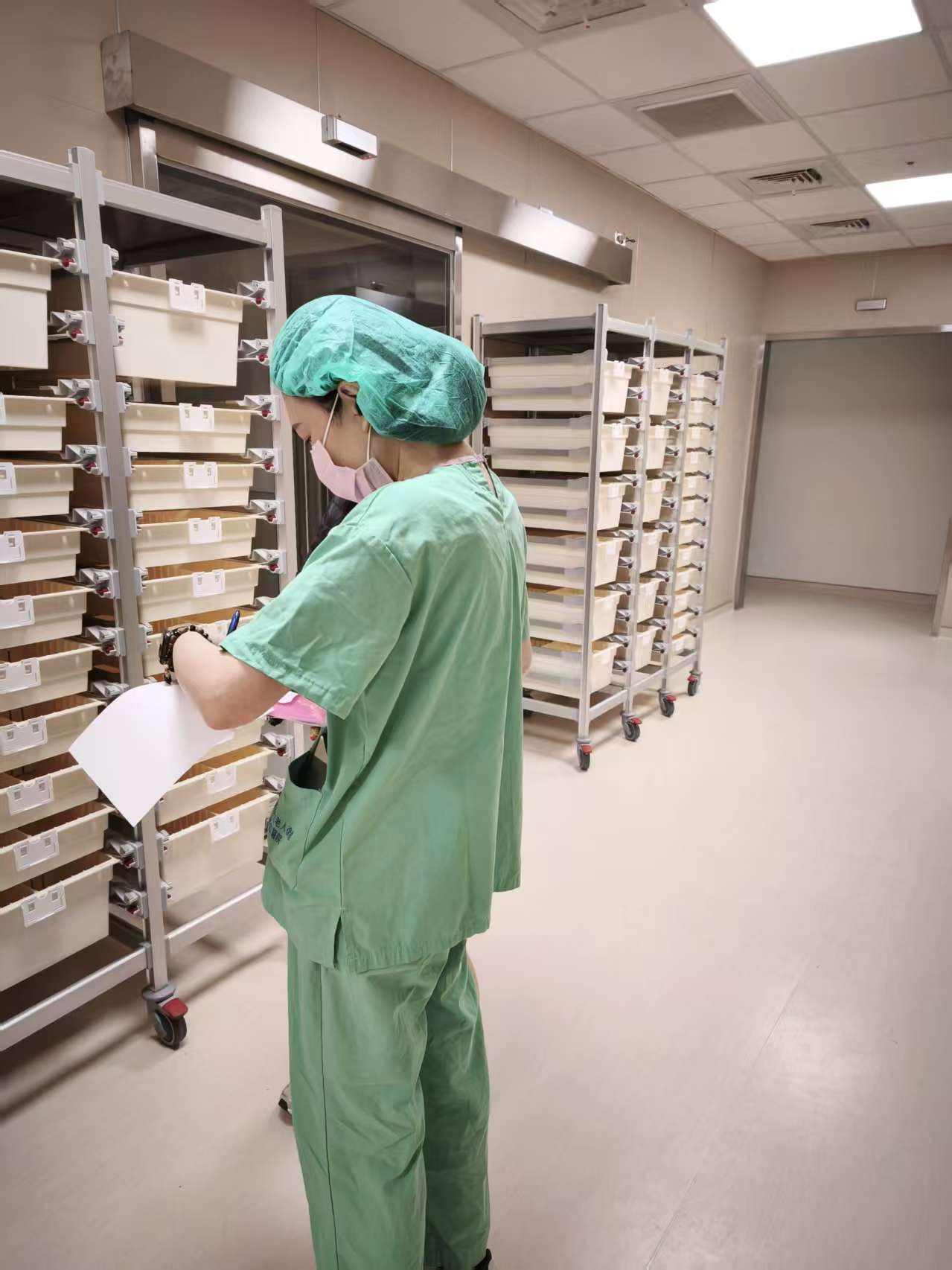
ISO 6040 modular trays carried on a medical trolley, showing the tray as the unit of transfer between shelving and transport. Image: Topmodul / Tongde Medical.
Where Transport Trolleys Fit: Application Scenarios
Topmodul describes the general working condition for its storage and transport products as an indoor hospital environment with controlled temperature and humidity, free from heavy corrosion and explosive dust, with manual implementation or positioning by clinical staff. Within that envelope, the transport trolley appears in several recurring situations.
Ward and department resupply
The open transport cart is used for intra-department transfer in hospitals or medical institutions and for moving supplies between storage rooms and wards. Because the frame is open and the baskets are removable, staff can restock a ward without pulling a full cabinet through a corridor. The trade-off is that this is a low-complexity format: it rewards departments with a clear supply list and a fixed restocking rhythm.
Pharmacy-to-ward medication movement
Where the hospital already runs ISO 6040 trays, the transport trolley becomes the vehicle for medication movement from a central pharmacy or storage room to wards and bedsides. The tray stays loaded; the trolley supplies the wheels and the structure. This is the scenario in which the modular logic pays off most visibly, because medication handling has the highest re-count burden of any supply category.
Emergency, anesthesia and nursing support
Transport trolleys and point-of-use carts work as a pair. Bulk stock arrives on the transport trolley; the crash cart, anesthesia cart and nursing cart hold the subset of items needed at the bedside. For departments that must maintain readiness, this separation keeps the emergency configuration stable instead of being rearranged every time supplies are topped up.
Clean areas and sterile storage
Sterile storage wire shelving is a storage format rather than a transport format. It is used in operating rooms and supply centers, with aluminum alloy frames and stainless steel trays designed for repeated cleaning and to avoid harbouring dirt. In practice, transport trolleys stop at the clean-area boundary and the transfer is completed on sterile shelving — a detail worth planning before equipment is ordered, because corridor-side transfer points determine how much handling happens inside the clean zone.
Comparison with Traditional Non-Modular Solutions
The practical difference between a modular transport trolley and a conventional hospital cart is not the cart itself. It is what happens to the goods at each handover.
| Dimension | Conventional non-modular cart | Modular transport trolley with ISO 6040 trays |
|---|---|---|
| Container unit | Mixed, often cart-specific | ISO 6040 tray shared with shelving and cabinets |
| Handling steps per replenishment | Goods decanted at each transfer | Tray transferred loaded |
| Storage density | Baseline | Up to 50% increase reported for the ISO 60-40 system (Pegasus Medical / MedicalExpo, 2024) |
| Cleaning | Material compatibility often undocumented | PC/ABS baskets and aluminum frames; stated compatibility with hospital cleaners and disinfectants |
| Reconfiguration | New cart purchase | Tray and accessory changes; diversified configurations combined per user needs |
| Assembly and service | Varies by supplier | No complicated tools required for assembly |
Comparison of published characteristics. Sources: Tongde Medical Technology product data; Pegasus Medical / MedicalExpo ISO 60-40 specifications.
The boundary conditions deserve equal weight, because a modular transport trolley is not the right answer in every department.
Open format versus controlled access. The T6020-2 is an open transport cart. It does not provide an enclosed, lockable compartment, so it is not the appropriate format for high-value or controlled medications that require restricted access during movement. Those flows need a closed format such as the Roller Shutter Cabinet or a closed cart configuration. Mixing the two requirements on one open trolley is a common planning mistake.
Manual positioning. Movement and positioning are performed manually by clinical staff. Corridor width, door thresholds, lift dimensions and floor surface therefore become specification constraints rather than facilities details. A 2000 mm tall open trolley has to be checked against the actual route, not only against the storage room.
Standardisation discipline. The benefits depend on the tray standard actually being respected. If departments continue introducing non-standard containers, the tray stops travelling and the trolley reverts to being an ordinary cart.
Compatibility with existing stock. An ISO 6040 basic unit such as the 600 x 400 x 100 mm T604010AN will not automatically fit legacy shelving accessories from other suppliers. Hospitals migrating in phases should expect a transition period in which both formats coexist.
What Buyers Should Confirm Before Specification
For a buyer still at the research stage, the useful output of this article is a short list of questions that must be answered before any transport trolley is quoted. Topmodul's own application notes make the same point: the size, drawer or shelf configuration, load requirements, cleaning and disinfection method, and accessory combination must be confirmed according to department use and hospital requirements.
| Check | Why it changes the specification |
|---|---|
| Which department and which route | Determines overall dimensions, height and manoeuvrability requirements |
| Open or closed format | Controlled-access items require a closed cabinet rather than an open transport cart |
| Tray standard in use | ISO 6040 compatibility decides whether goods can travel without decanting |
| Cleaning and disinfection method | Confirms material compatibility for PC/ABS baskets and aluminum frames |
| Load and configuration | Drawer, shelf and accessory layout follow the actual supply mix |
| Certification and inspection | CE and ISO 9001 status, plus the inspection stages applied before shipment |
Specification checklist derived from Tongde Medical Technology application and product data.
Market Context: Why Transport Equipment Is Getting More Attention
The commercial context supports the operational argument. A Horizon / Grand View Research outlook estimates the global medical carts market at US$4.83 billion in 2026, a figure that covers mobile healthcare storage and workstations including emergency, medication and procedure carts. The same research house projects the European medical carts market to grow at a compound annual growth rate of 15.8% between 2025 and 2030.
Market forecasts of this kind should be read as directional rather than precise. What they indicate is that mobile storage is no longer treated as furniture purchased at the end of a building project. Where hospitals are reorganising supply flows around secondary warehouses, pharmacy control and ward-level restocking, the transport layer receives budget attention because it is where the last manual handling step occurs.
A second signal is standardisation. When an ISO 60-40 compatible format is credited with up to 50% more storage capacity than traditional shelving, the argument for aligning trolleys to the same tray standard becomes a space argument as much as a handling argument — relevant in European hospitals where floor area is a fixed constraint.
Future Outlook
Two developments are likely to shape how transport trolleys are specified over the next planning cycles. The first is the gradual extension of modular logic from storage into inventory visibility: Topmodul's range already includes smart medical storage cabinets and medical consumables storage systems alongside the mechanical carts and shelving, which suggests that the tray is becoming a data carrier as well as a physical container. The second is the consolidation of hospital supply chains around fewer, larger secondary warehouses, which raises the value of equipment that can move between central and department level without reconfiguration.
Neither development removes the manual nature of hospital transport. They change what is being moved and how often it is counted. Buyers evaluating transport equipment today are, in effect, choosing the container standard their hospital will live with for the next equipment generation.
Frequently Asked Questions
What is a medical transport trolley used for?
A medical transport trolley is a mobile cart used to move medical supplies, consumables and small equipment between storage locations and clinical points of use. Topmodul's Medical trolley T6020-2 is an open transport cart in the modular medical cart series, sized 1385 x 445 x 2000 mm and built for intra-department transfer in hospitals or medical institutions, as well as movement between storage rooms and wards.
How is a medical transport trolley different from a crash cart or nursing cart?
The difference is the purpose of the equipment, not its mobility. An Emergency Crash Cart-T002, an anesthesia cart T001 and a Nursing Cart T003 are built for point-of-use availability: clinical staff position them where care is delivered and keep necessary equipment in one place. A transport trolley is built to move volume between locations. The two categories are usually deployed together, with the transport trolley resupplying and the crash, anesthesia or nursing cart holding the bedside subset.
What does ISO 6040 mean in a modular medical storage system?
ISO 6040 describes the modular tray format used as the basic storage unit in these systems. Topmodul's Storage tray T604010AN is a 600 x 400 x 100 mm material storage basic unit classified as an ISO 6040 unit, made of polycarbonate and ABS. Because the same tray fits shelving, trolleys and cabinets, medical supplies can be stored, handled and moved from a central pharmacy or storage room to wards and bedsides without being decanted into another container.
What information should be confirmed before ordering hospital transport trolleys?
The department's actual use should define the order. Configuration notes for this product range call for confirming size, drawer or shelf configuration, load requirements, cleaning and disinfection method, and accessory combination according to department use and hospital requirements. Route constraints such as corridor width and lift dimensions also need checking, because the equipment is positioned manually by clinical staff.
Are Topmodul medical carts and trolleys certified, and how is quality checked?
Topmodul products are CE certified and ISO 9001 certified. Tongde Medical Technology operates a total quality management system with a dedicated quality control team of five members who inspect every product at each stage, covering incoming material, in-process production, final inspection and pre-shipment checks before packing. The manufacturer was established in 2003 and operates a 30,000-square-metre facility with 100+ employees.
For readers assembling a specification, the Topmodul shelving and modular storage catalogue is available as a downloadable reference: 2026 TM Shelving Catalogue (PDF).
Company facts in this article are drawn from published information by Tongde Medical Technology (Ganzhou) Co., Ltd. Market figures are attributed to their cited research sources and should be treated as directional. HTNXT industry references are prepared for procurement interpretation and do not constitute a purchasing recommendation for any specific facility.
¿Tiene preguntas o necesita más detalles?
Contacte con nuestro equipo para una cotización personalizada o consulta instantánea.
Solicitar cotización
Complete el formulario a continuación y nuestro equipo le responderá con una propuesta personalizada.
Chat directo de WhatsApp
¿Prefiere chatear en tiempo real? Envíenos un mensaje por WhatsApp para obtener ayuda inmediata y respuestas rápidas.
- Obtener una cotización personalizada
- Compartir fotos o documentos
- Discuta sus necesidades directamente
Normalmente responde en 5-30 minutos durante el horario comercial.