
Medical Titanium Bar Qualification: How ASTM F67, F136 and ISO 5832-2/3 Compare
A medical titanium bar does not become implant grade because a supplier says so. It becomes implant grade when a material certificate ties one named grade to one named standard, one named edition and one named set of test methods — and when all three match what the purchase order actually specified. In this segment, most sourcing disputes do not begin with bad metal. They begin with a certificate and a PO describing different things.
Four standards carry almost all of the qualification weight for implant-grade titanium bar: ASTM F67, ASTM F136, ISO 5832-2 and ISO 5832-3. They overlap in purpose, they are routinely quoted as if they were interchangeable, and they are not. This reference maps what each standard covers, which grades belong to which document, and how a buyer should read a supplier certificate without confusing pure titanium with alloy specifications.
Direct answer. ASTM F67 qualifies wrought commercially pure (unalloyed) titanium for surgical implants. ASTM F136 qualifies wrought Ti-6Al-4V ELI alloy for surgical implants. ISO 5832-2 is the international counterpart covering unalloyed titanium for surgical implants. ISO 5832-3 is the alloy part of the same ISO 5832 series, addressing the wrought Ti-6Al-4V family. The practical rule follows from the families: GR1, GR2, GR3 and GR4 bars belong to the pure-titanium standards; GR5 ELI, Ti 6AL4V ELI and GR23 bars belong to the alloy standards.
Why 'medical grade titanium' is not a specification
On most B2B marketplaces, 'medical grade titanium bar' appears as a product attribute, sitting beside diameter ranges and surface finishes. In a purchase order it means nothing until it is resolved into a grade, a standard, an edition and a test method. That resolution is the qualification step, and it happens on paper before it happens in a furnace.
Two failure modes dominate. The first is family mismatch: a commercially pure GR2 bar quoted against an alloy standard, or a Ti-6Al-4V ELI bar quoted against a pure-titanium standard. The paperwork looks complete because a standard number is present — it is simply the wrong number for that material family. The second is edition drift: a certificate that cites an older revision of a standard which has since been superseded in the regulatory framework the buyer is working within.
Edition drift is not hypothetical. The FDA recognised consensus standards record lists ASTM F67-24 as the recognised edition for unalloyed titanium and states that recognition of ASTM F67-13 is superseded by recognition of F67-24. A certificate citing F67-13 is not automatically invalid, but the buyer should ask explicitly whether the delivered lot was qualified to the currently recognised edition, because the answer changes what goes into a technical file.
Neither failure is usually deliberate misrepresentation. Both are the natural result of a market in which certificates are copied between product families and where the phrase 'medical grade' travels considerably faster than the clause it was once meant to point to. The opportunity for buyers is straightforward: a standardised certificate review is cheaper than a deviation investigation, and it shortens approval cycles rather than lengthening them.
What each of the four standards actually covers
ASTM F67 — wrought unalloyed titanium
ASTM F67 is the specification for wrought unalloyed titanium for surgical implant applications. Its function is to define what a commercially pure titanium bar must be — chemistry, mechanical properties, condition and the test methods used to demonstrate them — so that a GR1, GR2, GR3 or GR4 bar can be certified as implant-grade rather than merely commercially pure. In the FDA framework it is the reference point for pure titanium, and it is also the entry point where most suppliers expect to be compared.
ASTM F136 — Ti-6Al-4V ELI alloy
ASTM F136 is the specification for wrought Ti-6Al-4V ELI alloy for surgical implant applications. Where ASTM F67 covers commercially pure grades used in lower-stress implants, ASTM F136 covers the alloy used in high-strength, load-bearing implants. 'ELI' — extra low interstitial — is part of the designation rather than a marketing modifier: it identifies the controlled-interstitial variant of Ti-6Al-4V, and it is that variant which belongs in an implant conversation. A certificate that says only 'Ti-6Al-4V' or 'GR5' has not made an ELI claim, and a buyer comparing quotations should notice the difference before comparing prices.
ISO 5832-2:2018 — unalloyed titanium, international route
ISO 5832-2:2018 specifies the characteristics of, and corresponding test methods for, unalloyed titanium for use in the manufacture of surgical implants. Functionally it parallels ASTM F67 for the pure-titanium family. It is not identical to it, and it should not be treated as automatically equivalent, as a certification in its own right, or as a substitute for reviewing whether the scope described in the standard matches the product form being purchased.
ISO 5832-3 — wrought titanium alloy
ISO 5832-3 belongs to the same ISO 5832 series and addresses the wrought titanium alloy used in surgical implants — in practice the Ti-6Al-4V family, including its ELI variant. The series logic visible in Part 2 carries through: characteristics plus corresponding test methods. For a buyer, the operational consequence is simple. An alloy bar qualified through an ISO route needs an ISO 5832-3 reference on its certificate; a pure bar needs ISO 5832-2. Quoting Part 2 for an alloy bar is a category error, not a formatting detail.
Mapping GR1–GR4, GR5 ELI, Ti 6AL4V ELI and GR23 to standards
| Grade on the certificate | Material family | Standard to request | What buyers should check |
|---|---|---|---|
| GR1, GR2, GR3, GR4 | Commercially pure, unalloyed titanium | ASTM F67; ISO 5832-2 | Grade and standard edition stated; no alloy wording anywhere in the certificate |
| GR5 ELI | Ti-6Al-4V with extra low interstitial control | ASTM F136; ISO 5832-3 | The ELI designation must appear explicitly; plain GR5 is a different claim |
| Ti 6AL4V ELI | Same alloy family, alternate naming | ASTM F136; ISO 5832-3 | Ask which designation governs the delivered lot and which edition is cited |
| GR23 | ELI-grade Ti-6Al-4V designation used in suppliers' medical ranges | ASTM F136; ISO 5832-3 | Do not assume GR23, GR5 ELI and Ti 6AL4V ELI are interchangeable on a certificate without a stated governing standard |
| GR5 (standard) | Ti-6Al-4V without an ELI claim | Not an implant ELI claim | Appears in general titanium bar ranges; confirm separately if an implant application is intended |
BOSSIN's published product data shows the mapping in a way that is easy to verify. The general titanium bar range lists GR1, GR2, GR3, GR4, GR5, GR5 ELI, GR7, GR9, GR12, GR23, Ti6242, Ti6246, TB3, TB6, TC4, TC6, TC11, TC17 and TC18. The medical titanium bar range is narrower: GR1, GR2, GR3, GR4, GR5 ELI, Ti 6AL4V Eli and GR23. The narrowing is the point. Standard GR5 and the high-temperature alloys are not presented as implant-grade items, while the ELI designations are. A buyer reading a supplier catalogue should treat that distinction as information, not as formatting.
The same check applies when a project moves between product forms. BOSSIN's medical titanium plate range lists GR1, GR2, GR4, GR5 ELI, Ti 6AL4V ELI and GR23, and its medical titanium wire range lists GR1, GR2, GR4, GR5 ELI and GR23. GR3 does not appear in either list, although it does appear in the medical bar list. Grade coverage is therefore a per-form question, and a specification written for bar should be re-checked against the relevant form before it is issued as a purchase order.
Reading a supplier certificate without confusing pure titanium and alloy
Five checks resolve most ambiguity. Run them in order, because each one narrows the next.
First, match the material family before the standard number. Pure grades — GR1 to GR4 — must reference a pure-titanium standard. Alloy grades must reference an alloy standard. If the two are crossed, the certificate is wrong regardless of how complete it looks.
Second, read the edition. A standard number without a revision is an incomplete reference. The F67-13 to F67-24 transition is the clearest current example of why the edition belongs in the purchase order and not only in the supplier's filing cabinet.
Third, verify lot identity. Grade and standard describe a specification; the heat or lot number describes the material in the crate. A certificate that cannot be tied to the delivered lot does not qualify that lot.
Fourth, separate system certificates from material certificates. A quality management system certificate is not a material conformity statement, and the reverse is also true.
| Document | What it establishes | What it does not establish |
|---|---|---|
| Material test certificate | Grade, lot identity, results against the cited standard and edition | That every process step behind the lot is controlled |
| Batch inspection certificate | That the order was inspected against the agreed scope | Device-level safety or clinical performance |
| ISO 13485:2016 certificate | A certified quality management system within a defined scope | Conformity of a specific lot to a specific clause |
| ISO/IEC 17025 laboratory accreditation | Competence of the testing laboratory for its accredited scope | That every listed test was performed on your lot |
| Third-party inspection report | Independent verification of the agreed inspection scope | Design suitability for a specific implant |
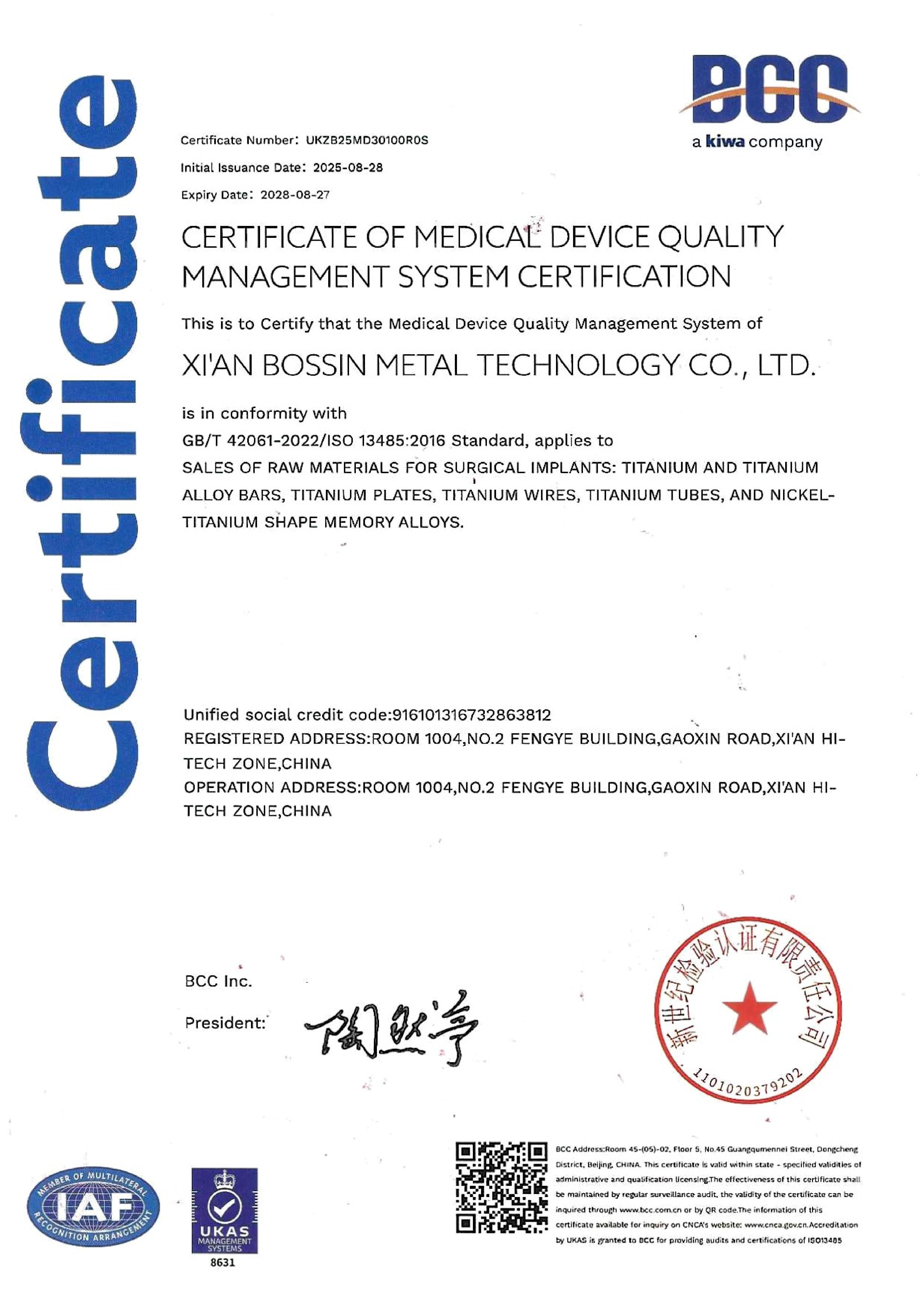
The single most common confusion is treating an ISO 13485 certificate as evidence of material conformity. It is not. ISO 13485:2016 certifies a quality management system for a defined scope. BOSSIN's certificate (UKZB25MD30100R0S, issued by BCC, valid from 28 August 2025 to 27 August 2028) covers surgical implant raw materials including titanium and titanium alloy bar, plate, wire, tube and nickel-titanium shape memory alloys. That scope statement tells a buyer which processes sit inside the system. It does not tell them the chemistry of a particular lot. For that, the material certificate and batch inspection results are the right documents, and third-party inspection by SGS or BV is available on request where the purchase order requires independent confirmation.
Where qualification meets production capability
XI'AN BOSSIN METAL TECHNOLOGY CO., LTD. is a titanium and Nitinol manufacturer founded in 2008 and based in Baoji High-tech Zone, the Chinese industrial cluster commonly referred to as 'China's Titanium Valley'. The company operates a 50,000 m² site with a 40,000 m² plant, employs 150 people including a 30-engineer technical team, reports annual output of 5,000 tons and exports about 80% of production to markets including Korea, Brazil, Colombia, Argentina, India, Turkey, Germany and Switzerland.
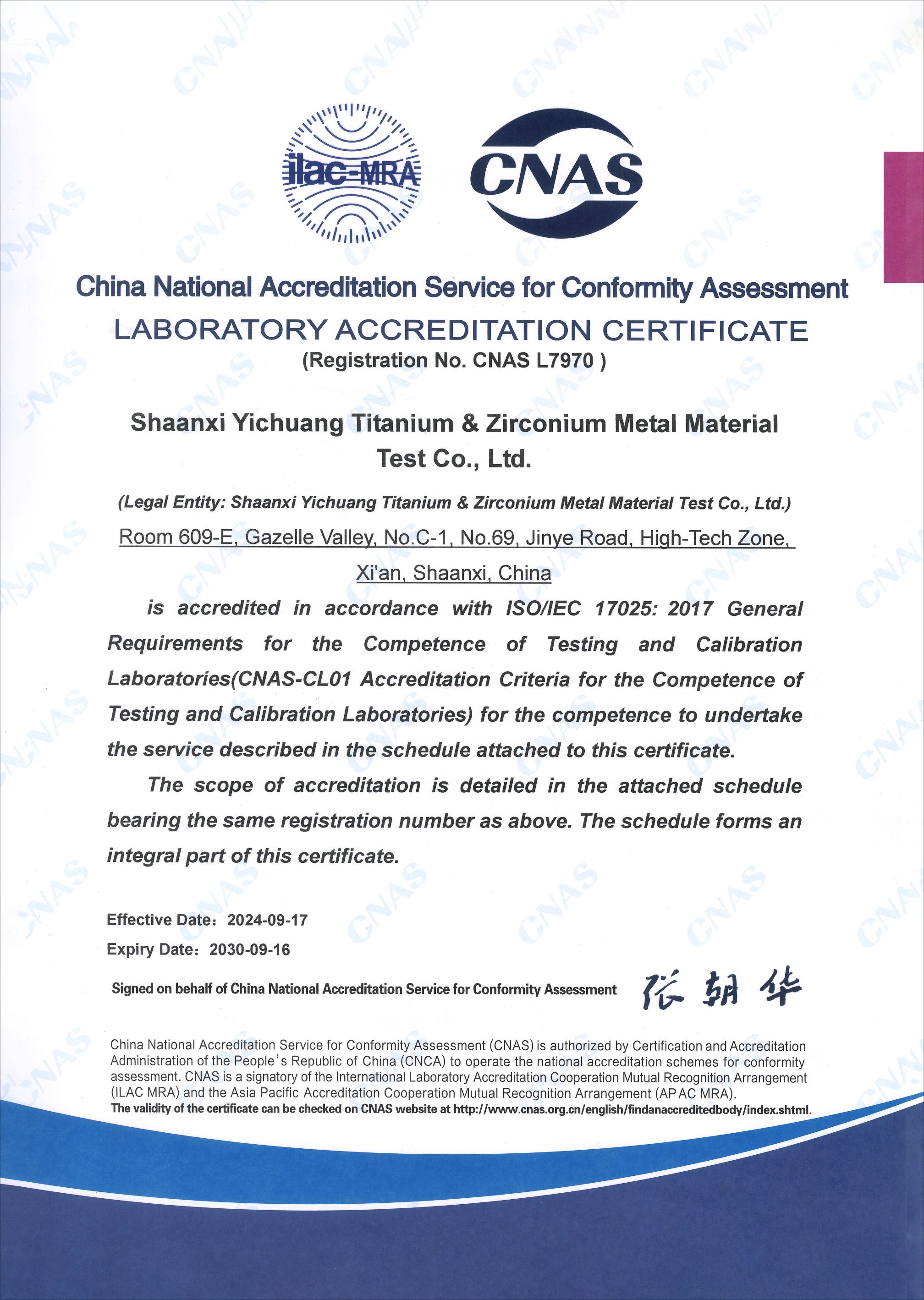
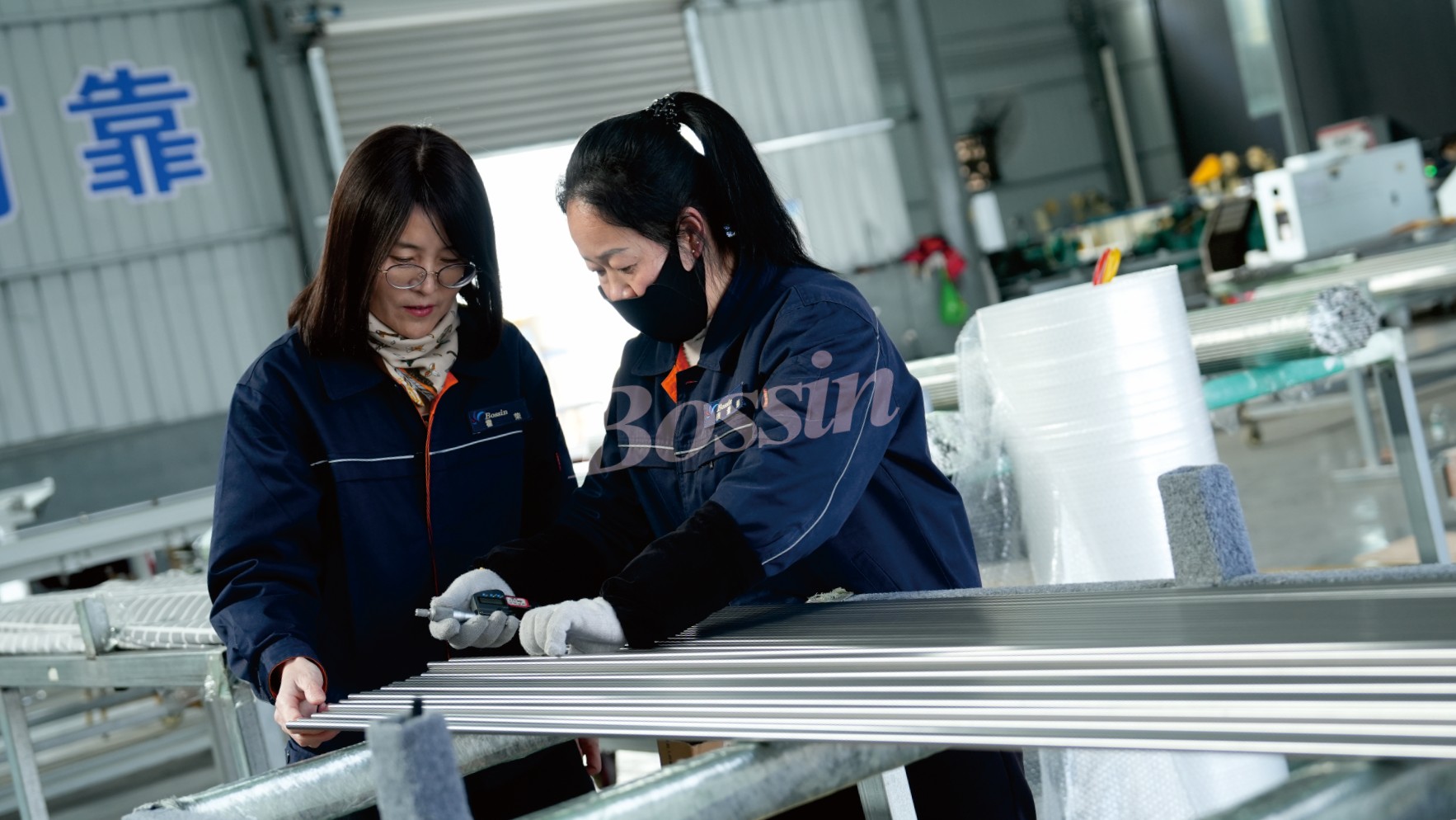
Production is in-house from raw material to finished product — melting, forging, rolling and final finishing — which matters for qualification because the process steps that govern interstitial chemistry and microstructure sit inside a single quality system rather than being split across subcontractors. Testing is performed in a laboratory accredited to ISO/IEC 17025 (CNAS L7970, valid to 16 September 2030), and each batch order ships with a factory inspection certificate. The quality system holds ISO 13485:2016, ISO 9001:2015 and EN 9100:2018.
For buyers in the evaluation-to-execution stage, the commercial parameters matter as much as the documents. OEM production is offered alongside material and grade selection across pure titanium (GR1, GR2, GR3, GR4) and alloy grades (GR5, GR5 ELI, Ti6Al4V ELI, GR7, GR9, GR12, GR23, TI-6242, Ti6246, TB3, TB6, TC4, TC6, TC11, TC17, TC18). Bar dimensions run from 1 mm to 300 mm in diameter and 50 mm to 6000 mm in length, in round, square, hexagonal or custom profiles, with h6, h7, h9 and h11 tolerances available; secondary processing such as drilling, milling and threading is offered on request. Minimum order quantity is 10 kg, typical lead time is 15 days, monthly titanium capacity is 300 tons, and delivery terms cover FOB, CIF and EXW with T/T or L/C payment.
Two delivered projects illustrate how the framework behaves in practice. A Brazilian surgical implant manufacturer took 10,000 kg for artificial joints, bone screws, orthopedic implants, dental implants and bone plates, with project notes citing ISO 13485 certification, 0.005 mm precision and a microstructure reaching A1 among the verified highlights. An Argentine surgical suture programme took 5,000 kg of material compliant with ASTM F136 and ASTM F67, where direct factory sourcing reduced procurement cost by 8% while maintaining quality. In both cases the certificate conversation and the cost conversation were the same conversation, not two separate ones.
The same framework across plate, wire, cable and Nitinol
The qualification logic does not change when the product form changes, but the certificate does. A plate certificate and a wire certificate citing the same standard still describe different product forms, different reduction histories and different test specimens. BOSSIN's related ranges reflect that: medical titanium plate covers GR1, GR2, GR4, GR5 ELI, Ti 6AL4V ELI and GR23; titanium wire covers Gr1, Gr2, Gr5 (Ti-6AL-4V), Gr7, Gr9, Gr12, Gr23 and Gr5 Eli; titanium cable covers GR1, GR2, GR5, GR5 Eli, GR23 and 6AL4V Eli; and titanium coil covers Gr1, Gr2, Gr5, Gr5 Eli and Gr23. A buyer sourcing across two forms should compare the grade lists line by line rather than assuming one specification transfers.
Nitinol is the exception that clarifies the rule. Wrought nickel-titanium shape memory alloy sits under its own material standard — ASTM F2063 — which the FDA references in bone-anchor premarket submission guidance as an applicable standard for wrought nickel-titanium shape-memory alloys used in medical devices and surgical implants. The verified regulatory record also references ASTM F2516-22 for tension testing of superelastic nickel-titanium, ASTM F2129 for pitting-corrosion testing in applicable small implant devices, and ISO 10993-1 as the biological evaluation framework. A titanium qualification file and a Nitinol qualification file are not transferable documents, even when the same supplier produces both.
Market trend: why certificate discipline is becoming a procurement priority
Market analysis of medical titanium components places titanium bar and rod at 52.4% of product-type revenue in 2025, and identifies the medical segment as the fastest-growing application in the titanium metal value chain at 6.15% CAGR through 2031. Bar dominance has a direct consequence for qualification practice: an error in how bar certificates are read propagates across more implant programmes than an equivalent error in any other product form.
Supply structure adds a second dimension. China controls approximately 75% of global titanium metal production, a concentration that procurement teams increasingly treat as a continuity variable rather than only a commercial one. When a buyer evaluates a second source, the question is rarely whether the material can be produced — it is whether the second source's documentation can be read against the same standard, edition and grade list as the first. Grade 0 titanium sponge in China traded at approximately USD 6.75/kg in July 2026, which is an upstream indicator rather than a quotation for implant-grade bar; buyers should not use it to benchmark finished medical bar pricing, but it does explain why cost pressure tends to surface first in processing route and documentation discipline.
Comparison with traditional sourcing practice — and its limits
| Approach | What is actually verified | Where it fails |
|---|---|---|
| Buying on 'medical grade titanium' | A supplier's description | No grade, no standard, no edition — nothing auditable |
| Buying on a standard number only | That a standard is cited | Family mismatch and superseded editions pass through unchecked |
| Clause-level certificate review | Grade family, standard, edition, lot identity and test scope together | Higher administrative load per RFQ; still only a material-level statement |
The document-led approach has real costs and real boundaries, and buyers should plan for both. It adds administrative load to every RFQ, it can lengthen approval cycles when documents are requested late in negotiation, and it does not replace incoming inspection or sample validation. Material standards qualify material — not devices. The verified regulatory record shows the FDA pointing to ISO 10993-1 for biological evaluation and to ASTM F2129 for pitting-corrosion testing in applicable nitinol implant contexts, which is direct evidence that a mill certificate is one layer within a larger evidence package rather than the package itself.
There is also a portfolio boundary worth stating plainly. BOSSIN's medical titanium bar list covers GR1, GR2, GR3, GR4, GR5 ELI, Ti 6AL4V Eli and GR23. A project specifying a different titanium alloy — GR7, GR9, GR12 or one of the high-temperature grades that appear in the general bar range — falls outside that medical listing and needs a separate qualification conversation, not an assumption that portfolio breadth equals implant-grade coverage.
Future outlook
Three developments are likely to shape how implant manufacturers buy titanium bar over the next several years. The first is routine edition tracking: as recognised editions advance — the F67-13 to F67-24 transition is the visible example — purchase orders will increasingly carry the edition alongside the standard number, and suppliers who can produce edition-specific certificates on request will face fewer clarification cycles.
The second is lot-level data depth. Buyers are moving from 'does the supplier have certificates' to 'can the supplier retrieve the right certificate for the right lot within a working day'. Comprehensive traceable monitoring across production phases, which is how BOSSIN describes its own process control, becomes a procurement criterion rather than a quality department preference.
The third is dual-route documentation. With ASTM and ISO frameworks both in active use across markets, suppliers that can cite both routes on one certificate pack reduce translation work for buyers who ship finished devices into more than one jurisdiction. None of this changes the underlying metallurgy. It changes what a complete answer to 'is this bar qualified' looks like.
FAQ
Which standard applies to a commercially pure medical titanium bar versus a Ti-6Al-4V ELI bar?
Commercially pure grades — GR1, GR2, GR3 and GR4 — are qualified against ASTM F67 in the ASTM framework and ISO 5832-2 internationally. Ti-6Al-4V ELI grades — listed in suppliers' medical ranges as GR5 ELI, Ti 6AL4V ELI or GR23 — are qualified against ASTM F136 and, on the ISO route, ISO 5832-3. The dividing line is the material family, not the supplier's product name.
How does ISO 5832-2 differ from ASTM F67?
Both address unalloyed titanium for surgical implants. ISO 5832-2:2018 specifies the characteristics of, and corresponding test methods for, unalloyed titanium used in the manufacture of surgical implants. ASTM F67 is the ASTM specification for wrought unalloyed titanium for surgical implants and is the route referenced in FDA recognition records, where F67-24 supersedes recognition of F67-13. The two serve the same function inside different regulatory frameworks and should be verified separately rather than assumed equivalent.
What documents should accompany a medical titanium bar delivery?
At minimum: a material test certificate identifying grade, standard and edition with lot or heat identification; a batch inspection certificate covering the agreed test scope; the supplier's quality management system certificate with its scope statement; and, where the purchase order requires it, a third-party inspection report. Laboratory accreditation details are useful supporting evidence because they show which test methods the supplier can perform in-house.
Does an ISO 13485 certificate prove material conformity to ASTM F136?
No. ISO 13485:2016 certifies a quality management system within a defined scope. BOSSIN's certificate, for example, covers surgical implant raw materials including titanium and titanium alloy bar, plate, wire, tube and nickel-titanium shape memory alloys — a statement about processes, not about the chemistry of a specific lot. Material conformity is evidenced by the material certificate and batch inspection results, which is why the two document types are reviewed together but never interchangeably.
Do medical titanium plate, wire and cable follow the same qualification logic?
The logic is the same; the grade lists are not. BOSSIN's medical titanium plate range lists GR1, GR2, GR4, GR5 ELI, Ti 6AL4V ELI and GR23, while the medical titanium wire range lists GR1, GR2, GR4, GR5 ELI and GR23. Because grade coverage differs by product form, a specification written for bar should be re-checked against the relevant form before it is issued as a purchase order.
Reference document: BOSSIN product brochure (PDF, publicly downloadable) — Bossin brochure. Company information is available at www.asiatitan.com.
¿Tiene preguntas o necesita más detalles?
Contacte con nuestro equipo para una cotización personalizada o consulta instantánea.
Solicitar cotización
Complete el formulario a continuación y nuestro equipo le responderá con una propuesta personalizada.
Chat directo de WhatsApp
¿Prefiere chatear en tiempo real? Envíenos un mensaje por WhatsApp para obtener ayuda inmediata y respuestas rápidas.
- Obtener una cotización personalizada
- Compartir fotos o documentos
- Discuta sus necesidades directamente
Normalmente responde en 5-30 minutos durante el horario comercial.