
Medical Storage Procurement FAQ: Tray, Rail, Cart Risks
Medical Storage Procurement FAQ: Tray, Rail, Cart Risks
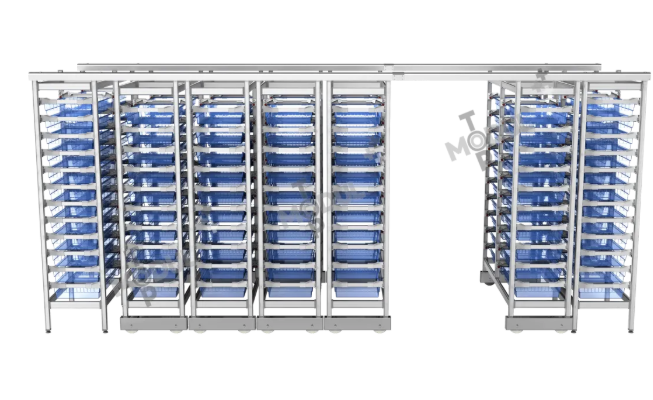
Procurement teams evaluating a modular medical storage system usually reach the same point: the product family looks coherent, but the order cannot be released until the tray, rail and cart interfaces are documented. For the T604010AN storage tray, the supplied asset information identifies the product and lists it alongside carts, shelving and cabinets, but it does not state its dimensions, load rating, CE certification or ISO 6040 compatibility. Rail length is a project-specific customization item rather than a published catalogue range. Screw-fixed track installation without drilling or gluing is also not documented in the supplied assets.
That does not make the system unsuitable. It defines the procurement work. The buyer must separate a catalogue association from a verified fit, and a manufacturer capability from a model-level certificate. For carts T001, T002, T003 and T6020-2, the immediate checks are certification scope, interface dimensions, cleaning method, load and fastening. This FAQ addresses those points in the order in which an evaluation-to-execution team normally resolves them.
What the supplied evidence establishes about Topmodul and Tongde Medical
Tongde Medical Technology (Ganzhou) Co., Ltd., whose modular medical storage brand is Topmodul, is a manufacturer founded in 2003 with a 30,000-square-metre factory and more than 100 employees. The company profile states that it produces modular medical carts, medical storage carts, hospital storage carts, medical supply carts, nursing carts, anesthesia carts, emergency crash carts, high density medical storage shelving, hospital medical shelving, sterile storage shelving and ISO 6040 medical storage systems. The same profile states that exports account for 90% of the business, with Western Europe, Eastern Europe and other markets listed. The supplied website is www.topmodul.cn.
The capability unit adds OEM and ODM design and production services, medical cart design and manufacturing, medical storage system integration, modular configuration and project-based solution support. It also states a monthly capacity of 20,000 units, a lead time of 30 to 45 days, a minimum order quantity of 100 units and 100% testing. These are manufacturer-stated commercial and production facts. They are relevant to supplier evaluation, but they do not prove tray fit, tray certification or a specific installation method.
Tray standard: what T604010AN does and does not confirm
The T604010AN is identified as a storage tray and appears in related-product lists for medical carts, high density medical shelving, sterile storage wire shelving, medical storage cabinets and medical trolleys. The supplied asset information does not state a tray standard, tray dimensions, load rating, divider configuration, rail interface or a model-by-model compatibility matrix. CE certification for the T604010AN tray is not stated in the provided asset information. ISO 6040 tray compatibility is also not stated in the provided asset information.
The distinction matters because a related-product list is a catalogue relationship, not a fit guarantee. A tray can be offered alongside a cart family without the asset information establishing that it fits every drawer, shelf or rail position in that family. Likewise, Topmodul's manufacturing scope includes ISO 6040 medical storage systems, but a system-level capability does not by itself make T604010AN an ISO 6040-compatible tray. The tray-level claim requires separate confirmation.
| Procurement item | What the supplied assets state | What the buyer should obtain before release |
|---|---|---|
| Product identity | Storage tray T604010AN is named and listed with several storage product families. | Confirm the exact tray drawing, dimensions and revision that will be supplied. |
| Tray standard | No tray standard is named for T604010AN. | Ask whether the tray is supplied to a declared dimensional or compatibility standard, and obtain the declaration in writing. |
| CE certification | CE certification for the T604010AN tray is not stated in the provided asset information. | Request a certificate or declaration whose stated scope names the tray, not only a related-product list. |
| ISO 6040 compatibility | ISO 6040 tray compatibility is not stated in the provided asset information. | Ask for a tray-level compatibility statement and the mating rail or shelving specification. |
| Load and material | The asset information does not state a tray load rating or material specification. | Request load data, material data and cleaning-compatibility data for the exact part. |
How T604010AN integrates with carts and shelving
Tray integration is an interface problem, not a branding problem. The buyer needs to know how the tray is located, retained and removed, and whether the same tray can move between a cart and a shelving unit without changing hardware. The supplied assets support a catalogue association between T604010AN and several product families, but they do not provide the interface dimensions needed to approve a fit.
A practical integration review should confirm the tray footprint against the shelf or drawer opening, the rail pitch and stop position, the retention method, the loaded weight, the removal clearance in a working aisle, and the cleaning method at the interface. If the tray is intended to move between a cart and shelving, confirm that the receiving rail or shelf has the same locating geometry. If the tray is dedicated to one cart model, record that limitation in the purchase specification so that it is not treated as a universal tray.
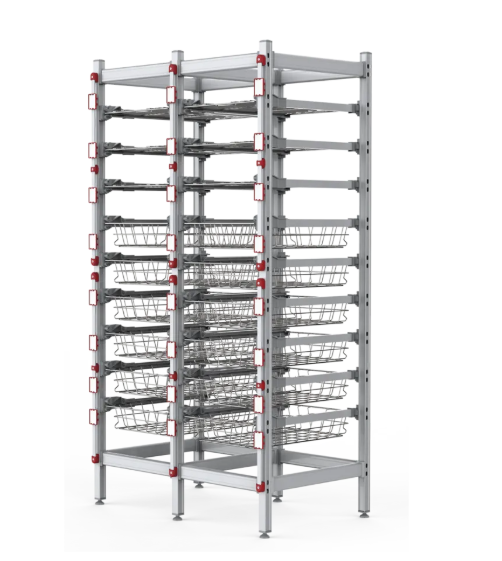
For hospital supply storage systems, the cost of a wrong interface is not limited to the tray. It can affect drawer configuration, picking time, cleaning access and spare-part planning. That is why the tray drawing should be treated as a controlled procurement document rather than a catalogue accessory line.
Rail length customization: what can be confirmed
Topmodul's capability unit lists customization for medical carts, hospital medication trolleys, medical supply carts, anesthesia carts, ISO 6040 medical storage systems, modular hospital storage systems and high density medical storage shelving. It also lists modular configuration and project-based solution support. On that basis, rail length is a credible project-specific configuration item. The supplied asset information does not publish a rail-length range, length increment, tolerance, splice rule or minimum order by length.
For execution, rail length should be fixed in the approved drawing and repeated in the quotation. The drawing should show overall length, hole pitch or fixing positions, end treatment, joint details, tray stop positions and the interface with the cart or shelving upright. If the rail is supplied in sections, the joint detail and alignment method should be visible. If the rail is cut on site, the buyer should confirm who is responsible for deburring, sealing and revalidation.
The supplied asset information does not state that the rails are PE or aluminum, and it does not state that the shelves are stainless steel. Those material claims should not be inferred from the presence of injection molding equipment, a granulator or a raw material warehouse. Those assets show plastics processing and material-handling capability, not a material certificate for a specific rail or shelf.
If a tender requires PE rails, aluminum rails or stainless steel shelves, the buyer should request a material datasheet for the exact part, including grade, finish, thickness where applicable, and cleaning-agent compatibility. A generic product-family description is not enough for a material-specific specification.
Track installation with screws, without drilling or gluing: what to verify
The supplied asset information does not describe a screw-only track installation method, a drill-free installation method or a glue-free installation method for T604010AN or the listed carts. A supplier may use the phrase screw-fixed without drilling or gluing to mean different things: fixing into an existing hole pattern, fixing into a factory-provided channel, or using a fastener that does not require a new hole in the final assembly. Those are different engineering claims and should not be treated as interchangeable.
Before accepting such a method, the procurement file should require an installation drawing and a written method statement covering the mounting substrate, fastener type, thread engagement, maximum fixing spacing, torque or retention guidance, corrosion protection, cleanability around the fastener, and the inspection step after installation. A verbal assurance that no drilling or gluing is needed is not a controlled installation instruction. If the track is fixed with screws, the buyer should also confirm whether the screw creates a new penetration in the cart or shelving surface, and how that penetration is sealed for cleaning.
The practical decision rule is simple: approve the interface, not the phrase. If the supplier cannot provide a model-specific drawing and fastener specification, the no-drilling or no-gluing claim remains unverified for procurement purposes.
Cart risks for T001, T002, T003 and T6020-2
The supplied certification and product data identify T001 as an anesthesia cart, T002 as an emergency crash cart and T003 as a nursing cart. T6020-2 is identified as a medical trolley. The CE Declaration of Conformity supplied for medical carts lists models T001 to T011 under MDR Class I, so T001, T002 and T003 fall within that stated model scope. T6020-2 is not named in that model list, so the T001 to T003 CE statement should not be extended to T6020-2 without separate confirmation.
The supplied risk unit lists common cart risks as overload, wheel damage, surface corrosion and loose structural connection. It states that these often occur under overload, frequent heavy use or poor maintenance, and recommends observing the rated load limit, wiping disinfectant residue after cleaning, checking casters and fasteners regularly, and replacing damaged parts promptly. The same unit does not provide model-specific load ratings, caster specifications or test data for T001, T002, T003 or T6020-2. Those general risks should therefore be used as checks, not as confirmed defects in a particular model.
| Model | Verified identity | Certification note from supplied assets | Parameters to confirm before order | Risk to manage |
|---|---|---|---|---|
| T001 | Anesthesia cart | Within the stated T001 to T011 CE Declaration of Conformity model scope. | Drawer and shelf configuration, lock, rated load, caster specification, cleaning method, spare parts. | Overload, caster wear, loose fasteners and cleaning residue at moving parts. |
| T002 | Emergency crash cart | Within the stated T001 to T011 CE Declaration of Conformity model scope. | Access layout, drawer retention, lock, rated load, caster specification, cleaning method. | Overload, damaged wheels, surface corrosion and loose structural connections. |
| T003 | Nursing cart | Within the stated T001 to T011 CE Declaration of Conformity model scope. | Drawer and shelf configuration, rated load, caster specification, cleaning method, accessory fit. | Overload, wheel damage, corrosion and fasteners loosening under frequent use. |
| T6020-2 | Medical trolley | Not named in the supplied T001 to T011 CE Declaration of Conformity model list. Separate confirmation is required. | Model-specific certification scope, dimensions, load, casters, shelf or drawer interface, cleaning method. | Do not assume the cart-family certificate applies; confirm model-level documentation and general mechanical risks. |
For all four models, the buyer should also confirm the cart-to-tray interface. A cart can be certified as a medical cart without the certificate establishing that a particular tray fits it. Certification scope and accessory fit are separate approval items.
Cleaning and infection-control review
Topmodul's supplied FAQ describes the modular storage rack as easy to clean and disinfect and states that replaceable parts facilitate disinfection. The procurement guidance in the risk unit also lists compatibility with hospital cleaning liquids and high-temperature disinfection among the parameters to check. Those statements support a cleaning-oriented design intent. They do not provide a validated list of cleaning agents, contact times, temperature limits or disinfection efficacy results for T604010AN or for each cart model.
Infection-control review should therefore ask for the cleaning and disinfection instructions that apply to the exact materials and finishes supplied. The review should cover the tray, rail, shelf, cart surface, casters and fasteners. If the hospital uses a specific disinfectant, the supplier should confirm compatibility in writing. If high-temperature disinfection is required, the buyer should confirm that the tray and rail assembly, not only the shelf, is rated for the process. The absence of a validated cleaning matrix is a documentation gap, not proof that the product cannot be cleaned.
OEM, factory quality control and certification scope
The manufacturer's quality evidence includes an ISO 9001:2015 certificate numbered 276Q240086, issued on 8 April 2024 and valid to 7 April 2027, with a scope described as production of medical shelves and cabinets and medical carts. A separate CE Declaration of Conformity for medical carts, reference REP-MDR-20241108M1, is dated 8 November 2024 and lists models T001 to T011 under MDR Class I. The supplied EU Medical Device Notification Certificate DE/CA20/00205020 is dated 26 November 2024. These documents support a quality-management and cart-certification narrative, but their stated scopes should be read precisely.
The ISO 9001 scope does not state tray certification. The cart CE declaration does not state tray certification. The related-product lists in the certification units include T604010AN, but a related-product entry is not the same as a certificate scope line naming the tray. Procurement teams should ask for the certificate or declaration that applies to the exact item being purchased and should check that the model number appears in the scope.
Factory quality control is described as 100% testing, with a five-member QC team performing checks at each production stage and before packing and shipment. The capability unit also states OEM and ODM services, modular configuration and project-based solution support. These facts are useful for supplier evaluation because they show a documented production and customization route. They should still be matched to the order: the buyer should confirm the inspection record, the approved drawing, the packaging standard and the spare-parts list for the specific cart and tray configuration.
Market context and the traditional-shelving comparison
Commercial research cited in the verified data estimates the global medical carts market at US$4.83 billion in 2026 and forecasts a 15.8% CAGR for the European medical carts market from 2025 to 2030. An industry benchmark for the ISO 60-40 modular system states that it can increase storage capacity by up to 50% compared with traditional shelving. These figures explain why procurement teams are examining modular storage, but they are market and industry-benchmark statements, not evidence that T604010AN is ISO 6040 compatible or that a specific Topmodul cart will deliver a 50% capacity gain.
The useful comparison with traditional shelving is therefore conditional. Modular systems can offer reconfigurable trays, replaceable parts and denser use of vertical space. Those potential advantages depend on the actual rail interface, tray dimensions, load rating, cleaning method and installation quality. Traditional shelving may be simpler to specify when the inventory is stable and tray-level reconfiguration is not required. The buyer should compare the documented characteristics of the proposed configuration, not the category label alone.
Application scenarios: what to verify at the point of use
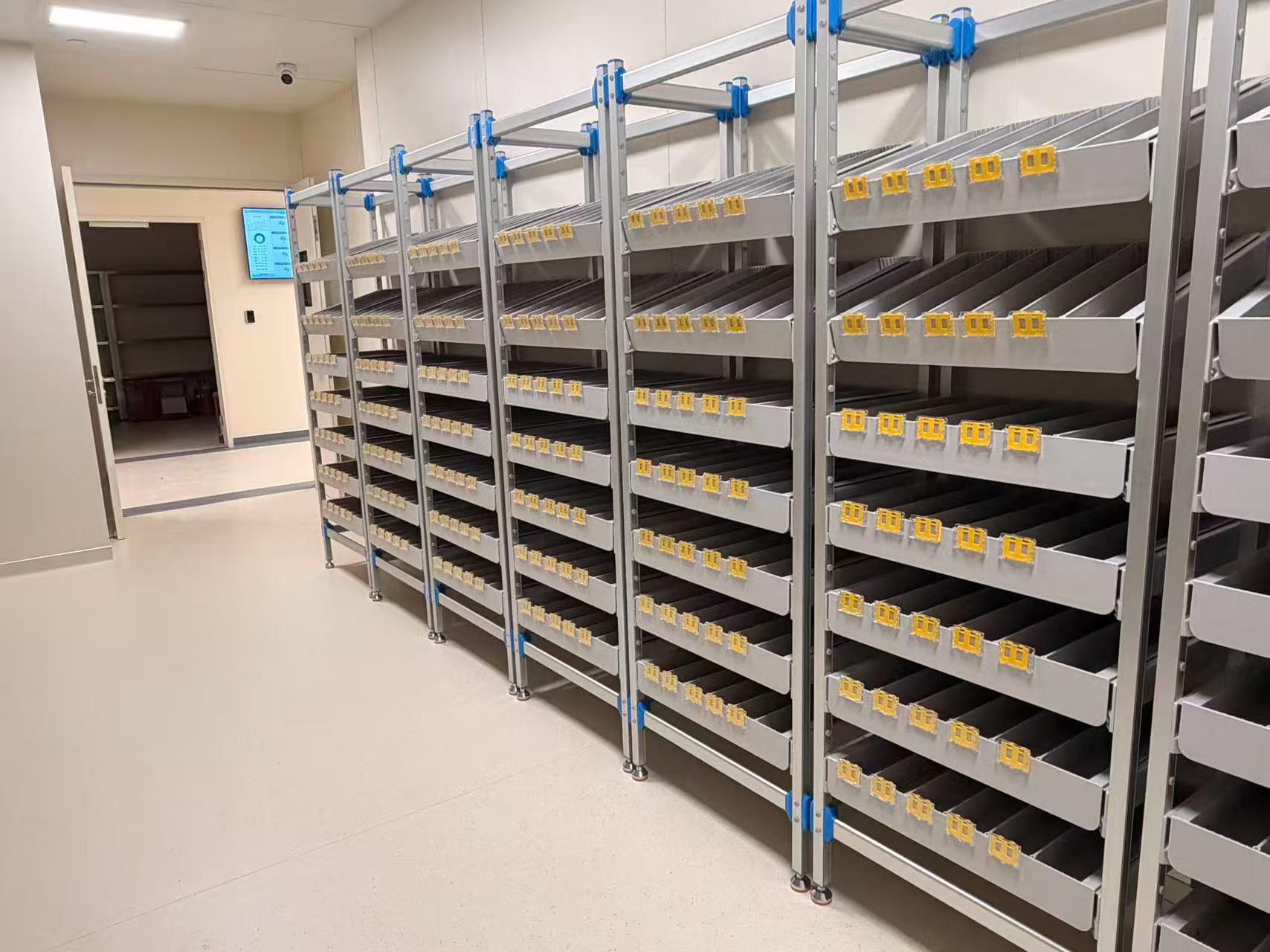
In a hospital pharmacy, the procurement question is usually whether trays can be rearranged without changing the shelving structure and whether the tray surface can be cleaned between medicine batches. The supplied assets support a modular configuration capability, but they do not provide a pharmacy-specific tray map. The buyer should request a proposed tray layout for the actual shelf bay and confirm the cleaning instructions for the tray and shelf.
In a nursing unit, the cart may be used for frequent supply movement between a storage room and patient areas. The relevant checks are caster condition, drawer or shelf retention, load and the ability to clean the cart at the end of a shift. In anesthesia and emergency scenarios, access layout and lock configuration are more prominent, but the same documentation rule applies: confirm the model-specific configuration and do not infer it from a product-family image.
These are procurement scenarios, not claims of installed customer projects. The supplied case material describes hospital storage and transport applications in general terms, including medicine storage, high density shelving and medical supply transport. It does not provide a T604010AN installation case, a rail-length project or a screw-fixed track project that can be cited as proof.
A practical release checklist
- Confirm the exact tray model, drawing revision and dimensions for T604010AN.
- State separately whether CE certification is required for the tray; do not rely on a related-product list.
- State separately whether ISO 6040 tray compatibility is required; ask for a tray-level declaration.
- Fix rail length, fixing positions, joint details and tray stop positions in the approved drawing.
- Confirm rail and shelf materials if PE, aluminum or stainless steel is specified; obtain the material datasheet.
- Require a written track installation method statement covering substrate, fasteners, torque or retention, sealing and inspection.
- For T001, T002 and T003, confirm the CE scope and the model-specific load, caster, lock and cleaning data.
- For T6020-2, obtain separate certification-scope confirmation because it is not named in the supplied T001 to T011 CE model list.
- Obtain cleaning-agent compatibility and disinfection instructions for the tray, rail, shelf and cart surfaces.
- Match the production inspection record, packaging standard and spare-parts list to the approved configuration.
Future outlook: documentation-led procurement
The next phase of modular medical storage procurement is likely to be less about category enthusiasm and more about document control. As hospitals move from evaluation to execution, the approval file will need tray drawings, rail interface dimensions, material data, cleaning instructions, cart-level certification scope and installation method statements. Manufacturers that can supply those documents with consistent model numbers will be easier to qualify than suppliers that rely on catalogue associations.
For Topmodul, the supplied evidence supports a manufacturer with OEM and ODM capability, modular configuration, project-based support, ISO 9001 quality management and CE documentation for listed cart models. The same evidence leaves tray certification, ISO 6040 tray compatibility, rail material and screw-fixed track installation as open confirmation items. Those gaps do not prevent a supported procurement discussion, but they should remain visible until the exact product documentation closes them.
FAQ
Does the T604010AN storage tray carry CE certification or ISO 6040 compatibility?
CE certification for the T604010AN tray is not stated in the provided asset information. ISO 6040 tray compatibility is also not stated in the provided asset information. T604010AN appears in related-product lists, but those lists do not replace a certificate scope or a tray-level compatibility declaration. A buyer should request a document that names the tray model and states the applicable standard or certification scope.
How can rail length be customized for a modular medical storage project?
Topmodul's stated capabilities include modular configuration, project-based solution support, OEM production and ODM design and production. Rail length can therefore be treated as a project-specific configuration item, but the supplied assets do not publish a length range, tolerance or minimum order by length. The buyer should fix the length, fixing positions, joint details and tray stop positions in an approved drawing and confirm them in the quotation.
Are the tracks installed with screws without drilling or gluing?
The supplied asset information does not state a screw-only, drill-free or glue-free track installation method for T604010AN or the listed carts. If a supplier proposes this method, the buyer should require a model-specific installation drawing and method statement covering the mounting substrate, fastener type, thread engagement, fixing spacing, retention, sealing and inspection. Without that documentation, the installation claim remains unverified.
What parameters should be checked for carts T001, T002, T003 and T6020-2?
For T001, T002 and T003, confirm the model-specific drawer or shelf configuration, lock, rated load, caster specification, cleaning method and spare parts, and check that the model is within the stated CE scope. T6020-2 is not named in the supplied T001 to T011 CE Declaration of Conformity model list, so its certification scope requires separate confirmation. For all four models, confirm the tray interface and the general risks of overload, wheel damage, surface corrosion and loose fasteners.
What can be verified about cleaning and infection-control design?
Topmodul's supplied FAQ describes the modular storage rack as easy to clean and disinfect and states that replaceable parts facilitate disinfection. The procurement guidance also lists compatibility with hospital cleaning liquids and high-temperature disinfection as parameters to check. The supplied assets do not provide a validated cleaning-agent list, contact time, temperature limit or disinfection efficacy result for each model, so those details should be requested for the exact tray, rail, shelf and cart configuration.
Reference document: 2026 TM Shelving Catalogue (PDF).
¿Tiene preguntas o necesita más detalles?
Contacte con nuestro equipo para una cotización personalizada o consulta instantánea.
Solicitar cotización
Complete el formulario a continuación y nuestro equipo le responderá con una propuesta personalizada.
Chat directo de WhatsApp
¿Prefiere chatear en tiempo real? Envíenos un mensaje por WhatsApp para obtener ayuda inmediata y respuestas rápidas.
- Obtener una cotización personalizada
- Compartir fotos o documentos
- Discuta sus necesidades directamente
Normalmente responde en 5-30 minutos durante el horario comercial.