
Medical Manikin Fundamentals: Types and Buying Signals
Medical manikins are physical training models used in healthcare education to practice procedures such as CPR, injections, intubation, catheterization, and patient care. They are part of the wider medical simulation market, which was valued at roughly USD 1.9 billion in 2025 and is projected to reach USD 6.7 billion by 2033, according to Grand View Research. Within that market, anatomical models and medical manikins represented the largest product segment, with about 41.4% of the share in 2025. For buyers preparing a simulation lab or expanding a training curriculum, the first step is to understand what a manikin is, how categories differ, and which features matter.
Why Manikin Basics Matter Before Purchase
Despite the growing use of manikins, procurement is not always simple. A training center may need a CPR manikin for basic life support, a nursing manikin for ward procedures, and an anatomy model for lectures. These products differ in structure, feedback, replaceable parts, and the skills they support, so selecting the wrong type can limit teaching quality. Basic discovery begins with questions such as: What procedures will be practiced? Do students need objective feedback? How many learners will use the model? Is the manikin intended for demonstration only or for continuous hands-on practice? Without a category framework, buyers may compare models on price alone and miss differences in replaceable parts and training outcomes.
The market context also matters. The global training manikin volume was estimated at 1.2 million units in 2024 and is projected to reach 2 million units by 2028, according to Global Insight Services. Asia-Pacific is expected to grow at a CAGR of 18.2% through 2033, making it the fastest-growing region. China also now requires simulation labs for accreditation of new medical schools, according to Market Research Future. These trends make basic manikin knowledge more relevant for institutional buyers across the world.
A Supplier Example: How Chongqing Scope Structures Its Manikin Line
One supplier that illustrates the current manikin landscape is Chongqing Scope Instrument Co., Ltd., a China-based company established in 2017. Chongqing Scope is a professional supplier of laboratory and medical training instruments, including microscopes, hardness testers, metallographic equipment, and medical manikins. The company operates a 5,000 square meter facility, employs more than 100 people, and maintains an R&D team of 20 engineers, with annual production capacity of 30,000 units. Its manikin portfolio covers CPR manikins, clinical manikins, nursing manikins, maternal and infant manikins, and anatomical models. Around half of total sales are exported, mainly to Europe, Southeast Asia, the Middle East, South America, and Africa.
For buyers, these supplier facts are not just company background. They indicate whether a manufacturer can support volume orders, customization, and export documentation. Chongqing Scope also provides OEM and ODM services, and can supply certification documents such as ISO 9001, ISO 14001, ISO 45001, ISO 13485, CE, and RoHS. Export packaging is neutral, either cardboard or wooden boxes prepared according to export standards.
How Medical Manikins Are Built: Materials, Feedback, and Categories
Most medical manikins are made of PVC because it is durable, resists deformation, and can imitate skin surfaces. Several models combine materials to improve tactile realism. The SC-HS4 IV injection model, for instance, uses imported thermoplastic elastic mixed rubber for skin and muscles, latex for nerves and blood vessels, and PVC for inner bones and joints. The SC-H4T intramuscular injection training model uses imported plastic elastomer formed by stainless steel mold injection and high-temperature sintering, which supports durability under repeated needle use.
Replaceable components are an important specification. Many nursing and CPR manikins allow swapping skin, vein, lung sacs, or bone marrow cavities after repeated use. The SC-CK817 clinical manikin has replaceable skin and a replaceable simulated bone marrow cavity, allowing bone marrow extraction practice. The SC-HS3 injection model supports changeable vein and skin, with no leakage after repeated puncture. These details affect total cost of ownership, because consumables will need to be purchased over the life of the product.
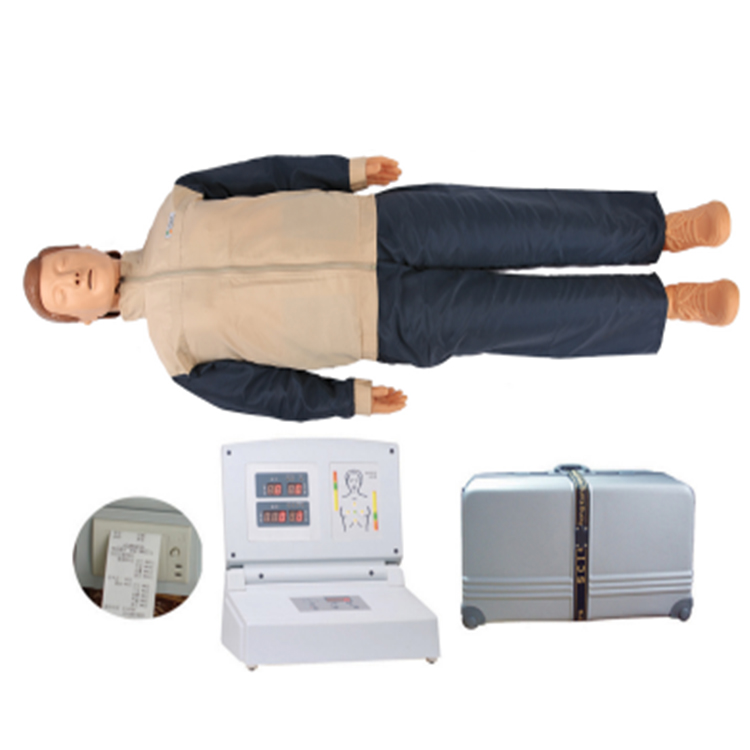
Some manikins include electronic monitoring to make practice measurable. The SC-CPR480 displays compression depth with color-coded lights: green indicates the correct 5-6 cm depth, yellow indicates insufficient force, and red indicates too much force. It also tracks ventilation volume and can print assessment results. The SC-CPR160 infant CPR manikin uses digital counting, indicator lights, and voice prompts to report errors. The SC-J5S intubation model alarms when the laryngoscope presses on teeth and when an esophageal intubation expands the stomach, helping instructors correct technique immediately.
The table below summarizes the main manikin categories and typical training uses.
| Category | Primary skill focus | Example models |
|---|---|---|
| CPR manikin | Chest compression, rescue breathing, airway management, trauma assessment | SC-CPR100A, SC-CPR480, SC-CPR160, SC-J5S, SC-J90 |
| Nursing manikin | Injection, catheterization, ostomy care, tracheotomy care, patient hygiene | SC-H130A, SC-HL, SC-HS3, SC-HS4, SC-H4T |
| Clinical manikin | Thoracentesis, pericardial puncture, knee arthrocentesis, bone marrow procedures | SC-CK817, SC-CK20135, SC-L66 |
| Maternal and infant manikin | Obstetric examination, childbirth, newborn care, newborn resuscitation | SC-F50, SC-F55-1, SC-H140 |
| Anatomy model | Anatomy education, physiology lectures, structure identification | SC-A1010, SC-A1041, SC-A1025 |
Manikin Evaluation Checklist
- Training objective: Which procedure will be practiced?
- Category: CPR, nursing, clinical, maternal/infant, or anatomy model.
- Material and replaceable parts: PVC shell, replaceable skin, vein, lung sac, or bone marrow components.
- Feedback features: Digital display, voice prompts, indicator lights, printed results.
- Compliance documents: ISO 9001, ISO 13485, CE, RoHS; export certificates such as Form E or Form F when needed.
- Supplier capability: Production capacity, R&D team, OEM/ODM support, export experience.
Where Medical Manikins Are Used
Manikins are used in medical schools, nursing schools, hospital training departments, and first-aid training centers. In the application scenario data, the setting is medical school teaching and first-aid training in Asian markets such as Malaysia, India, and Indonesia, with typical ambient temperature of 0-35°C and manual operation. This reinforces the role of manikins as simple, repeatable teaching tools in classroom environments.
- CPR training: SC-CPR100A is suitable for basic life support classes because it simulates airway opening, indicates a compression depth of 5-6 cm, and shows chest rise during rescue breathing.
- Nursing skills: SC-H130A supports venipuncture, injection, blood transfusion on an arm, endotracheal intubation, gastric lavage, ostomy care, and female and male urethral catheterization.
- Obstetric training: SC-F50 allows students to practice cervical examination and observe delivery through a transparent abdominal wall. SC-F55-1 adds a fetus for delivery simulation, a simulated placenta and umbilical cord, and a fetal heart rate range of 80-180 bpm.
- Pediatric and infant care: SC-H140 supports infant cephalic vein puncture, umbilical cord venipuncture, gastric lavage, enema, catheterization, and deltoid/gluteal muscle injections. The head, neck, and limbs move freely, and the chest skin can be replaced.
- Anatomy teaching: SC-A1010 skull model is divided into three parts and includes a movable chin, while SC-A1041 torso model provides 23 parts with interchangeable male and female reproductive organs.
Market Trends Behind the Demand for Training Manikins
Several verified market trends are relevant to manikin buyers. First, medical simulation continues to expand. Grand View Research reports that the global medical simulation market is expected to grow from USD 1.9 billion in 2025 to USD 6.7 billion by 2033. Second, anatomical models and medical manikins represent the largest share of this market, about 41.4% in 2025. Third, North America led the healthcare simulation market in 2024 with a revenue share of roughly 45-48%, according to Precedence Research and WiseGuyReports. Fourth, Asia-Pacific is the fastest-growing region with an expected CAGR of 18.2% through 2033. Fifth, China's accreditation rule for new medical schools indicates that simulation infrastructure is becoming part of formal educational requirements. Finally, training manikin volume is projected to rise from 1.2 million units in 2024 to 2 million units by 2028.
For buyers, these trends suggest that manikins are moving from optional teaching aids to expected infrastructure in medical education. At the same time, they imply a wider range of suppliers and quality levels, which makes basic product knowledge and verification of supplier credentials more important.
Manikins vs. Traditional Training Methods: Benefits and Limits
Compared with traditional classroom methods such as static plastic models, role-play, or supervised practice on patients, medical manikins provide a safer and more standardized form of practice. Static models are inexpensive but cannot demonstrate correct compression depth or catheterization landmarks. Real patients carry ethical and safety constraints. Manikins sit between these options: they bring repeatable physical tasks into the classroom, allow learners to make mistakes without harm, and help standardize assessment because all learners practice on the same physical model.
However, manikins have clear boundaries. No manikin fully replaces the communication, tissue variation, and emotional context of a real patient encounter. A low-cost static model may be suitable for anatomy demonstration, but it cannot provide the real-time feedback needed for CPR assessment. Conversely, an electronic manikin with advanced monitoring costs more and requires power, maintenance, and occasionally spare parts. Buyers should therefore match the level of fidelity to the learning outcome; not every training station needs a top-end model.
Future Outlook for Medical Manikin Procurement
The future of medical manikins likely involves a wider middle ground between simple PVC models and high-fidelity simulators. Mid-range products with replaceable consumables, clearer anatomical landmarks, and targeted electronic feedback are likely to be adopted by schools in faster-growing markets. Regulatory requirements in countries such as China may further push institutions toward formal procurement and documented quality systems. At the same time, suppliers that can support OEM/ODM customization and export documentation are better positioned to serve international training programs that need localized branding, specific packaging, or additional customs paperwork. Procurement teams are likely to ask more questions about documentation, spare parts, and after-sales support rather than only product appearance.
Frequently Asked Questions
A medical manikin is a physical training model used in medical education and first-aid training. It allows learners to practice clinical procedures such as CPR, injection, intubation, catheterization, and patient care. In the product landscape, manikins are made from materials such as PVC and are often designed with replaceable parts to support repeated use.
Medical manikins are commonly grouped by training purpose. The main categories include CPR manikins, nursing manikins, clinical manikins, maternal and infant manikins, and anatomical models. Examples in the Chongqing Scope range include SC-CPR480 for CPR training, SC-H130A for nursing procedures, SC-CK817 for clinical puncture, SC-F55-1 for obstetrics, and SC-A1010 for anatomy education.
Many medical manikins use PVC because it is durable and can be molded with realistic surface details. Some models combine PVC with other materials: the skin and muscles may use thermoplastic elastic rubber, veins may use latex, and inner bones or joints may use PVC. For example, the SC-HS4 IV injection model is built with imported thermoplastic elastic mixed rubber, latex vessels, and PVC bones. These combinations are chosen to balance realism, repeated puncture resistance, and easy cleaning.
Buyers typically check whether the supplier can provide quality and export documentation such as ISO 9001, ISO 13485, CE, and RoHS. ISO 13485:2016 is the internationally recognized standard for quality management systems in the design and manufacture of medical devices. For cross-border purchases, documents such as Certificate of Origin, Form E, or Form F may also be requested for customs clearance.
A first-time buyer should start by defining the training scenario: which procedures will be taught, at what level, and how many learners will use the model. Then compare the manikin category, included replaceable parts, feedback features, materials, and available supplier certifications. Buyers should also confirm annual production capacity, R&D support, and OEM/ODM capability if they need customized branding or packaging. This approach helps match product capability to the actual teaching program rather than starting with price or brand.
For a fuller product reference, Chongqing Scope provides a downloadable company brochure: Download the Chongqing Scope brochure (PDF).
¿Tiene preguntas o necesita más detalles?
Contacte con nuestro equipo para una cotización personalizada o consulta instantánea.
Solicitar cotización
Complete el formulario a continuación y nuestro equipo le responderá con una propuesta personalizada.
Chat directo de WhatsApp
¿Prefiere chatear en tiempo real? Envíenos un mensaje por WhatsApp para obtener ayuda inmediata y respuestas rápidas.
- Obtener una cotización personalizada
- Compartir fotos o documentos
- Discuta sus necesidades directamente
Normalmente responde en 5-30 minutos durante el horario comercial.