
Medical-Grade Home Health Devices: A Procurement Framework for Project Fit
Home medical health devices are no longer optional accessories for procurement teams; they are the operational backbone of fever screening, chronic disease follow-up, home respiratory care, maternity monitoring, and elderly-care programs. The core procurement question is not product availability but project fit — whether a device's measurement method, data flow, certification package, and supply model match the specific program that will use it. This article provides a scenario-based framework for selecting medical-grade home health devices, with reference to the product portfolio and manufacturing capabilities of Guangdong Genial Technology Co., Ltd. (GENIAL), an original medical-device manufacturer established in 2001.
The Procurement Challenge: Matching Device Type to Program Type
Healthcare projects increasingly move diagnostic touchpoints into homes, schools, pharmacies, postpartum centers, and community clinics. Each setting imposes different constraints on device selection. A school-based fever-screening program prioritizes non-contact measurement speed and cross-infection control, while a postpartum-care program needs continuous monitoring to reduce nighttime manual checks. A home chronic-disease project requires devices that can store historical records, support multiple family members, and integrate with a mobile application.
Market data supports the scale of this demand. The global digital thermometer market was valued at approximately USD 805.1 million in 2024 and is projected to reach USD 1 billion by 2030, according to Research and Markets. The global blood pressure monitoring devices market is estimated by Grand View Research at USD 4.2 billion in 2025, projected to reach USD 8.6 billion by 2033 at a CAGR of 9.3%. Fortune Business Insights reports that digital blood pressure monitors account for approximately 48% of total revenue share in the blood pressure monitoring devices market in 2024. Grand View Research expects the global pulse oximeter market to reach USD 5.3 billion by 2030 at a CAGR of 6.6% from 2024 to 2030. Market Research Future values the vibrating mesh nebulizer market at USD 0.75 billion in 2024, expected to grow to USD 1.57 billion by 2035.
The commercial signal is clear: buyers are procuring categories of devices for defined programs, not simply restocking SKUs. The evaluation therefore shifts from price lists to scenario capability — which device works in which environment, under which operational conditions, and with which compliance documentation.
GENIAL as a Project-Oriented Device Manufacturer
GENIAL (Guangdong Genial Technology Co., Ltd.) is a Chinese original manufacturer of medical devices, headquartered in Guangzhou, producing home medical health devices such as digital thermometers, blood pressure monitors, pulse oximeters, mesh nebulizers, sleep apnea therapy devices, and personal-care instruments. The company was founded in 2001, operates a 45,000-square-meter manufacturing base, and employs 251 people including a 29-engineer R&D team. Its annual output capacity is 15,000,000 units, with roughly 80% of products exported to Europe, North America, Southeast Asia, the Middle East, Africa, Latin America, and Oceania.
For project-led procurement, three company-level facts matter. First, GENIAL has obtained 262 intellectual property certificates, including an independently developed cloud health management platform. Second, the company holds system certifications for ISO 13485, ISO 45001, ISO 14001, BSCI, and GB/T29490 intellectual property management, and its products carry CE, FDA, NMPA, CB, FCC, and RoHS certifications. Third, product and trademark registration has been completed in 29 countries, with products reaching 117 countries and regions. These facts reduce supplier-evaluation risk for buyers who need regulatory coverage across multiple destination markets.
Device Selection Matrix by Project Scenario
The following matrix organizes GENIAL's home medical health devices by project type and device category. It reflects the applicable scenarios documented in the product corpus.
Technical Explanation: How These Devices Fit Real Working Conditions
Selection decisions are stronger when procurement teams understand the measurement principle behind each device category.
Temperature Monitoring: Contact, Infrared, and Continuous Wearable
Contact digital thermometers such as the GENIAL T14/T14SL/T14Y measure temperature from 32 to 42.9°C with an accuracy of ±0.1°C and an IPX5 waterproof rating. They operate in physical contact measurement mode with a buzzer notification upon completion, and are suitable for medical institution tender procurement projects. The T28 flexible-tip model adds a flexible probe for pediatric and hospital use, while animal-shaped models such as T15SC are designed for the baby-gift and children's retail market.
Infrared thermometers use thermal-radiation sensing. The T86/T87 non-contact forehead thermometers measure 32.0 to 42.9°C with ±0.2°C error between 35 and 42°C, and support rapid measurement without contact, reducing cross-infection risk during mass screening. Ear models like T94 and T90/T92 are also documented for household healthcare, pharmacy, pediatric hospital, and epidemic-prevention export scenarios.
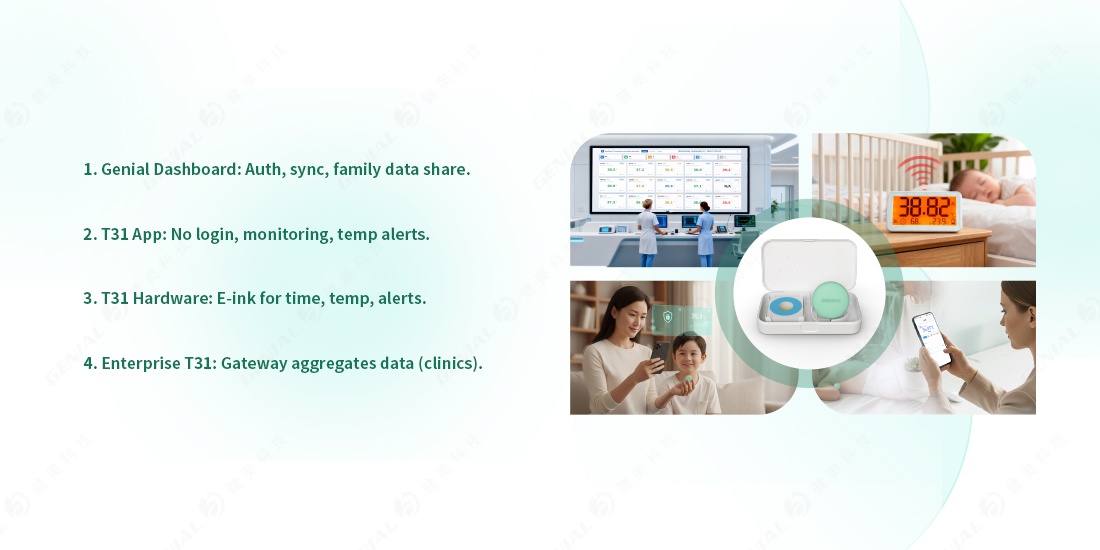
The wearable Bluetooth digital thermometer T31 extends temperature measurement from a point-in-time check to a continuous signal. It measures 20.0 to 45.0°C with ±0.1°C accuracy, is IPX4 splash-proof, weighs 33g including battery, and uses a medical-grade PP body with silicone adhesive patch. Its documented application industries include maternity centers, baby product companies, and chronic disease monitoring. In the scenario corpus, this device supports 24-hour continuous temperature monitoring, Bluetooth synchronization to a mobile app, abnormal-temperature alerts, and remote viewing for family members or caregivers.
Blood Pressure Monitoring: Upper-Arm and Wrist Configurations
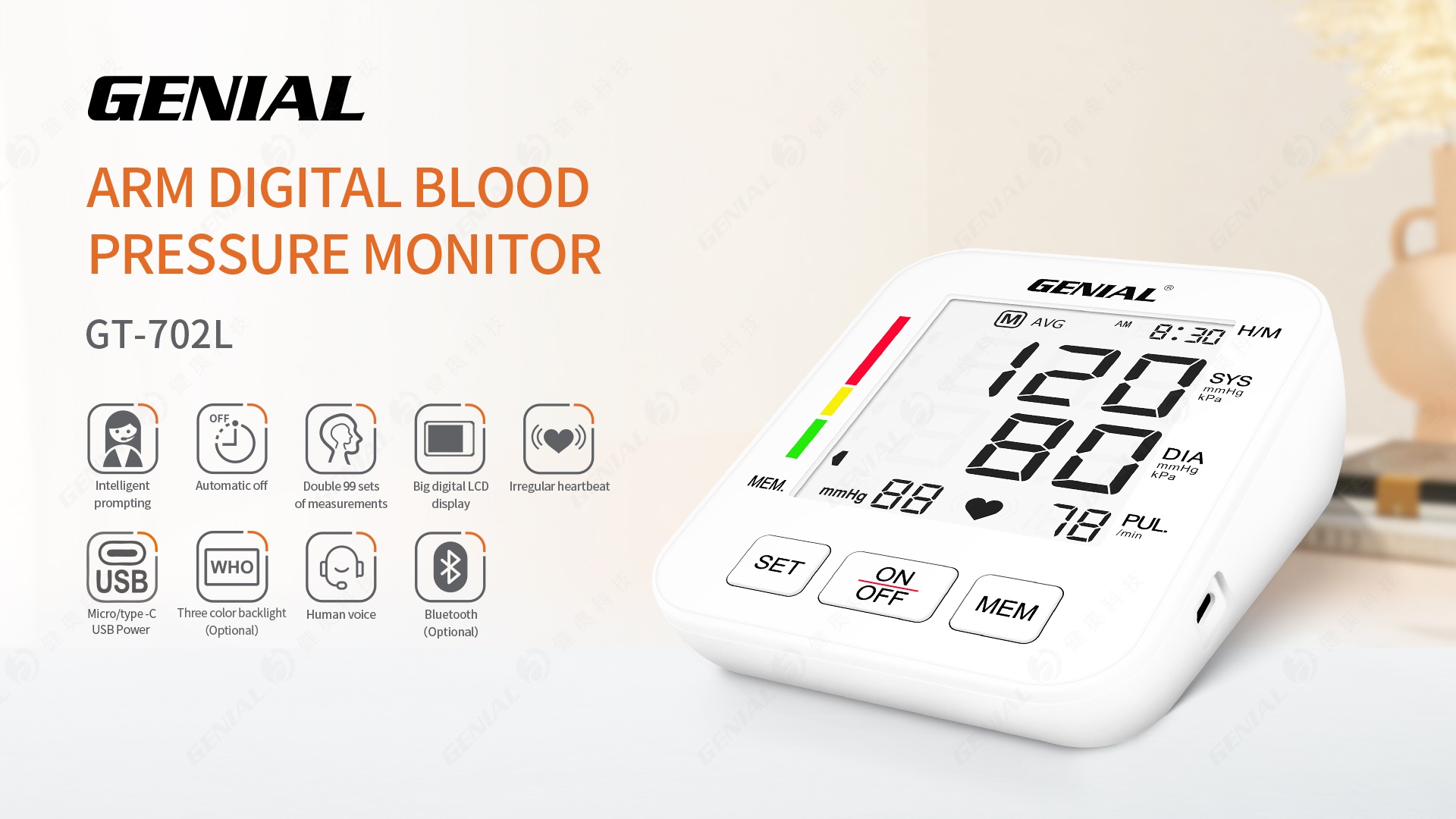
Digital blood pressure monitors operate in automatic pressurization measurement mode with one-button operation. Documented functions include measurement of systolic pressure, diastolic pressure, and pulse rate; WHO blood-pressure classification indication on applicable models; irregular-heartbeat detection on selected models; and dual-user memory storage. The GT-702L upper-arm model covers an arm circumference range of 22 to 42cm, while wrist models such as the GT-701C and GT-701L cover wrist circumference ranges between 13.5 and 21.5cm. Models with 99 memory sets for two users, such as GT-702V and GT-702BM, are suitable for longitudinal hypertension management. These devices are documented for pharmacy chains, nursing homes, physical examination centers, community clinics, household healthcare, and international trade applications.
Respiratory Care: Nebulization, Oxygenation, and Sleep Support
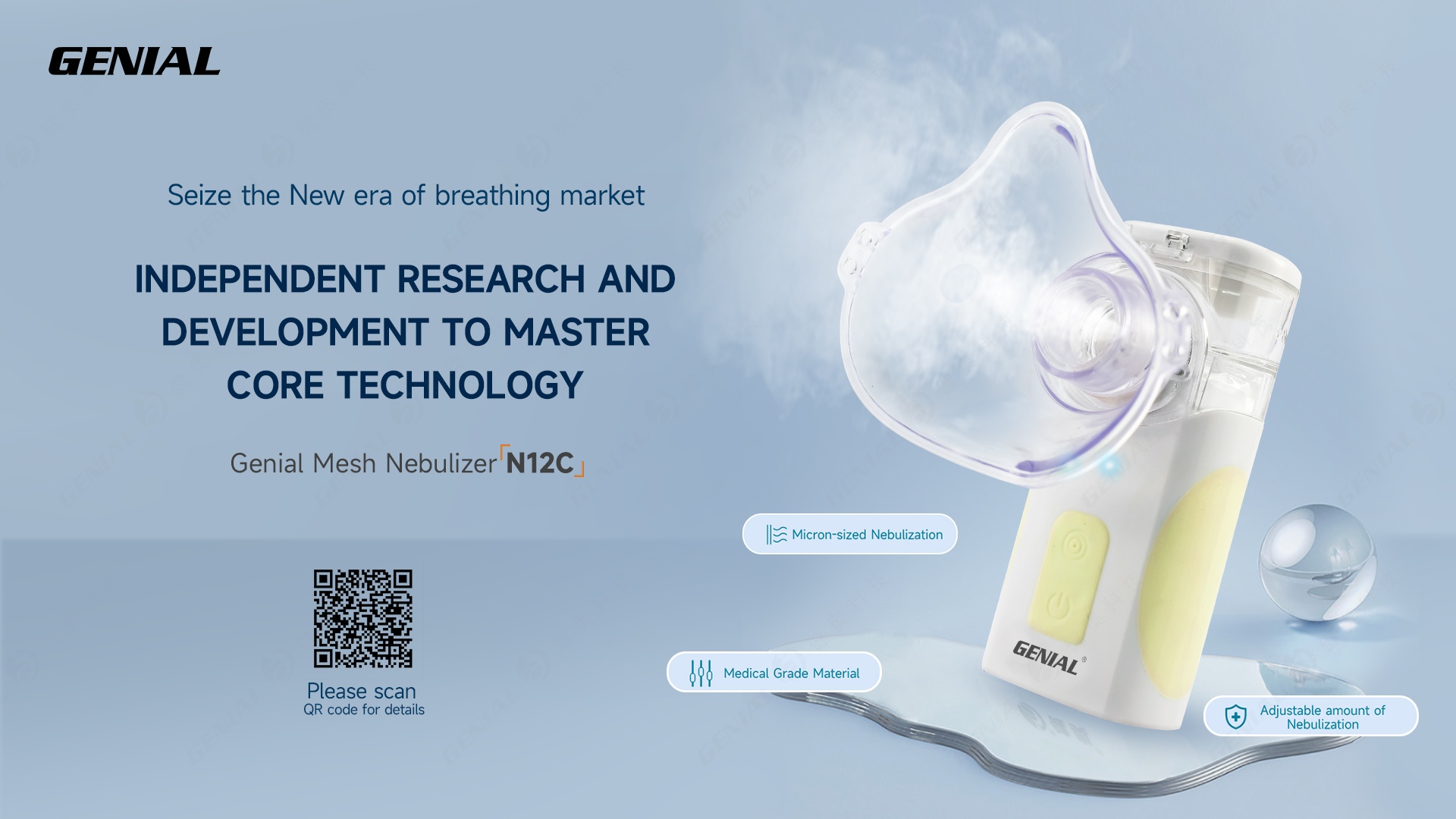
The portable mesh nebulizer N11/N21 has a liquid capacity of 8ml, a nebulization rate of ≥0.2ml/min, and produces particles with D50 below 5μm for at least 60% of output. Its noise level is ≤50dB(A), and it operates with 106kHz ultrasonic mesh atomization technology powered by battery or 3.7V lithium battery. The applicable industries documented for this model include pediatric wards, respiratory clinics, domestic cough treatment, and pet medical care. The N12/N22 series is documented for overseas OEM, rehabilitation centers, and private clinics.
Fingertip pulse oximeters in the GX series measure SpO₂ from 35% to 100% with ±2% accuracy in the 70% to 100% range, and pulse rate from 30 to 250 bpm. They use photoelectric transmission measurement technology with one-button operation and are documented for elderly-care institutes, respiratory departments, outdoor sports, household medical, and pharmacy channels.
For sleep-disordered breathing, the non-invasive CPAP ventilator series GH-B20V/GH-B25V/GH-B20T/GH-B20/GH-B25/GH-A20A/GH-A20 works at 4 to 20/25 cmH₂O, supports CPAP/APAP/S/T/VGPS modes, and holds noise to ≤35dB. It is documented for sleep disorder centers, hospital respiratory departments, rehabilitation institutes, and household snoring treatment.
Data and Interconnection Requirements
Project-based procurement increasingly includes a data-management requirement. The scenario corpus describes a dual-mode operation mechanism: an offline local mode where measurement data is shown on the device screen, and a Bluetooth cloud-intelligent mode where measurement data is synchronized to the mobile app and cloud platform. Bluetooth 5.0 stable connection is required, with low-battery app reminders. For institutions, one-to-many batch monitoring is achievable through Bluetooth gateways. The system supports Android and iOS, permanent cloud storage of historical records, automatic daily/weekly/monthly health trend reports, and one-click sharing of temperature, blood pressure, blood oxygen, and sleep ventilation data with family members and attending physicians.
Application Scenarios Across the Procurement Lifecycle
The hvq_6 project-fit question is best answered by mapping documented scenario types to device categories.
Medical Institution Tenders and Clinical Monitoring
Contact digital thermometers such as the T14 and T19C/T19D are documented for medical institution tender procurement projects. Infrared thermometers T86/T87 and T90/T92 are documented for hospital fever clinics, customs entry inspection, and factory epidemic prevention. A documented case unit for hospitals and clinics reports that GENIAL devices support clinical monitoring with digital management, continuous monitoring, automatic alerts, and reduced manual inspections.
Maternal, Infant, and Postpartum Programs
The T31 wearable thermometer is documented for postpartum care centers, maternal and infant care institutions, and pediatric hospitals. Its core value in this setting is continuous infant monitoring without repeated nighttime temperature measurement, a documented outcome described as improved user retention. The T15S/T15SL/T15SC animal-shape thermometers are documented for the baby gift market and children's commodity supermarkets. Flexible-tip thermometers T28 and the T14 series serve maternal-and-infant distribution channels and clinic supply.
Pediatric Respiratory and Home Cough Treatment
Mesh nebulizers N11/N21 are documented for pediatric hospital equipment procurement projects and respiratory-department supporting projects. The scenario corpus notes that nebulization therapy produces high-density aerosolized medication particles with particle size ≤5μm, helping medication reach the lower respiratory tract. The portable design and low noise level make them suitable for children who require frequent treatment at home.
Elderly Care and Community Chronic-Disease Programs
Upper-arm blood pressure monitors with 22 to 42cm arm-cuff coverage and 99-set dual-user memory are documented for elderly-care institutions, community health service centers, and chronic disease management institutes. The GT-702MA model includes a WHO blood-pressure classification function and is documented for physical examination centers and elderly-care facilities. The T31 wearable thermometer is also listed for elderly remote-care monitoring, where continuous temperature data can be shared with family members through the mobile app.
Campus and Public Epidemic-Prevention Procurement
Infrared thermometers are documented for public epidemic-prevention projects, including regional CDC procurement, school healthcare equipment tenders, industrial park security support, customs quarantine consumables procurement, overseas bulk epidemic-prevention material orders, and postpartum care center supporting procurement. The T81/T80 voice-broadcast model and T86/T87 forehead models are documented for school daily checks, factory epidemic prevention, and customs entry inspection.
Export and Cross-Border Supply Projects
For overseas distribution, the documented special requirements include domestic NMPA Class II medical device registration, metrology certificates, and export certifications such as FDA, CE, FCC, GCC, MDR, RoHS, and IECEE CB. Buyers planning cross-border projects should confirm that each product in the procurement bundle carries the specific certification required by the destination market. GENIAL's broader registration record — completed in 29 countries, with products sold to 117 countries — provides a documented baseline for such programs.
Market Trend Analysis: What the Data Supports
Four trends are supported by third-party market data rather than inference. First, digital thermometers remain a stable procurement category, with the global market projected to grow from USD 805.1 million in 2024 to USD 1 billion by 2030. Second, blood pressure monitoring is the largest documented category in this analysis: a USD 4.2 billion market in 2025, reaching USD 8.6 billion by 2033, with digital devices holding approximately 48% of revenue share in 2024. Third, pulse oximetry is expanding beyond clinical settings into elderly care, sports, and home respiratory management, with a projected market size of USD 5.3 billion by 2030. Fourth, mesh nebulizer technology is a growth segment within respiratory care, rising from USD 0.75 billion in 2024 to an expected USD 1.57 billion by 2035.
These figures indicate that procurement programs will increasingly bundle devices from multiple categories — temperature, blood pressure, oxygen, and respiratory support — rather than sourcing single SKUs. Suppliers with a broad documented portfolio and factory-level capacity reduce the coordination cost of such bundles.
Comparison with Traditional Supply Models and One Honest Limitation
Traditional procurement paths include buying consumer-branded medical devices from retail or distribution channels. That route offers immediate availability, established local brand recognition, and lower planning effort for small quantities. Omron Healthcare is documented by iData Research as a dominant competitor in global nebulizer and blood pressure monitor markets as of 2024, illustrating the strength of established consumer brands in these categories.
Manufacturer-direct procurement from an original manufacturer like GENIAL fits a different set of requirements: larger planned volumes, OEM/ODM customization, multi-SKU consolidation, certification documentation support, and long-term supply continuity. GENIAL's documented OEM model supports customization of packaging, gift box, user manual, logo printing, color schemes, and packaging specifications while core hardware and key functions remain unchanged. Minimum order quantities are documented as 10,000 units for thermometers, 2,000 units for infrared thermometers, 2,000 units for blood pressure monitors, 2,000 units for nebulizers, 2,000 units for wireless thermometers, 2,000 units for hair removal devices, and 500 units for ventilators. OEM lead times are documented at 3 days for samples, 3 to 7 days for small orders, and 10 to 15 days for mass orders. ODM adds customization of industrial design, tooling, structure, PCB firmware, algorithms, Bluetooth functionality, display interface, and packaging, with new mold development lead time of 45 to 50 days.
One honest limitation: for very small trial batches or immediate single-unit replacement needs, the manufacturer-direct model is less efficient than buying from local retail or distributor stock. The MOQ structure and lead times assume planned procurement. Buyers in the research-and-evaluation stage should weigh this trade-off before committing to a supply model.
Future Outlook: From Device Supply to Program Enablement
The direction of home medical health device procurement is moving toward program-level solutions. A postpartum-care project needs a wearable thermometer plus the app and cloud reporting that make continuous monitoring operational. A community hypertension program needs upper-arm monitors with dual-user memory and WHO classification, plus export-grade certifications if the program is cross-border. A respiratory support project needs a nebulizer that is quiet enough for children and an oxygen monitor that works reliably in home conditions. The supplier that can document these combinations — product parameters, compliance files, manufacturing capacity, and customization terms — becomes easier to evaluate and safer to specify.
Because device standards are also tightening, procurement teams should treat certification documents as part of the product specification. Clinical electronic thermometers must comply with ISO 80601-2-56:2017 for basic safety and essential performance, and medical electrical equipment including home health devices must meet IEC 60601-1-2 for electromagnetic compatibility, per the International Electrotechnical Commission. Documentation supporting these standards should be requested during supplier evaluation.
Frequently Asked Questions
What certifications should I require when selecting home medical health devices for a project?
For Chinese domestic programs, documented special requirements include NMPA Class II medical device registration and metrology certificates. For export programs, documented requirements include FDA, CE, FCC, GCC, MDR, RoHS, and IECEE CB certifications. Buyers should match the certification list to the destination country's regulatory framework.
Which GENIAL devices are suitable for medical institution tender procurement projects?
Contact digital thermometers are documented as suitable for medical institution tender procurement projects. Additional products documented for hospital and clinic settings include infrared ear thermometers, fingertip pulse oximeters, mesh nebulizers, and non-invasive sleep CPAP ventilators.
What is the role of the wearable Bluetooth thermometer in maternal and elderly-care programs?
The wearable Bluetooth digital thermometer model T31 is documented for postpartum care centers, maternal and infant care institutions, and chronic disease home monitoring. It provides 24-hour continuous temperature monitoring with Bluetooth synchronization to the mobile app, abnormal-temperature alerts, and remote sharing. The documented outcome for maternal and infant companies is improved user retention through reduced nighttime manual checks.
Which blood pressure monitor models fit a home chronic-disease management program?
Upper-arm models such as the GT-702L, GT-702BM, GT-702LM, and GT-703M cover arm circumference ranges from 22 to 42cm. Wrist models such as the GT-701C and GT-701L cover wrist circumference ranges from 13.5 to 21.5cm. Models with 99 memory sets for two users support longitudinal tracking. Required supporting equipment includes a cuff, batteries or power adapter, storage bag, and optional app support.
What are the key parameters to evaluate for a pediatric nebulization project?
The portable mesh nebulizer N11/N21 is documented for pediatric wards and respiratory clinics with a liquid capacity of 8ml, nebulization rate of ≥0.2ml/min, particle size D50 below 5μm for at least 60% of output, and noise ≤50dB(A). The device uses 106kHz ultrasonic mesh atomization and supports battery or 3.7V lithium battery power.
How should an institution plan for data integration when deploying health devices at scale?
The documented integration model supports Bluetooth 5.0 stable connection, Android and iOS compatibility, one-to-many batch monitoring through Bluetooth gateways, local cache upload after reconnection, cloud storage of historical records, and export of PDF health reports. Institutions should confirm Bluetooth transmission conditions and the availability of the app-and-cloud platform during the evaluation stage.
For procurement teams that need to verify product specifications or compliance documentation
GENIAL (Guangdong Genial Technology Co., Ltd.) provides a downloadable English brochure covering its device portfolio and manufacturing capabilities.
▸ Download the company brochure (PDF)
Website: www.cngenial.com | Contact: Gary | Email: market6@genial.cn | WhatsApp: +86 18938327866