
Material Trade-offs in USB Cables: Five Builds, One Decision
Material Trade-offs in USB Cables: Five Builds, One Decision
Choosing between a PVC, nylon-braided, TPE, silicone or IPX7-sealed USB cable is a four-variable decision rather than a colour choice. The jacket material sets the mechanical and temperature envelope, the conductor and current rating set the charging ceiling, the stated data rate sets the sync ceiling, and the sealing method determines where the cable can physically be deployed. In the five builds compared here — CB-PVC, CB-Nylon, CB-TPE, CB-SILICONE and CB-Waterproof — the supplied specifications separate them most sharply on power and on environment: CB-PVC is specified from 1 A to 2.4 A at 480 Mbps, CB-TPE is specified at 6 A with supplied power figures of 120 W/240 W, CB-SILICONE is specified at 6 A and 240 W with a working range of −20 °C to 70 °C, CB-Nylon combines a PVC inner layer with a nylon braid over tinned copper conductors, and CB-Waterproof is defined by an IPX7 sealed molding.
This comparison is written from a buyer's side of the table. It uses the build specifications supplied for these five products together with the public standards that govern USB Type-C power and data claims, and it deliberately marks the places where a specification is silent. Silence in a datasheet is not a defect; it is an unverified variable, and it should be closed at sample stage rather than assumed at purchase-order stage.

Production environment for USB cable assembly — the point at which jacket material, conductor build and current rating are fixed into a SKU.
Scope and evidence base
This article compares material, charging, data speed and environment fit only. It does not report independent laboratory test results for these builds, does not rank them, and does not claim that one build outperforms another in absolute terms, because no comparable outcome testing was available for that claim. Where a figure appears, it comes either from the specification supplied for the named build or from a named public source, and it is attributed at the point of use. Where a build's specification does not state a figure, the text says so instead of filling the gap.
The practical consequence for a buyer is straightforward: the five builds are not five grades of the same thing. They answer different questions. A comparison only becomes useful once you decide which of the four variables is the binding constraint in your own product line, and then read the other three as constraints rather than as selling points.
The five builds at a glance
The table below reproduces the specifications supplied for each build. Cells marked as not stated are genuinely absent from the reviewed material, not omitted for brevity.
| Build | Construction | Charging spec | Data spec | Environment |
|---|---|---|---|---|
| CB-PVC | PVC jacket | 1 A–2.4 A | 480 Mbps | Not stated |
| CB-Nylon | PVC inner layer plus nylon braid; tinned copper conductors | Not stated in reviewed material | Not stated | Braid adds an outer mechanical layer |
| CB-TPE | TPE jacket | 120 W/240 W; 6 A | Not stated | Not stated |
| CB-SILICONE | Food-grade silicone jacket | 240 W; 6 A | Not stated | −20 °C to 70 °C working range |
| CB-Waterproof | IPX7 sealed molding | Not stated in reviewed material | Not stated | IPX7 ingress protection |
Two patterns matter more than any single cell. First, the data-rate column is populated for one build out of five. Second, the power column splits the set into a 1 A–2.4 A tier and a 6 A tier, while CB-Nylon and CB-Waterproof fall outside both tiers in the material reviewed, because their supplied descriptions address construction and ingress protection rather than electrical ratings. A buyer who reads the five builds as a single ladder from entry to premium will mis-specify at least one line.
Material: what the jacket changes, and what it does not
The jacket is a mechanical and environmental decision first and an electrical decision second. It governs abrasion behaviour, hand feel, flexibility at temperature, resistance to oils and cleaning agents, and the surface that carries print or laser marking. It does not, on its own, raise the current a cable can carry; current capability is set by conductor cross-section and by the build rating that the manufacturer specifies and tests.
PVC: the volume default in the CB-PVC build
A PVC jacket is the conventional outdoor skin for general-purpose cables, and CB-PVC is specified from 1 A to 2.4 A at 480 Mbps. That combination describes a general-purpose sync-and-charge accessory rather than a fast-charging or data product: the charge band covers mainstream device charging, and the data rate sits at the USB 2.0 High Speed rate. In procurement terms PVC is the low-cost, high-volume option, and it is the natural build for bundled accessories, promotional packs and entry-level retail lines where the cable is expected to sit in a bag rather than on a workshop floor.
Its limitation is physical rather than electrical. A plain PVC jacket provides no separate abrasion layer, so the stress point at the connector transition absorbs handling directly. That is the reason jacket-level upgrades exist at all, and it is also the reason a durability claim attached to a different build should not be transferred onto CB-PVC.
Nylon: an outer mechanical layer over a PVC core
CB-Nylon changes the outside of the cable rather than the conductor. The supplied construction is a PVC inner layer with a nylon braid over it and tinned copper conductors. The braid is a mechanical layer: it takes abrasion and scuffing away from the inner jacket and distributes bending stress across a woven surface instead of a smooth one. Because the inner layer remains PVC, the electrical question of current rating is still answered by the build specification, not by the braid.
Tinned copper is a strand-surface decision. The tin coating protects the copper surface from oxidation, which matters for storage life, for humid handling, and for solderability at the joint. It does not change the conductor cross-section, so it does not by itself raise the current the build can carry. Buyers who need a specific current should ask for the rating in writing rather than infer it from the word 'tinned'.
TPE: flexibility under charging load
TPE is a thermoplastic elastomer, and CB-TPE is specified at 6 A with supplied power figures of 120 W/240 W. The material choice and the electrical choice point in the same direction: this is a charging-led build. TPE is selected where a cable must stay flexible under frequent handling while carrying current well above the 2.4 A band, and where a softer, less stiff feel is part of the product positioning.
The specification as supplied reads '120 W/240 W'. That is not a single rating, and a buyer should not flatten it into one. Before artwork, packaging copy or an e-commerce listing is written, confirm which variant a given SKU ships as, and confirm that the invoice description matches the tested rating.
Silicone: material plus a temperature envelope
CB-SILICONE uses a food-grade silicone jacket and is specified at 240 W and 6 A, with a working temperature range of −20 °C to 70 °C. 'Food-grade' is a material descriptor, and the document that supports it is the jacket material datasheet rather than the finished-cable datasheet. Buyers who need the descriptor for retail or for a specific market should request that datasheet explicitly.
The temperature range is the most procurement-relevant figure in the whole set. It tells a buyer that this build is specified outside a plain indoor-only envelope, which matters for cables that travel in vehicles, sit near equipment that runs warm, or are stored in unheated space. It is still a working range, not an unlimited one, and it is not a statement about connector retention at the upper end or about flex behaviour at the lower end; those are separate tests.
Waterproof: defined by sealing, not by jacket chemistry
CB-Waterproof is specified by its sealing method rather than its jacket: IPX7 sealed molding. IPX7 sits on the IEC 60529 ingress-protection scale and denotes protection against temporary immersion, with the exact depth and duration set by that standard. The document to check is therefore the test report, not the label on the packaging.
One boundary deserves plain language. IPX7 addresses water entering the connector and housing; it does not by itself state that the cable may be used or charged while wet. A sealed cable sold into outdoor, marine-adjacent or washdown-adjacent use should carry a clear usage instruction covering that point, because the rating alone will not stop a user from assuming more than it says.
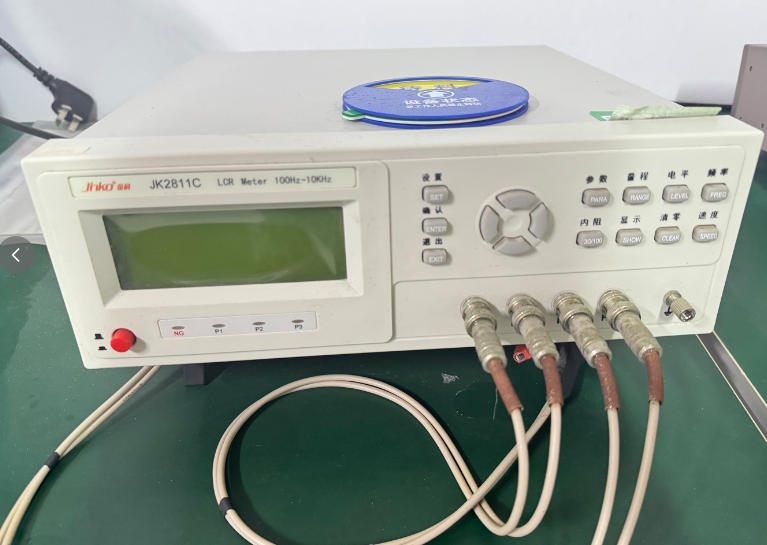
Verification equipment: the build specification becomes a purchasing fact only when the test report behind it is available.
Charging: the 2.4 A and 6 A tiers are different purchases
CB-PVC at 1 A–2.4 A covers the mainstream sync-and-charge band. CB-TPE and CB-SILICONE at 6 A, with supplied power figures of 120 W/240 W and 240 W respectively, sit in the fast-charging band. These are not the same purchase with different packaging, because the conductor and connector build behind a 6 A rating carries more copper and more inspection burden than the 2.4 A build, and that difference shows up in unit cost well before it shows up in a specification sheet.
The 240 W figure has a public reference point. USB Power Delivery Specification Revision 3.2 defines fast-charging protocols enabling power delivery up to 240 W over USB Type-C cables. That is a statement about what the standard permits; it is not a statement that any particular cable, charger or handset will negotiate that level in the field.
Two cautions follow for buyers. First, a cable rating is a ceiling, not a delivery guarantee — the delivered current depends on the charger, on what the device requests, and on the cable's electronic identification being read correctly. Buyers should confirm the identification data in the test documentation rather than infer it from a 6 A label. Second, CB-Nylon and CB-Waterproof carry no charging figure in the material reviewed. If either is intended for a fast-charging product line, obtain the rating in writing before the SKU is defined, because a braid and an IPX7 molding are both independent of current capability.
Data speed: one stated figure and four open questions
Only CB-PVC carries a data rate in the material reviewed: 480 Mbps, which corresponds to the USB 2.0 High Speed rate. For a general-purpose accessory, 480 Mbps paired with a 1 A–2.4 A charge band is internally coherent: it describes a sync-and-charge cable, not a data product.
For CB-Nylon, CB-TPE, CB-SILICONE and CB-Waterproof, no data rate is stated. This is the single largest gap in the comparison, and it matters most for SKUs sold under descriptions such as USB data cable, bulk data cable or USB sync and charge cable. A buyer who writes 'data cable' on a purchase order without a rate has bought an undefined performance level, and the supplier has no agreed basis on which to be measured.
Context for scale: the USB Type-C specification supports data transfer speeds up to 80 Gbps for USB4 Version 2.0 certified cables. That figure describes how wide the data tier has become across the industry; it is not a claim about any of these five builds, and it should not be pasted into a listing for a build whose rate has not been tested.
Environment fit: temperature, moisture and mechanical wear
Environment fit is where the five builds separate most cleanly for procurement purposes. CB-SILICONE is the only build with a stated working range, −20 °C to 70 °C. CB-Waterproof is the only build with a stated ingress rating, IPX7. CB-Nylon adds a mechanical outer layer without changing the electrical class. CB-PVC and CB-TPE are specified without an environment figure, which in practice means they should be treated as indoor builds until a document says otherwise.
The boundary to hold onto is that a temperature range and an ingress rating answer different questions. A cable specified from −20 °C to 70 °C is not thereby waterproof, and an IPX7 cable is not thereby rated for a temperature envelope. Where a product line genuinely faces both conditions, the buyer needs both documents rather than one rating stretched to cover the other.
Cost and total cost of ownership
Material cost in this category is dominated by metal rather than by polymer. Copper materials account for 60%–80% of total manufacturing costs for standard USB cables, according to SMM's 2026 Type-C supply-chain analysis, and the same source reported international copper prices hitting USD 13,000–13,300 per metric ton in early 2026. The procurement implication is uncomfortable but useful: moving from a plain PVC jacket to a braided or silicone jacket changes cost far less than moving from a 2.4 A conductor build to a 6 A conductor build. Buyers who treat jacket material as the main cost lever are optimising the smaller line.
Compliance adds a fixed cost per model rather than per unit. Published 2025 guidance cited a USB-IF full membership fee of USD 5,000 per year and testing fees for a basic USB-C data cable in the range of USD 2,200–3,300 per model. On a range that spans five builds and several lengths, that per-model structure is worth mapping before the range is finalised, because every additional build-and-length combination can carry its own qualification burden.
Durability claims shift the same calculation in the other direction. The manufacturer documents an anti-broken structure at the cable head position on the USB-Cable-25036, stating a 3–5 times longer service life and over 80% reduction in joint fracture failure rate compared with common market USB cables, at a slightly higher raw material cost but with a much lower long-term failure rate. Those are manufacturer-stated figures and should be read as such. Their procurement value lies in the shape of the trade: a modest material premium against a failure mode that otherwise drives replacement and returns.
One project record illustrates the scale at which that trade is usually evaluated: order quantities of 5,000 to 30,000 pieces per order, stable fast-charging speed, durable braided wire, low heating during long-time charging, zero mass quality complaints, a normal service life exceeding two years and a one-year warranty. The manufacturer's stated minimum order quantity is 2,000 units. Buyers trialling a new build should plan for sampling and qualification below those volumes, and should budget the artwork, packaging and qualification time separately from the unit price.
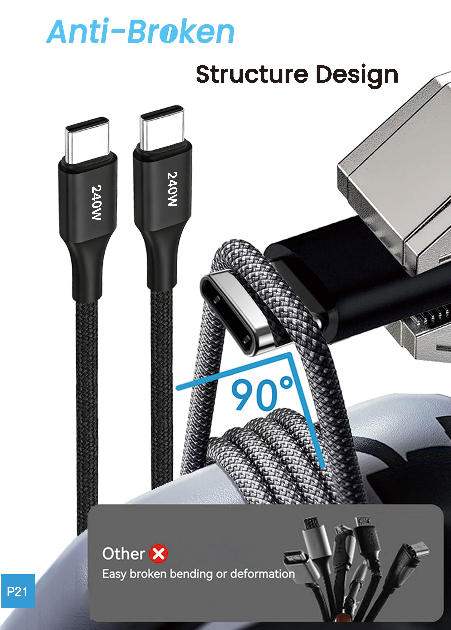
The connector-to-cable transition is the failure point that jacket and strain-relief design address; the manufacturer documents an anti-broken structure at this position on the USB-Cable-25036.
Shortlist logic: matching a build to a product decision
Read as decision rules rather than as a ranking, the five builds resolve most buyer questions in a predictable order:
- Bundled accessory, sync-and-charge, cost-led: CB-PVC. A 1 A–2.4 A band with 480 Mbps matches the accessory role, and the jacket carries no premium for a function the product does not need.
- Retail handling and abrasion are the returns driver: CB-Nylon. The nylon braid over a PVC inner layer addresses the outer surface, and tinned copper supports storage and humid handling. Confirm the current and data ratings separately.
- Charging speed is the product's selling point, indoors: CB-TPE. The 6 A, 120 W/240 W specification sits in the fast-charging tier, and the elastomer jacket suits frequent handling. Fix the wattage variant before listing.
- The cable must work outside a normal indoor envelope: CB-SILICONE. The 240 W, 6 A specification pairs with a stated −20 °C to 70 °C range and a food-grade silicone jacket.
- Water or heavy moisture is present: CB-Waterproof. IPX7 sealed molding is the defining specification; attach the immersion test report and a clear usage instruction on wet use.
Where a product needs two of these at once — fast charging in a wet environment, for example — the correct move is not to average two builds but to request a combined specification and its test evidence, or to accept one constraint as unmet. Overlapping requirements are where specification errors originate.
Verification: what to request before the purchase order
The manufacturer states 100% electrical testing, supplemented by random testing across short-circuit, swing, tensile, high and low temperature, power and plug-in tests. That test set maps well onto the risk profile of this category — overheating, poor contact and wire cracking — and it is the right basis for a qualification conversation, provided the buyer asks for build-specific evidence rather than a general statement of capability.
A practical document request for this five-build comparison includes: the stated data rate for each build, including the four where the reviewed material is silent; the electronic identification data supporting any 6 A rating; the IPX7 test report with depth and duration for CB-Waterproof; the temperature test report behind the −20 °C to 70 °C range for CB-SILICONE; the jacket material datasheet supporting the food-grade silicone descriptor; and the conductor specification confirming tinned copper and gauge for CB-Nylon. Each of these closes a specific open variable rather than adding paperwork.
Regulatory overlay that affects build selection
Under the EU Common Charger framework, USB-C is the harmonised charging receptacle, and the requirements have applied to listed categories of portable radio equipment — including handheld mobile phones, tablets, digital cameras, headphones, headsets, handheld videogame consoles, portable speakers, e-readers, earbuds, keyboards, mice and portable navigation systems — since 28 December 2024, with laptops covered since 28 April 2026.
Two standards sit underneath that framework. IEC 62680-1-3:2024 defines USB Type-C receptacles, plugs and cables and corresponds to the USB-IF Type-C Cable and Connector Specification; the USB-IF document library holds the Type-C cable and connector specifications together with a functional test specification, and the applicable revision must be verified for each product claim. Separately, Apple's MFi programme requires licensing and certification for third-party manufacturers producing Lightning cables and authorised USB-C cables for Apple devices.
The consequence for this comparison is that the connector layer is not optional. Even the 480 Mbps CB-PVC build needs Type-C connector conformity if it ships into covered EU categories; the choice of jacket does not exempt a cable from the connector requirement. For any Lightning USB cable, iPhone cable or MFi Lightning cable line, licence evidence belongs in the supplier qualification file before cost is discussed.
Outlook: power and data tiers are separating
The standards picture points to a structural change in how these builds should be specified. USB Power Delivery Revision 3.2 defines power delivery up to 240 W, while the Type-C specification supports up to 80 Gbps for USB4 Version 2.0 certified cables. Power capability and data capability are now governed by different parts of the same framework, and the two do not move together.
For buyers, the practical reading is that a single label such as 'fast charging cable' no longer identifies a product. A SKU definition should carry a power line and a data line separately, because the five builds here demonstrate exactly that gap: two builds reach 6 A while only one build publishes a data rate at all. If EU-bound portfolios continue to consolidate on USB-C, the connector will stop being a differentiator and the remaining differentiation will sit in the four variables this comparison covers — material, charging, data and environment.
About the manufacturer behind these builds
Dongguan Focuses Electronics Technology Co., Ltd. is a USB cable manufacturer operating a 6,000 m² facility in Tangxia Town, Dongguan, with 150 employees, an annual output of 25,000,000 units and a 6-engineer R&D team. The company exports to the EU, North America, the Middle East and Asia, with a stated minimum order quantity of 2,000 units.
Build specifications, catalogue images and product details for the CB-PVC, CB-Nylon, CB-TPE, CB-SILICONE and CB-Waterproof ranges are collected in the 2026 Focuses catalogue, which is publicly available to download.
FAQ
What actually differs between a PVC, nylon, TPE and silicone USB cable?
The differences sit in four places: jacket material, current rating, stated data rate and environment range. In this build set, CB-PVC uses a plain PVC jacket specified at 1 A–2.4 A and 480 Mbps; CB-Nylon puts a nylon braid over a PVC inner layer with tinned copper conductors; CB-TPE uses a TPE jacket specified at 6 A with 120 W/240 W; and CB-SILICONE uses a food-grade silicone jacket at 6 A and 240 W with a −20 °C to 70 °C working range. Only CB-PVC publishes a data rate in the reviewed material.
Does a 6 A, 240 W cable charge faster than a 2.4 A PVC cable?
A higher cable rating raises the ceiling, not the delivered result. USB Power Delivery Revision 3.2 defines power delivery up to 240 W over USB Type-C, but the current a device actually receives depends on the charger, on what the device requests, and on the cable's electronic identification being read correctly. A 6 A build such as CB-TPE or CB-SILICONE can support a higher charging tier than a 1 A–2.4 A build such as CB-PVC, but the charger and handset must also support that tier.
Which build should be specified for wet, dusty or outdoor environments?
CB-Waterproof, which is specified as IPX7 sealed molding. IPX7 sits on the IEC 60529 ingress-protection scale and denotes protection against temporary immersion, with depth and duration set by that standard; the test report is the document to verify. The rating concerns water ingress into the connector and housing and does not by itself state that the cable may be used or charged while wet, so a clear usage instruction should accompany any outdoor or washdown-adjacent product.
Can an IPX7 waterproof USB-C cable be used for fast charging?
Not on the basis of the reviewed material. The CB-Waterproof specification defines the sealing method as IPX7 sealed molding; it states no current or wattage rating in the material reviewed. Ingress protection and charging capability are independent properties, so a buyer needing both should obtain the electrical rating in writing and confirm it against the intended charger and device rather than assuming that a sealed cable is also a fast-charging cable.
How should a buyer verify these five build specifications before ordering?
Request build-specific documents rather than a general capability statement: the data rate for each build, the electronic identification data behind any 6 A rating, the IPX7 test report with depth and duration, the temperature test report behind the −20 °C to 70 °C range, the material datasheet supporting the food-grade silicone descriptor, and the conductor specification confirming tinned copper and gauge for CB-Nylon. The manufacturer states 100% electrical testing plus random short-circuit, swing, tensile, high and low temperature, power and plug-in tests, which is a reasonable basis for reviewing those documents against the specification you intend to buy.
¿Tiene preguntas o necesita más detalles?
Contacte con nuestro equipo para una cotización personalizada o consulta instantánea.
Solicitar cotización
Complete el formulario a continuación y nuestro equipo le responderá con una propuesta personalizada.
Chat directo de WhatsApp
¿Prefiere chatear en tiempo real? Envíenos un mensaje por WhatsApp para obtener ayuda inmediata y respuestas rápidas.
- Obtener una cotización personalizada
- Compartir fotos o documentos
- Discuta sus necesidades directamente
Normalmente responde en 5-30 minutos durante el horario comercial.