
Material Handling Forklift Export Qualification Checklist
Material Handling Forklift Export Qualification Checklist
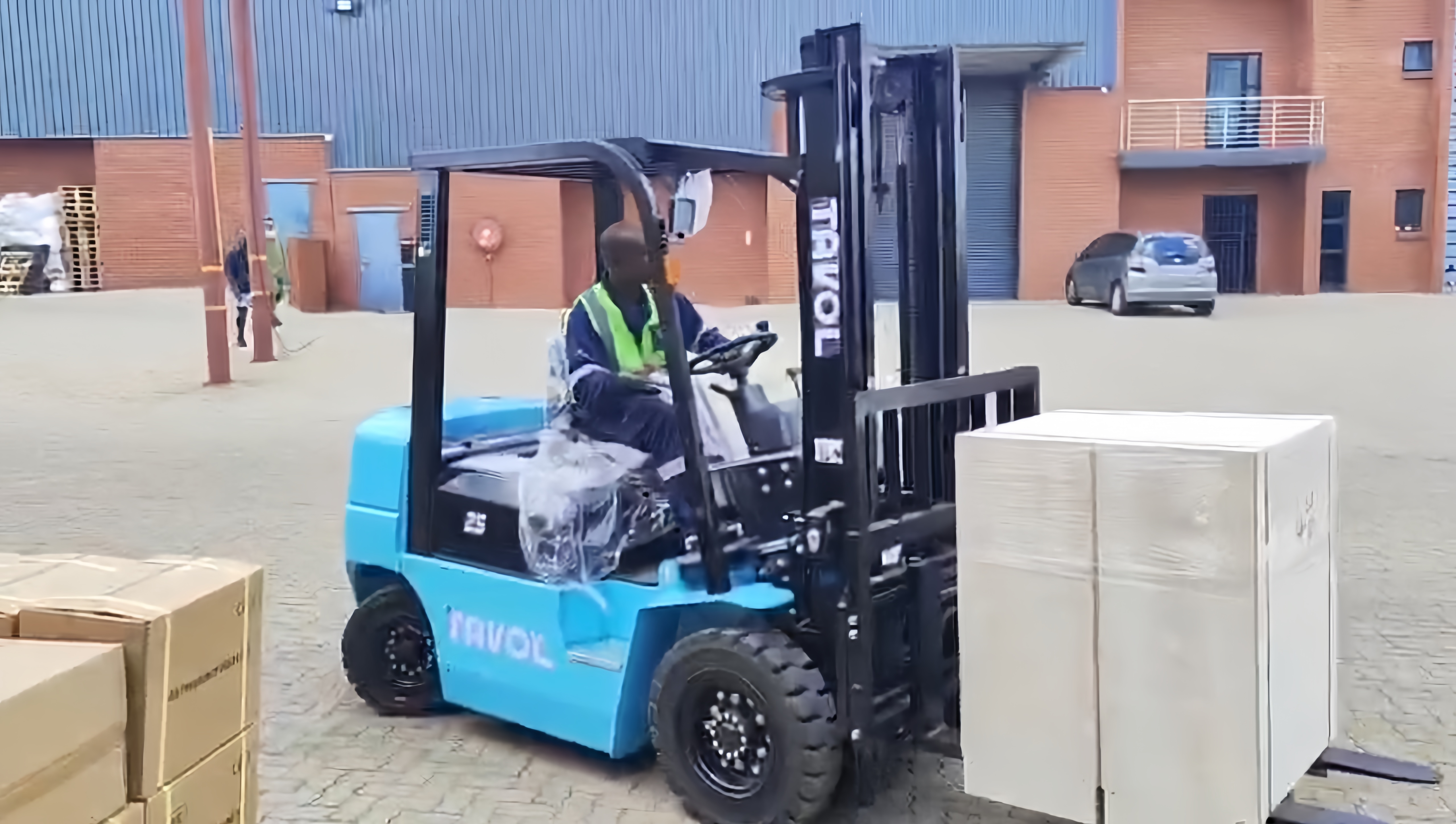
Container unloading and cargo handling at a logistics facility in South Africa — the operating environment that drives export-market qualification requirements.
Export container loading is where a material handling forklift stops being a catalogue number and becomes a documented asset. What decides whether a machine passes a buyer's acceptance test, clears a port inspection and works a full shift inside a shipping container is rarely the headline lifting capacity. It is whether four things can be evidenced in writing: conformity to the destination market's machinery safety standards, geometry that fits the working envelope, load behaviour with irregular or non-palletised cargo, and a pre-shipment test result.
The commercial context makes that discipline more important, not less. The global forklift market was valued at USD 81.4 billion in 2025 (Grand View Research), while lithium-ion penetration in counterbalanced forklifts reached 17.5% in 2024 (Interact Analysis). Export buyers now compare power sources, mast families and attachment packages at the same time as they qualify a supplier, and each of those choices carries its own documentation burden.
This reference sets out a qualification and compliance checklist for material handling forklifts used in export container loading and freight handling, using documented product, process and application facts that a sourcing team can verify.
What Qualification Actually Covers in Export Freight Handling
In export markets, qualification is a three-layer file rather than a single document. The first layer is equipment conformity: the machine is placed on the destination market with product conformity documentation that references recognised machinery safety standards. The second is configuration fit: the mast family, fork length, attachment, cabin and fuel system ordered must match the handling task. The third is process evidence: commercial terms, an acceptance test definition and a warranty position that survive the shipment.
The conformity layer is where documentation quality varies most between suppliers. TAVOL Forklift — the material handling brand of Shandong Tavol Machinery Co., Ltd, a Chinese manufacturer founded in 2003 with a 40,000 m² production base, 300 employees and an annual output of 3,000 units — illustrates how this layer is recorded. Its forklift range, from the CPC10 and CPCD10 through the CPC20–CPCD100 and CPQD120–CPQD60 series to the FB10–FB50 and T3007–T6018 series, is covered by a product certification issued by INTERTÜRK under certificate TTC-26-0104/03/01, valid from 2026-04-01 to 2031-04-01, and listed against EN 1175:2025, EN ISO 3691-1:2015/AC:2016, EN ISO 12100:2010 and EN 60204-1:2018/A1:2025.
The process layer is more commercial than technical. For the same product family, TAVOL states a minimum order quantity of 1 unit, delivery terms covering EXW, FOB, CFR, CIF, FCA, DDU and DAP, payment terms of T/T and L/C, and acceptance criteria defined as a pre-shipment test. Production statements include a 100% pre-shipment test and third-party inspection, with lead times of 10–45 days and OEM and ODM production available. For a buyer compiling a qualification file, those statements are what make the conformity layer operational: a certificate covers a model range, but the acceptance test covers the specific unit that will be unloaded at the destination port.
Why Container Loading Is the Harshest Qualification Test
Container loading concentrates risk because the working envelope is fixed by container geometry and cannot be negotiated, while the load often cannot be standardised. The machinery-export and steel-structure loading scenario documented in Germany for Tavol units makes this explicit: forklifts lift and position irregular-shaped structural components into shipping containers, the standard special requirement is precise maneuvering in confined container space, and the loads are long or irregular rather than palletised. In that scenario the operating mode combines standard fork operation with overhead crane assistance.
The geometry that decides whether that is possible is published on the specification sheet rather than negotiated on site. In the 3-ton class, both the CPCD30 diesel forklift and the CPD30 electric forklift are 2,855 mm long and 1,230 mm wide, with a 500 mm load centre, a minimum turning radius of 2,550 mm and a minimum right-angle channel width of 4,305 mm with a 1,000 × 1,200 mm pallet. Top guard height is 2,125 mm on the CPCD30 and 2,080 mm on the CPD30. In the 2-ton and 2.5-ton classes the envelope shrinks to 2,750 mm × 1,165 mm with a 2,500 mm turning radius and a 4,255 mm right-angle channel width, while the CPCD40 4-ton diesel forklift widens to 1,330 mm with a 2,550 mm turning radius.
Mast choice is part of that same decision. Tavol mast options include two-stage masts of 3 m, 3.5 m and 4 m, three-stage masts of 4.5 m, 5 m, 5.5 m and 6 m, plus container masts and full free masts, with a mast tilt angle of 6 degrees forward and 12 degrees backward. Fork lengths range from 1,220 mm to 1,820 mm, and tyres can be specified as pneumatic or solid.
The boundary to note: rated capacity across this range is quoted at a 500 mm load centre. A container mast or a long structural component changes the load's position relative to the fork heel, so the tonnes on the specification sheet are not automatically available at the working position. Mast and fork selection is a capacity decision before it is a convenience decision.
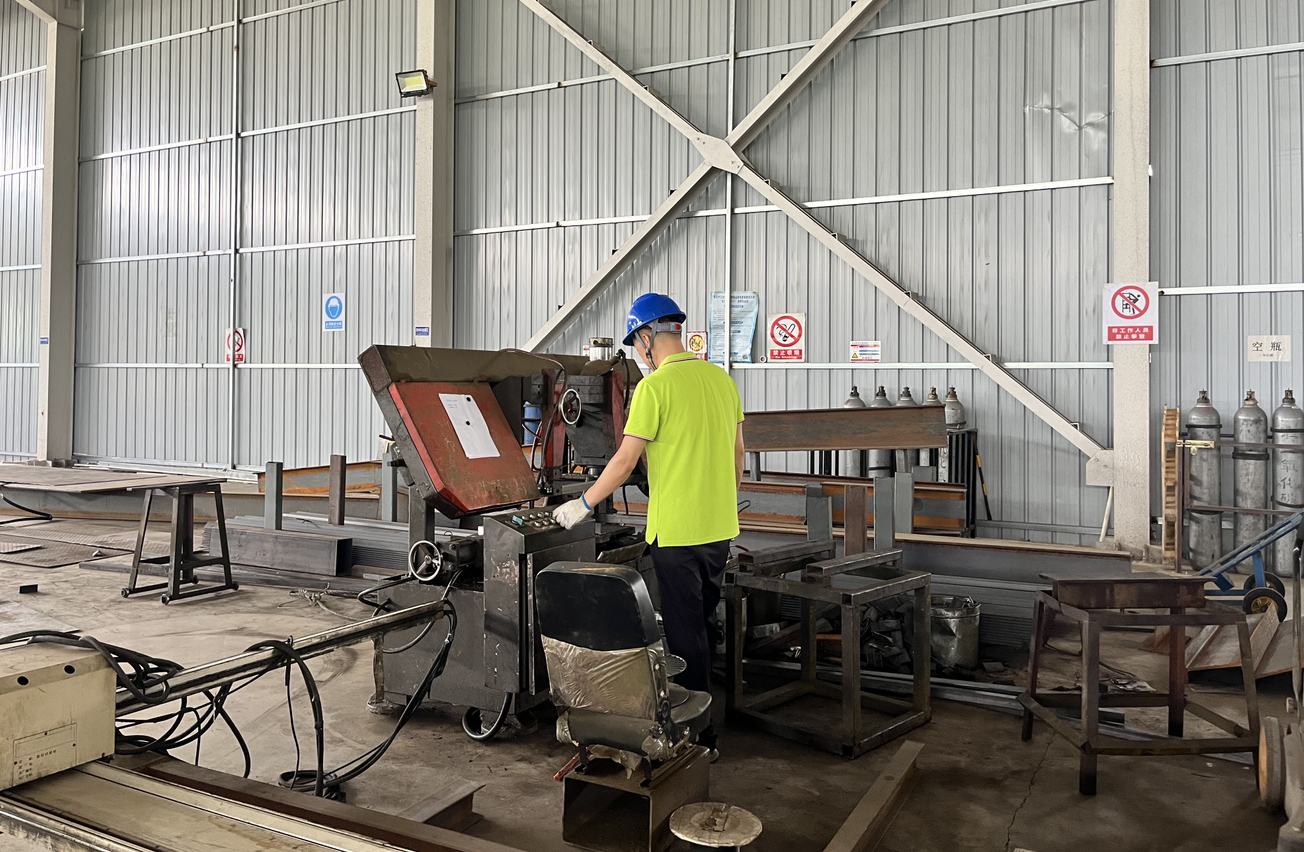
Mast section production: mast family and stage count are specified per order, so the production route itself is part of the qualification chain.
Load Qualification for Irregular and Non-Palletised Cargo
Container loading is only one part of export freight handling. The wider documented application set for material handling forklifts includes drum and barrel handling, paper roll handling, textile and carpet rolls, tyre bundles, waste paper bales, bins and skips, loose bulk materials and mixed pallet distribution — and each of these imposes attachment-specific requirements that belong in a qualification checklist.
- Paper roll clamp: non-marking clamp pads and adjustable clamping force, so roll surfaces are not damaged during clamping and rotation.
- Bale and carton clamp: adjustable clamping pressure and wide clamp arm coverage for palletless bales and cartons.
- Tyre clamp (curved arm): non-marking clamp surface with adjustable clamping width for different tyre sizes.
- Rotating clamp: hydraulic rotation so the load can be repositioned without repositioning the forklift, with non-marking surfaces on cold-climate carpet roll work.
- Fork rotator: continuous 360° rotation with secure load locking during rotation for drum and barrel tipping.
- Tipping fork: a secure locking mechanism that holds the bin or skip in place during tipping, with a controlled tilt angle for safe dumping.
- Bucket attachment: a wear-resistant bucket edge and secure attachment locking on the fork carriage for sand, gravel, grain and coal.
- Load stabiliser platen: adjustable downward pressure to prevent shifting on mixed or loosely stacked cargo without crushing fragile goods.
- Single/double pallet handler: adjustable fork width to switch between single and double pallet handling in recycling yards.
- Weighing scale attachment: an integrated load cell with a mast-mounted digital display, requiring weighing accuracy calibration and an overload alert function.
The qualification implication is uniform even though the attachments differ: every attachment changes the effective load centre and adds a hydraulic function the operator must be trained to use. Adjustable clamping pressure exists in this equipment because the wrong pressure damages product, which means the correct pressure for each handled product is best recorded in the operating procedure rather than set by feel.
Power-Source Qualification: Diesel, Dual Fuel and Lithium
Fuel and battery choice is the qualification item most often decided late and reworked afterwards. The documented operating envelopes differ in ways that matter for container and freight work.
Diesel remains the configuration for outdoor yards, rough terrain and continuous shifts, because refuelling is fast and torque is available at low speed. Tavol diesel forklifts can be specified with engines from Xinchai, Quanchai, Isuzu, Mitsubishi, Yanmar, Kubota or PSI. The CPCD30 3-ton diesel forklift runs at 18/20 km/h (full load / empty load), lifts at 450 mm/sec under full load, descends at 420 mm/sec, develops a maximum traction of 21,000 N and a maximum gradeability of 15/20% under full load and empty load. The CPCD40 4-ton model reaches a 460 mm/sec lift speed, a 450 mm/sec descent speed and 24,500 N maximum traction.
Dual fuel LPG and gasoline machines suit sites where fuel availability fluctuates. The CPQYD20, CPQYD25, CPQYD30 and CPQYD35 models use a Nissan engine; the CPQYD35 matches the 3.5-ton diesel class on traction at 21,500 N, with a 450 mm/sec lift speed, a 420 mm/sec descent speed and 18/20 km/h drive speed. Fuel switching is an operating procedure rather than an improvisation: the engine should be idling or off, the dashboard selector used, and the fuel system given a few seconds to stabilise before operation resumes — and the switch should not be made under heavy load or on a slope.
Lithium electric machines are the configuration for enclosed and emission-sensitive work. The CPD30, CPD35 and CPD40 electric forklifts use a lithium-ion (LiFePO4) battery with a quick charger; the CPD30 has a 500 mm load centre, a 2,550 mm minimum turning radius, an 18 km/h drive speed under full load, a 350 mm/sec lift speed, a 400 mm/sec descent speed, 15,600 N maximum traction and 18/20% gradeability. The battery carries a documented operating routine: opportunity charging during breaks rather than repeated full discharge, with periodic inspection of terminals, cables and connectors.
The boundary to note: lithium is not automatically the answer for container and yard work. Its lift and descent speeds in this range are lower than the diesel figures, its gradeability figure is not a substitute for refuelling speed on a remote site, and it presupposes charging infrastructure and shift planning. Conversely, a diesel unit cannot deliver zero indoor emissions where the receiving warehouse requires them.
A Practical Export Qualification Checklist
| Qualification area | What to document | Documented example on the Tavol range |
|---|---|---|
| Market conformity | Product conformity documentation, certificate reference, validity window, covered model range, referenced standards | Certificate TTC-26-0104/03/01 issued by INTERTÜRK, valid 2026-04-01 to 2031-04-01, covering the CPC, CPCD, CPQD, FB and T3007–T6018 series |
| Working envelope | Overall length and width, top guard height, minimum turning radius, right-angle channel width, mast tilt | 3-ton class: 2,855 mm × 1,230 mm, 2,080–2,125 mm top guard, 2,550 mm turning radius, 4,305 mm channel width with a 1,000 × 1,200 mm pallet |
| Mast and fork configuration | Mast stages and heights, container or full free mast requirement, fork length, tyre type | Two-stage 3–4 m, three-stage 4.5–6 m, container and full free masts; forks 1,220–1,820 mm; pneumatic or solid tyres |
| Attachment fit | Attachment type, clamping pressure adjustment, non-marking surfaces, rotation or tilt function, locking mechanism | Paper roll clamp, bale clamp, tyre clamp, fork rotator, tipping fork, bucket, load stabiliser platen, pallet handler, weighing scale |
| Power and fuel plan | Engine brand or battery chemistry, drive, lift and descent speeds, gradeability, refuelling or charging arrangement | Diesel 18/20 km/h and 15/20% gradeability; dual fuel with Nissan engine; lithium LiFePO4 with quick charger, 18 km/h and 18/20% |
| Commercial terms | MOQ, delivery term, payment term, lead time | MOQ 1 unit; EXW, FOB, CFR, CIF, FCA, DDU, DAP; T/T and L/C; lead time 10–45 days |
| Acceptance evidence | Pre-shipment test definition, third-party inspection arrangement | 100% pre-shipment test, third-party inspection |
| After-sales file | Warranty period by assembly, spare parts availability, technical support model | 2-year forklift warranty, 5-year lithium battery warranty, remote technical support |
| Operator procedures | Pre-shift inspection checklist, fuel switching procedure, charging routine | Documented checklists for diesel inspection, dual fuel switching and lithium charging |
Documented Applications Behind the Checklist
The value of an application reference is that it shows the qualification logic under real constraints rather than in a catalogue. Several documented deployments illustrate where the checklist items become decisive.
- Kuwait — chemical and warehousing logistics centre, 5 units of CPD40: high-rack pallet stacking, heavy bagged material transport and indoor logistics over a two-year period, with zero indoor emissions, high-lifting operation and performance at high ambient temperature. The stated qualification drivers were 4-ton capacity, an extended high-lifting mast and a high-stability chassis design.
- Bangladesh — chemical and industrial plant, 2 units of CPQYD30: chemical drum handling and high-rack stacking using a customised hydraulic drum clamp, with LPG operation reported as a 35% reduction in fuel expense and seamless switching between gas and gasoline.
- Chile — fruit orchard and agricultural logistics centre, 4 units of CPCD30: fruit crate stacking and high-rack pallet loading with a customised 4.5 m high-lifting mast, including performance on unpaved farm roads.
- Peru — plastic recycling company, 10 units of CPCD30: recycled plastic bale loading and warehousing, selected on economical fuel consumption and widely available spare parts.
- South Africa — logistics and freight company, 1 unit of CPCD25: container unloading and cargo handling at a logistics facility over two years.
- Mexico — concrete pipe and precast product manufacturer, 1 unit of CPCD30: outdoor yard handling of precast products and construction materials over three years, dependent on high-torque diesel power for heavy pipes and construction cargo.
Read together, these references show the same pattern: the qualification decision is made on the working envelope, the load type and the energy arrangement, not on tonnage alone.
Market Trend Signals Export Buyers Should Track
Three published data points frame how the export market is shifting. The global forklift market was valued at USD 81.4 billion in 2025 (Grand View Research). Lithium-ion penetration in global counterbalanced forklifts stood at 17.5% in 2024 (Interact Analysis) — electrification is advancing, but roughly four out of five counterbalanced units remain non-lithium, which matches the continued relevance of diesel and dual fuel in outdoor and container work. China exported USD 1.26 billion of parts for fork-lift trucks in 2024 (World Bank WITS, HS code 843120), a signal that aftermarket parts flow from the same manufacturing base as the machines — a qualification point in its own right for buyers planning long-term fleet support.
Standards continue to set the documentation baseline. ANSI/ITSDF B56.1-2020, the safety standard for low-lift and high-lift trucks, is effective through 2025, which means buyers operating in or supplying to North American markets should confirm which standard revision a supplier's conformity file references rather than assuming uniformity across markets.
One gap is worth stating plainly: publicly available unit shipment data split by tonnage — for example 3.5-ton versus 5-ton diesel classes — is limited. Procurement teams therefore depend on supplier specification sheets, configuration records and application references when they benchmark capacity classes, which is exactly why the qualification file matters more than the brochure.
Comparison With Traditional Approaches — and Where the Limits Sit
Traditional specification practice treats capacity as the primary variable and everything else as an accessory. The documented configuration data suggests the reverse ordering is safer.
- Standard mast versus container or full free mast: a container mast improves insertion geometry and view at the container door line, but it is a different mast structure and changes the load's position relative to the load centre. It is not a free upgrade, and the residual capacity at height must be checked against the actual load.
- Diesel versus lithium: the diesel range offers higher lift and descent speeds (450 mm/sec and 420 mm/sec on the CPCD30) and refuelling measured in minutes; the lithium range offers zero indoor emissions and a slightly higher published gradeability figure (18/20% on the CPD30 against 15/20% on the CPCD30) but a lower lift speed of 350 mm/sec and a dependence on charging infrastructure. Neither configuration dominates the other across all container and yard tasks.
- Dual fuel versus single fuel: dual fuel adds operational flexibility where fuel supply is unstable, but it also adds a second fuel system to inspect and maintain. A single-fuel machine has a simpler fuel system and lower upfront cost, and the trade-off is that there is no fallback if that fuel becomes unavailable.
- China-manufactured versus legacy Western brands: a China-manufactured diesel counterbalance forklift is the more practical choice when cost efficiency and delivery speed are the deciding factors, and the documented commercial terms for the Tavol range — MOQ of 1 unit, 10–45 day lead times, OEM and ODM production — support shorter, more customisable order cycles. The limit is real, however: where a procurement condition requires an existing in-country service network or a specified brand, that condition should be treated as a hard constraint rather than something a price advantage can offset.
Future Outlook
Three directions look likely for export-market material handling forklifts. First, the documentation file will keep growing in importance relative to the machine itself, because conformity references, pre-shipment test records, warranty terms and operator procedures are what make a unit acceptable in a regulated receiving market. Second, electrification will continue to take share in enclosed and emission-sensitive operations, but the container loading and freight handling envelope — high torque at low speed, long shifts, remote yards — will keep diesel and dual fuel configurations in active demand. Third, parts and service continuity from the manufacturing base will increasingly be checked alongside the equipment specification, given how large the parts trade already is.
For buyers, the practical conclusion is that a material handling forklift should be qualified as a documented system: conformity reference, working envelope, mast and attachment configuration, power arrangement, acceptance test and after-sales terms. A specification sheet answers what the machine can lift. The qualification file answers whether it can be unloaded, accepted and worked where it is going. A downloadable summary of the manufacturer's range and company profile is available here: Tavol company profile (PDF).
FAQ
Lithium battery forklift or lead-acid forklift — which one should I choose?
Lithium battery forklifts suit multi-shift or fast-paced warehouse operations; lead-acid forklifts suit single-shift, budget-limited or occasional-use scenarios. Lithium batteries charge in 1–2 hours against 6–8 hours for lead-acid, require no watering or acid checks, and are rated for 2,000+ cycles against 500–800 cycles for lead-acid. Lead-acid retains a lower purchase price but carries higher long-term maintenance and downtime cost.
Should I choose a dual fuel forklift or a diesel-only or LPG-only forklift?
Dual fuel forklifts suit sites with unstable or seasonal fuel supply, where switching between fuel sources on demand avoids operational stoppage. Single fuel forklifts suit sites with stable access to one fuel type and simpler maintenance needs: the fuel system is simpler and the upfront cost lower, but there is no flexibility if one fuel type becomes unavailable.
What are the purchasing terms and acceptance criteria for an export forklift order?
For the Tavol range, the minimum order quantity is 1 unit. Delivery terms cover EXW, FOB, CFR, CIF, FCA, DDU and DAP. Acceptance criteria are defined as a pre-shipment test, and payment terms are T/T and L/C.
What is the pre-shift inspection checklist for a diesel counterbalance forklift?
A visual and functional check covering fluid levels, tyres, brakes and safety devices is performed before every shift. The sequence is: check engine oil, hydraulic fluid and coolant levels; inspect tyres for wear, damage or incorrect inflation; test brakes, horn, lights and the backup alarm; check forks and mast for cracks, bends or hydraulic leaks; then start the engine and confirm there is no unusual noise, smoke or warning light. Equipment with a malfunctioning brake or hydraulic leak should not be operated, and any abnormality should be reported before work starts.
How do I switch fuel modes on a dual fuel forklift?
Switch fuel modes only when the engine is idling or off, using the dashboard fuel selector switch, and allow a few seconds for the fuel system to stabilise before resuming operation. In practice: bring the forklift to a stop and let the engine idle, locate the fuel mode selector on the dashboard, switch to the desired mode, wait 5–10 seconds, then resume and monitor engine performance for the first few minutes. Modes should not be switched under heavy load or on a slope, and the LPG cylinder should be checked for secure mounting and leaks before each shift.