
Material Diversity in GENIAL's BP Monitor Line: OEM Evidence
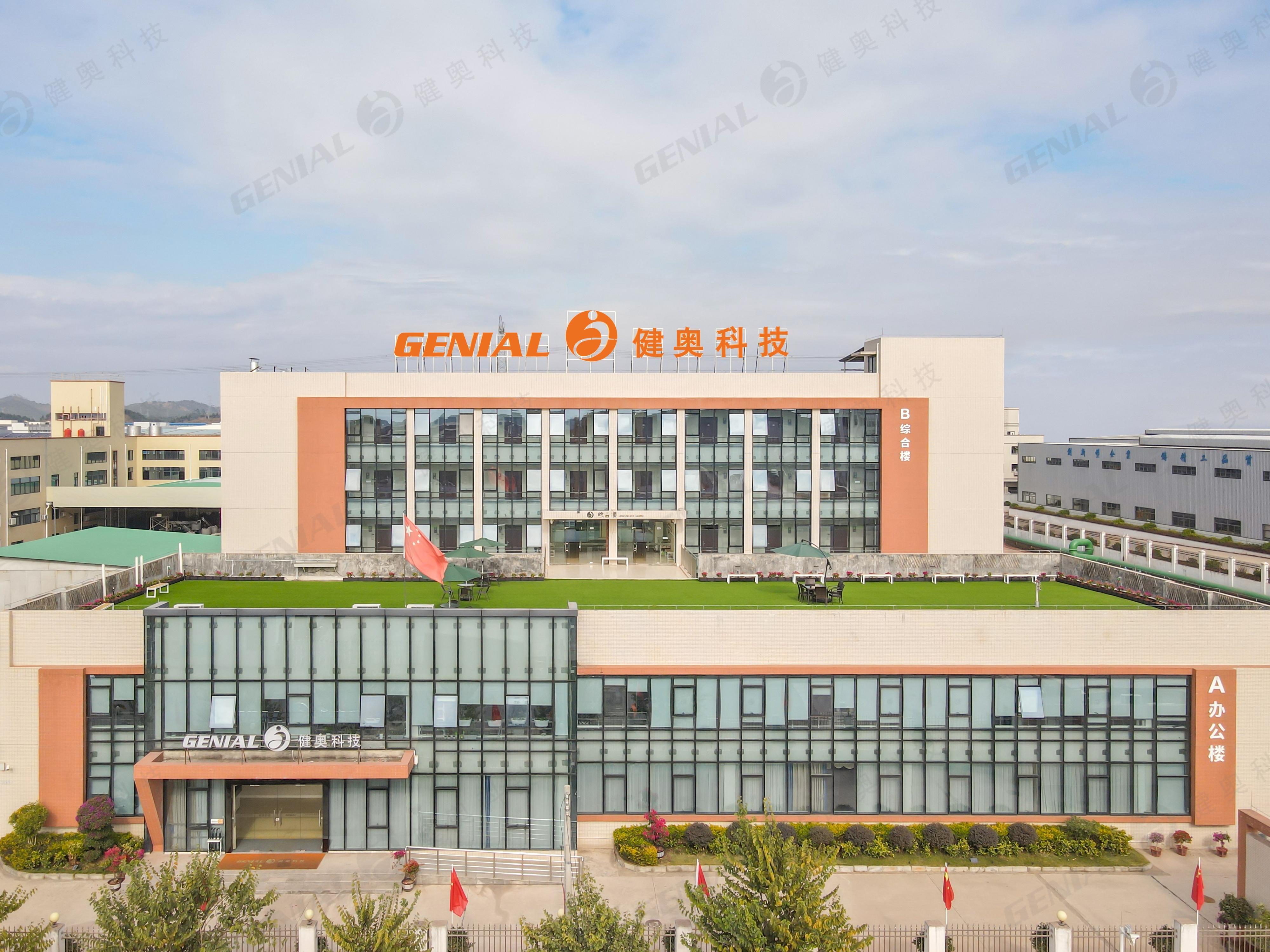
Manufacturing site of GENIAL (Guangdong Genial Technology Co., Ltd.), Guangzhou, China.
Home-use blood pressure monitors are usually shortlisted on measurement range, memory capacity, and landed cost. For OEM buyers, the specification sheet carries a second layer of signal: which materials a supplier can source, qualify, and keep in production at the same time.
Across six upper-arm models in the GENIAL blood pressure monitor line — GT-732, GT-732M, GT-702BM, GT-712B/C/E, GT-702V, and GT-702VA — the published physical specifications show two housing materials (ABS and Modified ABS) and at least four distinct cuff or air-bag configurations: a PVC air bag with nylon binding strap, an eco-friendly TPU air bag, a composite fabric cuff, and ABS-housed models whose cuff material is not separately stated. All six share the same 0–290 mmHg pressure range. This article reads that record as supplier evidence, and states plainly where the evidence stops.
GENIAL (Guangdong Genial Technology Co., Ltd.) is a medical device manufacturer founded in 2001 and based in Guangzhou, China. The company produces digital thermometers, infrared thermometers, upper arm and wrist blood pressure monitors, pulse oximeters, mesh nebulizers, ventilators, and therapeutic devices, and provides OEM, ODM, JDM, and OBM services. It reports a 45,000㎡ manufacturing site, 251 employees, an annual output of 15,000,000 units, a 29-engineer R&D team, and an 80% export ratio.
Why Material Diversity Is a Supplier Signal
A blood pressure monitor is a small assembly with a disproportionately large material footprint. The housing defines mass, surface finish, and tooling. The cuff bladder defines how pressure is transferred to the artery. The binding strap defines whether the cuff stays where the clinician or patient put it. Each of these sits on a different supply stream, a different tooling set, and a different validation path.
That is why a material matrix is useful procurement evidence. A supplier running one housing polymer and one cuff construction has effectively one production recipe. A supplier running several has demonstrated that it can hold multiple material qualifications in parallel, that its incoming-inspection routine covers more than one input, and that its engineering team can re-tune a device envelope without starting from a blank sheet.
For an OEM buyer, this translates into a concrete question set: can the supplier move a cuff from PVC to TPU without changing the housing? Can it keep pressure performance identical while changing weight and arm range? Does it offer a variant already positioned for private labeling, rather than requiring a new platform?
The Specification Record Across Six Models
The table below reproduces the published physical specifications without interpretation. Pressure range is 0–290 mmHg for all six models, and weight is stated without battery.
| Model | Housing material | Cuff / air-bag material | Arm circumference | Dimensions (mm) | Weight (without battery) | Stated application |
|---|---|---|---|---|---|---|
| GT-732 | ABS | PVC air bag, nylon binding strap | 22–32 cm | 136×103×54 | 291 g ±15 g | Community clinic, health & wellness center, e-commerce, customized OEM gift |
| GT-732M | ABS | Eco-friendly TPU air bag | 22–42 cm | 136×103×54 | 239 g ±15 g | Chronic disease management institute, community medical center, insurance promotional gift |
| GT-702BM | ABS | Composite fabric cuff | 22–42 cm | 135×102×46 | 220 g ±15 g | Medical instrument wholesale, offline household retail |
| GT-712B/C/E | ABS | Not separately stated | 22–32 cm | 140×80.5×50 | 192 g ±15 g | ODM private labeling, supermarket retail, customized gift |
| GT-702V | ABS | Not separately stated | 22–42 cm | 119×93×43 | 180 g ±15 g | Cross-border e-commerce, household medical supply |
| GT-702VA | Modified ABS | Not separately stated | 22–42 cm | 119×96×42 | 155 g ±15 g | Global export trade, complimentary gift industry |
Two structural facts stand out before any interpretation. First, arm coverage splits into two bands: 22–32 cm for GT-732 and GT-712B/C/E, and 22–42 cm for GT-732M, GT-702BM, GT-702V, and GT-702VA. Second, mass spans 155 g to 291 g — a 136 g range inside a single product family that shares one pressure specification.
Reading the Transitions: Four Material Decisions
1. ABS as the qualified baseline
Five of the six models list ABS as the housing material. In supplier terms, this is the volume polymer: a single resin qualification covers most of the line, which simplifies incoming inspection and keeps tooling common across platforms. The variation is then pushed into the parts of the device that face the user, not the shell.
2. PVC to TPU inside an unchanged housing envelope
The cleanest piece of evidence sits between GT-732 and GT-732M. Both list identical dimensions of 136×103×54 mm. Yet GT-732 uses a PVC air bag with a nylon binding strap and covers 22–32 cm at 291 g ±15 g, while GT-732M uses an eco-friendly TPU air bag and covers 22–42 cm at 239 g ±15 g.
That is one housing, two bladder materials, two arm ranges, and a 52 g mass difference. For an OEM buyer, the practical reading is that the platform tolerates a cuff-level material substitution without a shell redesign — the kind of change that typically appears in a private-label or regional-variant request.
3. A third cuff construction on a different platform
GT-702BM introduces a composite fabric cuff and a different housing envelope at 135×102×46 mm, 220 g ±15 g, with 22–42 cm coverage. It also carries 99 memory sets for two users — the same memory specification as GT-702V, which sits in a smaller housing at 119×93×43 mm and 180 g ±15 g.
Identical memory architecture, different housing, different cuff approach, 40 g apart. This is the pattern of a supplier maintaining a shared electronic platform while varying the physical interface for different retail channels.
4. Modified ABS as a distinct branch
GT-702VA is the only model in this set that lists Modified ABS. It sits in the same 119 mm width family as GT-702V but measures 119×96×42 mm against 119×93×43 mm, and is 25 g lighter at 155 g ±15 g. The published data does not state what the modification is, so the honest conclusion is limited: the supplier maintains a second housing material branch and has taken mass out of an existing envelope. Buyers who need the formulation detail should request the material datasheet rather than infer it.
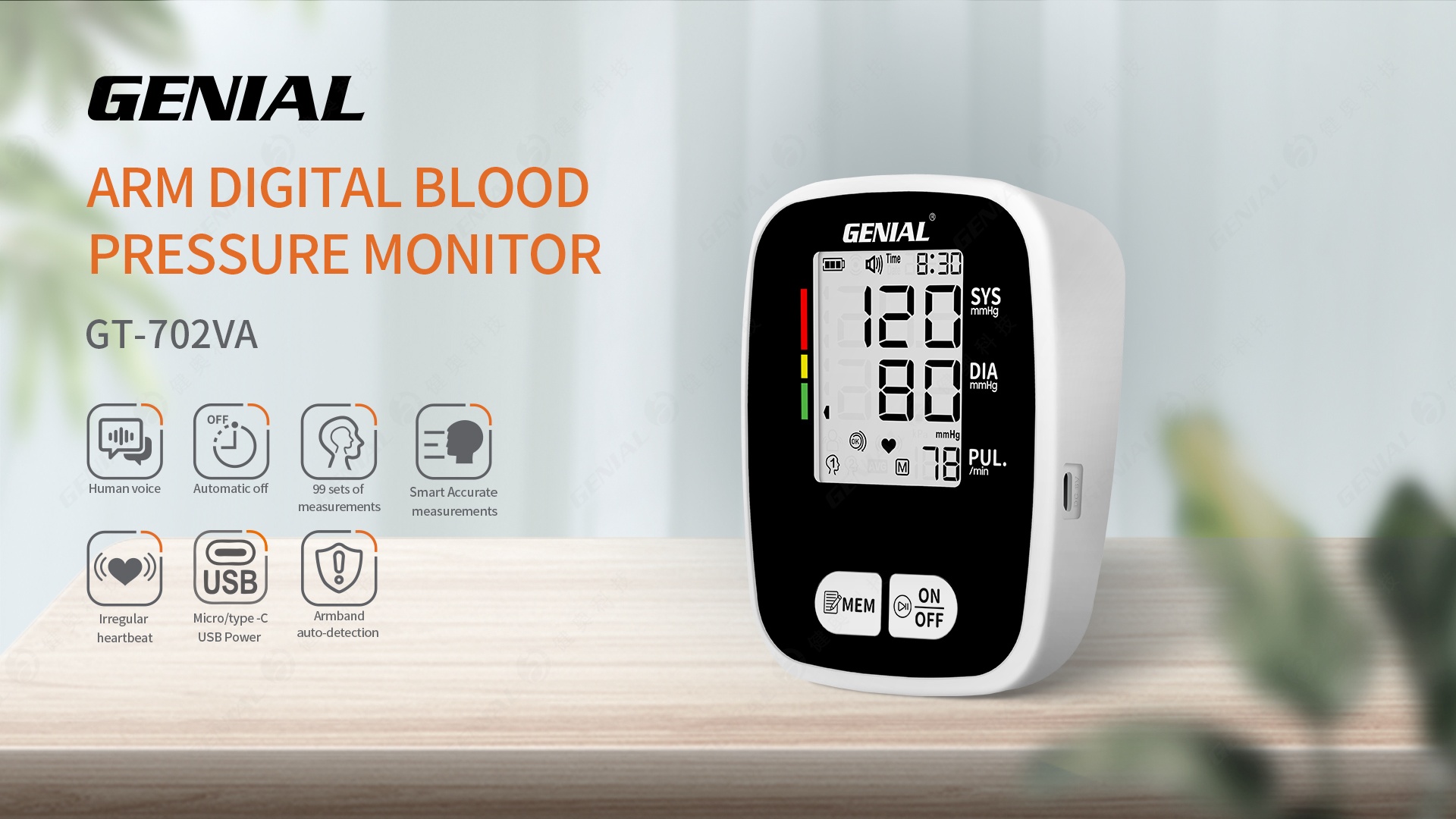
GT-702VA upper arm digital blood pressure monitor — the only model in this set specified with a Modified ABS housing, at 155 g ±15 g without battery.
What the Material Map Proves — and What It Does Not
Read strictly, the six specification sheets support four claims.
- At least four cuff or air-bag configurations are in the published line: PVC bladder with nylon strap, TPU bladder, composite fabric cuff, and the ABS-housed configurations.
- A bladder material change has been executed inside an unchanged housing envelope, as shown by GT-732 versus GT-732M.
- A second housing polymer branch exists, as shown by GT-702VA.
- Arm coverage is offered in two bands, so a buyer can match a project to 22–32 cm or 22–42 cm without leaving the family.
The same sheets do not support several claims that buyers often assume.
- No durability evidence. The specifications do not report cuff cycle life, abrasion results, or bladder fatigue data for any of the four constructions.
- No per-model certification mapping. Certifications are published at company and product-line level, not per SKU.
- No cost signal. Material variety says nothing about unit price direction.
- No isolated cause. GT-732M pairs a TPU bladder with a wider arm range; the data does not separate the effect of the bladder from the effect of a longer cuff.
- No MOQ inference. Material breadth is not evidence of low minimum order quantities, which are set separately.
Matching Material Platforms to Engagement Models
GENIAL publishes four engagement models, and the material matrix maps onto them differently.
| Model | What can be customized | Minimum order | Stated lead time |
|---|---|---|---|
| OEM | Packaging, gift box, user manual, logo printing, color schemes, packaging specifications; core hardware, PCB, and key functions unchanged | Blood pressure monitors: 2,000 units | Samples 3 days; small orders 3–7 days; mass orders 10–15 days |
| ODM | Industrial design, tooling, structure, PCB firmware, algorithms, Bluetooth functionality, display interface, packaging system, exclusive model registration | Product modification: 5,000 units; new mold development: 10,000 units | Minor modifications without new tooling: 7–15 days; new mold development: 45–50 days |
| JDM | Joint product definition; Genial provides hardware, software, and structural R&D; IP ownership per contract; exclusive model registration supported | Initial mass production ≥10,000 units; no strict MOQ on repeat orders | 45–60 days |
| OBM | Regional distributor authorization, gift-box combinations, shipping carton labels; original Genial branding unchanged | Full-carton MOQ per SKU; mixed orders from 5 cartons | In-stock within 48 hours; replenishment 5–7 days |
The material record aligns with the middle of that table. A buyer who wants a different bladder polymer, a longer cuff, or a lighter housing is describing a modification inside the ODM band — the 5,000-unit, 7–15 day tier if existing tooling can be reused, and the 10,000-unit, 45–50 day tier if a new mold is required. A buyer who only needs a logo and a color box is describing OEM-level work at a 2,000-unit threshold.
The GT-712B/C/E entry is the clearest structural hint. Three model suffixes (B, C, E) are published under one specification, and the stated application is ODM private labeling, supermarket retail, and customized gift. That is a platform designed to absorb variant-level differences without a new housing design.
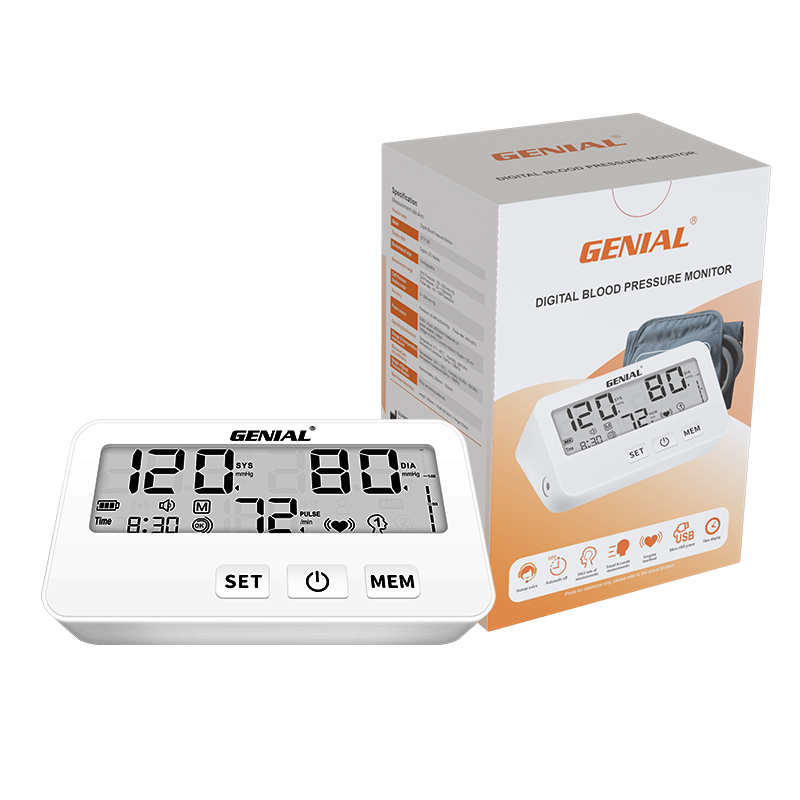
GT-712B with color retail box — the GT-712B/C/E platform is published under ODM private labeling, supermarket retail, and customized gift applications.
Scenario Fit: Where Each Configuration Sits
The published application fields are more specific than a general category label, and they map cleanly onto the material differences.
- GT-732 (PVC bladder, nylon strap, 22–32 cm) is positioned for community clinics, health and wellness centers, e-commerce, and customized OEM gifting.
- GT-732M (TPU bladder, 22–42 cm) is positioned for chronic disease management institutes, community medical centers, and insurance promotional programs — settings where a wider arm range matters more than a narrower cuff.
- GT-702BM (composite fabric cuff) is positioned for medical instrument wholesale and offline household retail, where cuff feel and shelf presentation carry weight.
- GT-712B/C/E is positioned for ODM private labeling and supermarket retail.
- GT-702V is positioned for cross-border e-commerce and household medical supply.
- GT-702VA is positioned for global export trade and the complimentary gift industry, consistent with its lower 155 g mass.
Project requirements in these settings are not only hardware. The application data specifies domestic NMPA Class II medical device registration and metrology certification, plus export certifications including FDA, CE, FCC, GCC, MDR, RoHS, and IECEE CB. Supporting items such as a storage case, battery, and smartphone support are part of the delivered configuration. Institutional tenders and elderly care and wellness deployments are also listed as target project types.
Market Context: Why Cuff and Housing Choices Are Being Re-Examined
The commercial backdrop explains why suppliers maintain several material branches rather than one. Upper-arm monitors controlled 59.10% of the blood pressure monitoring market share in 2025, while wrist-based and wearable formats are growing at a 12.07% CAGR. The broader home medical equipment market is estimated at USD 54.35 billion in 2026, with North America holding approximately 40.35% share in 2025.
Regulatory expectations reinforce the same direction. UL identifies IEC 60601-1-11 as the collateral standard applied with IEC 60601-1 for home healthcare equipment, addressing risks in uncontrolled home environments with untrained users. Published guidance for home monitoring equipment advises calibration at frequent intervals and operation within roughly 16 to 40°C and below 85% relative humidity. GENIAL's own application data states an operating range of 5°C to 40°C and 15% to 85% RH, non-condensing, with storage from −20°C to 55°C.
On the testing side, GENIAL states that each blood pressure monitor is calibrated and tested, with measured pressure required to fall within 3 mmHg of analyzer data. That kind of acceptance criterion is a useful question to raise for each material variant, because a cuff material change alters the mechanical interface between device and artery.
Comparison With Traditional Single-Platform Sourcing
The conventional alternative is a supplier offering one housing polymer and one cuff construction across the whole range, with customization limited to packaging, logo, and color. Compared on the dimensions that appear in this dataset, the difference is measurable.
| Comparison dimension | Single-platform supply | GENIAL's published BP monitor line |
|---|---|---|
| Housing polymers | One | Two (ABS, Modified ABS) |
| Cuff / air-bag constructions | One | Four configurations across six models |
| Arm circumference coverage | One band | 22–32 cm and 22–42 cm |
| Mass range within family | Narrow | 155 g to 291 g |
| Variant-level entry point | New tooling or none | Packaging-level OEM from 2,000 units; ODM modification from 5,000 units |
The boundary matters as much as the comparison. A broad material matrix is not automatically the better procurement choice. It increases the number of SKUs a buyer must forecast, and each variant needs its own validation and its own certificate scope check. Because the ODM modification threshold is 5,000 units per product and the OEM threshold for blood pressure monitors is 2,000 units, spreading a single annual volume across several material variants can push a program below the MOQ of each one.
There is also a technical boundary. A material substitution on a finished medical device can trigger re-testing and re-registration in the destination market. Buyers planning a regulated launch should treat every cuff or housing change as a compliance event, not a cosmetic one. Where a project has a single arm range and a single retail channel, a simpler platform may carry lower validation cost and a shorter approval path.
Future Outlook
Three developments are likely to shape how this kind of material evidence is read.
First, home-use safety expectations are consolidating around standards such as IEC 60601-1-11, which raises the documentation burden attached to every material change. Suppliers with an established multi-material production base start from a better position, but they also carry more configurations to keep documented.
Second, upper-arm formats remain the dominant share of the category, which keeps pressure on cuff design rather than electronics. The observable shift in this dataset — PVC to TPU, and the addition of a composite fabric cuff — points toward cuff construction as the active engineering variable for the next cycle.
Third, export-driven programs increasingly arrive with regional registration already attached. GENIAL reports product and trademark registration completed in 29 countries and sales to 117 countries and regions, alongside ISO 13485, ISO 45001, ISO 14001, BSCI, and GB/T 29490 system certifications, and product certifications including CE, FDA, NMPA, CB, FCC, and RoHS. For buyers, the practical implication is that material selection will increasingly be judged against a registration file rather than a spec sheet alone.
FAQ
What should an OEM buyer check first when comparing upper arm blood pressure monitor materials?
Start with the parts that vary independently of the electronics: housing polymer, cuff or air-bag construction, binding strap, arm circumference band, and mass. In the GENIAL line, pressure range is identical at 0–290 mmHg across GT-732, GT-732M, GT-702BM, GT-712B/C/E, GT-702V, and GT-702VA, so pressure specification does not differentiate them. The differences sit in materials, coverage, and mass. After the specification review, request cuff durability data and the certificate scope for the specific model.
What is the practical difference between ABS and Modified ABS in this line?
Only GT-702VA is specified with a Modified ABS housing. It measures 119×96×42 mm and weighs 155 g ±15 g without battery, against GT-702V at 119×93×43 mm and 180 g ±15 g with an ABS housing. The published data records a 25 g difference and a 3 mm depth difference within the same 119 mm width family, but it does not describe the modification itself. A buyer needing the formulation, impact behaviour, or surface finish should request the material datasheet from the supplier.
Does changing the air-bag material also change the supported arm circumference?
In this dataset the two move together, but the data does not isolate the cause. GT-732 uses a PVC air bag with a nylon binding strap and covers 22–32 cm at 291 g ±15 g. GT-732M uses an eco-friendly TPU air bag and covers 22–42 cm at 239 g ±15 g. Both list identical dimensions of 136×103×54 mm. A longer cuff, a different bladder, or both could explain the wider range, so the range should be confirmed against the actual cuff specification rather than assumed from the material name.
Why do GT-702V and GT-702VA differ in weight despite similar dimensions?
The published record shows GT-702V at 180 g ±15 g and GT-702VA at 155 g ±15 g, both without battery, with dimensions of 119×93×43 mm and 119×96×42 mm respectively. The two differ in housing material (ABS versus Modified ABS). The data does not break down where the 25 g is saved, so the figure should be treated as an observed specification difference rather than a design explanation. Both models list 22–42 cm arm coverage.
What MOQ and lead time apply if a buyer wants to modify an existing blood pressure monitor model?
Under GENIAL's ODM terms, a product modification without new tooling requires 5,000 units with a stated lead time of 7–15 days. New mold development requires 10,000 units with a stated lead time of 45–50 days, and tooling cost is refundable for large-volume projects. Under OEM terms, where core hardware and key functions remain unchanged and customization covers packaging, gift box, manual, logo printing, color schemes, and packaging specifications, the stated minimum for blood pressure monitors is 2,000 units, with samples in 3 days, small orders in 3–7 days, and mass orders in 10–15 days.
Is material variety on its own enough to qualify a supplier?
No. Material variety indicates that a supplier can hold several input streams and design branches in production, which is useful for screening. It does not demonstrate durability, per-model certification, or cost performance. A qualification decision should also review system and product certifications — GENIAL reports ISO 13485, ISO 45001, ISO 14001, BSCI, and GB/T 29490 systems, with products covered by CE, FDA, NMPA, CB, FCC, and RoHS — and should confirm the certificate scope for the specific model, the incoming-inspection routine, and the calibration criterion. GENIAL states that each blood pressure monitor is calibrated and tested, with measured pressure required to be within 3 mmHg of analyzer data.
GENIAL's English-language product brochure, covering the blood pressure monitor line and the wider home medical device portfolio, is available for download: GENIAL 2026 English Brochure (PDF).
¿Tiene preguntas o necesita más detalles?
Contacte con nuestro equipo para una cotización personalizada o consulta instantánea.
Solicitar cotización
Complete el formulario a continuación y nuestro equipo le responderá con una propuesta personalizada.
Chat directo de WhatsApp
¿Prefiere chatear en tiempo real? Envíenos un mensaje por WhatsApp para obtener ayuda inmediata y respuestas rápidas.
- Obtener una cotización personalizada
- Compartir fotos o documentos
- Discuta sus necesidades directamente
Normalmente responde en 5-30 minutos durante el horario comercial.