
Material Compliance in Home Elevators: Reading Glass and Coating Specs
A home elevator certificate tells a buyer that a design has been assessed against a named standard. It does not tell a buyer what the machine is made of. Those are two separate questions, and in residential lift procurement the second one is usually answered later — often in a specification annex, sometimes only in a quotation footnote. Material compliance is the discipline of closing that gap before the purchase order is signed rather than at handover.
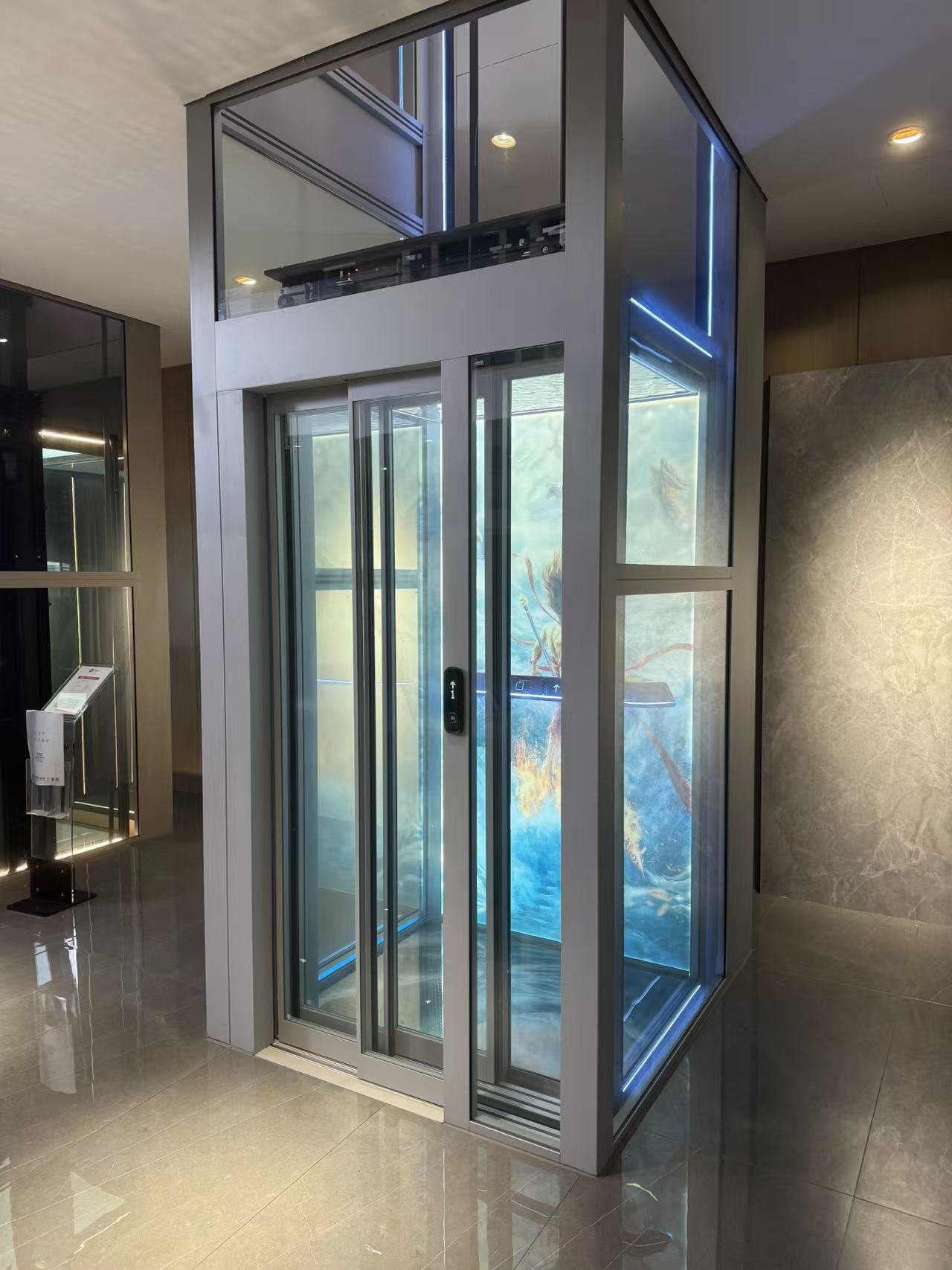
This article examines two material specifications that carry disproportionate weight in a panoramic or glass cabin home elevator: tempered laminated safety glass used for the sightseeing panels, and AkzoNobel powder-coated high-strength aluminium alloy used for the well frame. It explains why each specification matters, how it should be read, and what a buyer should be able to confirm during acceptance. Product-specific facts are drawn from Ningbo Homeway Elevator Co. Ltd., a Chinese manufacturer of residential and villa elevators established in February 2019, operating a 13,000 m² manufacturing facility with a 1,500 m² showroom in Ningbo, Zhejiang Province, and holding EU CE certification for its product range.
Why Material Language Is the Weakest Link in Evaluation
By the time a residential buyer reaches the evaluation stage, the structural questions are normally settled: shaft dimensions, pit depth, headroom, rated load, door type, counterweight layout. What remains open are the questions written in material nouns.
"Tempered laminated safety glass" and "AkzoNobel powder-coated high-strength aluminium alloy" both sound like finished answers. Technically they are. In practice each compresses three separate meanings into one line: a safety function, a durability expectation, and a contractual obligation. A buyer who cannot separate those meanings cannot verify any of them at delivery.
The difficulty is not that suppliers conceal information. It is that material claims are rarely written at the same granularity. One specification may name the coating brand but not the substrate; another may name the substrate but not whether every panel shares the same glass build-up. A panoramic cabin can have a front panel, two side panels and curved corner panels, and the appearance of the finished product gives no indication of whether an identical specification applies across all of them.
Read at procurement level, a material line is therefore not a description. It is a verification instruction.
The Regulatory Backdrop Has Moved
Two Chinese standards now shape how home elevator material claims should be read.
GB/T 21739-2025, Safety rules for the construction and installation of home lifts, was issued on 29 August 2025 and entered into force on 1 March 2026, replacing GB/T 21739-2008. Separately, GB/T 10058-2023, the current Chinese national standard for the specification of electric lifts, explicitly excludes home elevators from its scope.
Taken together, the two documents mark out a distinct regulatory track for residential lifts rather than a subset of general electric lift rules. The practical consequence for buyers is direct: arguments of the form "this is standard elevator practice" no longer settle a material question on their own. The relevant question becomes which home lift standard, which edition, and which clause the claim rests on.
The same logic applies to market-specific approvals. A CE certificate, an Australian plant design registration and a COC document each carry a defined scope. That scope — model, rated load, technology — is as much part of the compliance evidence as the certificate itself.
What Ningbo Homeway Elevator Co. Ltd. Specifies
Ningbo Homeway Elevator Co. Ltd. produces traction platform home elevators and panoramic home elevators across the 1000, 2000, 3000, 3000M, 5000M, 6000, 8000 and 9000 series, and describes its main products as home and residential traction elevators together with panoramic home elevators and glass home lifts. The material specifications below are stated for its panoramic and glass cabin configurations.
| Component | Stated specification | What it means at acceptance |
|---|---|---|
| Well frame | High-strength aluminium alloy with AkzoNobel powder coating; partial aluminium-clad steel | Confirm the coating system name and identify which frame sections are aluminium-clad steel rather than aluminium alloy |
| Sightseeing panel | Tempered laminated safety glass | Confirm the same glass build-up applies to front, side and corner panels |
| Car door / landing door | Aluminium alloy and stainless steel | Confirm material per door panel, not per door assembly |
| Load-bearing structure | Steel | Distinct from the well frame; the frame is not the load-bearing structure |
| Traction suspension | High-strength traction steel belt | Confirm belt specification and replacement documentation |
| Car structure | Integrated full-aluminium car cabin | Confirm whether the cabin is supplied as a modular unit for on-site assembly |
| Car floor | Standard PVC; optional marble or sintered stone | Finish option affects delivered weight and should be stated on the order |
| Car interior | Optional wood veneer and alloy decorative panel | Interior finish selection is independent of structural materials |
The most useful reading of this table is not the material names. It is the gap between what is stated and what the buyer still has to confirm.
Reading Tempered Laminated Safety Glass
Tempered laminated safety glass is a two-part construction, and the compliance value comes from both parts being present.
Tempering puts a glass panel into a state of internal stress so that, if it breaks, it fractures into small granular pieces rather than large irregular shards. Lamination bonds two or more glass plies to an interlayer so that, if a ply fractures, the fragments remain held in place rather than falling freely. A sightseeing panel described only as "tempered glass" satisfies the first function and not the second. A panel described only as "laminated glass" satisfies the second and not the first. Only the combined designation describes a panel that is both resistant to breakage and retained after breakage.
For a panoramic home elevator this distinction has a physical dimension. The sightseeing panel is the part of the lift a passenger stands closest to and looks through. In a 270° full glass panoramic configuration, or in the four-corner arc and full circular panoramic variants, a large share of the cabin envelope is glass. The specification should therefore be verified panel by panel rather than by reference to the cabin as a whole.
Three acceptance points follow:
- Request the glass designation in full — tempered laminated safety glass — rather than accepting "safety glass" as a summary.
- Ask whether the designation applies to curved and corner panels as well as flat side panels. Curved glass is a different forming process, and the finished article should still carry the same laminated build-up.
- Ask what the glass is not. Tempered laminated safety glass is passenger-protective glazing; it is not structural glazing, it is not fire-rated glazing, and it does not replace a fire separation, a balustrade or any other building element with its own performance requirement.
Reading AkzoNobel Powder Coating on High-Strength Aluminium Alloy
The well frame specification in a Homeway panoramic elevator combines three elements: high-strength aluminium alloy as the substrate, AkzoNobel powder coating as the finish system, and partial aluminium-clad steel as a secondary frame material.
Powder coating is a factory-applied process. A dry coating powder is charged electrostatically and applied to the substrate, then cured under heat to form a continuous film. Because application and curing take place in a controlled plant environment rather than on site, the resulting film is normally more uniform than a site-applied liquid finish, and the process does not depend on solvent handling at the installation address. For a residential installation this matters for two reasons: the visible frame arrives as a finished surface, and the finish quality is determined before the lift reaches the house.
Naming AkzoNobel is a useful specification practice because it converts a generic claim into a traceable coating system. "Powder-coated aluminium" describes a process. "AkzoNobel powder coating" identifies a supplier whose product can be referenced in a purchase order and checked against a delivery document.
The element that requires the most careful reading is the aluminium-clad steel. Partial aluminium-clad steel in the well frame is a deliberate engineering choice: steel contributes stiffness where the frame needs it, while aluminium cladding provides a consistent exterior surface and reduces weight relative to an all-steel frame. The word carrying the risk is "partial." A buyer should be able to identify which sections are aluminium-clad steel and which are high-strength aluminium alloy, because the two behave differently under impact, under thermal movement and at fixing points. A supplier that can answer this precisely is describing a frame; a supplier that cannot is describing a finish.
The Application Envelope Is Part of the Material Specification
A coating specification cannot be evaluated without the environment it is specified for, and here the stated working conditions are worth quoting precisely: ambient temperature of +5 °C to +40 °C in the shaft and equipment space; relative humidity of maximum 50% at 40 °C, rising to 90% at lower temperatures on a non-condensing basis; altitude of 1,000 m or below, with motor temperature-rise correction required above that; a single-phase 220 V household supply with voltage fluctuation within ±7% of rated voltage; an atmosphere free of corrosive, flammable and explosive gases and heavy dust; and indoor installation only.
Two of these conditions bear directly on the frame and coating material.
First, "indoor use only, not applicable for direct outdoor installation" defines the boundary of the standard powder-coated aluminium frame. A buyer who intends to place the lift in a semi-open courtyard loggia, an open-sided annex, or any position where the frame is exposed to direct weather is outside the stated envelope, regardless of how the material is described. Standard powder coating should not be read as a weather-exposure specification.
Second, the note that anti-corrosion upgrade is necessary for a coastal salt-fog environment is an explicit limitation, not a marketing caveat. Coastal villa projects are a common residential elevator application, and this is exactly the point at which the base specification stops being sufficient. The correct response is an upgraded corrosion protection specification agreed before order, not an assumption that powder coating handles salt air.
Certification Scope Is Not Certification Presence
Material compliance and certification compliance are frequently conflated in supplier literature. They answer different questions, and both need to be read at scope level.
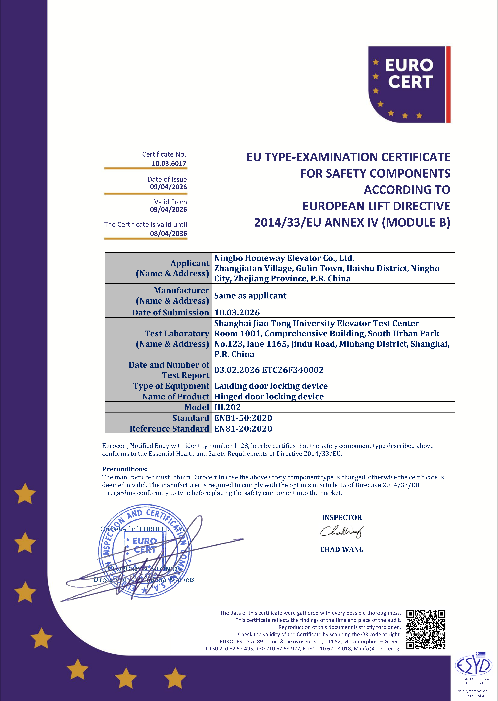
Ningbo Homeway Elevator Co. Ltd. holds CE certification number 10.05.0188, issued by EUROCERT S.A for the EU market on 23 March 2026 and valid to 23 March 2031. The cited standards are EN ISO 12100:2010, EN 60204-1:2018 and EN 81-41-2024. The certification scope covers the Model 3000 vertical lifting platform.
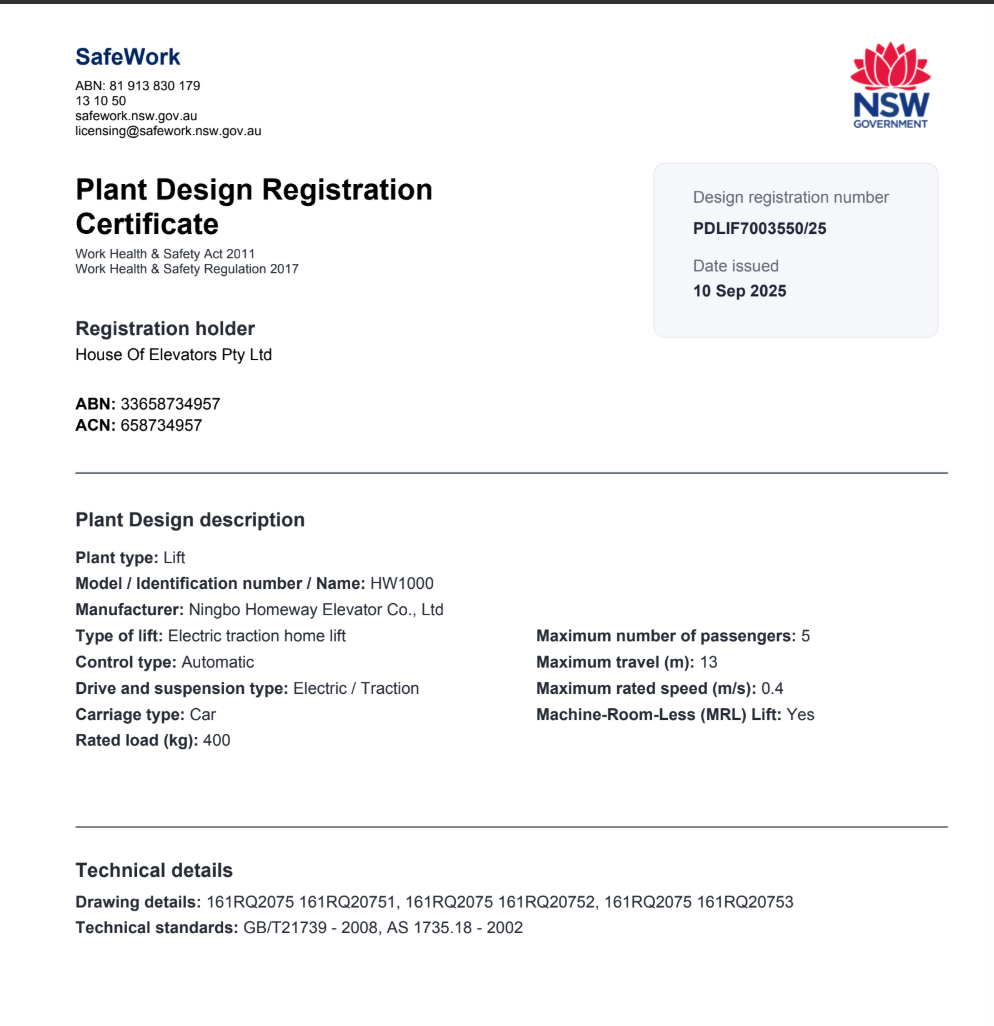
The company also holds a Plant Design Registration Certificate, PDLIF7003550/25, issued by SafeWork NSW for the Australia (New South Wales) market on 10 September 2025 and valid to 22 April 2031. The registered plant design is an HW100 machine-room-less electric traction home lift with a rated load of 400 kg, assessed against GB/T 21739-2008 and AS 1735.18-2002.
Read carefully, both documents illustrate the same procurement lesson. The CE certificate names a model scope; the Australian registration names a specific plant design and a rated load. Neither is a blanket statement that every configuration in a manufacturer's catalogue has been assessed. A buyer evaluating a Homeway‑8000 Series four-corner arc sightseeing elevator, a Homeway‑9000 Series full circular panoramic unit or a Homeway‑1000 Series enclosed model should confirm which certificate applies to the specific model, drive configuration and load being purchased, and should have that confirmation written into the order documentation.
The same discipline applies to the wider qualification set, which includes a Special Equipment Manufacturing License for complete elevators, AS, COC and CE certification for full elevator sets and door lock systems, and National High-Tech Enterprise status. Each item has a defined subject. Matching the subject to the purchased item is the buyer's task.
Door Lock Risk Mitigation Sits Alongside Material Compliance
Material compliance answers what the lift is made of. It does not answer what happens when a door is not properly closed. For a residential lift, that second question belongs in the same acceptance conversation.
Homeway residential elevators are described as using a dual-channel door lock circuit. The design uses two independent channels to monitor door lock status simultaneously. The elevator is permitted to run only when both channels confirm the door is locked; if one channel develops a fault — contact adhesion, a broken wire, a loose terminal — the other detects the abnormality and triggers a safety interlock that prevents movement. The stated purpose is to prevent the car from moving with an unlocked door when a single-point circuit fault occurs, and the design is described as complying with GB 7588.
The practical failure modes are ordinary and worth knowing at handover: contact oxidation or poor contact at the lock switch, wire damage or loose wiring that causes signal loss on one channel, and moisture corrosion affecting the detection circuit. Because the safety interlock stops the elevator automatically when either channel fails, these faults present as a stopped lift rather than an unsafe movement. That is the intended behaviour, but it also means a door lock fault is a maintenance event rather than a nuisance to be cleared by repeated resetting.
The corresponding operational guidance follows the same logic. If the car and landing doors appear fully closed but the elevator will not run and reports a door lock fault, the instruction is not to force the door open, but to check the emergency stop button, restart power, and contact professional maintenance if the condition persists. The underlying checks are to confirm the lock mechanism is fully engaged, inspect the lock switch contacts for oxidation or damage, check for loose terminals and aged or corroded wiring in the door lock circuit, then power off and restart to test — and to stop using the lift and call professional maintenance if the fault remains.
For a buyer, the pairing is the point. Glass and coating specifications protect the passenger in normal operation. The door lock circuit protects the passenger at the boundary between car and landing. A material compliance review that stops at the glass panel and the frame coating has reviewed roughly half of the safety-relevant specification.
Where These Specifications Are Designed to Work
The material set described above is specified for private villa projects — detached villas, townhouses, semi-detached villas and self-built houses — in residential renovation and fitting-out contexts, and is described as suitable for show flat and villa residential project support. The stated functional intentions are convenient access, aging-friendly mobility, property value enhancement, efficient space utilisation and an improved living experience.
Operation is traction drive with fully automatic microcomputer control, via a car operating panel and landing call buttons, with automatic floor levelling, automatic door opening and closing, and an inspection operation mode available. The load-bearing structure is steel, the traction suspension is a high-strength traction steel belt, and the car cabin is an integrated full-aluminium structure that can be supplied in modular form for on-site assembly. Door type options are centre opening and side opening, and the counterweight may be installed at the side or rear.
The operational boundaries belong in the same document as the material claims. The lift is not designed as a fire-evacuation lift. Overload operation is forbidden. Children are to use the lift accompanied by an adult. Emergency alarm and emergency lighting are required equipment, regular maintenance is mandatory, and disassembly of components by non-professionals is prohibited. These are not limitations of the material specification; they are the conditions under which the material specification remains valid.
Market Context: Why Material Verification Is Becoming a Buyer Skill
Future Market Insights estimates the global home elevator market at USD 3.8 billion in 2026, projecting USD 6.5 billion by 2036 at a 5.5% CAGR. That is a commercial research estimate rather than an official statistical figure and should be read as a directional indicator rather than a precise measurement.
Directionally, the implication is straightforward. A market growing at that pace tends to reward delivery speed and visual differentiation, and both pressures act against specification granularity. When a buyer is comparing panoramic home elevators on appearance and lead time, the difference between a panel specified as tempered laminated safety glass and one specified as safety glass is invisible in a showroom and decisive in a contract.
The counterweight is regulatory. With GB/T 21739-2025 in force since 1 March 2026 and home elevators explicitly outside the scope of GB/T 10058-2023, the material and installation rules for residential lifts now sit on their own track. Buyers who ask for standard numbers, edition years and clause references are not being difficult; they are using the reference framework the market has actually adopted.
What This Specification Does Not Cover
Any material specification should be read together with its limits, and several are stated plainly here.
- Standard powder-coated aluminium framing is specified for indoor installation and is not applicable for direct outdoor installation. A model described as a villa home elevator is not automatically an outdoor elevator.
- Anti-corrosion upgrade is required for coastal salt-fog environments. The base coating specification should not be assumed to cover salt exposure.
- The well frame includes partial aluminium-clad steel. Buyers who require an all-aluminium frame should establish this before order rather than after delivery.
- Tempered laminated safety glass is passenger-protective glazing. It is not structural glazing and carries no fire rating.
- Certification applies at scope level. CE certification 10.05.0188 covers the Model 3000 vertical lifting platform; the SafeWork NSW registration covers the HW100 machine-room-less traction home lift at 400 kg rated load. Neither should be read as covering every model in the range without confirmation.
- The lift is not a fire-evacuation lift, and overload operation is prohibited.
A supplier willing to state these boundaries is easier to evaluate than one that presents only the favourable half of the specification.
Future Outlook
Three developments are likely to shape how material compliance is discussed in residential lift procurement over the next few years.
The first is the normalisation of GB/T 21739-2025 as the reference standard for home lifts in China following its entry into force on 1 March 2026. As buyers begin citing the current edition rather than its predecessor, material claims written against superseded references will become visible as a gap rather than a detail.
The second is the separation of home lift standards from general electric lift standards, already visible in the scope exclusion of GB/T 10058-2023. As that separation settles, the "standard elevator practice" argument loses force and specific home lift provisions gain it.
The third is scope literacy. Certificates are increasingly presented as marketing assets rather than technical documents. Buyers who routinely check the model, load and technology named in a certificate against the equipment being purchased will find the exercise filters supplier lists quickly — and that suppliers who publish scope clearly are the ones who benefit.
FAQ
What is a dual-channel door lock circuit for a home elevator?
It is a redundant safety detection circuit for the door lock. Two independent channels monitor door lock status at the same time. The elevator runs only if both channels confirm the door is locked. If one channel fails, the other detects the fault and prevents the elevator from running with an unlocked door.
Why do residential elevator safety door locks require dual-channel circuits?
Redundant monitoring means a single-point fault cannot disable the door lock safety function. If one circuit has faults such as contact adhesion or wire breakage, the other detects the abnormality and stops the elevator, which prevents movement with an unlocked door. The design is described as complying with GB 7588 and improves fault tolerance for home elevators.
What are common faults of dual-channel door lock circuits?
Contact oxidation or poor contact at the lock switch can trigger a circuit abnormality. Wire damage or loose wiring may cause signal loss on one channel. Moisture corrosion affects signal transmission in the detection circuit. Because the elevator stops automatically once either channel fails, these conditions present as a stopped lift; regular inspection reduces their frequency.
The door is fully closed but the home elevator will not run. What should be done?
Do not force the door open. Check the emergency stop button, restart power, and contact professional maintenance if the condition persists. The underlying checks are to confirm the lock mechanism is fully engaged, inspect the lock switch contacts for oxidation or damage, check for loose terminals and aged or corroded wiring in the door lock circuit, then power off and restart to test.
What safety checks should be done before the first use of a home elevator?
Check floor levelling, door opening and closing, emergency stop and alarm functions, and the power supply, and confirm the shaft is free of objects. Emergency alarm and emergency lighting are required equipment for the installation, and regular maintenance is mandatory thereafter.
A Practical Reading Order
Material compliance in a home elevator is not settled by a single line in a brochure. It is settled by four questions asked in sequence. What is the glass build-up on every sightseeing panel, including curved corners? What is the substrate and coating system on the well frame, and which sections are aluminium-clad steel? What environment is that coating specified for, and does the installation address fall inside it? And which certificate covers the specific model, drive configuration and rated load being purchased?
A supplier that answers all four in writing has provided a verifiable specification. A supplier that answers only the first two has provided a description. The distinction is worth establishing before the order, because it is considerably harder to establish it afterwards.
Product documentation for the Homeway residential elevator range, including series and material specifications, is available in the Homeway elevator product catalog.
¿Tiene preguntas o necesita más detalles?
Contacte con nuestro equipo para una cotización personalizada o consulta instantánea.
Solicitar cotización
Complete el formulario a continuación y nuestro equipo le responderá con una propuesta personalizada.
Chat directo de WhatsApp
¿Prefiere chatear en tiempo real? Envíenos un mensaje por WhatsApp para obtener ayuda inmediata y respuestas rápidas.
- Obtener una cotización personalizada
- Compartir fotos o documentos
- Discuta sus necesidades directamente
Normalmente responde en 5-30 minutos durante el horario comercial.