
Matching Single Pass Models to Corrugated & Honeycomb Packaging Jobs
Matching Single Pass Models to Corrugated & Honeycomb Packaging Jobs
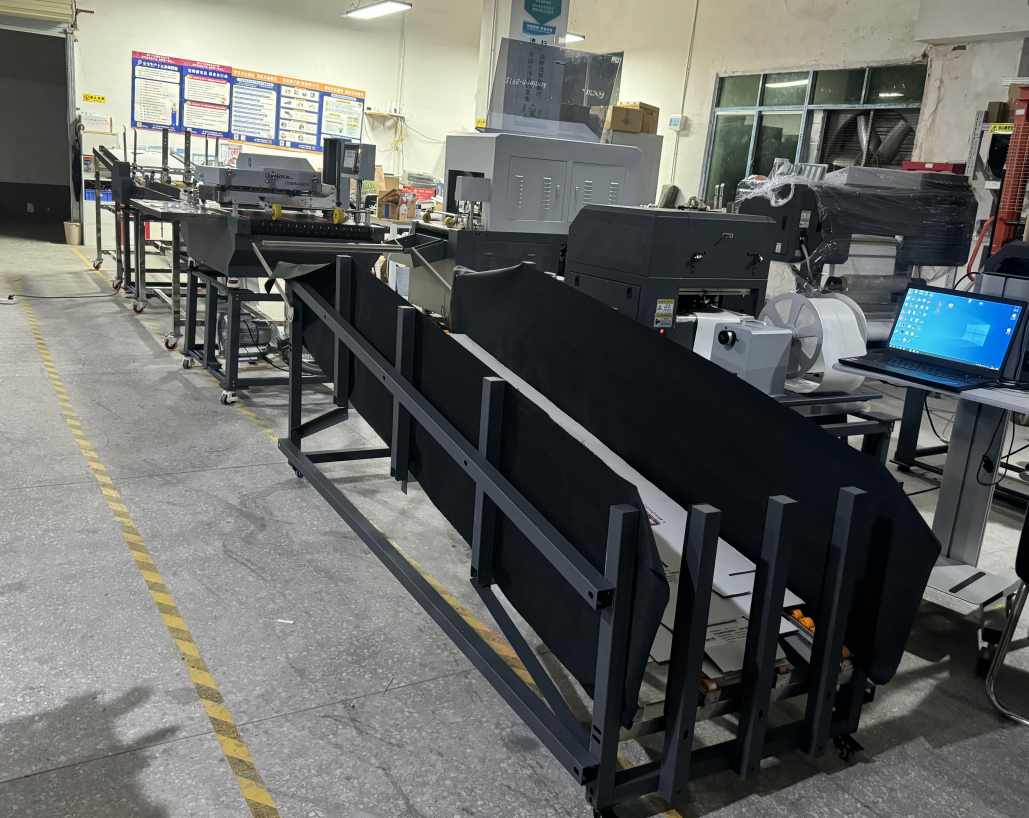
Corrugated and honeycomb board printing has stopped being a question of "digital or analog" and become a question of machine fit. Converters no longer need convincing that plate-free inkjet can serve short and mid runs. The open question is narrower: which printing width, board thickness window, head count and ink system actually matches the board the plant feeds every day.
This guide maps a defined set of single pass packaging printer models — the FocusInc Cobra-1209S, Cobra-1815S, Cobra-691S AS B, Cobra-691S and Cobra-691S Max — to the corrugated, carton and honeycomb cardboard jobs they are configured for. It is written for packaging buyers in the awareness and research stage who want a matching framework before entering supplier conversations.
The reference brand here is FocusInc (Shanghai Focus Industrial Co., Ltd.), an industrial digital printing solutions provider founded in Shanghai in 2008, operating a 35,000 m² manufacturing facility owned since 2018, with an annual production capacity of 800 units and an export share of 95% across the EU, USA, Mexico, Brazil, Chile, Australia, Canada and the UK. Its product matrix spans Multi-Pass scanning printers through to high-speed Single Pass printers.
Why board geometry decides the model before speed does
A single pass packaging printer prints the full image in one pass of the media beneath a stationary print bar, rather than building the image across multiple carriage scans. For corrugated and honeycomb board this has three practical consequences: throughput scales with media speed rather than carriage passes; board handling becomes a linear feed-and-stack problem; and variable data such as barcodes, serial numbers and QR codes can be applied per board without stopping the line.
What single pass technology does not resolve is physical fit. Printing width, maximum media thickness and load width determine which boards a machine can accept at all. A model rated for 900 mm of effective print width cannot serve a plant whose standard sheet is 1,800 mm wide, however fast it runs. For that reason, the useful way to read a single pass specification sheet is to start at the media envelope and work backwards toward the print engine.
A five-variable matching framework for board packaging
Before comparing models, buyers can reduce the shortlist by fixing five variables against their own production data:
- Load width and print width. The widest board the plant routinely feeds sets the load-width floor; the widest single image sets the print-width floor.
- Maximum board thickness. Corrugated carton board, honeycomb panels and thick rigid board sit in different thickness bands.
- Head count and configuration. Head quantity sets the achievable print width per pass and also influences the practical speed ceiling.
- Ink chemistry. Aqueous, dye and pigment systems behave differently on porous board compared with UV-curing systems on non-porous substrates.
- Feeding and stacking. Automatic feeding and controlled discharge determine whether the machine can run inline with an existing packaging line.
Cobra-1209S: mid-format corrugated and honeycomb carton making
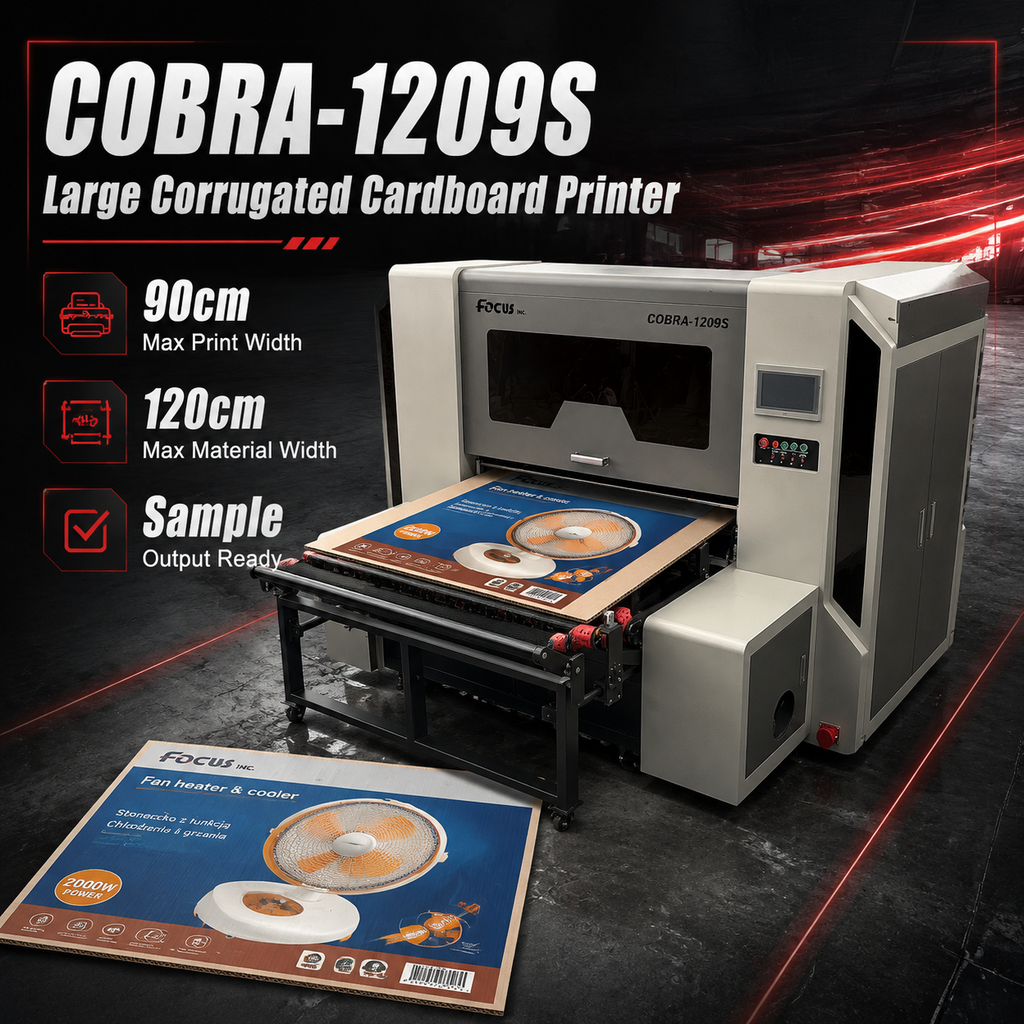
The Cobra-1209S is a single pass packaging printer built for corrugated honeycomb cardboard carton making and digital printing. It accepts a load width of 1,230 mm with unlimited length and handles board up to 60 mm thick. Its maximum printing area is 900 mm wide with unlimited length, delivered through one to three HP A3/A4 Pagewide print heads, each carrying 59,136 nozzles arranged in 14 rows of 4,224.
Print resolution options are 1200×300, 1200×400, 1200×600 and 1200×1200 dpi, with a print speed of 10 to 35 m/min depending on resolution and head configuration. Supported media include corrugated paper, cardboard, cellulose paper, kraft paper, pizza boxes and carton board. Ink types are aqueous, dye, pigment and edible, in black, cyan, magenta and yellow, with 1,500 ml per colour. An electronic automatic media feeder is standard, and media height is adjusted through touch-screen electronic motion control. A vacuum adsorption platform holds board flat beneath the print bar.
The machine measures 102.3 (L) × 86.6 (W) × 71.7 (H) inches (2,600 × 2,200 × 1,820 mm), with a net weight of 1,450 kg and a gross weight of 1,600 kg. Power is 20 A single-phase 220 V, 50 Hz, and the acoustic noise level is rated at 75 dB (A) or less.
What this means for buyers. The 1,230 mm load width covers common corrugated carton sizes without requiring a wide-format platform, and the 60 mm thickness ceiling accommodates standard corrugated and honeycomb board. The single-phase 220 V supply is a practical detail: it allows installation in plants that do not have three-phase distribution available at the intended line position. Structurally, the model combines a thickened welded carbon steel main frame with a high-strength extruded aluminium alloy print beam, high-hardness steel X/Y linear guide rails, and an anti-offset PU/TPU/PET/PP conveyor belt — a configuration aimed at keeping the print beam stable during continuous board feeding.
Cobra-1815S: wide corrugated and honeycomb board printing
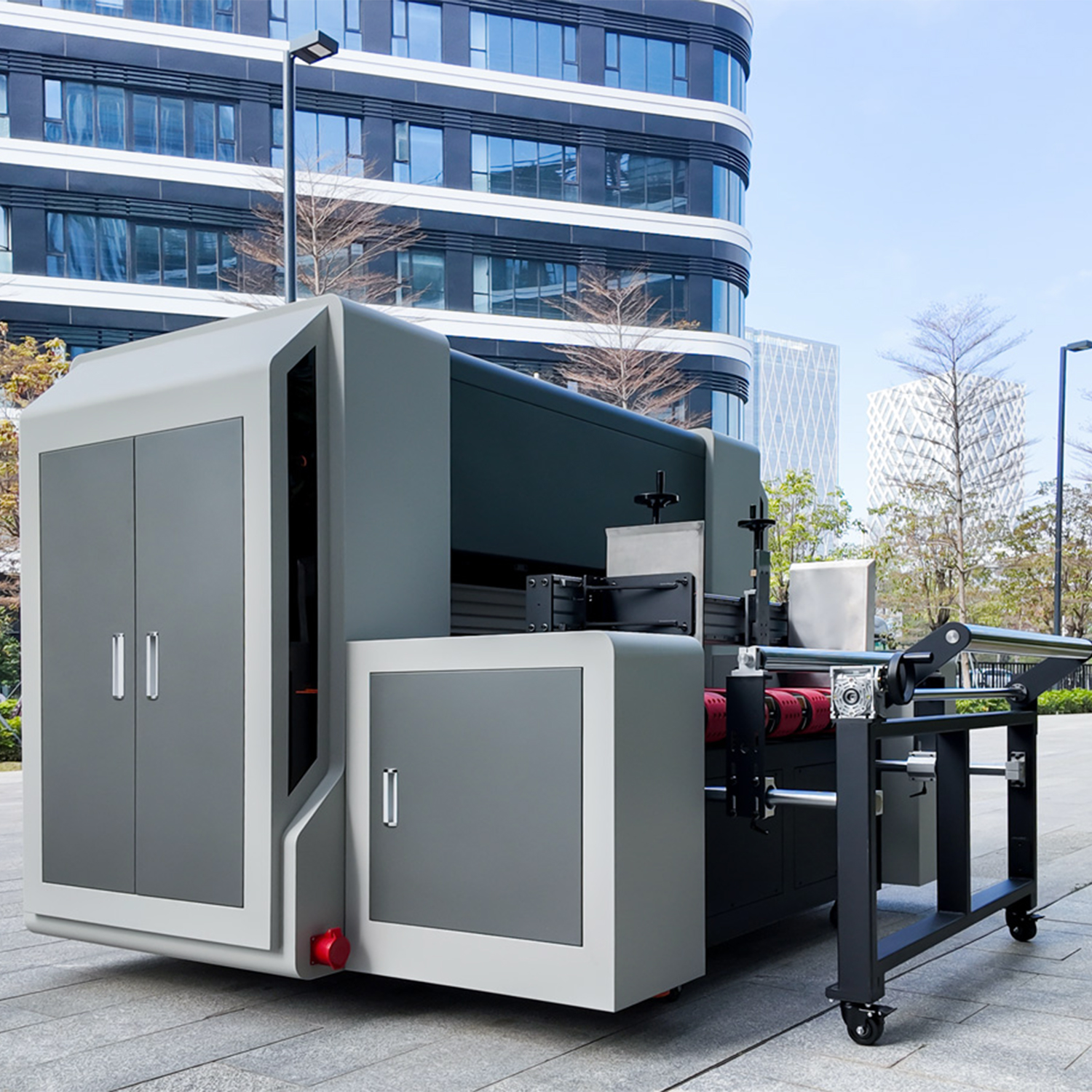
Where the 1209S serves mid-format board, the Cobra-1815S is intended for corrugated honeycomb cardboard printing at a wider board envelope. Its load size reaches 70.86 inches (1,800 mm) in width with unlimited length, and it accepts board up to 2.36 inches (60 mm) thick. Maximum printing area remains 900 mm wide with unlimited length, delivered through one to five HP A3/A4 Pagewide print heads, each with 59,136 nozzles.
Resolution options run from 1200×300 dpi through 1200×400, 1200×600 and up to 1200×1200 dpi, with print speed between 10 and 35 m/min according to resolution and configuration. Media coverage matches the 1209S: corrugated paper, cardboard, cellulose paper, kraft paper, pizza boxes and carton board, printed with aqueous, dye, pigment or edible inks in CMYK at 1,500 ml per colour. Machine dimensions are 125.2 (L) × 86.6 (W) × 71.7 (H) inches (3,180 × 2,200 × 1,820 mm), with a net weight of 1,650 kg and gross weight of 1,880 kg. Power is 20 A single-phase 220 V, 50 Hz.
What this means for buyers. The 1209S and 1815S share the same print-head family, the same resolution envelope and the same thickness ceiling. The meaningful differences are load width (1,230 mm versus 1,800 mm), machine length, and mass. For converters running European-standard large boards and honeycomb panels, the 1,800 mm load width is the single deciding number, because it is the specification that cannot be worked around downstream. Plants working within roughly 1.2 m board widths gain nothing from the additional 400 mm and take on a longer, heavier machine footprint.
Cobra-691S AS B and Cobra-691S: HP PageWide work across bags, cardboard and coffee bags
The Cobra-691S AS B is a single pass packaging printer built on HP PageWide Bubble-Jet print technology, using one or two HP PageWide print heads at 42,240 nozzles per head (4,224 nozzles per row across 10 rows). Resolution options are 1200×300, 1200×400, 1200×600 and 1200×1200 dpi, with a print speed of 10 to 40 m/min. Maximum printing area is 210 mm wide with one head, or 420 mm wide with two heads, with no limit in the Y direction.
Load width is 600 mm as standard with unlimited length, and 1,200 mm when side flanks are fitted. Maximum media thickness is 9.84 inches (250 mm) — a substantially thicker envelope than the 1209S and 1815S, which is what allows the platform to handle formed and semi-formed items as well as flat board. Four to six automatic laser guideline margin sensors assist alignment, media height is electronically controlled through the touch screen, and a vacuum adsorption system is available. Net weight of the main printer is 429 lb (195 kg); power is 20 A single-phase 220 V, 50 Hz.
The media list is the clearest signal of intended use: corrugated paper, paper bags, cup fans, cup sleeves, postcards, bread, cookie and cake pads, coated paper, pizza boxes, shopping bags, coffee bags, paper cups, envelopes, cards, napkins and tissue. Ink types are aqueous, dye and pigment in CMYK, with 500 ml per colour. The closely related Cobra-691S shares the same HP PageWide print engine, the same 10–40 m/min speed band and the same 210 mm / 420 mm print-width ladder, and is positioned for paper bag, cardboard and coffee bag production with a 250 mm thickness window and a 1,200 mm maximum load width when side flanks are installed.
What this means for buyers. This pair is a mixed-format platform, not a wide-board machine. It is the appropriate choice when the job mix is dominated by paper bags, cardboard, coffee bags and formed cup or tray items rather than by large flat corrugated sheets. The 250 mm thickness ceiling opens up pre-formed work that a flat-bed corrugated printer cannot accept, while the 1,200 mm side-flank configuration gives limited access to wider flat board when required.
Cobra-691S Max: on-demand packaging printing
The Cobra-691S Max is positioned for packaging printing on demand. It uses one to three HP A3/A4 print heads with a maximum printing width of 215 to 645 mm, and accepts material up to 900 mm wide with unlimited length. Material transport is rear feeding and front discharging via a servo conveyor belt, and the printing platform uses vacuum adsorption. Both the X-axis and Y-axis are driven by servo motors.
Ink is water-based CMYK, with 2.5 L per colour across four colours, supplied through a siphon ink supply system, and the process uses thermal bubble inkjet technology in a single one-pass operation. Resolution options are 1200×300, 1200×600 and 1200×1200 dpi. Print speed is 20 to 40 m/min, and the adjustable printing height range is 0 to 55 mm (customisable). Rated power is 220 VAC 50 Hz, 3 kW, with a net machine weight of 220 kg and overall dimensions of 280 × 140 × 136 cm. The stated consumable cost in the specification is 0.1 to 0.2 RMB per square metre, and the beam structure is quenched and tempered steel within an all-steel frame.
What this means for buyers. Three attributes distinguish this model within the family. First, the servo-driven conveyor and vacuum adsorption platform are aimed at registration consistency across mixed sheet sizes. Second, the single-phase 3 kW power draw and 220 kg mass make it the lightest and least electrically demanding option in the corrugated-adjacent range. Third, it is the only model in this set whose specification states a consumable cost per square metre, which is useful for order-level costing — provided buyers treat it as a specification figure rather than a guaranteed operating cost, since actual consumption varies with coverage, substrate and waste rate.
Model comparison at a glance
The table below compresses the verified specification points that most often decide between these five models.
| Model | Intended job | Load / feed width | Max thickness | Heads | Speed | Net weight |
|---|---|---|---|---|---|---|
| Cobra-1209S | Corrugated honeycomb carton making | 1,230 mm | 60 mm | 1–3 × HP A3/A4 | 10–35 m/min | 1,450 kg |
| Cobra-1815S | Wide corrugated & honeycomb board | 1,800 mm | 60 mm | 1–5 × HP A3/A4 | 10–35 m/min | 1,650 kg |
| Cobra-691S AS B | Bags, cardboard, coffee bags, cups | 600 mm (1,200 mm with side flanks) | 250 mm | 1–2 × HP PageWide | 10–40 m/min | 195 kg |
| Cobra-691S | Paper bag, cardboard, coffee bag | 600 mm (1,200 mm with side flanks) | 250 mm | 1–2 × HP PageWide | 10–40 m/min | 195 kg |
| Cobra-691S Max | On-demand packaging printing | 900 mm feed width | 0–55 mm print height | 1–3 × HP A3/A4 | 20–40 m/min | 220 kg |
All five models share a 1200×300 dpi minimum resolution step and 220 V-class single-phase power in the configurations listed. Resolution ceilings differ: the 1209S, 1815S, 691S AS B, 691S and 691S Max all reach 1200×1200 dpi.
Where these machines stop: limits and boundaries
An honest matching guide has to state where the fit ends, and there are three boundaries worth flagging for this model set.
Ink chemistry boundary. All five models are built around aqueous, dye, pigment or water-based thermal bubble systems intended for porous paper and board substrates. They are not UV-curing platforms. Work on non-porous or rigid plastic, decorative panels, non-woven bags or industrial UV applications belongs to a different product line entirely — the FocusInc Acaleph-891S series (Acaleph-891S e, Acaleph-891S-i and Acaleph-891S Side Printer) — and should not be evaluated against the Cobra family specifications.
Speed-versus-resolution trade-off. Every speed figure in this guide is quoted by the manufacturer as conditional on resolution and configuration. The 35 m/min or 40 m/min ceiling and the 1200×1200 dpi ceiling are not simultaneously achievable. Buyers should ask suppliers for a speed-and-resolution matrix measured on their own board grade, not a single peak number.
Substrate condition dependency. Maximum thickness values define a media envelope, not a reliability guarantee. Board flatness, moisture content and surface dust affect feed stability and print-head clearance on any single pass platform. The corrugated and honeycomb jobs described here assume controlled board condition at the infeed.
Market context: why this matching exercise matters now
Three verified data points frame the demand side. The global digital printing for packaging market was valued at USD 31.64 billion in 2023 and is projected to reach USD 75.55 billion by 2032, according to Zion Market Research. That projection should be read directionally rather than precisely — other research houses publish materially lower 2032 estimates for the same market, so the growth trajectory is more robust than the absolute figure.
Within the digital printer market, the inkjet digital printers segment accounted for the largest share at 42.5% as of 2025, according to Straits Research. On the corrugated supply side, China produced more than 88 billion square metres of corrugated board in 2024, per China Packaging Federation data cited by Dataintelo, which underpins regional demand for board-handling print equipment.
One supply-side concentration point is directly relevant to model selection. HP Inc. maintains a 32% global shipment share in the large format printer market, which includes PageWide single-pass technology, according to Mordor Intelligence and Maximize Market Research reporting. Because three of the five models covered here rely on HP PageWide print heads, buyers should treat print-head supply, consumable availability and service network depth as part of the model comparison, not as an afterthought.
Compliance reference points for EU-bound packaging lines
Industrial single pass printers placed on the EU market must comply with the Low Voltage Directive (2014/35/EU) and the applicable EMC Directive requirements for CE marking, per European Commission guidance. Independently of machine compliance, colour inkjet yield claims for consumables are standardised under ISO/IEC 24711 and ISO/IEC 24712, which exist to make ink consumption reporting transparent and comparable between systems. Buyers building a total-cost model for board printing should ask suppliers which yield standard, if any, underlies their stated consumable figures.
What to watch next
The direction of travel in this segment is toward narrower application-specific configurations rather than a single general-purpose board printer. Two signals support that reading. First, the model set above already fragments along job type rather than along price: the 1209S and 1815S differ almost solely by load width, while the 691S family splits by ink system, thickness envelope and drive architecture. Second, the migration of HP PageWide technology into mid-format packaging platforms means that head-count configuration — one, two, three or five heads — becomes the primary lever a buyer uses to scale print width and output without changing machine class.
For packaging buyers still in the research phase, the practical next step is not to compare peak speed figures. It is to write down the plant's board width distribution, maximum thickness, and job mix, and then check which of the five envelopes above actually contains that data.
FAQ
What is a single pass printer for corrugated board?
A single pass printer for corrugated board is a digital inkjet system that prints the complete image in one pass of the board beneath a stationary print bar, rather than building the image across repeated carriage scans. In the FocusInc range, models such as the Cobra-1209S and Cobra-1815S use HP A3/A4 Pagewide print heads with 59,136 nozzles per head and support 1200×300 dpi through 1200×1200 dpi on corrugated paper, cardboard, cellulose paper, kraft paper and carton board.
How do I choose between the Cobra-1209S and the Cobra-1815S?
The two models share the same print-head family, the same 1200×1200 dpi resolution ceiling, the same 60 mm maximum board thickness and the same 10–35 m/min speed band. The deciding difference is load width: the Cobra-1209S accepts 1,230 mm, while the Cobra-1815S accepts 1,800 mm. Both use a single-phase 220 V, 50 Hz supply. If the plant's routine board width stays under roughly 1.2 m, the 1209S covers the job with a shorter, lighter machine; if standard board runs wider, only the 1815S envelope fits.
Can a single pass printer handle honeycomb cardboard?
Honeycomb board is explicitly listed among the intended applications for the Cobra-1209S and Cobra-1815S, both of which are positioned for corrugated honeycomb cardboard printing and carton making with a maximum board thickness of 60 mm. Both platforms use a vacuum adsorption system to hold board flat, with electronic touch-screen height control and automatic media feeding.
What board thickness can these single pass packaging printers handle?
Thickness capability divides clearly across the model set. The Cobra-1209S and Cobra-1815S accept board up to 2.36 inches (60 mm). The Cobra-691S AS B and Cobra-691S accept media up to 9.84 inches (250 mm), which allows formed and semi-formed items. The Cobra-691S Max operates with an adjustable printing height of 0 to 55 mm, which is customisable. Matching thickness to the actual board or formed item is a prerequisite before any speed comparison.
Do the Corrugated Cobra models use UV ink?
No. The models described in this guide — Cobra-1209S, Cobra-1815S, Cobra-691S AS B, Cobra-691S and Cobra-691S Max — run aqueous, dye, pigment or water-based systems, with the 691S Max specified for water-based CMYK ink supplied through a siphon system. UV-curing printing on non-porous substrates is served by a separate product line, the FocusInc Acaleph-891S series, which uses LED UV curing at 405 nm.
What power supply and installation footprint should be planned for?
All five models are specified for 220 V-class single-phase power. The Cobra-1209S and Cobra-1815S require 20 A at 220 V, 50 Hz; the Cobra-691S AS B and Cobra-691S also require 20 A single-phase 220 V, 50 Hz; and the Cobra-691S Max requires 220 VAC 50 Hz at 3 kW. Physical footprint scales with capability: the Cobra-691S AS B main printer weighs 195 kg, the Cobra-691S Max 220 kg, the Cobra-1209S 1,450 kg and the Cobra-1815S 1,650 kg, with the 1815S measuring 3,180 × 2,200 × 1,820 mm. Rated acoustic noise is 75 dB (A) or less across the range.
Reference document: the FocusInc factory introduction brochure is publicly available for download at FocusInc Factory Intro (PDF).