
Matching Shredders to Waste Streams: A Project-Fit Guide from Soyu Machinery
The Challenge of Waste Stream Diversity
Every recycling or waste-to-energy facility faces the same operational reality: no two waste streams are identical. From e-waste and medical waste to bulky plastics and metal scrap, each material demands a specific shredding approach—one that balances throughput, particle size, contamination control, and long-term reliability. Soyu Machinery (Changshu Shouyu Machinery Co., Ltd.), a Chinese manufacturer of industrial shredders founded in 2009, has built its product line around this diversity, offering a range of machines engineered for specific applications rather than a one-size-fits-all solution.
Problem and Opportunity: Finding the Right Fit
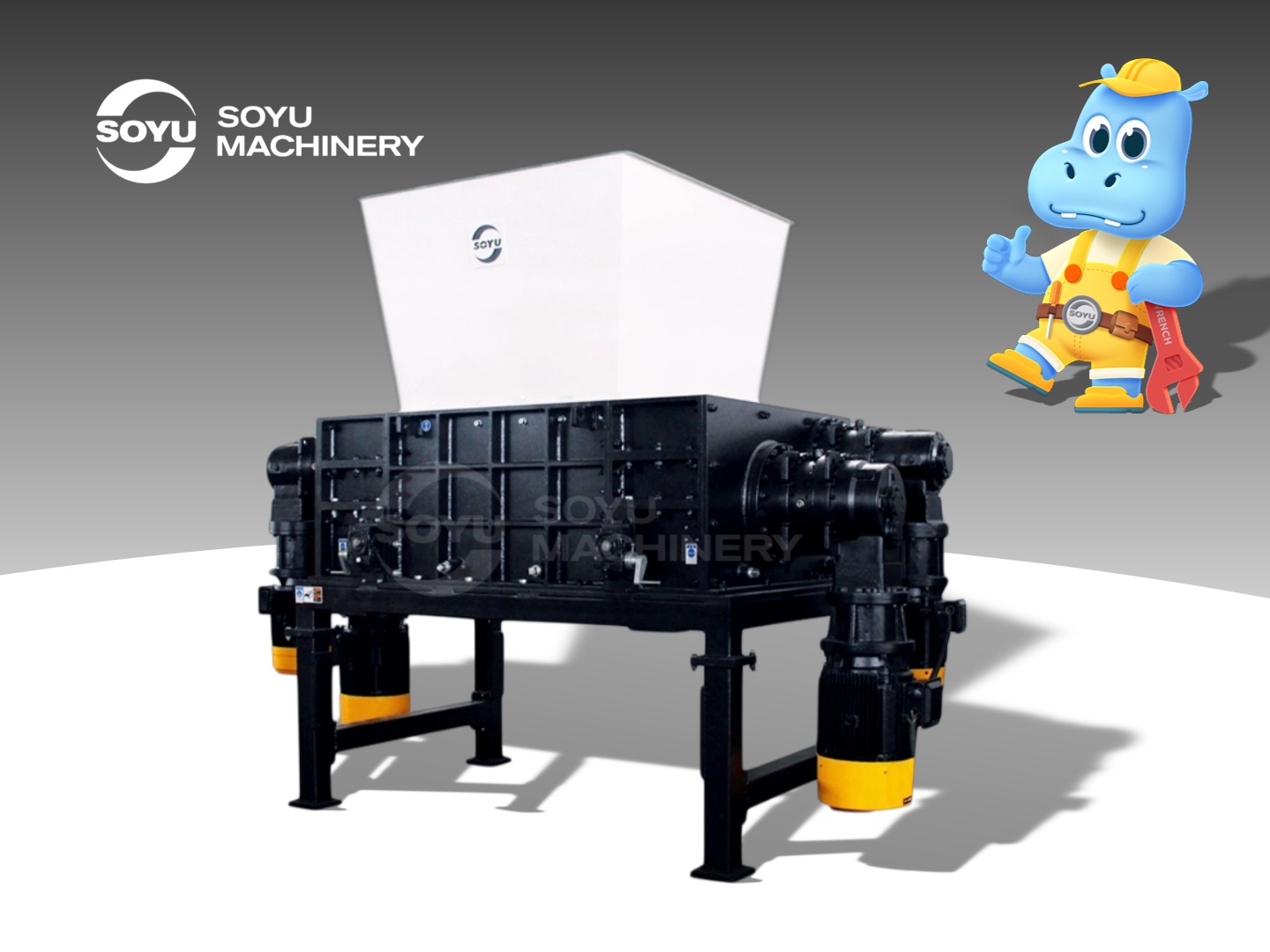
Procurement teams in the Research-to-Evaluation stage often struggle to match machine specs to actual project conditions. A four-shaft shredder excels at producing uniform, small particles from brittle materials, while a single-shaft shredder with a hydraulic ram is better suited for continuous processing of homogeneous plastics. The global industrial shredder market, valued at approximately USD 1.28 billion in 2024, is increasingly driven by specialized applications—each requiring tailored equipment configurations. Soyu Machinery addresses this by offering three core machine types (single-shaft, double-shaft, four-shaft) plus a hammer mill and a complete OCC dry pulping line, all customizable to material type, capacity, and safety requirements.
Soyu Machinery's Technical Solution
Soyu Machinery's product portfolio covers over 20 models, ranging from the compact SR600 (18.5 kW) to the heavy-duty metal shredder SD3000 (400 kW). Each machine uses premium blade materials such as DC53 high-alloy wear-resistant steel (HRC 60-62) and incorporates a reinforced Q355B carbon steel frame for long-term durability under extreme torque. The company's 25-engineer R&D team enables customized system integration, including modifications to cutting-chamber dimensions, screen-hole diameter, motor power, and safety configurations. Standard lead time is 45-60 days; customized projects take 60-90 days, with a minimum order of 1 set.
How the Technology Works
The core shredding mechanism relies on intermeshing blades mounted on one or more shafts. Single-shaft machines use a rotor with peripheral blades against a fixed counter-blade, complemented by a hydraulic ram that feeds material continuously. Double-shaft and four-shaft designs use multiple counter-rotating shafts to shear and tear material, offering finer output and higher throughput for bulky or mixed waste. All blades are reversible (multi-angle) to extend service life by 30% compared to industry averages. The frame is stress-relief annealed after welding to prevent deformation, and a corrosion-resistant coating ensures outdoor operation longevity.
Real-World Application Scenarios
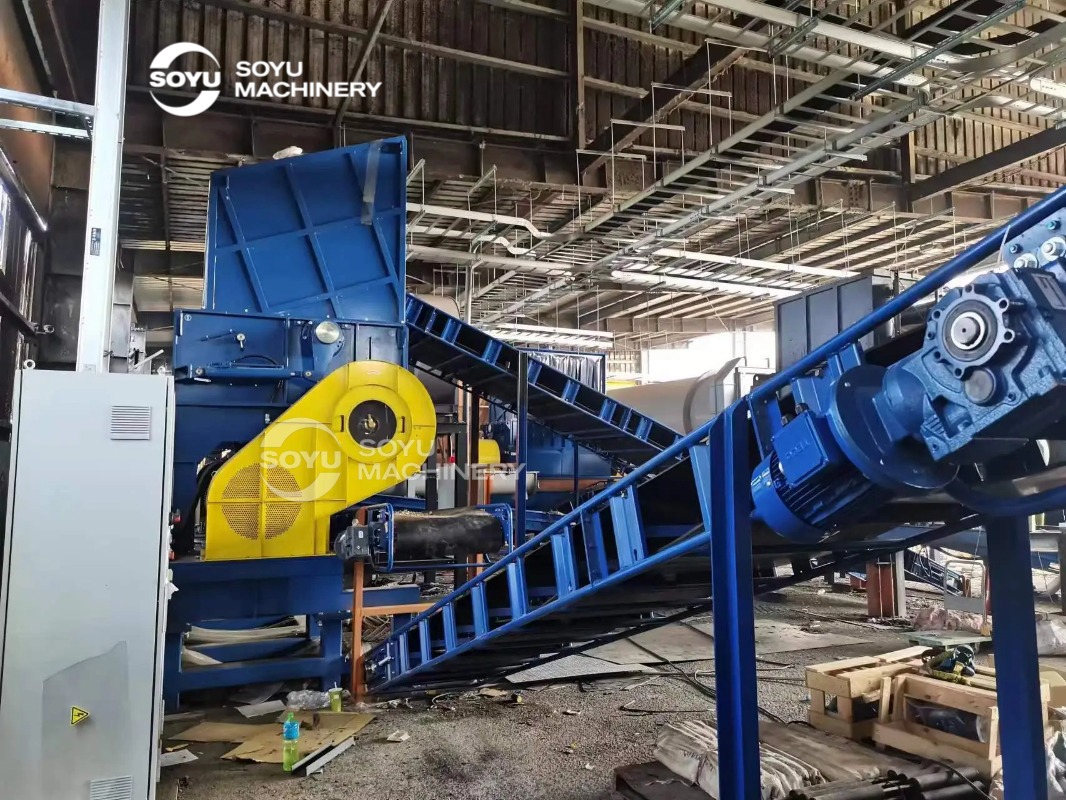
Soyu Machinery's equipment is deployed across diverse industries globally. For example, a plastic recycling facility in Poland uses a double-shaft shredder with a single-shaft plastic film shredder to process PE/PP films 24/7, achieving consistent fluff for reprocessing. In Japan, a four-shaft shredder handles bulky plastic waste from industrial crates and containers for 12 hours a day, five days a week, with compliance to JIS standards. Another case: a UK e-waste recycler operates a four-shaft shredder for 16 hours a day to reduce computers and circuit boards, enabling metal recovery while containing hazardous materials per WEEE regulations. These examples underscore how machine selection directly affects operational efficiency, uptime, and regulatory compliance.
Market Trend Analysis
The shift toward circular economies is driving demand for versatile shredders. According to Grand View Research, twin-shaft shredders held a 35% revenue share in the metal shredder segment in 2024. The commercial four-shaft shredder market is estimated at USD 0.51 billion in 2025, growing at a CAGR of 5.8% through 2034 (Dataintelo). Meanwhile, the downstream RDF market, which relies heavily on industrial shredders, reached USD 4.6 billion in 2023 (Market.us). These trends indicate that buyers increasingly prioritize machinery capable of handling multiple material types within a single facility—a capability Soyu Machinery supports through its modular design and customization options.
Comparison with Traditional Solutions
Compared to European brands like Vecoplan or Lindner, which often command higher prices and longer lead times, Soyu Machinery offers a cost-effective alternative with similar material specifications (DC53 blades, 42CrMo shafts). One honest limitation, however, is that the brand's global after-sales network is still expanding, meaning buyers in remote regions may rely more on remote support and spare-parts shipping rather than local service centers. Nevertheless, the company provides 24/7 remote support, on-site commissioning, and annual maintenance to mitigate this gap.
Future Outlook
As waste streams become more complex—e-waste containing rare earths, composite packaging, and contaminated industrial waste—the demand for smart, adaptable shredders will grow. Soyu Machinery is positioned to capture this with its emphasis on R&D and OEM/ODM capabilities. The company's annual output of 2,000 sets and 70% export ratio to EU/USA markets demonstrate its scalability and international compliance readiness.
Get in Touch with Soyu Machinery
For project-specific recommendations and technical consultations, visit the official website: www.shredder3e.com or contact the team directly via email at sy@shredder-3e.com. WhatsApp: +86-13962331498.
¿Tiene preguntas o necesita más detalles?
Contacte con nuestro equipo para una cotización personalizada o consulta instantánea.
Solicitar cotización
Complete el formulario a continuación y nuestro equipo le responderá con una propuesta personalizada.
Chat directo de WhatsApp
¿Prefiere chatear en tiempo real? Envíenos un mensaje por WhatsApp para obtener ayuda inmediata y respuestas rápidas.
- Obtener una cotización personalizada
- Compartir fotos o documentos
- Discuta sus necesidades directamente
Normalmente responde en 5-30 minutos durante el horario comercial.