
Matching PAF Forms to Applications: Grinding Wheels, Ceramics and Smelting
Potassium aluminium fluoride reaches three unrelated production lines: abrasive wheel presses, ceramic and glass kilns, and electrolytic aluminium cells. In each plant it arrives in a specific commercial form — white or grey, powder, granular or lump — and the form, more than the chemistry, decides whether the material performs as intended. A mismatch rarely appears on a certificate of analysis; it appears later as shortened wheel life, uneven glaze, or unstable bath behaviour.
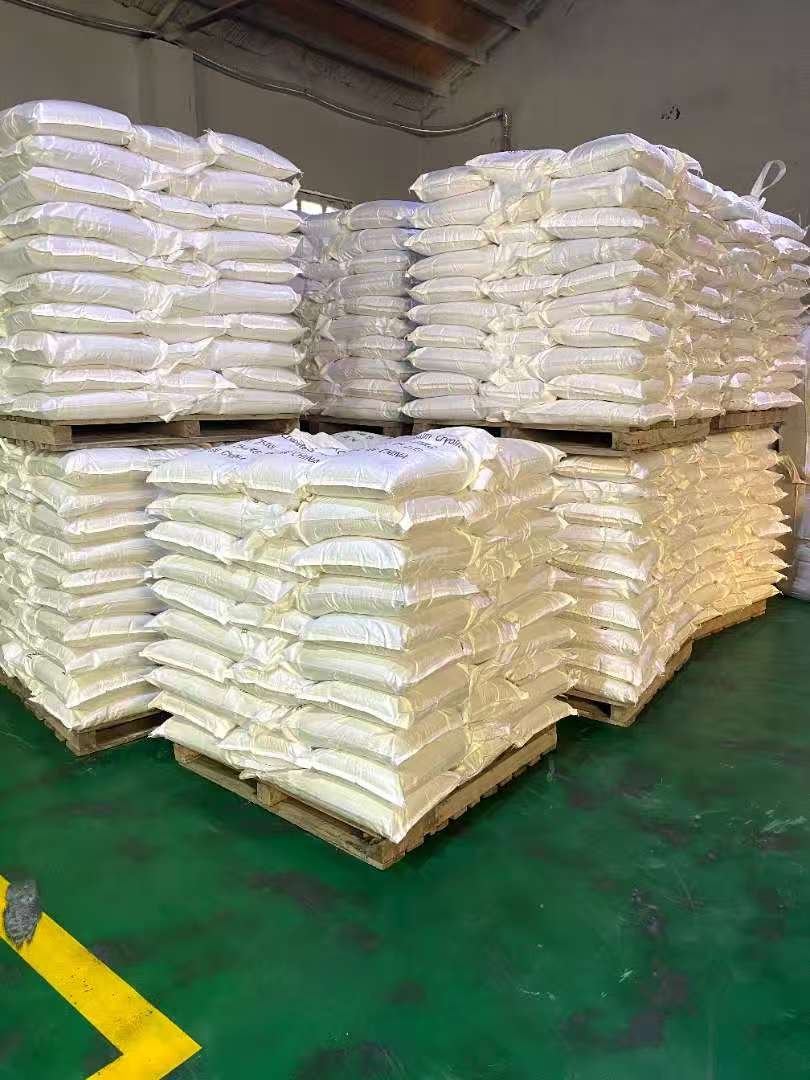
The compound behind those forms is potassium fluoroaluminate, written as KAlF4 or as the complex fluoride K3AlF6. Its molecular weight is approximately 142.07 g/mol and its CAS number is 60304-36-1. In international trade it commonly moves under HS code 38101090, the heading used for pickling preparations for metal surfaces and fluxes. Those identifiers matter for documentation and customs clearance, but they do not distinguish a brazing-grade white powder from a coarse grey granule. That distinction is what this article addresses.
Why one compound performs three different jobs
PAF is used across abrasives, ceramics and aluminium smelting because it carries three separate physical functions at once. As an active filler in resin-bonded grinding wheels it modifies how heat and abrasive grains behave inside the bond. As a flux in ceramics and glass manufacturing it lowers sintering temperatures and modifies glaze and glass properties. In electrolytic aluminium smelting it acts as a core flux that lowers the melting point of alumina and supports electrolysis efficiency.
The property that connects these roles is thermal behaviour. PAF melts in the region of 557–580 °C, with published application documentation describing a melting point of approximately 560 °C. That relatively low melting range is what allows the material to soften and flow inside a grinding arc, inside a kiln load, or inside an electrolyte bath before the surrounding material reaches its own critical temperature. A buyer choosing a form is, in practice, choosing how quickly and how evenly the material reaches that working state.
What actually changes between PAF grades and forms
Three variables separate one PAF offer from another, and they are independent of each other.
Colour and purity. White PAF and grey PAF are not cosmetic variants. Industrial grade material at 98% minimum is typically used for foundry and abrasive applications, where it is often supplied as grey PAF. High purity material above 99% — white PAF — is normally required for brazing and specialty glass. Specifying white PAF where grey is sufficient raises cost without changing process results; specifying grey where a brazing or specialty glass process requires high purity can compromise fluxing behaviour.
Physical form and particle size. Suppliers quote powder at mesh 200, granular at 0.3–1.0 mm and 0.5–1.5 mm, and lump material. Particle morphology can also be controlled — angular, spherical or crushed — which affects flowability and how the material packs into a mix or a feed system.
Intended function. The same product family is sold as an active filler, a flux, an opacifier, and a degassing and slag-removal agent. Function determines form far more than form determines function.
Grinding wheels: PAF as an active filler
In resin-bonded grinding wheels, potassium aluminium fluoride is described as a performance enhancer with five linked effects. First, it absorbs heat: because it melts at around 560 °C, it behaves like a distributed micro heat sink inside the grinding arc, absorbing cutting heat and reducing the risk of workpiece discoloration and deformation. Second, it improves adhesion between the bond and the abrasive grains, which strengthens the wheel and extends service life. Third, its thermal stability helps conduct heat away and slows resin ageing. Fourth, it supports self-sharpening by allowing dulled grains to release at the right moment so fresh cutting edges are exposed. Fifth, it reduces adhesion of grinding debris to the wheel surface, limiting clogging during prolonged operation.
For a wheel manufacturer, the practical implication is that PAF is an engineering input into the bond formulation rather than a commodity additive. Fine powders disperse more evenly through a mix, while coarser material may suit processes where dust generation and mixing time need to be controlled. This is one of the clearest cases where particle size and grade should be specified together with the resin system.
Ceramics and glass: PAF as a flux and opacifier
In ceramics and glass manufacturing, PAF is used as a flux and opacifier. Its function is to lower sintering temperatures, improve glaze texture, and enhance the heat resistance and corrosion resistance of glass. Lowering the sintering temperature has a direct operational consequence: kiln energy demand and thermal load on refractories can be reduced when the flux is correctly matched to the body or glaze composition.
Because this application depends on melting and reaction behaviour rather than mechanical dispersion, high purity material is the more typical requirement, particularly in specialty glass where trace impurities can affect optical or surface properties. Buyers in this segment normally treat white PAF as the default specification and reserve grey or industrial grade for less sensitive ceramic bodies.
Electrolytic aluminium smelting: PAF as a melting-point reducer
Electrolytic aluminium smelting is the largest-volume application. Here potassium aluminium fluoride acts as a core flux that lowers the melting point of alumina and improves electrolysis efficiency, which is why it is described as a fundamental material in the modern electrolytic aluminium industry. In this environment the material is consumed continuously and in bulk, so the relevant purchasing questions shift towards consistency of supply, stable particle size distribution from batch to batch, and predictable melting behaviour rather than fine dispersion in a polymer matrix.
Granular and lump forms are common in this segment because they handle well in bulk logistics and feed systems, while powder grades are used where faster dissolution or a specific feed method is required.
Two more application matches: brazing and foundry casting
Two further uses of the same product family illustrate how widely the form-to-application logic applies.
In corrosion-free brazing of aluminium alloys — including components such as battery water-cooling plates and air-conditioning radiators used in new energy vehicles — potassium fluoroaluminate removes oxide films and improves weld quality. This is a high-purity application, where white PAF is the standard choice.
In non-ferrous metal recycling and casting, PAF is used for degassing and slag removal in recycled aluminium recycling and aluminium alloy casting, improving melt cleanliness. A documented case from a Korean manufacturer shows a two-year, ongoing programme at 60 MT per month for metal additive and flux applications, where the customer requirement was high purity and the reported outcome was stable supply. That pattern — steady monthly volume, defined purity, stable results — is typical of foundry and casting buyers.
Matching table: form, grade and application
| Application | Typical form | Grade focus | Primary function |
|---|---|---|---|
| Abrasive and grinding wheel industry | Powder, fine particle size | Industrial grade, grey or white | Active filler: heat absorption, grain bonding, self-sharpening, anti-clogging |
| Ceramics and glass manufacturing | Powder | High purity, white | Flux and opacifier: lowers sintering temperature, improves glaze and glass durability |
| Electrolytic aluminium smelting | Granular 0.3–1.0 mm / 0.5–1.5 mm, lump | Industrial grade | Core flux: lowers alumina melting point, supports electrolysis efficiency |
| Aluminium brazing | Powder, closely controlled distribution | High purity, white | Removes oxide film, improves weld quality |
| Recycled aluminium and alloy casting | Granular or powder | Industrial grade, grey | Degassing and slag removal |
The table is a starting framework, not a fixed rule. Within each row, the exact mesh or millimetre range still has to be validated against the customer's own mixing, feeding and firing equipment.
Where PAF is not the right answer
Three boundaries are worth stating plainly, because they affect both cost and compliance.
Grade escalation is not free performance. White PAF above 99% purity is required for brazing and specialty glass, but in foundry and abrasive applications industrial grade at 98% minimum is the recognised specification. Buying a higher grade than the process requires adds cost and does not automatically improve wheel life or casting cleanliness. Conversely, downgrading to industrial grade in a brazing line is a genuine technical risk, not a cost saving.
Handling and storage are regulated, not optional. Potassium aluminium fluoride is categorised as GHS Acute Toxicity Category 4 for oral, dermal and inhalation exposure and Skin Irritation Category 2 under the OSHA Hazard Communication Standard framework. Product documentation also specifies storage in a dry, well-ventilated place. Buyers should confirm that their receiving, weighing and mixing areas are consistent with that classification before committing to bulk volumes.
Finer does not automatically mean better. Coarser granular material offers better flowability, which the product literature identifies as a design objective of the granulation and shaping process, while very fine powders generally require more attention to dust control during handling. Selecting a particle size that the plant can actually handle safely and consistently is part of the specification, not an afterthought.
Market context: what is growing and what is still not measured
The global potassium aluminium fluoride market was valued at USD 1.76 billion in 2024 and is projected to reach USD 2.62 billion by 2033, a compound annual growth rate of 4.8% over the 2025–2033 period, according to DataHorizzon Research. Two caveats belong with that figure.
First, market sizing for this family of materials is definition-sensitive. Some published estimates value the narrower potassium fluoride market at a substantially smaller figure than estimates for potassium aluminium fluoride, because PAF figures include complex metallurgical flux volumes that pure potassium fluoride figures exclude. Buyers comparing supplier commentary to market reports should check which definition is being used.
Second, adjacent price benchmarks are not PAF prices. Northeast Asian pricing for the related fluoride AlF3 reached USD 1.80 per kg in March 2026, up 6.5% from the fourth quarter of 2025, according to IMARC Group. AlF3 is a related benchmark only. A standardised public price spread between white and grey PAF is not consistently available, so any grade-versus-grade cost comparison has to be built from actual supplier quotations and the consumption rate of a specific process.
The demand drivers behind the growth forecast are visible in the application list itself: aluminium smelting and casting activity, recycled aluminium processing, and brazing demand linked to aluminium components for new energy vehicles and thermal management systems.
Customization and supply: what buyers can actually specify
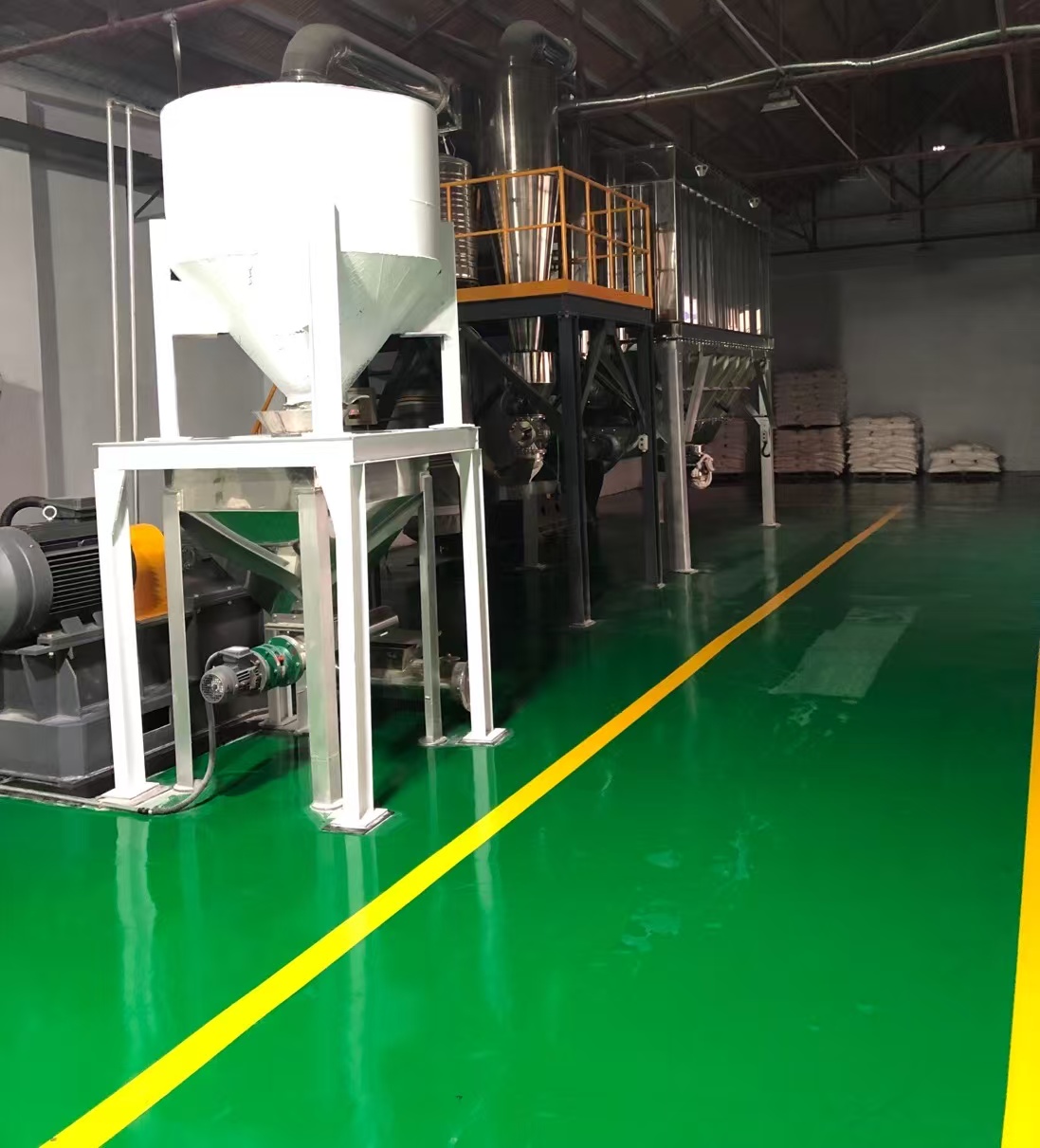
Sumetech Industry Co., Ltd is a China-based manufacturer of potassium aluminium fluoride and boron nitride, founded in 2019 and operating a 6,000 m² production facility with an annual output of 5,000 MT and a monthly capacity of 1,000 MT. The company reports an export ratio of approximately 90%, with main markets in Turkey, Japan, Korea and Europe, and a technical team of five specialists covering inorganic fluoride chemistry and powder processing. Its stated scope covers OEM and ODM production services for potassium aluminium fluoride, including customization of size and colour.
In practical terms, that translates into specification points a buyer can raise during evaluation: particle size distribution ranging from coarse granules to sub-micron powders, morphology (angular, spherical or crushed), purity grade, and packaging specification. Standard commercial parameters include mesh 200 powder, 0.3–1.0 mm and 0.5–1.5 mm granular, and lump material, in both grey and white grades. Documented lead time is 30 days, monthly capacity is 1,000 MT, and quality control is described as 100% testing. After-sales support is offered remotely and on site. Commercial terms published for the product family include FOB, CIF and FCA delivery terms, pre-shipment test as the acceptance criterion, and 30/70 payment terms.
A specific application such as a particular wheel bond, a glaze composition or a smelter feed line is best resolved by matching particle size and purity to the process before finalising volume, since the same base chemistry delivers different results across those three environments.
Compliance documentation for EU and other regulated markets
For EU-bound shipments, the relevant documentation for this product family is RoHS 2.0 based. A Verification of Conformity numbered CKEYS251222003 was issued on 22 December 2025 by Guangdong KEYS Testing Technology Co., Ltd. for the EU market, covering potassium aluminium fluoride, potassium fluoroaluminate, fluoride potassium aluminate, potassium cryolite and potassium tetrafluoroaluminate in both white and grey forms. A corresponding RoHS test report numbered RKEYS251215033 was issued on the same date, referencing RoHS Directive 2011/65/EU and its subsequent amendments and the IEC 62321 series of test standards, including IEC 62321-3-1:2013, IEC 62321-4:2013 with AMD1:2017, IEC 62321-5:2013, IEC 62321-6:2015, IEC 62321-7-1:2015, IEC 62321-7-2:2017 and IEC 62321-8:2017.
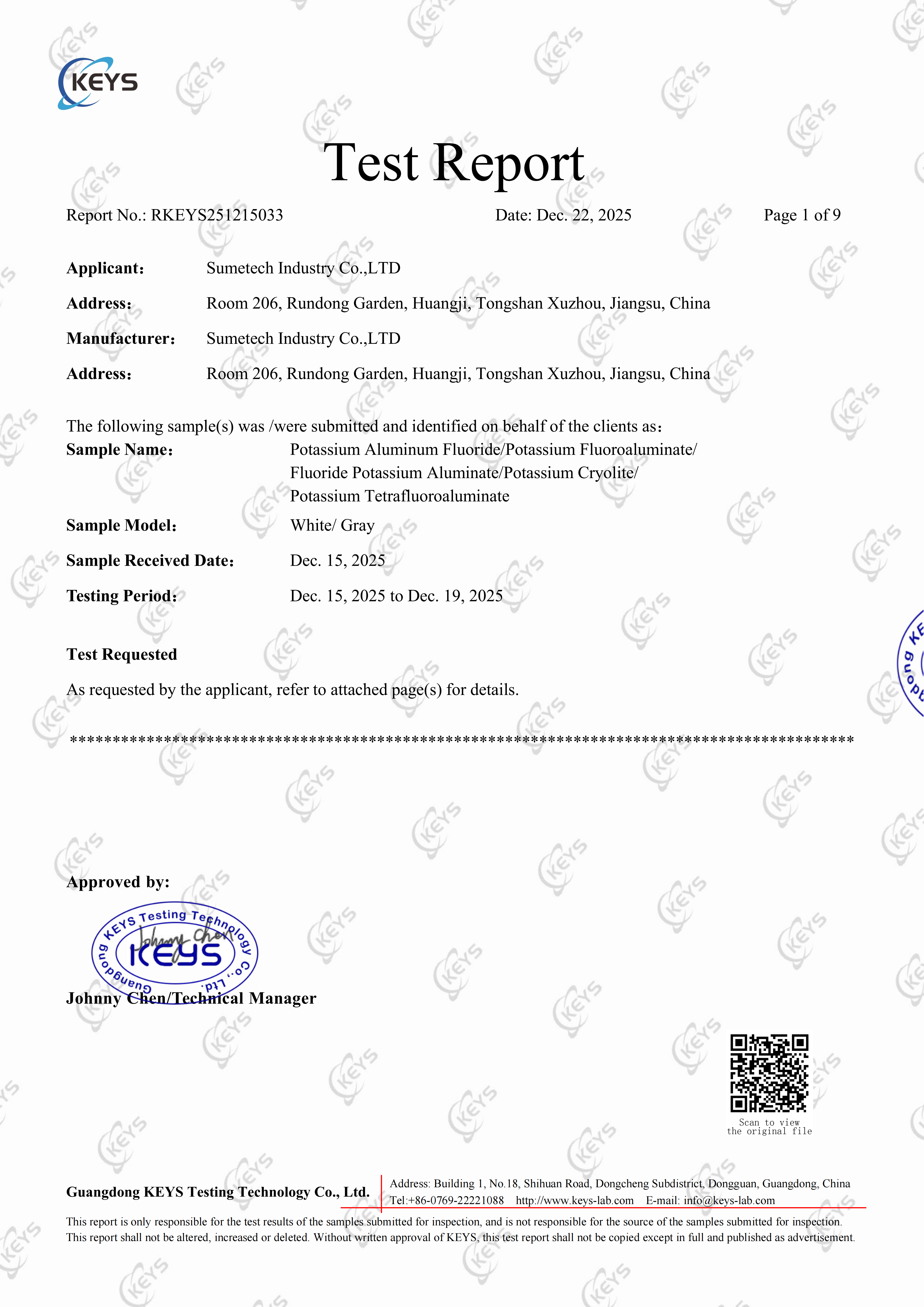
Because the certificate scope covers both colour grades and all three physical forms, EU buyers evaluating a form change within the same product family can generally rely on the existing conformity documentation rather than commissioning new testing. Buyers in other regulated markets should still confirm local requirements separately, as RoHS 2.0 addresses EU market access specifically.
Future outlook
Three developments are worth tracking for anyone procuring PAF across these applications. The first is the continued shift towards grade-specific procurement: as buyers become more precise about whether they need white or grey material, form-level specification is likely to replace product-level purchasing in more supply agreements. The second is the aluminium value chain itself, where smelting, casting and recycling volumes drive the bulk of demand growth, supported by the 4.8% CAGR forecast through 2033. The third is brazing demand tied to aluminium thermal management components, which pulls high-purity white PAF into a market segment that behaves more like a specialty chemical than a commodity flux.
For grinding wheel manufacturers, the more immediate change is formulation-level: PAF is increasingly specified as a functional filler with defined particle size, not as a generic additive. That shifts the buying conversation from price per tonne towards performance per tonne, which in turn puts more weight on batch-to-batch particle size consistency and on the supplier's ability to hold a specification over repeated shipments.
FAQ
What is the difference between white PAF and grey PAF?
White and grey refer to colour grades that correspond to different purity levels. Industrial grade material at 98% minimum is typically used for foundry and abrasive applications and is commonly supplied as grey PAF. High purity material above 99% is normally required for brazing and specialty glass and is supplied as white PAF. The choice should follow the process requirement, because specifying a higher purity than the application needs adds cost without changing results, while substituting industrial grade into a brazing process carries technical risk.
Which PAF form should be used for grinding wheels, ceramics and aluminium smelting?
Grinding wheel and ceramic applications generally use powder grades, because the material must disperse or melt evenly within a bond matrix or a glaze composition. Electrolytic aluminium smelting typically uses granular material at 0.3–1.0 mm or 0.5–1.5 mm, or lump material, because bulk handling and feed behaviour matter more than fine dispersion. Brazing uses closely controlled powder, while foundry degassing and slag removal can use either granular or powder depending on the melt treatment method. Particle size should always be validated against the customer's own mixing, feeding and firing equipment.
How does PAF work as an active filler in resin-bonded grinding wheels?
Potassium aluminium fluoride improves grinding wheel performance through five linked effects. It melts at around 560 °C and absorbs a substantial share of grinding heat, reducing workpiece discoloration and deformation. It improves adhesion between the bond and the abrasive grains, strengthening the wheel and extending service life. Its thermal stability helps conduct heat away and slows resin ageing. It supports self-sharpening so dulled grains release and fresh cutting edges are exposed. It also reduces adhesion of grinding debris to the wheel surface, limiting clogging during extended operation.
Can potassium aluminium fluoride be customized in particle size, colour and packaging?
Yes. OEM and ODM production services are available for potassium aluminium fluoride, including customization of size and colour. Customizable parameters include particle size distribution from coarse granules to sub-micron powders, morphology such as angular, spherical or crushed shapes, purity grades, and packaging specifications. Standard quoted parameters include mesh 200 powder, 0.3–1.0 mm and 0.5–1.5 mm granular material, and lump, in both grey and white grades.
What compliance documentation and commercial terms apply to PAF orders?
For the EU market, RoHS 2.0 documentation is available: a Verification of Conformity numbered CKEYS251222003 and a RoHS test report numbered RKEYS251215033, both issued on 22 December 2025 by Guangdong KEYS Testing Technology Co., Ltd. and covering white and grey potassium aluminium fluoride across the IEC 62321 test standard series. Because potassium aluminium fluoride is classified as GHS Acute Toxicity Category 4 for oral, dermal and inhalation exposure and Skin Irritation Category 2, handling and dry, well-ventilated storage conditions should be confirmed at the receiving site. Published commercial terms for the product family include FOB, CIF and FCA delivery terms, pre-shipment test as the acceptance criterion, and 30/70 payment terms.
Additional specification details and a full product overview are available in the Sumetech product catalogue.