
Matching Leather Accessories to Retail, Travel, and Fashion Use Cases
The global leather goods market was valued at USD 282.7 billion in 2024 and is projected to reach USD 552.9 billion by 2033, according to Custom Market Insights. China alone exported USD 36.96 billion of leather articles, travel goods and harness in 2024, based on UN COMTRADE data published through Trading Economics. Those figures describe a large and durable category — but they say nothing about whether a specific product line will work in a specific channel.
Buyers typically learn this the hard way. A tote bag developed for a fashion retailer, a passport holder sold through a travel-gift counter, and a leather pony charm used as a low-ticket add-on are all described as “leather accessories” in a catalogue. In production they are different products: different panel construction, different hardware loads, different edge finishing, and — for anything placed on the European market — different chemical compliance exposure.
This industry reference maps the main leather accessory families to the applications they actually serve: fashion retail, wholesale, travel, gifting, and jewellery-adjacent retail. It uses published product specifications to show what changes between them, and where the boundary of a single cut-and-sew manufacturing model lies.
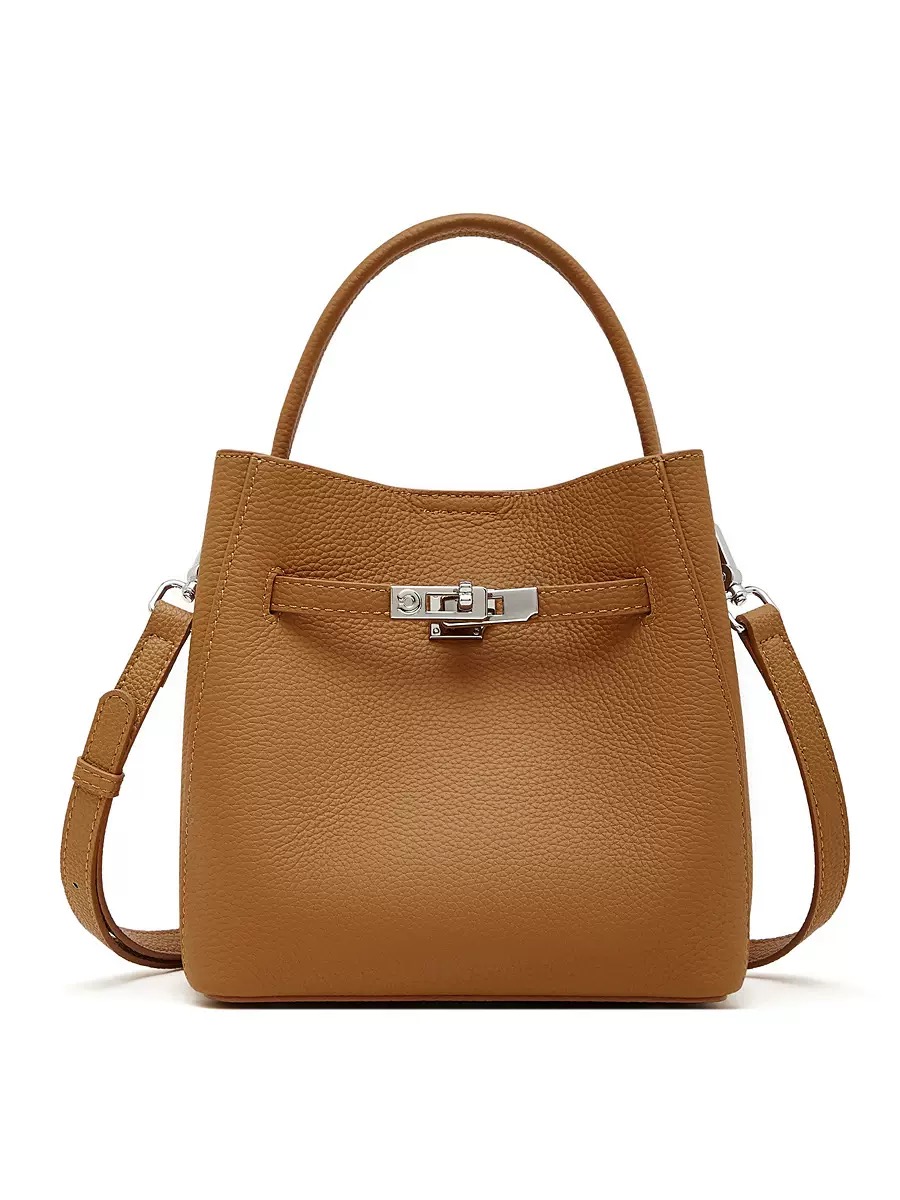
Cover: a custom leather crossbody bag — a core silhouette in fashion retail and wholesale assortments. Image: Dongguan Feiteng Leather Co., Ltd.
Application Fit Comes Before Supplier Comparison
Procurement teams usually open with a supplier shortlist. For leather accessories, a more productive first step is an application brief: who buys the item, where it is used, how often it is handled, and what the buyer notices in the first thirty seconds.
- Fashion retail and wholesale buyers are usually buying a silhouette that can be repeated across colourways and seasons. Style language and hardware consistency matter more than the novelty of any single SKU.
- Travel and travel-gift buyers need small items that survive handling and transit — luggage tags and passport holders that hold their shape and their edge finishing.
- Corporate and business gift buyers prioritise personalisation: embossing or embroidery that carries a logo cleanly on a small surface area.
- Jewellery and accessories retailers buy small-format leather items — charms, mini jewellery boxes — that sit beside a main product without competing with it.
Each of these briefs implies a different mix of material grade, craft method, and hardware specification. The opportunity for buyers is that a single well-configured leather goods range can serve several of them at once, provided the manufacturing base supports the processes each line needs.
Application Map: Which Leather Line Sells Where
The table below summarises the product families, their published material and hardware options, and the channels they are specified for. It is drawn from product unit documentation rather than marketing summaries, so the differences between lines are visible at specification level.
| Product family | Typical models | Materials | Specified channels |
|---|---|---|---|
| Leather bags | Underarm bag, backpack, tote bag, crossbody bag, clutch bag, briefcase, travel bag; crescent bag; shoulder bag; hand bag | Genuine leather, PU leather, microfiber leather | Retail of fashion items; wholesale; consumable industry |
| Travel goods | Leather heart luggage tags, leather normal luggage tags, leather luggage tags, leather passport holder | Real leather, PU, microfiber | Retail of fashion items; leather gift; business gift; wholesale |
| Wallets and purses | Women’s wallet, men’s wallet, card holder, purse | Real leather, PU, microfiber | Retail of fashion items; leather gift; business gift; wholesale |
| Charms and keychains | Leather pony bag charm, leather keychain, leather phone charm | Genuine leather, microfiber, PU | Retail of fashion items; leather gift; business gift; wholesale |
| Small leather gift and jewellery packaging | Leather mini jewellery box, leather jewellery bag | Real leather, PU, microfiber | Retail of fashion items; leather gift; business gift; wholesale; jewellery and accessories industry |
Fashion Retail and Wholesale: Bags Anchor the Assortment
Bag lines in a leather goods factory are usually described by function rather than by fashion name, because one body can serve several selling positions. A single product specification can cover use as an underarm bag, backpack, tote bag, crossbody bag, clutch bag, briefcase, or travel bag — the same construction logic, differentiated by strap configuration, size, and closure.
Specific models carry their own designations: crescent bag and underarm bag sit within a broader leather bag range that also includes shoulder bags and hand bags, including a “wind french stick” underarm silhouette. Sizes are custom across the range, and material options are genuine leather, PU leather, and microfiber leather.
Hardware is where a bag line is won or lost at retail
Documented hardware options for this range include alloy, gold-electroplated, gold or silver, and brass-black finishes at rust-proof grade; YKK or ordinary zippers; magnetic clasps; snap fasteners; rivets; and shoulder-strap adjustment clasps. Available crafts include embossed, embroidery, patchwork, edge oiling, silk-screen, and digital printing. Style coverage spans simple, luxury, vintage, daily use, casual, and all-match directions.
For a wholesale buyer, that spread is the practical value proposition: one production partner holding a consistent construction standard while moving the surface treatment between a minimal daily-use line and a vintage-styled line. For a fashion retailer, the relevant question is narrower — whether the factory can reproduce the same silhouette across successive colourways without re-engineering the pattern.
The listed application industries for this family are the retail of fashion items, wholesale, and the consumable industry, with common application scenarios in Europe, North America, and Asia-Pacific markets.
Travel Goods: Luggage Tags and Passport Holders
Travel leather goods are small, handled constantly, and frequently bought in sets. The published product types are leather heart luggage tags, leather normal luggage tags, leather luggage tags, and leather passport holder, with model designations covering luggage tag and passport holder formats. Materials are real leather, PU, or microfiber; sizes are custom.
Hardware for this family includes alloy, gold-electroplated, gold or silver, and brass-black rust-proof grade finishes, magnetic clasps, and snap fasteners. Crafts include embossed, embroidery, patchwork, edge oiling, silk-screen, and digital printing, with styles in simple, luxury, vintage, daily-use, and casual directions. Application industries are the retail of fashion items, leather gift, business gift, and wholesale.
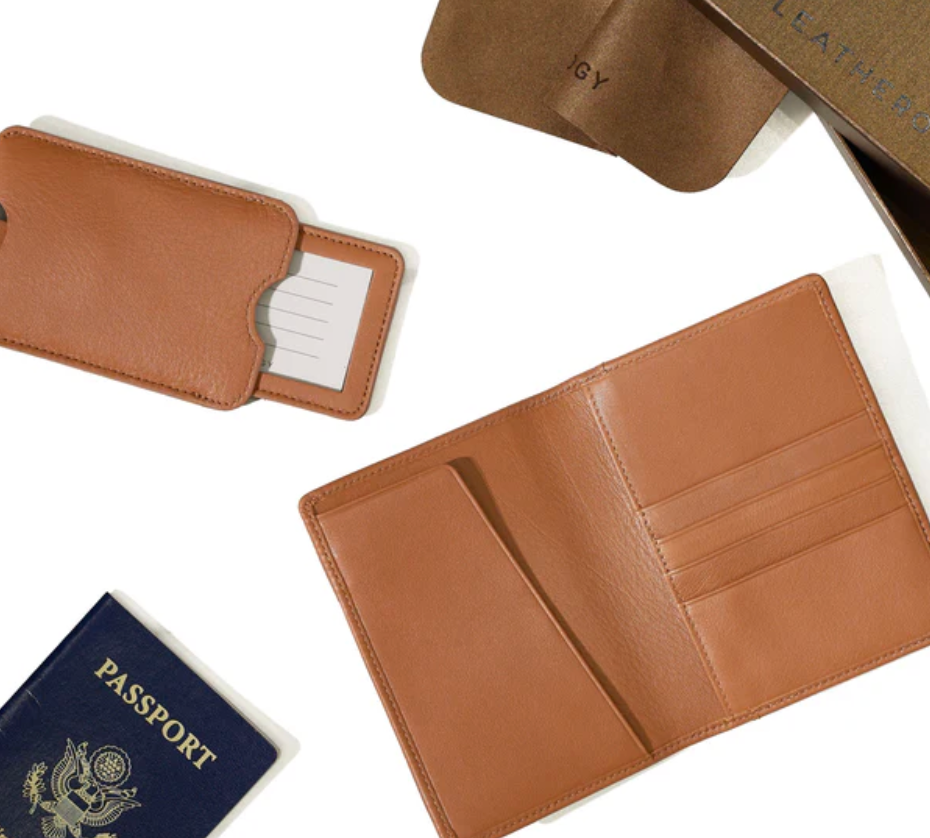
Passport holder and luggage tag sets are typically merchandised as travel-gift pairings rather than as standalone SKUs. Image: Dongguan Feiteng Leather Co., Ltd.
Two application notes matter here. First, set logic: because both items share the same craft vocabulary (embossed, embroidery, edge oiling) and the same hardware grades, a matching passport holder and luggage tag can be developed from one material and finishing decision — which is why travel retail and corporate gifting both buy them as paired items. Second, personalisation surface: luggage tags and card holders offer a small, flat, high-visibility area where embossed or embroidered branding reads cleanly, which is the primary reason business gift programmes specify them.
Wallets, Card Holders, and Purses: Segmented by Gender and Gift Volume
Wallets are the most segmented family in a leather goods range because the buying logic splits by user, by occasion, and by price positioning. Documented classifications are women’s wallet, men’s wallet, card holder, and purse, with model designations covering women’s wallet, men’s wallet, and card holder formats.
Material options are real leather, PU, or microfiber, and size is custom. Hardware includes alloy, gold-electroplated, gold or silver, and brass-black rust-proof grade finishes, YKK or ordinary zippers, magnetic clasps, and snap fasteners. Craft options are embossed, embroidery, patchwork, edge oiling, silk-screen, and digital printing, across simple, luxury, vintage, daily-use, and casual styles. The family is specified for retail of fashion items, leather gift, business gift, and wholesale.
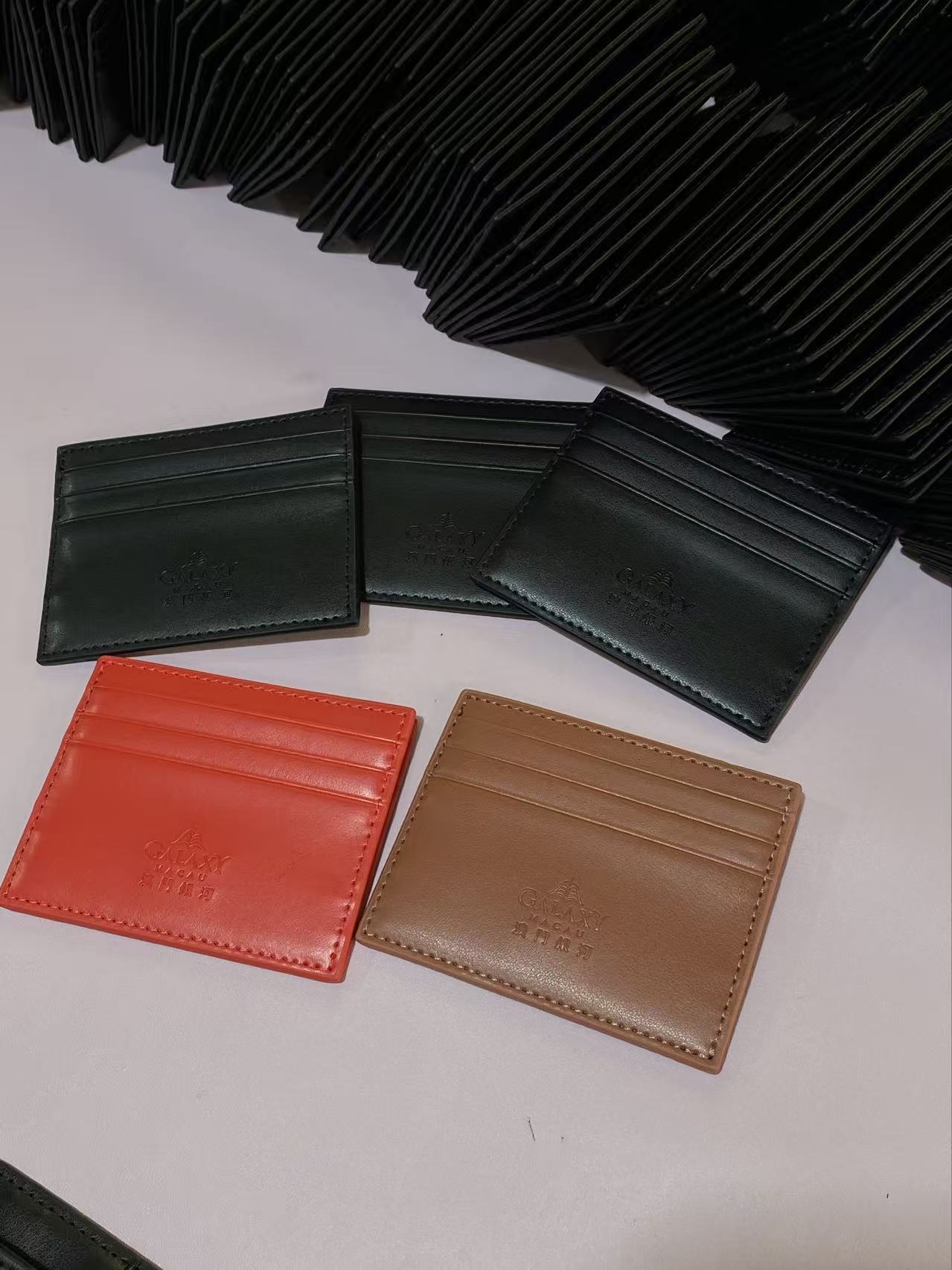
Card holders are frequently purchased in colour sets, which makes surface finishing and colour consistency the primary quality question. Image: Dongguan Feiteng Leather Co., Ltd.
The practical decision for buyers is not “which wallet is best” but how many wallets the target consumer will buy. A single-card-holder consumer and a full-size wallet consumer are different shoppers with different replacement cycles. Card holders in particular are bought in colour sets and used as add-on or gifting items, which places more weight on surface finishing consistency than on internal compartment engineering.
Charms and Keychains: Small-Format Lines for Gift and Add-On Sales
Charms and keychains are small-format leather accessories with a distinct commercial role: they are low-commitment purchases that attach to a product the customer already owns. Published product types are leather pony bag charm, leather keychain, and leather phone charm, grouped in the leather charm and keychain category under model designations bag charm and key chain.
Materials are genuine leather, microfiber, and PU. Hardware options include alloy, gold-electroplated, gold or silver, and brass-black rust-proof grade finishes, and snap fasteners. Available crafts include embossed, embroidery, patchwork, edge oiling, silk-screen, and digital printing; size is customisable and styles span simple, luxury, vintage, daily use, and casual. The product is designed for daily use and casual scenarios and is specified for the retail of fashion items and the leather gift industry.
Because the item is small, the production question is different from a bag: tight stitch radii, embroidery registration on a curved surface, and the reliability of the attachment hardware carry proportionally more of the perceived value. This is the family where a factory’s access to specialised stitching equipment matters most.
Materials, Crafts, and Hardware: What Actually Changes Between Applications
Across every family above, three variables move together: material grade, craft method, and hardware specification.
Material. Genuine leather accounted for the largest revenue share of the global leather goods market in 2025, at 52.7%, according to Grand View Research. That makes material declaration both a commercial and a compliance decision, not only a cost lever. The documented alternatives in this range — genuine leather, PU leather, and microfiber — are not interchangeable substitutes; they change hand-feel, ageing behaviour, edge finishing requirements, and the applicable regulatory exposure.
Craft. The craft vocabulary is shared across families: embossed, embroidery, patchwork, edge oiling, silk-screen, and digital printing. What changes is where each method is viable. Embossing suits flat personalisation panels such as luggage tags and card holders. Embroidery reads better on charms and bag faces, where a raised surface is a design feature. Edge oiling is a finishing step that becomes visible on bags and wallets, where the edge is exposed to handling.
Hardware. The listed options — alloy, gold-electroplated, gold or silver, brass black at rust-proof grade, YKK or ordinary zippers, magnetic clasps, snap fasteners, rivets, and shoulder-strap adjustment clasps — represent a graded specification ladder. A travel item and a gifting item can carry the same alloy base and still differ in finish and durability requirement.
Compliance layer
Leather goods manufacturers placing product on the European market must comply with the EU REACH regulation (EC No 1907/2006) with respect to restricted chemical substances including Chromium VI and lead, as set out by the European Chemicals Agency. Separately, the Leather Working Group audit is the primary global standard for environmental compliance in leather manufacturing, with certifications ranging from Bronze to Gold. Dongguan Feiteng Leather Co., Ltd holds ISO 9001, SEDEX, and BSCI certifications.
The Manufacturing Base Behind the Range
Dongguan Feiteng Leather Co., Ltd is a genuine leather goods manufacturer established in 2005 and located at Room 201, Building A, No. 2, Xixi Tianyuan Street, Liaobu Town, Dongguan City, Guangdong Province, China. The company specialises in genuine leather goods including leather gifts, fashion accessories, and ladies’ bags, and produces leather bags, leather wallets, leather accessories, leather bag charms, leather keychains, hand bags, tote bags, shoulder bags, and leather card holders.
The manufacturing facility covers 2,500 m², employs approximately 105 staff, and carries an annual production capacity of 840,000 pieces. Development is supported by a six-person R&D team of sample makers and an in-house sample making room — the function that turns an application brief into a producible specification. Export business accounts for 70% of total sales, with main markets in Europe, Australia, Canada, the Middle East, and the USA.
The range is organised the way the application map above suggests. Leather gifts cover luggage tags, ID holders, and cardholders. Fashion accessories cover car key covers, keychains, and bag charms. Ladies’ bags cover handbags, shoulder bags, tote bags, crossbody bags, and wallets. Production operates in sewing mode using normal sewing machines, automatic sewing machines, and special high-end sewing machines — and the documented application scenario is outdoor use, fashionable dressing style, and social contact, in the fashion and luxury casual clothing industry, the leather gift industry, and cross-border e-commerce.
What this tells a buyer is less about scale and more about range coherence: the product families, craft vocabulary, and hardware ladder all belong to the same production system, which is what allows a retailer, a wholesaler, and a gift buyer to be served from one development cycle without each line being outsourced to a different process.
Market Trend Analysis
Three verified market signals are relevant to application-led sourcing decisions.
- Category growth. The global leather goods market was valued at USD 282.7 billion in 2024 and is projected to reach USD 552.9 billion by 2033 (Custom Market Insights), indicating a category that continues to expand rather than contract.
- Production concentration. Asia Pacific held a 36.6% revenue share of the global leather goods market in 2025, with China remaining the largest individual market (Grand View Research). China’s exports of leather articles, travel goods and harness totalled USD 36.96 billion in 2024 (UN COMTRADE / Trading Economics).
- Material mix. Genuine leather accounted for the largest revenue share at 52.7% in 2025 (Grand View Research), which keeps material sourcing and chemical compliance on the critical path for any range that includes genuine leather lines.
One caution belongs in any market analysis. Published leather goods market sizes differ materially depending on category definition: Grand View Research cites approximately USD 282.1 billion for 2025, while Fortune Business Insights cites USD 531.07 billion using broader category boundaries. Buyers comparing supplier growth claims should confirm that both sides are using the same definition before drawing conclusions — a market figure is only meaningful alongside the scope it was measured on.
Direct Factory Development and Traditional Intermediated Sourcing: A Boundary Check
The traditional route to leather accessories is intermediated sourcing: buying from trading companies, agents, or stock-line catalogues. Its advantages are real — immediate availability, low development commitment, and a very wide assortment from a single contact point. Its limits are equally real: customization depth is bounded by what is already in stock, and visibility into material declaration, finishing method, and hardware grade is usually second-hand.
Direct factory development reverses that trade-off. Custom size, style, craft, and hardware become available, supported by in-house sample makers who can translate a brief into a produced sample. In exchange, the buyer takes on specification work, sampling time, and the production commitments linked to material runs.
Four boundaries are worth stating plainly, because they affect whether direct development is the right route for a given programme.
- The production model is cut-and-sew. The documented operation mode for this type of factory is sewing. Product families whose structure depends primarily on moulded, cast, or rigidly formed components sit outside what a sewing-based line is configured to do — a bag, wallet, charm, or travel accessory is a natural fit; a hard-shell moulded item is not.
- Category listing is not the same as category depth. A factory can legitimately list a product family while having different capability depth in it than in its core lines. Buyers should verify the specific line they intend to buy through samples and construction detail, rather than evaluating the catalogue as a whole.
- Chemical compliance is market-specific. Placing genuine leather articles on the EU market requires REACH compliance with respect to substances such as Chromium VI and lead. A supplier without the documentation trail is not a viable partner for that market, regardless of price.
- Customization carries development cost. Custom size, craft, and hardware require sample development before production. That cost is legitimate and should be planned into the programme timeline rather than treated as a supplier inefficiency.
Future Outlook
Three directions appear consistent with the evidence above. First, application-specific development is likely to keep gaining weight over generic catalogue breadth, because channels buy against scenarios — travel sets, gift programmes, seasonal retail lines — rather than against product families in the abstract. Second, material and compliance documentation will continue to rise in importance as genuine leather holds the majority revenue share and EU chemical restrictions remain in force. Third, personalisation methods already documented in production — embossed and embroidery work on small, flat surfaces such as card holders and luggage tags — are the most natural place for brand-specific differentiation to grow.
For buyers in the awareness and research stages, the practical implication is a shift in how suppliers are evaluated. Instead of asking which factory has the largest catalogue, ask which factory can hold a defined specification across the specific application you are buying for — and can show you the sample that proves it.
FAQ
1. What does a leather goods factory actually produce?
A leather goods factory converts leather and leather-alternative materials into finished consumer items through cutting and sewing operations. A typical documented range includes leather bags, leather wallets, leather accessories, leather bag charms, leather keychains, hand bags, tote bags, shoulder bags, and leather card holders. Product families commonly extend into leather gifts such as luggage tags, ID holders and cardholders; fashion accessories such as car key covers, keychains and bag charms; and ladies’ bags such as handbags, shoulder bags, tote bags, crossbody bags and wallets.
2. How do I decide which leather accessory categories fit my sales channel?
Match the category to how the end consumer uses and buys it. Fashion retail and wholesale channels are specified for bags and wallets, where silhouette repeatability across colourways matters most. Travel retail, leather gift and business gift channels are specified for luggage tags, passport holders, card holders and charms, where personalisation surface and set logic matter. The jewellery and accessories industry is specified for small leather packaging items such as leather mini jewellery boxes and jewellery bags. The same factory can serve more than one of these, but the specification — material, craft, hardware grade — changes between them.
3. Can one supplier cover fashion bags, travel goods, and gifting lines at the same time?
Frequently, yes — provided the product families share a production system. In a leather goods factory operating in sewing mode with normal, automatic, and special high-end sewing machines, bags, wallets, charms, travel goods, and small leather gift items use the same cut-and-sew base and a shared craft vocabulary of embossed, embroidery, patchwork, edge oiling, silk-screen, and digital printing, plus a shared hardware ladder. What buyers should confirm is depth per line rather than breadth of listing: a category can appear on a catalogue and still be shallower than the supplier’s core production.
4. Which materials are available, and how should buyers choose between them?
Documented material options across bags, wallets, travel goods, charms, and small leather gift items are genuine leather, PU leather, and microfiber. Genuine leather accounted for the largest revenue share of the global leather goods market in 2025 at 52.7%, according to Grand View Research. The choice changes hand-feel, ageing behaviour, edge finishing requirements, and regulatory exposure — genuine leather articles destined for the EU fall under REACH restrictions covering substances such as Chromium VI and lead. Material selection should therefore be tied to the destination market and the product’s handling intensity, not only to unit cost.
5. What customization is possible on small leather items such as charms and keychains?
Documented customization for the charm and keychain family includes customisable size; styles in simple, luxury, vintage, daily use, and casual directions; hardware in alloy, gold-electroplated, gold or silver, and brass-black rust-proof grade finishes plus snap fasteners; and crafts covering embossed, embroidery, patchwork, edge oiling, silk-screen, and digital printing. Product types in this family include leather pony bag charm, leather keychain, and leather phone charm. Because the surface area is small, embroidery registration and attachment hardware reliability carry a larger share of perceived quality than they do on larger items.
6. Which certifications and compliance requirements matter when sourcing leather goods?
Two regulatory and standards layers apply most often. In the European Union, the REACH regulation (EC No 1907/2006) restricts chemical substances including Chromium VI and lead in leather goods placed on the market, as set out by the European Chemicals Agency. Globally, the Leather Working Group audit is the primary standard for environmental compliance in leather manufacturing, with certification levels from Bronze to Gold. On the manufacturing side, documented certifications include ISO 9001, SEDEX, and BSCI, which Dongguan Feiteng Leather Co., Ltd holds. Buyers should confirm which of these apply to their destination market before committing to a material specification.
7. What are the limits of a sewing-based leather goods production model?
A sewing-based model is configured for cut-and-sew construction: bags, wallets, card holders, charms, keychains, luggage tags, and passport holders all fall naturally within it. Items whose structure depends primarily on moulded or cast components fall outside it, because the equipment base is stitching machinery rather than moulding equipment. A second limit is depth variance: a factory may list a category while holding more depth in another. Third, customized size, craft, and hardware require sample development before production, which is a real cost and timeline factor. These limits do not disqualify the model — they define which programmes it suits.
For buyers who want the full product specification, craft list, and capability documentation in one place, the manufacturer’s brochure is available here: Dongguan Feiteng Leather Co., Ltd — company brochure.