
Matching LED Fixtures to Commercial Layouts: A Buyer's Framework
Two commercial LED lighting quotations can carry the same wattage, the same luminous efficacy and the same colour temperature and still deliver different results in the same building. The difference is layout fit: whether the fixture's form, light distribution and mounting method match the geometry of the space it is asked to light.
A buyer's decision framework reverses the usual order of work. Instead of starting from a catalogue and hunting for a space where a given model might work, the framework starts from the layout — clear span, aisle geometry, ceiling height, ceiling construction and control requirement — and uses those inputs to eliminate fixture families before commercial comparison begins. In practice it converts a floor plan into a shortlist of two or three form factors rather than a list of thirty models.
Timing makes this discipline more valuable, not less. The global commercial lighting market was estimated at USD 47.54 billion in 2024, with LED products already holding a 58.1% revenue share (Grand View Research). When the majority of a market is LED, most purchases stop being first-time technology decisions and become replacement or retrofit decisions inside buildings where mounting points, ceiling grids, cut-out sizes and cable routes are already fixed. Under those conditions, layout fit is the first filter — not a detail resolved after price.
Why layout, not wattage, decides a commercial LED lighting specification
Luminous efficacy describes a fixture in isolation. It does not describe coverage. A 150 lm/W fixture aimed at a wall performs differently from a 135 lm/W fixture spread along an aisle, even though the second number looks weaker on a comparison sheet. Four failure patterns recur in commercial projects:
- Efficacy comparison across form factors. Panel lights, high bays and floodlights are frequently ranked in a single table, although their distribution patterns solve different geometric problems.
- Inherited as-built conditions. Retrofit projects inherit ceiling cut-outs, purlin spacing, truss positions and existing suspension points. A fixture that cannot attach to what is already there adds cost that never appears on the product quotation.
- Waste at the edges. Over-lighting an aisle end or a corner because a fixture was chosen for its centre-of-room performance is a common form of installed waste — extra units, extra energy, no extra usability.
- Control specified last. When sensor or dimming requirements are added after fixture selection, the fixture family is often already fixed and the control layer becomes a separate, costlier integration.
Layout-first selection addresses all four by treating distribution, fixing method and control as selection variables rather than post-selection adjustments.
The four variables that define a layout-driven decision
Every commercial layout can be narrowed with the same four questions, followed by one gate:
- Layout archetype — clear-span high space, lineal aisle or run, ceiling-module interior, exterior perimeter, or an off-grid point.
- Light distribution — a lineal 90°(H) × 120°(V) pattern, a symmetric round pattern, or a throw-and-aim floodlight pattern.
- Installation flexibility — surface kit, chain or cable suspension, recessed or surface mounting, cut-out tolerance, connector design.
- Control layer — integral microwave sensor, optional motion sensor, PIR detection, remote dimming, timers.
The gate is the environmental envelope: IP rating, surge protection and colour temperature range. A fixture that fails the gate is excluded regardless of how well it fits the first four variables.
Step 1 — Classify the layout archetype
Classification is a drawing exercise, not a product exercise. Six archetypes cover most commercial enquiries: clear-span high space; racked aisle or lineal run; ceiling-grid interior; exterior perimeter or open ground; off-grid or hard-to-wire point; and low-ceiling comfort zones in light commercial settings. Each archetype constrains the answer more than the wattage target does, because each one has a different relationship between mounting height, spacing and the surface being lit.
Ambiguous cases should be split rather than averaged. A warehouse that contains both racked aisles and an open staging floor is two layouts with two correct answers; forcing one fixture family across both is where uniformity complaints usually originate.
Step 2 — Read the mounting height and the mounting surface
Height sets the distribution; the surface sets the fixing. In the range published by Zhejiang Lepeng Electric Appliance Co.,Ltd., the SH-E01 LED linear high bay light is documented with two mounting routes — a mounting kit for surface installation or chain and cable suspension — and a one-piece connector intended to simplify installation. The FCL-E01 LED ceiling fan light is documented as a flush-mount, low-profile design with a one-piece connector, which suits low ceilings where a pendant or suspended fixture would intrude.
Buyers should record three measurements before any shortlist is drafted: mounting height to the fixture plane, the spacing of the structural members available for fixing, and the distance to any obstruction such as racking uprights, ductwork or sprinkler runs. These three numbers eliminate most unsuitable form factors immediately.
Step 3 — Choose the light distribution before the wattage
Distribution is the variable most often skipped, and the one that most directly produces either even coverage or wasted output. The SH-E01 linear high bay is specified with a beam angle of 90° (H) × 120° (V). Read geometrically, that describes a pattern that is comparatively tight in one plane and wide in the other — the shape that suits a lineal run where the objective is a continuous band of light along an aisle rather than a circular pool beneath each fixture.
Round, symmetric high bays solve a different problem: they suit open floor areas where coverage has to radiate in all directions from a single high mounting point. The HL-E01 UFO LED high bay light is documented with power options of 100W, 150W, 200W and 240W, efficiency ratings of 140, 160, 185 and 210 lm/W, colour temperatures of 4000K, 5000K and 6500K, 6KV/6KV surge protection, and a die-cast aluminium body with a hollow heat dissipation structure using Sosen and Moso power supplies.
Step 4 — Test installation flexibility against as-built conditions
Installation flexibility is where retrofit projects are won. Three documented examples show how the variable behaves in practice.
The PL02 LED panel light is documented as surface-mounted or recessed, in round and square shapes at 5-inch, 8-inch and 12-inch sizes, with cut-out sizes of φ75-125mm, φ75-150mm and φ75-250mm in 25mm increments, adjustable sliding hole spacing, and a quick-connect interface for fast installation and removal. In a refurbishment where existing ceiling apertures vary by a few millimetres, that adjustability is a functional specification, not a convenience.
The 8200 LED solar flood light is documented with a separate installation design: the solar panel and the light head can be mounted apart, with an extension cable included for flexible panel placement. This allows the panel to be positioned for solar exposure while the head is aimed at the area requiring detection — a configuration that a combined unit cannot achieve on a shaded wall.
The FL-C01 Series LED floodlight is documented with a strong bended bracket for durable and easy installation across a 10W to 300W power range. For perimeter and facade work, the aiming mechanism matters as much as the output, because floodlight performance on site depends on where the beam is pointed.
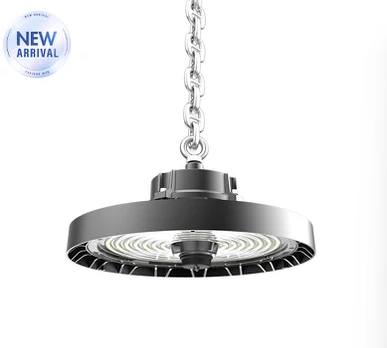
UFO-form high bays suit open, clear-span areas where coverage must radiate from a single high mounting point. Image: HL-E01 UFO LED high bay light, Zhejiang Lepeng Electric Appliance Co.,Ltd.
Step 5 — Specify the control layer as a fixture property
Sensors are only cheap when they are designed into the fixture. Where control is added afterwards, the cost appears as separate hardware, separate wiring and separate commissioning. Three documented configurations are relevant:
- PL02 LED panel light — remote control plus a built-in microwave sensor for automatic ON/OFF, with three-level dimming at 50%, 75% and 100%, and 3-CCT selectable colour temperature from 2700K to 6000K.
- HL-E01 UFO LED high bay light — optional motion sensor compatibility with a smooth 3-second brightness transition, which avoids the abrupt switching that is disruptive in occupied industrial space.
- 8200 LED solar flood light — PIR passive infrared motion sensor, remote control with 1H, 2H and 4H timer options, and an auto mode.
A buyer who requires sensor control in a lineal warehouse aisle should note that the published specification sets for the SH-E01 linear high bay and the FL-C01 Series floodlight do not list an integral sensor. That is a real constraint in the framework, not an oversight to be resolved later: it means the control strategy for such a run has to be planned separately, or the layout has to be reconsidered around a fixture family that carries detection as standard.
Step 6 — Match the environmental envelope
Protection ratings gate the shortlist. The SH-E01 linear high bay carries IP65 and a 5-year warranty, which places it in dust- and water-exposed industrial interiors. The PL02 panel light carries IP20 and is intended for commercial and residential indoor scenarios — it is not a wet-area or dusty-environment fixture. The 8200 solar security light carries IP44 for outdoor weather resistance. The HL-E01 is documented with 6KV/6KV surge protection, while the FL-C01 Series is documented with surge protection up to 2KV and a power factor above 0.9.
That difference is a decision input. On an exposed outdoor site with a long cable run, the higher surge rating of the HL-E01 deserves attention even if a floodlight form factor is otherwise preferred. Where the current documentation for a specific model does not state a rating the project requires, the correct action is to obtain the rating from the manufacturer's current documents rather than assume it from the product category.
Standards reference the same discipline. Core safety and performance standards for LED luminaires include IEC 60598, UL 1598 and UL 8750, as listed by UL Solutions — the framework should end with a check against the market-specific standard rather than with a price comparison.
A layout-to-fixture reference table
| Layout archetype | What decides the fixture | Relevant fixture family | Documented boundary |
|---|---|---|---|
| Clear-span high space (workshop, gym, open distribution floor) | Mounting height and symmetric coverage from a single point | HL-E01 UFO LED high bay light — 100/150/200/240W; 140/160/185/210 lm/W; 4000K/5000K/6500K; 6KV/6KV surge | No 3000K option; beam angle not stated in the published spec set |
| Racked aisle or lineal run | Distribution along the run rather than around a point | SH-E01 LED linear high bay light — 50/100/150/200W; 100/135/150 lm/W; 90°(H)×120°(V); IP65; 5-year warranty; three lengths | Fixed lengths (305.6, 580.6, 855.6 mm); long rows need multiple units and planned fixing points; no integral sensor listed |
| Ceiling-grid interior (office, retail, clinic, corridor) | Module size, cut-out tolerance, control | PL02 LED panel light — 9/12/18/24W; 90/110 lm/W; 2700–6000K 3-CCT; 50/75/100% dimming; remote + microwave sensor; surface or recessed | IP20 — indoor dry-area use only |
| Exterior perimeter, facade, yard, open ground | Throw distance and the ability to aim | FL-C01 Series LED floodlight — 10–300W; 100/120 lm/W; 3000K/4000K/6500K; surge up to 2KV; PF above 0.9; aluminium and glass; bended bracket | Surge rating below the HL-E01; confirm the IP rating required by the project from current documentation |
| Off-grid or hard-to-wire points | Absence of a mains supply at the detection point | 8200 LED solar flood light — 10W; 1600 lm; 6500K; PIR sensor; IP44; remote with 1H/2H/4H timers; separate panel and head | Security-level output that depends on solar exposure; not a primary area-lighting solution |
| Low-ceiling comfort zones (residential, light commercial) | Low profile and combined function | FCL-E01 LED ceiling fan light — 24W light; 1800 lm; 3000K/4000K/6500K; RGB mixing; 3-speed forward and reverse; 36/42/52 inch; flush mount | Intended for residential and light commercial settings, not industrial duty |
Parameters as published in the manufacturer's current product documentation; confirm configuration-specific values before issuing a purchase schedule.
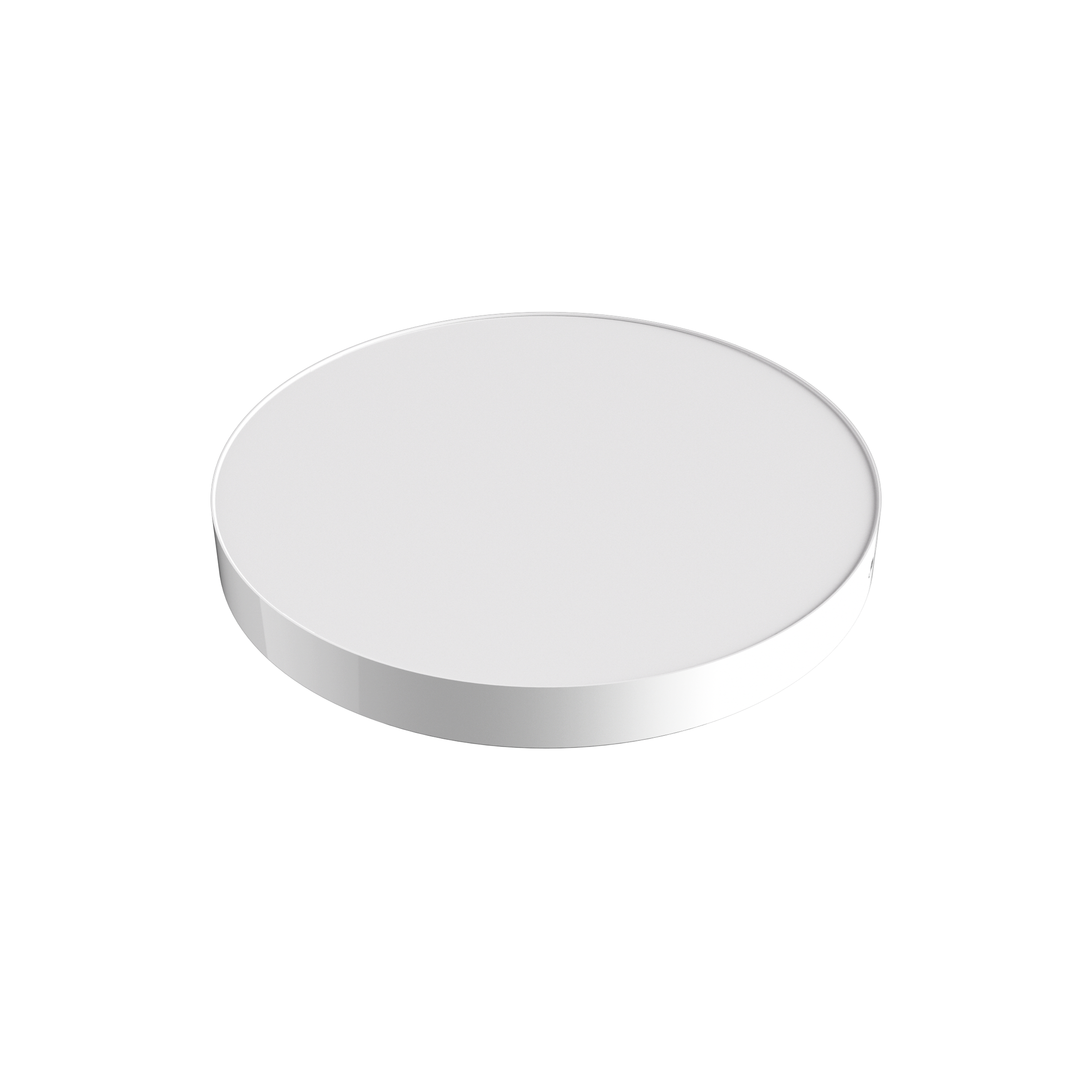
Ceiling-grid interiors are governed by module size, cut-out tolerance and control rather than raw output. Image: PL02 LED panel light, Zhejiang Lepeng Electric Appliance Co.,Ltd.
Where the framework points inside the Lepeng range
Zhejiang Lepeng Electric Appliance Co.,Ltd. is a manufacturer specialising in LED lamps and LED luminaires, established in 2009. The company operates three production bases — its headquarters in the Baiguan Industrial Zone, Shangyu, Zhejiang, plus additional bases in Qiandaohu, Zhejiang and Jingdezhen, Jiangxi — across a total factory area of 200,000 square metres, with approximately 2,000 staff including a 200-person R&D team. Published capacity is approximately 540 million lamps annually, with monthly capacity of 45 million LED lamps and 5 million LED luminaires. About 90% of products are exported to the EU, Southeast Asia, the Middle East and Latin America, and the company's own brand MKOPTO has gained recognition in global lighting markets.
Portfolio breadth matters to this framework for a specific reason: a decision tree is only useful if the shortlist can actually be filled from one source. The company's documented range covers LED Floodlight, LED Highbay, LED Linear Highbay, LED Street Light, LED Garden Light, LED Stadium Light, LED Solar Flood Light, LED Solar Street Light, LED Solar Garden Light, LED Bulkhead, LED Tri-proof Light, LED Worklight, LED Ceiling Light, LED Ceiling Fan Light, LED Panel Light, LED Slim Batten, LED Tube, LED Bulb and LED Mood Light. That coverage allows a mixed-archetype building — warehouse plus office block plus perimeter — to be specified without splitting the fixture family arbitrarily, and the A60 LED Globe Bulb with E27 or B22 base covers ancillary socket-based points.
How the archetypes map to real projects
- Warehouse with racking: SH-E01 linear runs over aisles, HL-E01 over the open staging floor, PL02 in the attached office and welfare areas.
- Light industrial workshop: HL-E01 where machines are laid out around a central circulation space; SH-E01 where benches and conveyors create defined lineal zones.
- Retail and hospitality interior: PL02 for ceiling-grid general lighting with microwave detection in low-traffic corridors or back-of-house; FL-C01 for signage and facade wash.
- Compound or yard security: FL-C01 on structures with a power supply, 8200 solar units on gate posts, fences and outbuildings where no cable route exists.
- Light commercial comfort areas: FCL-E01 for covered terraces and low-ceiling lounges where a fan and light are specified together.
Market context: why layout discipline matters more each year
Three published data points explain the direction of travel. The global LED lighting market was valued at USD 109.11 billion in 2025 and is projected to reach USD 336.90 billion by 2034 (Fortune Business Insights) — growth that will largely be delivered through replacement and upgrade cycles rather than greenfield installation. The LED flood light market alone was valued at USD 9.4 billion in 2025, with an expected CAGR of 8.52% to USD 20.1 billion by 2034 (IMARC Group), indicating sustained demand for exterior and large-area fixtures where aiming and distribution decide performance. On the supply side, China exported USD 31.4 billion in light fixtures in 2024, representing 59.3% of total global exports (OEC), which means most international buyers are selecting from a deep, price-transparent supply base where differentiation is rarely on price alone.
The procurement consequence is straightforward. When fixture cost converges, the difference between a good and a poor project outcome shifts to specification quality — which distribution, which fixing method, which control layer, and which documented ratings. Layout-first selection is how a buyer converts that shift into an advantage.
How this compares with traditional fixture-first selection
The conventional approach ranks models by wattage and efficacy, then adjusts the layout around the winner. It is faster at quotation stage and often slower at commissioning. The framework approach costs one extra step — reading the drawing — and reduces the probability of a re-specification after installation. The trade-offs are real and should be stated plainly:
- Lineal fixtures require more mounting points. Covering a long aisle with SH-E01 units means more fixtures, more fixing positions and more connections than hanging a single UFO high bay at the aisle centre. The gain is a more even band of light along the run; the cost is installation labour and planning effort.
- Fixed lengths limit flexibility. The SH-E01 is offered in three lengths (305.6, 580.6 and 855.6 mm). Runs that do not divide neatly into those lengths need planned end-of-row treatment rather than improvisation on site.
- Colour temperature and photometric data are not universal. The HL-E01 starts at 4000K and its published specification does not carry a beam angle; projects requiring warm interiors or contractually required photometric pre-calculation need additional documentation before approval.
- Indoor panels stay indoors. The PL02 is IP20. Using a ceiling-module fixture in a wash-down or dusty zone is a rating failure, not a styling choice.
- Solar security units are not area lighting. The 8200 delivers 1600 lm from 10W with IP44 protection and PIR detection. It is well matched to gates, fences and outbuildings; it is not a substitute for a mains-powered high bay or a 300W floodlight.
- Surge ratings differ across the portfolio. With 6KV/6KV documented for the HL-E01 and up to 2KV for the FL-C01 Series, exposed sites should verify the protection level rather than assume parity across families.
There is also a boundary on the framework itself. It requires a plan, a section and, ideally, photometric files. A buyer without drawings cannot complete steps one to three reliably, and should obtain them before issuing an enquiry — otherwise the shortlist reverts to catalogue browsing with extra paperwork.
Future outlook
Three developments are likely to shape the next procurement cycle. First, control integration continues to migrate into the fixture: the microwave sensor and three-level dimming now documented on the PL02, and the optional motion sensor compatibility with a 3-second transition on the HL-E01, reflect a market where detection is a fixture property rather than a separate project. Second, solar-powered outdoor categories keep expanding — the global solar street lighting market is projected to reach USD 22.5 billion by 2030, with a CAGR of 15.8% from 2024 (Vantage Market Research) — which will push buyers to separate genuinely off-grid applications from locations where mains power remains the better engineering answer. Third, compliance documentation is becoming part of the tender pack rather than an afterthought, with IEC 60598, UL 1598 and UL 8750 forming the reference set for luminaires and LED equipment.
For buyers, the practical implication is that the fixture schedule becomes the primary control document. A schedule that states archetype, distribution, fixing method, control layer and protection rating per line item is harder to substitute than one that lists wattage alone.
A short procurement checklist
- Classify every space into an archetype; split mixed areas instead of averaging them.
- Record mounting height, structural fixing spacing and obstruction distances on the drawing.
- Fix the distribution pattern before the wattage, and request photometric or IES files per configuration.
- Confirm the fixing method against as-built conditions: surface kit, chain or cable suspension, recessed or surface, cut-out tolerance.
- Decide the control layer at fixture level — integral microwave sensor, optional motion sensor, or PIR detection with timers.
- Gate the shortlist on IP rating and surge protection; obtain missing ratings from current documentation.
- Check colour temperature availability against the interior design intent, not the default option.
- Confirm warranty terms per model; the SH-E01 is documented with a 5-year warranty.
- Reference the applicable standard — IEC 60598, UL 1598 or UL 8750 — in the purchase specification.
- Verify the manufacturer's production base, capacity and export experience for delivery-scale orders.
Product documentation covering the models referenced in this framework is available in the company's catalogue: Zhejiang Lepeng Electric Appliance Co.,Ltd. product catalogue.
FAQ
How does a buyer decide between a linear high bay and a UFO high bay for a warehouse?
Decide from the geometry, not the wattage. The SH-E01 LED linear high bay light is specified with a 90°(H) × 120°(V) beam angle in three lengths, IP65 protection and a 5-year warranty, with power options of 50W, 100W, 150W and 200W and efficacy of 100, 135 or 150 lm/W — a configuration suited to lineal runs such as racked aisles. The HL-E01 UFO LED high bay light offers 100W to 240W, efficiency of 140, 160, 185 or 210 lm/W, colour temperatures of 4000K, 5000K and 6500K, and 6KV/6KV surge protection in a die-cast aluminium body — a configuration suited to open floor areas. Where a photometric calculation is required, request the beam data for the specific model, since the published HL-E01 specification does not state a beam angle.
What does a 90°(H) × 120°(V) beam angle mean in practice?
It describes the spread of light in two planes rather than one. The horizontal plane is specified at 90° and the vertical plane at 120°, so the projected pattern is comparatively tighter in one direction and wider in the other. In a lineal layout this produces a continuous band along the run, which is why the SH-E01 specification is associated with aisles, factories and workshops. A symmetric round distribution, by contrast, spreads from a single high point in all directions. Neither pattern is better in isolation; each matches a different layout geometry.
Which fixtures in the range support sensors or automatic switching?
Three documented configurations exist. The PL02 LED panel light includes a remote control and a built-in microwave sensor for automatic ON/OFF, together with three-level dimming at 50%, 75% and 100% and 3-CCT selectable colour temperature from 2700K to 6000K. The HL-E01 UFO LED high bay light offers optional motion sensor compatibility with a smooth 3-second brightness transition. The 8200 LED solar flood light uses a PIR motion sensor with remote control, 1H, 2H and 4H timer options and an auto mode. The published specifications for the SH-E01 linear high bay and the FL-C01 Series floodlight do not list an integral sensor, so sensor control in those applications must be planned as a separate layer.
Is a 10W solar flood light suitable as primary lighting?
The 8200 LED solar flood light delivers 1600 lm at 10W with a 6500K colour temperature, IP44 protection, a monocrystalline silicon solar panel and PIR motion detection. It is designed for residential and commercial outdoor security use, such as yards, driveways, gateways and walls. Its output and its dependence on solar exposure position it as security and supplementary lighting rather than as primary area illumination; primary lighting in commercial spaces is served by mains-powered families such as the high bay, floodlight and panel ranges.
Which IP ratings apply where across the range?
The SH-E01 linear high bay light is rated IP65 and is intended for harsh industrial environments such as warehouses, factories and workshops. The PL02 panel light is rated IP20 and is intended for commercial and residential indoor scenarios, so it is not suitable for wet or dusty zones. The 8200 solar security light is rated IP44 for outdoor weather resistance. For the FL-C01 Series floodlight, surge protection up to 2KV and a power factor above 0.9 are documented; the IP rating required by a specific project should be confirmed against current documentation before the fixture schedule is issued.
What documentation should be requested before approving a fixture schedule?
Six items are practical: the beam angle or photometric file for each configuration, the IP rating and surge protection level, the mounting method and any cut-out dimensions, the colour temperature options available, the warranty term, and the applicable safety standard. For reference, core standards for LED luminaires include IEC 60598, UL 1598 and UL 8750, as listed by UL Solutions. Where a published specification does not state a value the project depends on, the value should be obtained in writing rather than inferred from the product category.
¿Tiene preguntas o necesita más detalles?
Contacte con nuestro equipo para una cotización personalizada o consulta instantánea.
Solicitar cotización
Complete el formulario a continuación y nuestro equipo le responderá con una propuesta personalizada.
Chat directo de WhatsApp
¿Prefiere chatear en tiempo real? Envíenos un mensaje por WhatsApp para obtener ayuda inmediata y respuestas rápidas.
- Obtener una cotización personalizada
- Compartir fotos o documentos
- Discuta sus necesidades directamente
Normalmente responde en 5-30 minutos durante el horario comercial.