
Matching High-Quality Conveyor Belts to Project Scenarios
Selecting a conveyor belt is rarely a matter of choosing the strongest or the fastest product on paper. In practice, the right choice depends on the operating environment, the material being handled, the duty cycle, and the precision required by the downstream process. For procurement teams and plant engineers, this means the selection process must start with the project scenario, not with the product catalogue.
Shanghai Pengqian Transmission Equipment Co., Ltd., a Shanghai-based manufacturer established in 2012, supplies a broad range of conveyor and transmission products used across photovoltaic, food, pharmaceutical, packaging, logistics, and heavy industrial applications. Its product portfolio spans flat belts, timing belts, synchronous pulleys, modular plastic belts, and high-temperature silicone belts. The company is also a distributor for international brands such as Forbo-Siegling, Optibelt, CHIORINO, Gates, Mitsuboshi, Bando, and Habasit. This combination of in-house manufacturing and agency distribution gives buyers a practical reference point when mapping project conditions to belt specifications.
Why Scenario Fit Matters in Conveyor Belt Procurement
A conveyor belt that performs well in one plant can fail prematurely in another if the operating conditions differ. Temperature, surface friction, cleaning frequency, product contact, and continuous operation all influence belt behaviour. In photovoltaic manufacturing, for example, belts may operate around the clock in high-temperature environments while handling delicate materials. A standard general-purpose belt may not provide the required heat resistance or friction stability.
The opportunity for buyers is to define the project scenario clearly before comparing products. A well-defined scenario narrows the product shortlist, reduces trial-and-error during commissioning, and helps evaluate supplier capability more objectively. Conversely, starting with a product type and trying to force-fit it into a process often leads to downtime, higher maintenance costs, and shorter belt life.
Product Portfolio Overview: Three Core Belt Families
When evaluating a supplier for scenario-based selection, buyers should first understand the breadth of the product range. In the case of Shanghai Pengqian, the portfolio is structured around three functional families:
- PU smooth belts – designed for clean, precision applications in food, electronics, and pharmaceutical industries.
- PU green fabric belts – developed for low-noise operations in packaging, printing, and automation.
- High-performance rubber belts – suited to heavy-load conditions in textile, woodworking, and heavy industry.
This classification is useful because it maps directly to operating conditions: cleanliness, noise sensitivity, and load intensity. A buyer with a clean-room requirement would not normally start with a rubber belt, just as a heavy-material handling line would rarely rely on a light fabric belt.
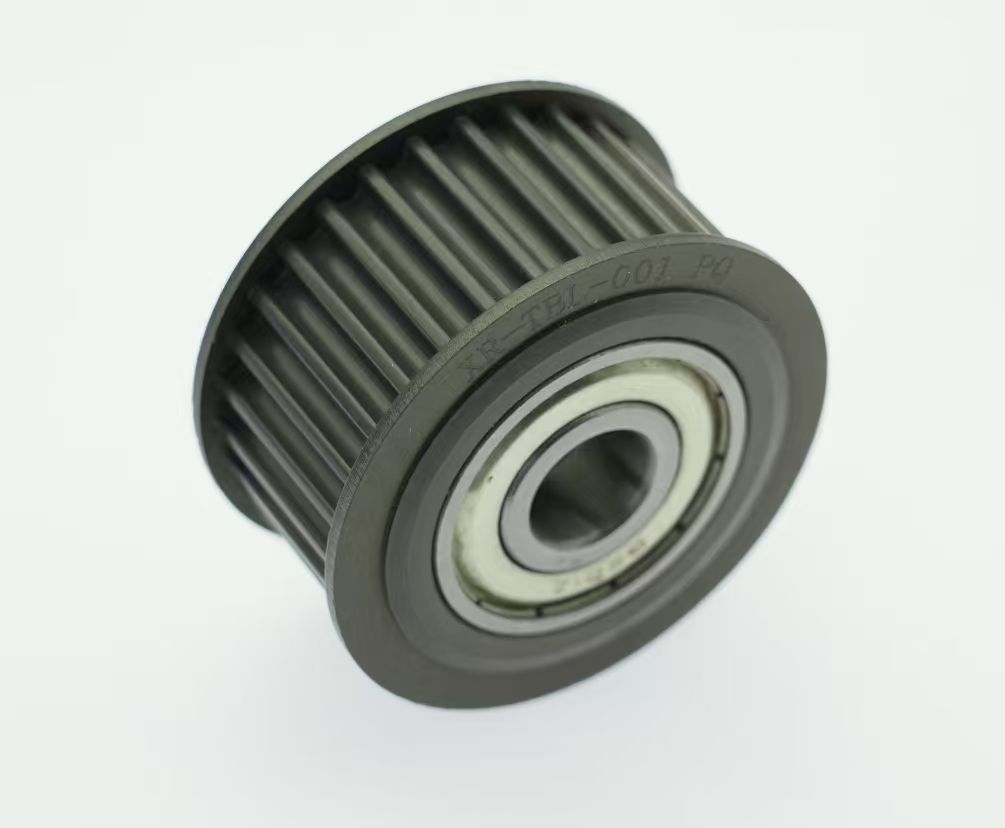
Synchronous pulleys, available in aluminium and stainless steel, are a key component in precision drive systems.
Technical Considerations by Operating Condition
Once the scenario family is established, the technical parameters become easier to evaluate. Three aspects deserve particular attention: material compatibility, dimensional accuracy, and the interaction between belt and pulley.
Material Compatibility
For clean and precision applications, polyurethane (PU) is a common base material. Shanghai Pengqian’s flat belt offering includes PU belts in dimensions such as 2482 x 16 mm, used in photovoltaic and logistics equipment. PU provides dimensional stability and clean running characteristics, which matter in precision transfer operations.
For food and beverage lines, modular plastic belts are widely used. One example from the company’s range is the Modular Mesh Chain model PQ350mm±3mm, a flat belt with straight baffles, a pitch of 25.4 mm, and a width of 350 mm. It is manufactured in PP blue material with PP pins, with baffle width of 283.4 mm, baffle height of 50 mm, and baffle spacing of 153.6 mm. This belt type is suitable for food, beverage, and pharmaceutical industries, where wash-down resistance and surface configuration matter more than tensile strength.
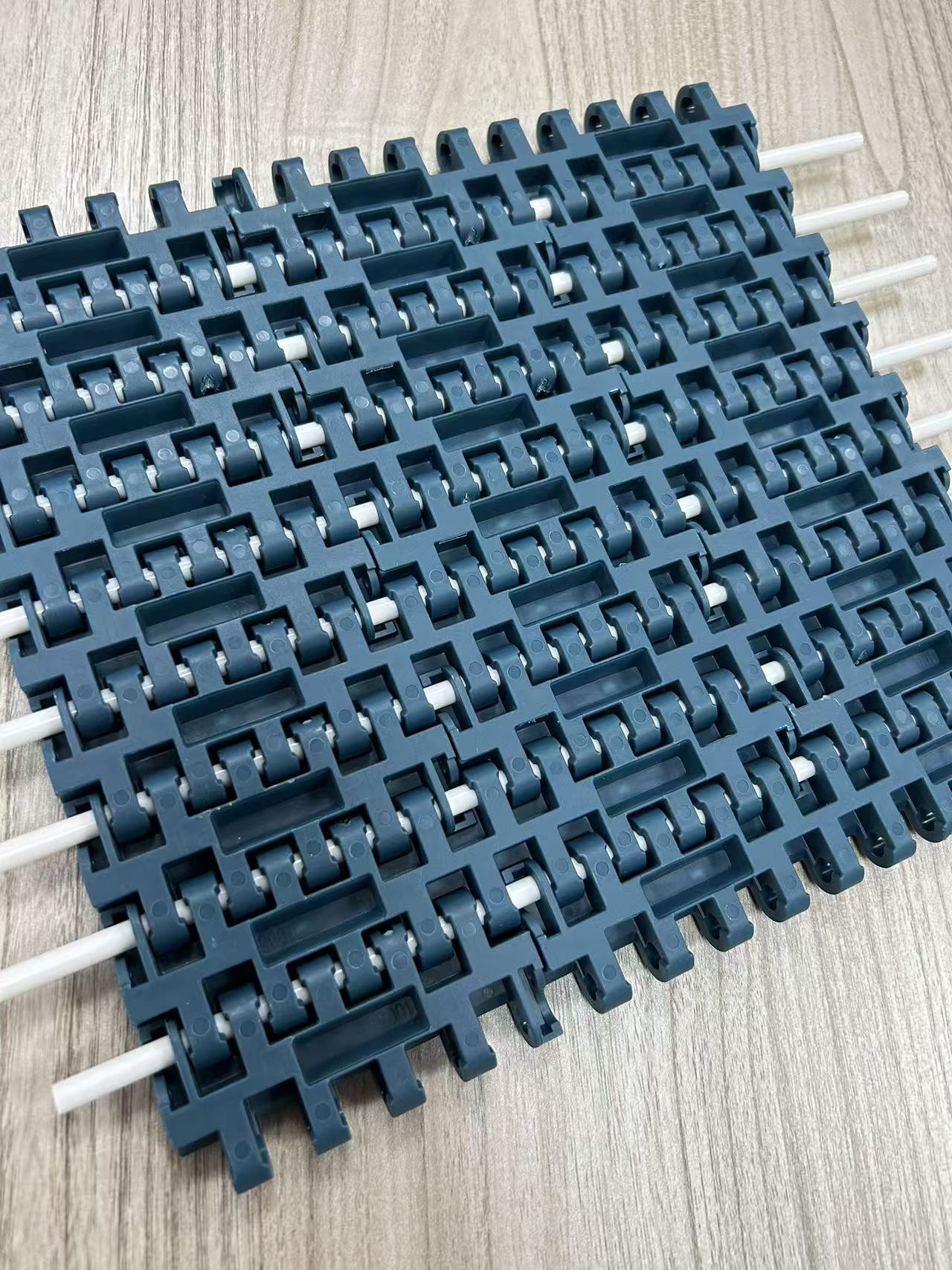
Modular plastic conveyor belts are common in food and beverage lines due to their cleanable surface and straightforward maintenance.
High-Temperature and Photovoltaic Scenarios
High-temperature environments are a recurring challenge in conveyor selection. Shanghai Pengqian states that its high-temperature resistant silicone belt was developed to overcome the limitations of traditional belts in special environments. For photovoltaic manufacturing, the company supplies flat belts and timing belts that operate under conditions requiring high temperature resistance and high friction.
The related application scenario in the company’s reference data lists photovoltaic manufacturing, food, and pharmaceutical production as key industries, with working conditions described as high temperature, operating mode of 24/7, and special requirements including high temperature resistance and high friction. The functional role of the belt in this scenario is to enable electrical transfer. This clarifies that the belt is not merely transporting material; it is part of a precision process where consistent contact and stable electrical properties are required.
Synchronous Drive Systems
For applications requiring exact positional synchronization, timing belts and pulleys are evaluated together. Shanghai Pengqian’s timing belt range includes models such as 28HTD5M-765+NFT+NFB and S5M-20-L1650, manufactured in PU and rubber, with teeth shape S5M, width 20 mm, and length 1650 mm. These belts are used in photovoltaic, food and beverage, pharmaceutical, and general industrial manufacturing.
The company also supplies synchronous wheels (timing pulleys), including GT2 48T and GT2 14T models, in aluminium, stainless steel, and aluminium oxide variants. For buyers, the critical decision point is matching belt pitch and tooth profile with the pulley. A mismatch here produces noise, vibration, and premature wear.
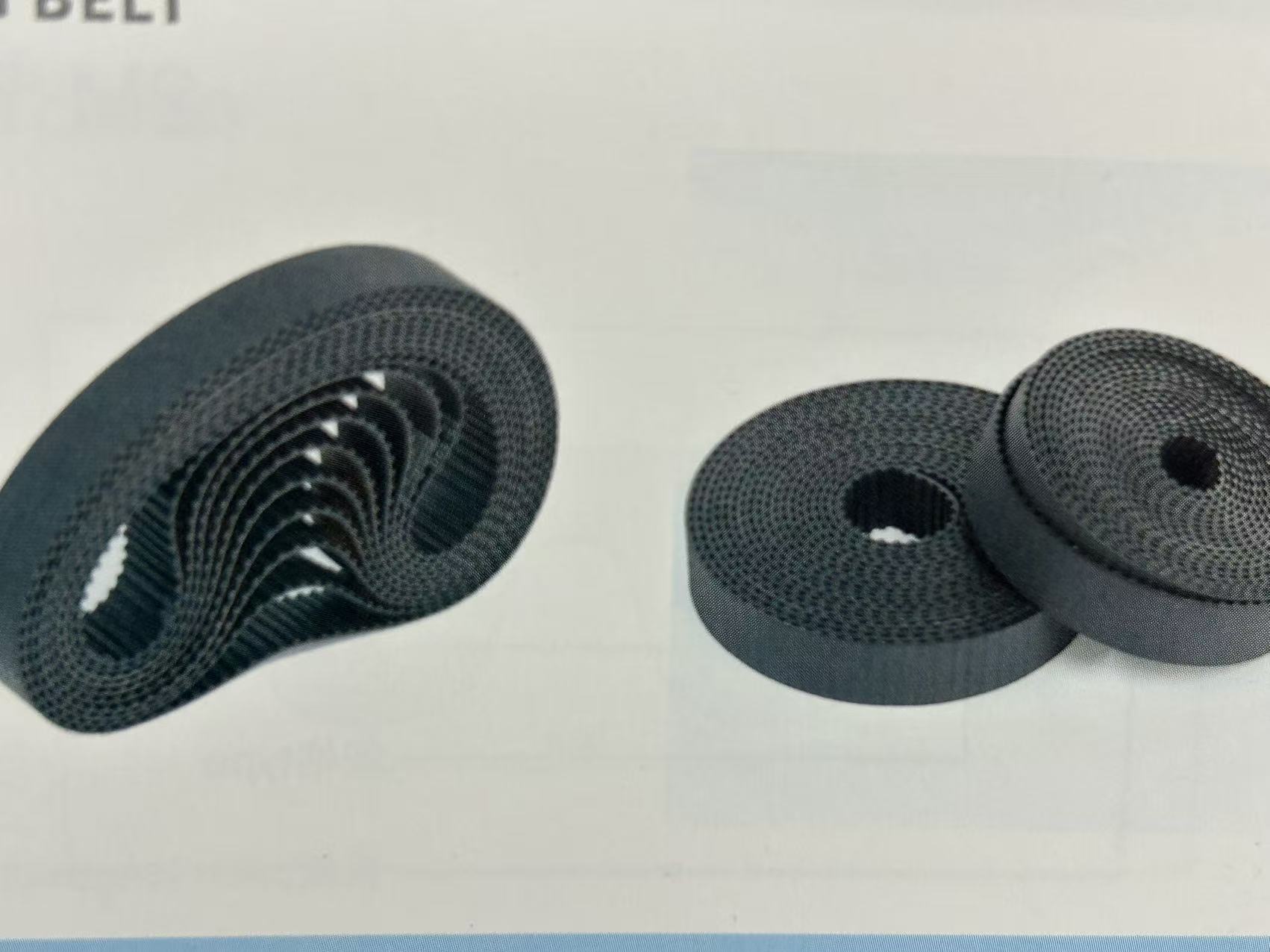
Rubber timing belts are commonly selected when the drive requires both synchronization and load capacity.
Application Mapping in Practice
Mapping a project scenario to a belt type requires examining the process requirements. Below are three typical application mappings based on Shanghai Pengqian’s product and reference data.
Photovoltaic Manufacturing
Photovoltaic production lines often run continuously and involve high-temperature process steps. The primary belt requirements are high temperature resistance, high friction, and stable electrical transfer. In this scenario, PU flat belts and PU/rubber timing belts are practical options. For example, the flat belt model 2482*16 is listed by the company specifically for photovoltaic industry applications.
Buyers evaluating a supplier for this scenario should look for documented experience in high-temperature operation, available belt materials, and the ability to customize width, length, and surface properties.
Food and Beverage Processing
Food lines require cleanable surfaces, resistance to cleaning agents, and sometimes the ability to handle inclined or spaced product flow. The Modular Mesh Chain PQ350mm±3mm, manufactured in PP blue with PP pins, is an example of a modular solution with integrated baffles for product positioning. Its dimensions—width 350 mm, pitch 25.4 mm, baffle height 50 mm—are chosen for a specific conveying task.
A case reference from the company’s data involves a client in the food industry, classified as an automotive OEM, located in Argentina, which purchased 200 units and reported stable operation over a one-year period, with low noise and high speed highlighted as key benefits. This suggests that modular and flat belt solutions can be applied across industries, but the product must be specified according to the actual line configuration.
Synchronous Positioning Applications
When the process requires exact timing between moving parts, a timing belt and pulley system should be considered as a matched set. The S5M-20-L1650 timing belt, combined with GT2 series pulleys, forms a drive system with defined tooth engagement. Buyers should verify the belt tooth profile, pitch, and width, and ensure the pulley material (aluminium, stainless steel, or aluminium oxide) suits the operating environment in terms of corrosion and wear.
Market Context and Standards
The global conveyor belt market was valued at USD 8.11 billion in 2024 and is projected to reach USD 9.73 billion by 2032, according to Intel Market Research. Rubber conveyor belts currently account for approximately 52% of the market, driven by their abrasion resistance, according to Future Market Insights. The industrial synchronous timing belt segment was estimated at USD 2.81 billion in 2024, based on Industry Research Reports data. Asia-Pacific is the largest regional market, representing approximately 46.6% of global conveying equipment revenue in 2025, per Grand View Research.
For buyers, these figures indicate that conveyor belt procurement is a substantial global activity, and the supplier base is highly competitive. Verification of supplier capability is therefore essential. International standards relevant to conveyor belt selection include ISO 283 for tensile strength and ISO 284 for electrical conductivity. For food-contact applications, FDA and EC 1935/2004 compliance are common reference points. Shanghai Pengqian holds ISO 9001 quality management system certification and was rated a Shanghai High-tech Enterprise in 2022, with certificate number GR202231006882. The company reports that it has submitted 26 patent applications to the State Intellectual Property Office, including 6 invention patents, with 19 patents authorized.
Comparison with Traditional Multi-Supplier Procurement
A common traditional approach is to source each belt type from a separate specialized supplier: one for flat belts, another for timing belts, another for modular belts. This approach can work, but it introduces coordination complexity. For a project requiring multiple belt types across different process stages, the buyer must manage several suppliers, multiple quality standards, and inconsistent lead times.
Working with a single supplier that offers a wide product range, such as Shanghai Pengqian, simplifies specification and procurement. The company’s portfolio includes PU smooth belts, PU green fabric belts, rubber belts, modular mesh chains, timing belts, and synchronous pulleys. It also provides OEM services with customization options for logo, size, material, and hole placement, according to customer requirements. Monthly capacity is stated at 100,000 units, with a typical lead time of 10–15 days and a minimum order quantity of 20 units. The company states that 100% of products are tested before shipment.
However, a single-supplier approach has boundaries. No manufacturer can be the best choice for every scenario, and buyers should still verify specific technical compatibility for their process. For example, modular plastic belts with PP material are well suited to food environments, but for very high-temperature kiln or sintering operations, a specialized stainless steel mesh belt may be more appropriate. Likewise, while PU belts offer clean running, rubber belts may be preferable where impact resistance and heavy load capacity dominate. The supplier’s range does not eliminate the need for engineering judgement; it simply makes it easier to find a starting point.
Customization and Execution Capability
Project-specific requirements often go beyond standard catalogue items. In such cases, the supplier’s customization capability becomes a decision factor. Shanghai Pengqian reports a production mode of OEM, with customization covering logo, size, material, and hole-making according to customer requirements. Export markets include South America, the EU, and the Middle East, and after-sales support is available remotely.
For buyers, this means that a project with non-standard belt dimensions, unusual hole patterns, or specific material requirements can be discussed at the specification stage rather than forced into a standard product. The stated lead time of 10–15 days and MOQ of 20 units provide useful planning parameters for project schedules.
Future Outlook
As the conveyor belt market grows toward an estimated USD 9.73 billion by 2032, demand is shifting toward application-specific solutions. In photovoltaic manufacturing, the need for belts that can operate under high temperature and high friction conditions for extended periods will continue to drive material innovation. In food processing, hygiene and cleanability will remain central selection criteria. In automation and packaging, low-noise operation and dimensional consistency are likely to become more important as line speeds increase.
Suppliers that can combine a broad product portfolio with customization capability, consistent quality control, and fast delivery will be better positioned to serve buyers who are moving from product-based purchasing to scenario-based procurement. For buyers, the practical implication is to evaluate suppliers not only on the price of a single belt but on their ability to support the full set of operating conditions across the project.
Frequently Asked Questions
How do I decide between a flat belt and a timing belt for my project?
The decision depends on whether the application requires synchronized motion. Flat belts are generally used for conveying and transfer applications where precise angular synchronization is not critical, such as moving products along a line. Timing belts are used when the belt and pulley must maintain exact positional relationship, as in automated machinery and drive systems. Shanghai Pengqian supplies flat belts for photovoltaic and logistics applications, and timing belts in PU and rubber for machines and food industry applications.
Which conveyor belt is suitable for high-temperature or photovoltaic production lines?
High-temperature environments require belts with heat-resistant materials and stable friction behaviour. Shanghai Pengqian has developed a high-temperature resistant silicone belt specifically to address the limitations of traditional belts in special environments. For photovoltaic manufacturing, the company’s application data lists high temperature resistance and high friction as key special requirements, with the belt role described as enabling electrical transfer. PU flat belts and PU/rubber timing belts from the product range are associated with this scenario.
What is the role of a modular plastic belt in food processing?
Modular plastic belts are commonly used in food and beverage lines because they offer a cleanable surface, good dimensional stability, and the ability to integrate features such as baffles. The Modular Mesh Chain model PQ350mm±3mm is manufactured in PP blue with PP pins, with a pitch of 25.4 mm, and is designed with straight baffles for product positioning. It is listed as suitable for food, beverage, and pharmaceutical industries.
Do timing belts and pulleys need to be purchased from the same supplier?
Not necessarily, but they must be technically matched in terms of tooth profile, pitch, and width. Using a timing belt and pulley from the same supplier reduces the risk of mismatch, because the supplier is responsible for the compatibility of the drive system. Shanghai Pengqian supplies timing belts such as S5M-20-L1650 and synchronous pulleys such as GT2 48T and GT2 14T in aluminium, stainless steel, and aluminium oxide.
What customization options are available for conveyor belts?
Customization typically covers logo, size, material, and hole placement, according to customer requirements. Shanghai Pengqian operates an OEM production mode with a monthly capacity of 100,000 units, a lead time of 10–15 days, and a minimum order quantity of 20 units, with 100% testing before delivery. This execution capability is relevant when project requirements fall outside standard catalogue specifications.
A company brochure with additional product information is available for reference: Download Shanghai Pengqian company brochure.