
Matching Dredging Vessels to Deep-Water & Coastal Projects
Matching Dredging Vessels to Deep-Water & Coastal Projects
Dredging and marine construction programmes are usually decided before the first suction pipe or grab bucket reaches the seabed. What separates an on-schedule project from a delayed one is rarely raw vessel size — it is fit. A vessel's design envelope, covering dredging depth, material handling, mobility and station-keeping, either matches the geophysical and logistical conditions of a site or it does not, and operational effort alone rarely closes the gap.
Market scale makes that decision consequential. The global dredging equipment market was valued at USD 4.86 billion in 2023 and is projected to grow to USD 7.36 billion by 2030 (Grand View Research). Hydraulic dredgers, including cutter suction dredgers, held the largest revenue share of approximately 46.65% in 2023, and trailing suction hopper dredgers are estimated to account for 46.0% of total dredging market activity by 2026 (Future Market Insights). Those figures describe a fleet that is becoming more specialised by project type, and less interchangeable.
This reference maps three project scenarios to three vessel profiles manufactured and exported by Zhenjiang Yanyang Engineering Co., Ltd., which trades as Yanyang Marine — a Zhenjiang, China-based builder and exporter of dredgers and marine construction vessels founded in 1996. The 26,800 m³ trailing suction hopper dredger is mapped to deep-water channel and large-scale reclamation work; the 110 m pile leader height Pile Driving Barge to port and bridge construction; and the 25 m³ grab dredger to near-shore coastal operations. Each mapping is followed by the boundary conditions that determine whether the match actually holds.
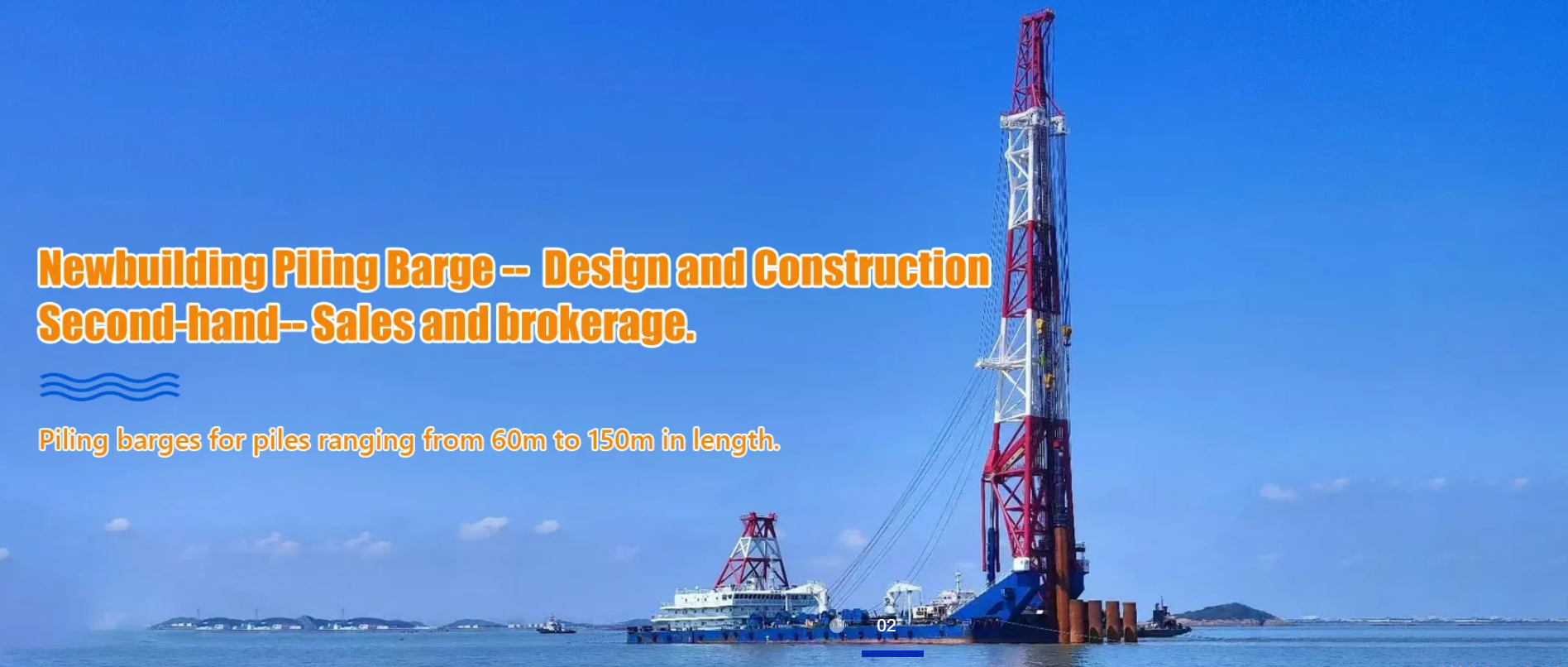
Five Variables That Decide Vessel–Project Fit
Matching a dredging vessel to a project reduces to five questions. A procurement team that answers them in order avoids most specification errors, because each answer removes a category of vessel from the shortlist.
1. Working depth. The required dredging depth must sit inside the vessel's rated range, with margin for overdepth and seabed variation. Published depth tiers across this fleet span 18–32 m for a backhoe dredger and 40/70/115 m for a large trailing suction hopper dredger.
2. Material. Soft sediment, hard clay, compacted gravel and rock require different cutting or grabbing tools, and tool selection is a vessel-level decision rather than an attachment decision.
3. Production mode. Hydraulic dredging vessels in this fleet operate in continuous mode, either self-propelled or barge-towed — a different output curve from cycle-based mechanical dredging, and a different way of costing a works programme.
4. Mobility and station-keeping. A self-propelled, dynamically positioned hopper dredger and a towed, anchor-held piling platform sit at opposite ends of the mobilisation spectrum, and mobilisation is often the largest variable cost in short campaigns.
5. Spoil logistics. Where the material goes often decides which vessel is bought or chartered. Dredging spreads typically require dredge pumps, pipelines, surveying systems and anchor handling equipment as matched supporting assets.
Across all five variables, the vessels described here are specified for offshore and coastal marine operations, including open sea and harsh marine environment conditions. That framing matters: a vessel rated for coastal work and a vessel rated for open-sea deployment are not interchangeable, even when their nominal capacities look similar on a specification sheet.
Deep-Water Channels and Large-Scale Reclamation: The 26,800 m³ TSHD
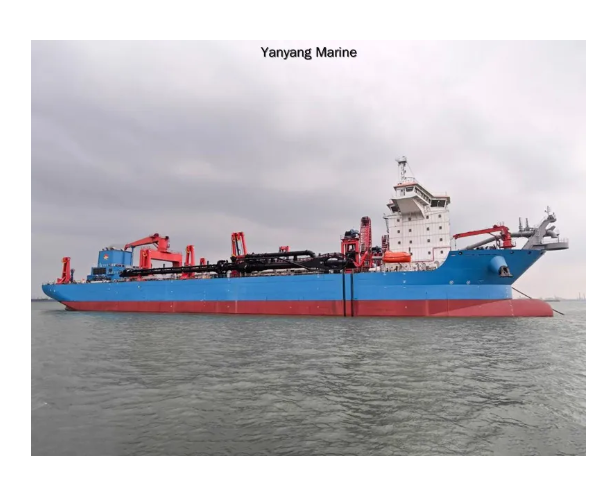
For deep-water channel excavation, port expansion and large-scale reclamation, the defining asset in this fleet is a 26,800 m³ trailing suction hopper dredger (TSHD) with an overall length of approximately 171.20 m, a length between perpendiculars of 160.00 m, a moulded breadth of 36.00 m and a moulded depth of 15.80 m. Draft at international freeboard is 9.50 m.
| Parameter | Specification |
|---|---|
| Length overall | approx. 171.20 m |
| Moulded breadth / depth | 36.00 m / 15.80 m |
| Draft at international freeboard | 9.50 m |
| Hopper capacity | approx. 26,800 m³ |
| Suction pipe diameter | Φ1200 mm |
| Dredging depth | 40 / 70 / 115 m |
| Speed at 11.5 m draft | approx. 15.5 kn |
| Total installed power | 27,726 kW |
| Class | CCS, CSA Trailing Suction Hopper Dredger, dredging within R1, DP-1; AUT-0 and G-ECO(BWM(T)) notations |
Two parameters matter most in scenario matching. The first is dredging depth, specified here in three tiers — 40 m, 70 m and 115 m — supported by an inboard dredge pump pair (HK, 2 × 6,000 kW) and an underwater pump set (HK+BKKER, 2 × 3,300 kW). Multi-tier depth capability is what allows one hull to serve both harbour deepening and deeper channel work without re-equipping. The second is transport efficiency: with a hopper capacity of approximately 26,800 m³ and a suction pipe diameter of Φ1200 mm, spoil is carried onboard rather than transferred to a barge, which removes an entire vessel from the transport chain and the coordination load that comes with it.
Propulsion and power are sized for open-sea deployment. Total installed power is 27,726 kW, from three Wartsila main diesel engines of 8,000 kW each, two Wartsila auxiliary/harbour generators of 1,600 kW and a Cummins emergency generator of 526 kW. Main thrusters are rated 2 × 10,500 kW, with ZF bow thrusters of 2 × 1,100 kW and a ZF stern thruster of 1,100 kW. Jet water pumps are CCCC 2 × 2,000 kW. The vessel is specified for deep-water channels, port expansion and large-scale reclamation, with stable performance in harsh open sea conditions.
Port and Bridge Construction: The 110 m Pile Driving Barge
Port and bridge construction reverses the project sequence: the seabed is prepared, then foundation elements are installed. The 110 m pile leader height Pile Driving Barge is a steel pile-driving vessel with an overall length of approximately 118.50 m, a breadth of 37.70 m and a depth of 7.70 m. Its pile frame height above the design draft is 137.00 m.
The working specification is set by the piles, not by the hull. Planting piles are typically Ø4000 mm in diameter, 107 m long plus the water depth, and 400 t in weight. Those figures describe large-diameter foundation work for port structures, jetties and bridge piers, where pile frame height determines whether a long, heavy element can be pitched in a single piece rather than spliced in the water. For procurement teams, the practical implication is that the piling platform's frame height is a hard constraint on the largest foundation element the project can accept — it cannot be worked around with a larger crane alone.
What the vessel is not matters equally. A pile driving barge does not excavate or transport spoil, so it never substitutes for a dredger in the fleet plan; the two sit in sequence. It is also a working platform rather than a transit vessel in most configurations, which means positioning and anchor handling equipment belong in the required spread and in the schedule. In practice this makes piling productivity a function of positioning efficiency and weather exposure in open water, and it is worth modelling both before the vessel is selected — a piling campaign can be constrained by the platform's ability to hold position rather than by its pile capacity.
Near-Shore Coastal Operations: The 25 m³ Grab Dredger
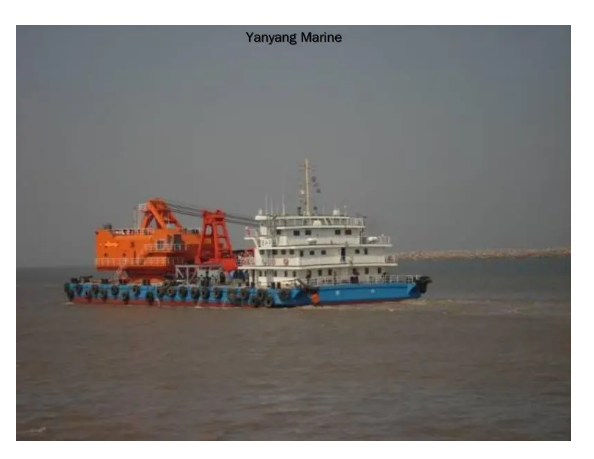
Near-shore coastal work — berth maintenance, small-craft channels and coastal approaches — rewards manoeuvrability and material tolerance rather than raw volume. The 25 m³ grab dredger in this fleet is a self-propelled, ZC-classed vessel with an overall length of 58.00 m, a length between perpendiculars of 56.30 m, a moulded breadth of 22.60 m and a moulded depth of 4.80 m at a designed draft of 3.00 m. Its navigation area is coastal, and it is crewed by 10 persons.
Grab capacity is 25 m³, and the vessel is specified for removing hard clay and soft sediment in near-shore operations. Displacement is 3,651.308 t, with gross tonnage of 2,349 T and net tonnage of 705 T. Machinery consists of two Weichai X6170ZC-21 main engines rated 456 kW at 1,500 r/min, driving through HCD400A reduction gearboxes with a 5:1 ratio, with two SB-HW4 generators onboard. Frame spacing is 0.60 m.
Two procurement notes follow from these parameters. First, a 25 m³ grab is a cycle-based tool: output depends on cycle time and lift height rather than continuous flow, which makes it well matched to precision removal and to berths where material type or geometric constraints rule out a suction dredger, and poorly matched to high-volume channel excavation. Second, the vessel was completed in 2012. For a buyer evaluating a unit of this generation, condition assessment, refurbishment scope and current class status carry more weight than the original specification sheet, and those should be verified before the vessel is committed to a works programme.
Hard Material and Long Discharge Distances: The 8,000 m³/h Cutter Suction Dredger
Between the deep-water hopper dredger and the near-shore grab lies the cutter suction dredger (CSD), which excavates in place and transports spoil through a pipeline. The largest unit described in this range is an 8,000 m³/h self-propelled CSD for major port construction, reclamation and deep-sea channel excavation, with a stated dredging depth of 30 m and a discharge distance of 8,000 m. Dimensions are 121 m length overall, 25 m width and 8.5 m depth.
Stated applications include international container port deepening, trans-oceanic shipping channel excavation, large-scale offshore airport construction, coastal city expansion and land reclamation, and deep-water berth construction for VLCC tankers. The trade-off is infrastructural rather than technical: a CSD spread depends on pipelines, anchoring or spud systems and receiving arrangements for the spoil, which makes it a strong fit for large, defined work areas and a weaker fit for fragmented or small-volume sites where the pipeline route itself becomes a constraint on the programme.
The Supporting Fleet: Split Hopper Barges and Backhoe Dredgers
Scenario matching is rarely about a single vessel. Two supporting types complete the project logic.
The 2,600 m³ split hopper barge — part of a 1,200–3,200 m³ build range and classed CCS — has an overall length of 76.95 m, a waterline length of 75.92 m, a moulded breadth of 15.60 m, a moulded depth of 6.00 m and a design draft of 4.00 m, with beam of 9.15 m, frame spacing of 0.60 m, main engine power of 3,740 kW × 2, a crew of 10 and Ice Class B. It is used for transporting spoil and is specified for coastal and inland waterway projects, which makes it the natural partner for grab and backhoe operations that produce material faster than it can be piped away.
The EX5500 backhoe dredger covers the opposite niche: confined and hard-material excavation with a smaller footprint. Overall length is 71.5 m, beam 22 m and draft 2.5 m, built around a Hitachi EX 5500 excavator with 2 × 1,076 kW of excavator power and 2 × 350 kW of propulsion. Dredging depth is 18 / 24 / 32 m with a capacity of 15 / 18 / 20.5 m³ per cycle, and the unit is specified for long-term offshore dredging operations.
Whichever combination a project adopts, the supporting spread follows the same logic: dredge pumps, pipelines, surveying systems and anchor handling equipment, operated continuously and either self-propelled or barge-towed. Treating that spread as part of the vessel decision, rather than as a later add-on, is what keeps a scenario match valid through execution.
Application Matching Matrix
| Project profile | Primary vessel | Governing parameters | Supporting assets | Boundary to verify |
|---|---|---|---|---|
| Deep-water channel excavation & port deepening | 26,800 m³ TSHD | Dredging depth 40/70/115 m; hopper 26,800 m³; suction pipe Φ1200 mm | Dredge pumps, surveying systems, positioning thrusters | 9.50 m draft; DP-1 notation; disposal or reclamation site |
| Large-scale reclamation & offshore airport construction | 8,000 m³/h self-propelled CSD | Dredging depth 30 m; discharge distance 8,000 m | Pipelines, anchor handling equipment, surveying systems | Pipeline route and spoil receiving area |
| Port & bridge foundation installation | 110 m pile leader height Pile Driving Barge | Pile frame height 137.00 m; typical pile Ø4000 mm, 107 m + water depth, 400 t | Anchor handling and positioning equipment | Weather windows; positioning spread; non-dredging platform |
| Near-shore coastal maintenance | 25 m³ Grab Dredger | Grab capacity 25 m³; design draft 3.00 m; coastal navigation area | Split hopper barge for spoil transport | Cycle-based output; vessel completed 2012 |
| Confined or hard-material excavation | EX5500 Backhoe Dredger | Dredging depth 18/24/32 m; capacity 15/18/20.5 m³ | Split hopper barge, surveying systems | 2.5 m draft limits open-water deployment |
| Spoil transport, coastal & inland waterways | 2,600 m³ Split Hopper Barge | LOA 76.95 m; design draft 4.00 m; Ice Class B | Towage and handling equipment | Transport role only — not a dredging unit |
Market Trends Reshaping Vessel Selection
Three structural drivers are changing how buyers match vessels to scenarios. The first is volume growth: the dredging equipment market is projected to move from USD 4.86 billion in 2023 to USD 7.36 billion by 2030 (Grand View Research), which increases both newbuild demand and competition for established second-hand units. The second is fleet composition. Hydraulic dredgers held approximately 46.65% of revenue share in 2023, while TSHDs are estimated to account for 46.0% of total dredging market activity by 2026 (Future Market Insights) — a distribution that reflects how much channel maintenance and offshore sand extraction now depend on self-loading hopper capacity rather than on mechanical excavation.
The third driver is offshore wind. The offshore wind industry is identified as a key emerging driver for dredging equipment, requiring specialised vessels for seabed preparation and cable trenching across more than 380 GW of new capacity by 2033 (Global Wind Energy Council). That demand profile differs from traditional port work: trenching and seabed preparation favour precision and positioning over bulk hopper capacity, which is one reason dynamic positioning and class notations have moved from a technical footnote to a shortlisting criterion.
Regulatory and classification frameworks are the quieter trend. ISO 8384:2019 provides the international standard vocabulary and definitions for dredgers, including specific terms for TSHD and CSD — useful when comparing offers from suppliers who describe similar vessels differently. Classification societies such as Bureau Veritas and DNV publish dredger-specific rules, including guidelines for the assignment of reduced freeboards for dredgers. For buyers, the practical consequence is that class notation is now a comparable specification field in its own right, not merely a compliance formality.
Where Vessel Matching Meets Its Limits
Traditional coastal and port dredging has long relied on a multi-vessel mechanical spread: a grab or backhoe excavating into hopper barges that shuttle spoil to a disposal ground, with piling handled separately by general-purpose barges or land-based plant. That model still has a place, and comparing it with an integrated hydraulic approach clarifies where each scenario match breaks down.
| Dimension | Traditional multi-vessel mechanical spread | Integrated hydraulic vessel |
|---|---|---|
| Excavation method | Cycle-based grab or backhoe | Continuous suction (TSHD/CSD) |
| Spoil handling | Separate hopper barge required | Onboard hopper (TSHD) or pipeline (CSD) |
| Mobility | Depends on tugs and support craft | Self-propelled options available |
| Best-fit scenario | Confined areas, hard material, low volumes | Large volumes, defined channels, reclamation |
| Principal constraint | Vessel count and coordination load | Draft, positioning class, disposal requirements |
None of the mappings above remove the underlying constraints. The 26,800 m³ TSHD is a 9.50 m draft vessel with DP-1 notation, so it cannot substitute for a shallow-draft unit inside partially built harbour basins, and its cycle assumes a disposal or reclamation site within reach. The Pile Driving Barge cannot dredge, and its schedule remains exposed to open-water weather. The 25 m³ grab dredger's cycle-based output makes it unsuitable for high-volume channel excavation, and its 2012 completion year shifts due diligence toward condition, refurbishment scope and current class status.
Commercial boundaries matter as much as technical ones. Customised dredgers are not an immediate solution: standard vessels are quoted at 2–3 months delivery, while customised units run to 8–12 months, which means specification decisions must be locked early enough to fit the construction programme. Yanyang Marine states that its vessels are offered at approximately 50% lower cost compared with European manufacturers. That is a supplier commercial claim and should be validated against project-specific scope, class requirements, spare parts provision, commissioning support and delivery terms — not treated as a like-for-like price comparison across different specifications.
Future Outlook
Three developments are likely to shape vessel–scenario matching over the next several years. Offshore wind capacity expansion, with more than 380 GW of new capacity indicated by 2033 (Global Wind Energy Council), will keep pressure on specialised seabed preparation and trenching capability, favouring units with reliable station-keeping and classed notation over pure bulk capacity. Port deepening programmes tied to larger vessel classes will continue to favour the high-capacity hopper and cutter suction segment, which already accounts for the largest revenue share among hydraulic dredgers.
A second shift concerns fleet composition rather than vessel design. Project owners increasingly assemble mixed spreads — a self-propelled hydraulic unit for main excavation, a mechanical dredger for confined or contaminated material, and split hopper barges for transport — instead of specifying a single dredger type for an entire programme. That approach raises the importance of interface planning, since the constraint on output moves from the excavation vessel to the transport and discharge chain.
A third factor is procurement structure. Refurbishment and conversion of existing tonnage sit alongside newbuild in most market forecasts, supported by the after-sales scope — newbuilding together with maintenance, repair and conversions — that yards now offer to keep older vessels in class. Buyers who treat the vessel decision as a single transaction, rather than as a lifecycle commitment with a service network attached, are likely to find their scenario match degrading faster than the hull itself.
FAQ
Which vessel type is used for deep-water channel dredging, and why?
Deep-water channel work in this range is handled by the 26,800 m³ trailing suction hopper dredger, which is specified for dredging depths of 40 / 70 / 115 m with a hopper capacity of approximately 26,800 m³ and a suction pipe diameter of Φ1200 mm. It carries CCS class with CSA Trailing Suction Hopper Dredger, dredging within R1 and DP-1 notations, and is intended for deep-water channels, port expansion and large-scale reclamation.
What dredging depths are available across the fleet?
Published depth figures in this range are 40 / 70 / 115 m for the 26,800 m³ trailing suction hopper dredger, 30 m for the 8,000 m³/h self-propelled cutter suction dredger, and 18 / 24 / 32 m for the EX5500 backhoe dredger. The 25 m³ grab dredger is specified for near-shore coastal operations with a design draft of 3.00 m and a coastal navigation area.
What supporting equipment does a dredging vessel require?
Dredging vessels in this fleet require supporting equipment including dredge pumps, pipelines, surveying systems and anchor handling equipment. Operations are generally continuous, with self-propelled or barge-towed modes depending on the vessel and the project configuration, and the supporting spread should be planned as part of the vessel selection rather than added afterwards.
Can one vessel cover both deep-water channel work and near-shore coastal operations?
No single unit in this fleet covers both extremes. The 26,800 m³ trailing suction hopper dredger is a 171.20 m vessel drawing 9.50 m at international freeboard, suited to open-water channel and reclamation work, while the 25 m³ grab dredger is a 58.00 m self-propelled vessel with a coastal navigation area and a 3.00 m designed draft. Programmes that span both conditions are typically matched with a combination of vessel types rather than one hull.
Which classifications and standards should buyers verify?
Vessels in this range can be classed by IACS societies including CCS, BV, LR and DNV. The 26,800 m³ TSHD carries CCS class with CSA Trailing Suction Hopper Dredger, dredging within R1 and DP-1 notations; the 25 m³ grab dredger is ZC-classed; and the 2,600 m³ split hopper barge is CCS classed with Ice Class B. ISO 8384:2019 provides the international vocabulary and definitions for dredger types, while classification societies such as Bureau Veritas and DNV publish dredger-specific rules, including guidelines for the assignment of reduced freeboards for dredgers.
What delivery timelines apply to standard and custom-built dredging vessels?
Standard vessels in this range are quoted at 2–3 months delivery, while customised dredgers run to 8–12 months. Customisation covers dredging depth, discharge distance, installed power and overall configuration, so the specification decision needs to be finalised well ahead of the construction programme it supports.