
Matching Dirt Ebike Configurations to Off-Road, Urban, and Fleet Projects
Industry Context
As the electric mobility market matures, buyers are increasingly moving beyond spec-sheet comparisons to evaluate how a dirt ebike performs in specific real-world environments. For powersports dealers, fleet operators, and urban commuters, the question is no longer just about power and range but about how a bike's motor type, suspension, brake system, and software integration align with the intended operating conditions.
Problem and Opportunity
Many procurement teams face a common disconnect: a bike that excels on a desert trail may fail on wet city streets, while a street-legal model might lack the torque for steep off-road climbs. The opportunity lies in matching supplier capabilities—such as mid-drive vs. hub motors, voltage platforms, and dual-mode firmware—to the specific terrain and usage patterns of each project.
Freego's Solution Architecture
Freego, a U.S.-headquartered electric mobility OEM with a production base in China and a sales office in Chino, California, offers a structured product line that spans multiple performance tiers. The company's portfolio includes hub-motor dirt bikes (X-series) for dual-mode street/off-road use and mid-drive models (Nova series) for extreme terrain, alongside IoT-enabled variants for rental and ride-sharing fleets.
All Freego dirt ebikes support a pedal assist + pure electric dual-mode driving, allowing riders to switch between modes according to local regulations and terrain demands. The bikes are designed for conditions ranging from off-road trails, sand, mud, steep inclines >25°, and extreme terrains to urban paved roads and bike lanes, depending on the model configuration.
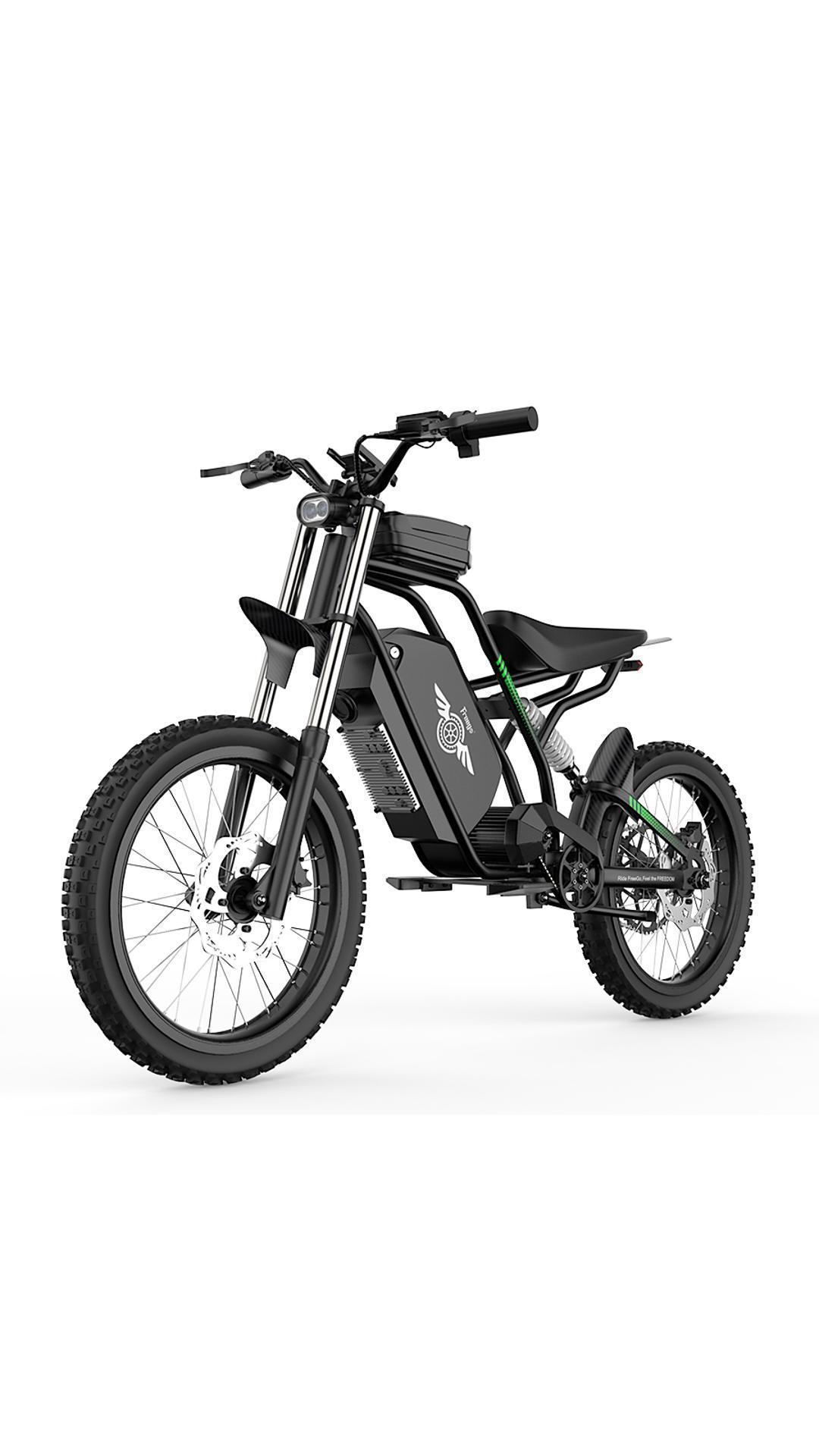
Technical Breakdown: Matching Components to Scenarios
Three key technical dimensions determine project compatibility:
- Motor type: Mid-drive motors (Nova 3, Nova 4, Nova 5) provide higher torque at the wheel for steep slopes and technical trails, while hub motors (X-series) offer simpler maintenance and smoother on-road performance.
- Voltage and battery: 72V 40Ah systems (Nova 5, X3) deliver extended range and power for long-duration off-road adventures; 60V 30Ah configurations balance weight and cost for mixed use.
- Suspension and brakes: Full hydraulic suspension with inverted forks and 4-piston hydraulic disc brakes are standard on the Nova 5, suited for desert and mountain riding, while the X2 Pro's KKE brand hydraulic front and rear shock absorbers handle both urban bumps and moderate trails.
For fleet operators, the product requires supporting equipment such as IoT Modules, a Cloud management platform, multi-unit charging docks, cloud-based fleet intelligent scheduling, and real-time battery monitoring. These models operate in IoT-controlled unlocking and swappable battery operation mode, enabling commercial-grade reliability.
Application Scenarios and Model Recommendations
Powersports & Outdoor Recreation
For off-road parks, hunting trips, and desert adventures, the Freego Nova 5 (8000W mid-drive motor, 72V 40Ah battery, 53MPH top speed, ≥45% slope climbing) is the recommended configuration. Its forged aluminum alloy frame and KKE brand hydraulic shock absorbers are engineered for extreme conditions. Powersports retailers in the U.S. have stocked the Nova and X-Man series to attract riders transitioning from gas-powered dirt bikes.

Urban Transportation & Commuting
Street-legal dual-mode dirt ebikes like the Freego X2 Pro (6000W hub motor, 60V 30Ah battery, 28MPH urban mode / 50MPH off-road mode, 4-piston hydraulic disc brakes) meet the requirements of mixed traffic, wet streets, and night riding. The pedal-assist throttle mode and low-noise motor operation make it suitable for daily commuting.
Rental & Ride-sharing Business
For city-wide scooter sharing or resort rentals, durability and remote management are critical. Freego's models equipped with IoT modules and cloud-based fleet scheduling are designed for high-frequency public use and outdoor 24/7 exposure. Swappable battery systems reduce downtime, while remote fault diagnosis allows operators to maintain uptime without field support.
Market Trends and Buyer Considerations
The shift toward electric off-road vehicles in the U.S. and Europe has accelerated demand for UL2849 and CE-certified products. Buyers increasingly require dual-mode firmware that can limit speed to 28MPH for street legality while unlocking higher power for off-road parks. Freego's X-series and Nova series both offer this capability, with the Nova 5 Pro reaching 62MPH in street-legal mode.
Another emerging trend is the need for IPX6 waterproofing and all-weather reliability. Freego's D11 scooter, for example, carries an IP65 rating, and the company's dirt ebikes are designed with sealed electrical components to withstand moisture.
Comparison with Traditional Solutions
Compared to gas-powered dirt bikes, electric models offer lower total cost of ownership, quieter operation, and easier regulatory compliance for mixed-use environments. However, one honest limitation is that high-power electric dirt bikes (8000W+) still require multiple hours of charging between rides, making them less suited for back-to-back long-range racing without a battery swap infrastructure.
Future Outlook
As battery energy density improves and swappable battery standards emerge, the gap between electric and gas performance will continue to narrow. The integration of IoT and fleet-management software will become a baseline requirement for commercial rentals, and mid-drive motors are expected to dominate the off-road segment. Freego's investment in both hub and mid-drive architectures positions it to serve a broad range of project types through 2028 and beyond.
Frequently Asked Questions
- Q: What operating modes do Freego dirt ebikes support?
A: They operate in pedal assist + pure electric dual-mode driving. For urban models, the product operates in pedal-assist & throttle mode, with multi-speed levels. - Q: What environments are Freego dirt ebikes designed for?
A: They are designed for off-road trails, sand, mud, steep inclines >25°, and extreme terrains, as well as outdoor all-terrain, urban paved roads, bike lanes, and mild slopes. - Q: What supporting equipment is needed for rental fleet models?
A: They require IoT Modules, a Cloud management platform, multi-unit charging docks, cloud-based fleet intelligent scheduling, and real-time battery monitoring. - Q: Are Freego dirt ebikes street-legal?
A: The X-series and Nova series feature dual-mode firmware with a 28MPH urban mode that meets street-legal requirements in many jurisdictions; full compliance depends on local regulations. - Q: What is the recommended model for steep slope climbing (>45%)?
A: The Freego Nova 5 with an 8000W mid-drive motor and ≥45% slope climbing capacity is engineered for extreme inclines.
For a comprehensive technical overview and commercial terms, download the Freego corporate brochure.
¿Tiene preguntas o necesita más detalles?
Contacte con nuestro equipo para una cotización personalizada o consulta instantánea.
Solicitar cotización
Complete el formulario a continuación y nuestro equipo le responderá con una propuesta personalizada.
Chat directo de WhatsApp
¿Prefiere chatear en tiempo real? Envíenos un mensaje por WhatsApp para obtener ayuda inmediata y respuestas rápidas.
- Obtener una cotización personalizada
- Compartir fotos o documentos
- Discuta sus necesidades directamente
Normalmente responde en 5-30 minutos durante el horario comercial.