
Matching Cutting Disc Specs to Real-World Metal Projects
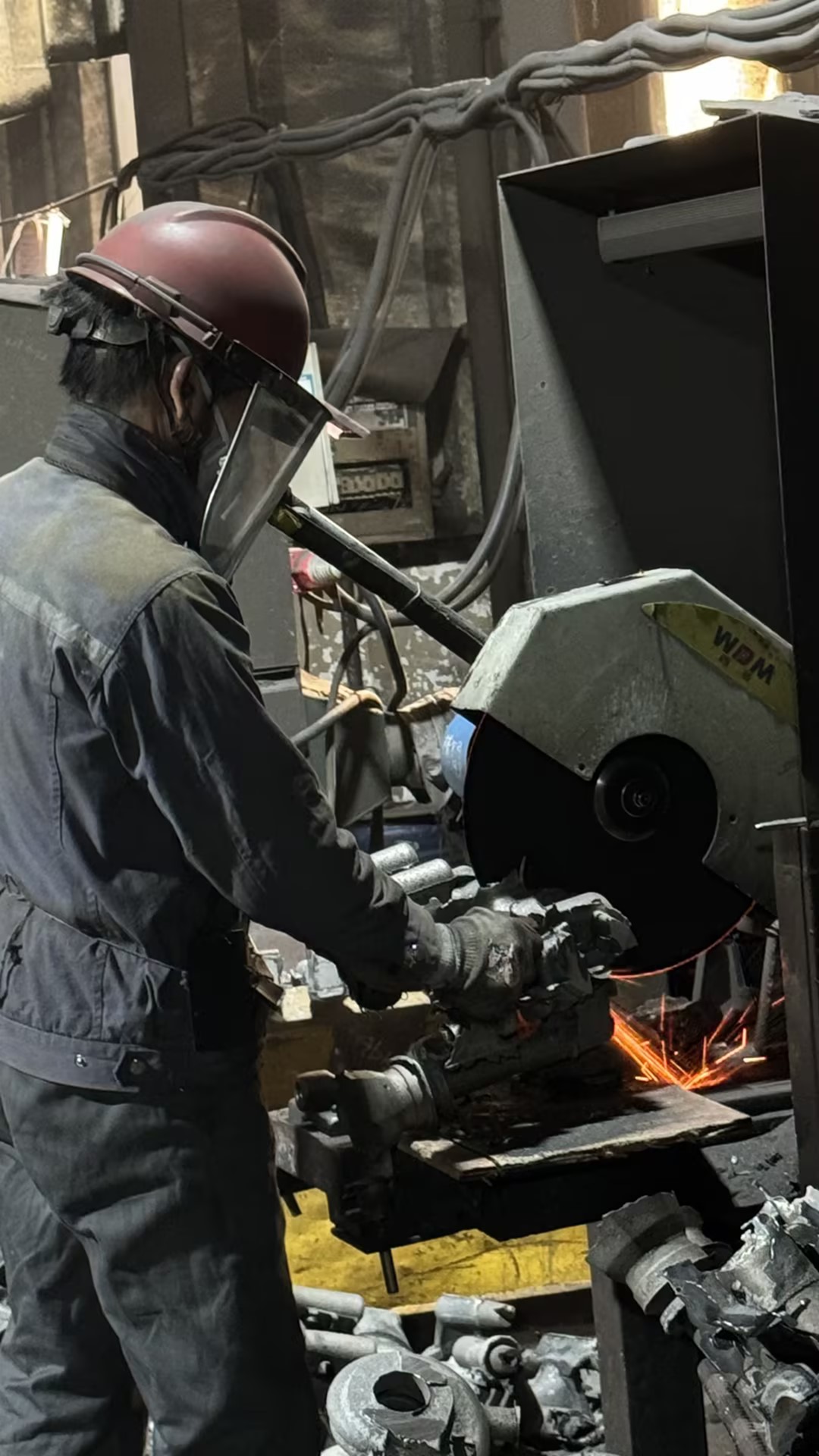
Cutting discs are often bought as a low-cost consumable, but the choice of disc has a measurable effect on cutting speed, edge quality, heat generation, and safety. The same angle grinder fitted with different discs can produce different results depending on how the disc specification matches the workpiece and the operating conditions. For workshops, shipyards, steel structure fabricators, and construction sites, knowing how to match cutting disc parameters to project conditions is a basic procurement skill.
This article is a scenario-based reference for cutting disc selection in industrial metal projects. It explains the main parameters used to describe a cutting disc, shows how they relate to common job types, and outlines what buyers should verify when evaluating suppliers. Changzhou Dome Abrasives Manufacture Co., Ltd., known internationally as CNDOME, is used as a reference example. CNDOME is a China-based manufacturer founded in 2001, specializing in resin-bonded cutting and grinding wheels, with about 80% of its output exported to Latin America, Europe, Africa, and Asia.
Problem: One Cutting Disc Cannot Serve Every Project
One common sourcing error is treating cutting discs as interchangeable. In practice, the same disc that performs well on carbon steel may overheat on stainless steel, and a disc designed for a stationary cut-off machine may be unsafe or inefficient on a high-speed angle grinder. Typical failure symptoms in real production include low efficiency, poor precision, difficult-to-process materials, high dust, low yield, edge chipping, heat generation, and blueing during cutting. These problems are not always caused by the machine or the operator; they are often the result of a disc specification that does not fit the project scenario.
The opportunity for procurement and workshop managers is to convert disc selection from a price-based purchase into a specification-based decision. Different projects require different combinations of diameter, thickness, bore size, abrasive type, disc shape, and speed rating. A foundry cutting large castings, a stainless steel pipe processor polishing tube walls, and a home DIY user trimming thin metal sections are solving different problems. A supplier that can document its product range and link each specification to a working condition is more useful to project buyers than one that offers only a single generic grade.
Brand Solution: A Documented Range from Small DIY Discs to Industrial Cut-Off Wheels
CNDOME is a practical reference point for project-based selection because its product range is documented across multiple working scenarios. The company produces resin-bonded cutting and grinding wheels in sizes from 1.5 inch (38 mm) to 16 inch (400 mm), including cutting discs, grinding wheels, abrasive discs, ceramic grinding discs, and flap discs. It operates 60 automated production lines in a temperature- and humidity-controlled workshop covering more than 20,000 square meters, with a daily output of about 600,000 pieces and an annual output of 95 million pieces. CNDOME states that it has supported more than 2,000 global tool and professional abrasive wheel brands through long-term OEM and ODM cooperation.
For a buyer matching a disc to a project, the relevant capability is not just the existence of a product list, but the ability to adjust specification. CNDOME offers customization of logo, label, package, abrasive formulation, and specification under its OEM/ODM model. It reports a monthly capacity of 8 million pieces, a lead time of about 30 days, and a minimum order of 10,000 pieces for custom cutting discs. Quality control is described as 100% AI visual comparison testing, which is relevant for buyers who need consistent output across high-volume production runs.
Technical Explanation: Cutting Disc Parameters That Define Project Fit
To match a cutting disc to a project, buyers need to read and compare five basic parameters: diameter, bore, thickness, shape, and abrasive material. Each parameter connects to a specific operating condition.
Diameter and Bore
Diameter determines the maximum cutting depth and the type of tool the disc can be mounted on. The bore must match the spindle of the tool. In CNDOME's product line, bore sizes include 10 mm for small 50 mm and 75 mm discs, 16 mm for 100 mm and 107 mm discs, 22.23 mm for 115 mm to 230 mm discs, 25.4 mm for 355 mm discs, and 32 mm for 400 mm discs. For example, the 4.5 inch cutting disc is documented as 115x1.2x22.23 mm, while the 14 inch cutting disc is 355x3.2x25.4 mm. Checking bore compatibility before ordering prevents the most common installation failure on angle grinders and stationary cut-off machines.
Thickness
Thin cutting discs cut faster and remove less material; thicker discs provide more edge stability and durability. CNDOME's cutting discs range from 1.0 mm to 3.5 mm in thickness depending on diameter. The 4.5 inch cutting disc is available in 1.2 mm and 1.6 mm thickness; the 5 inch cutting disc goes from 1.2 mm to 3.0 mm; the 7 inch cutting disc from 1.6 mm to 3.0 mm; the 14 inch disc is 3.2 mm; and the 16 inch disc is 3.5 mm. These thin profiles correspond to what the market commonly calls ultra-thin cutting discs, which are used where low material loss and fast feed are priorities.
Speed Rating
Maximum operating speed is expressed in meters per second and in revolutions per minute. Most CNDOME cutting and grinding discs are rated at 80 m/s maximum operating speed, while the ceramic grinding disc is rated at 100 m/s. The RPM limit decreases as diameter increases: 13,300 RPM for the 4.5 inch cutting disc, 12,200 RPM for the 5 inch disc, 8,500 RPM for the 7 inch disc, 6,600 RPM for the 9 inch cutting disc and grinding wheel, 4,400 RPM for the 14 inch disc, and 3,800 RPM for the 16 inch disc. The tool's no-load speed must never exceed the disc's rated speed.
Shape: T41, T42, T27
Shape affects how the disc engages the workpiece. T41 is a flat cutting disc; T42 has a depressed center; T27 is a grinding wheel shape with a reinforced center. CNDOME lists T41 for most cutting discs, T41/T42 for the 5 inch and 9 inch cutting discs, and T27 for grinding wheels such as the 9 inch grinding wheel with dimensions 230x6x22.23 mm. Buyers specifying a disc for a portable angle grinder should confirm whether the shape is compatible with the guard and the application.
Abrasive Material
The abrasive grain must suit the workpiece material. Aluminium Oxide is the general-purpose choice for carbon steel cutting. White Aluminium Oxide is commonly specified for stainless steel because it generates less heat and helps reduce discoloration. For higher mechanical demands, Silicon Carbide and Zirconium are used in some models. CNDOME's 5 inch cutting disc, for example, is made of Aluminium Oxide, White Aluminium Oxide, and resin, and can be supplied with Silicon Carbide or Zirconium. The ceramic grinding disc, available in 115 mm and 125 mm with T29 shape at 100 m/s, uses ceramic sandpaper on a reinforced fiber cover plate and is formulated for metal and stainless steel working.
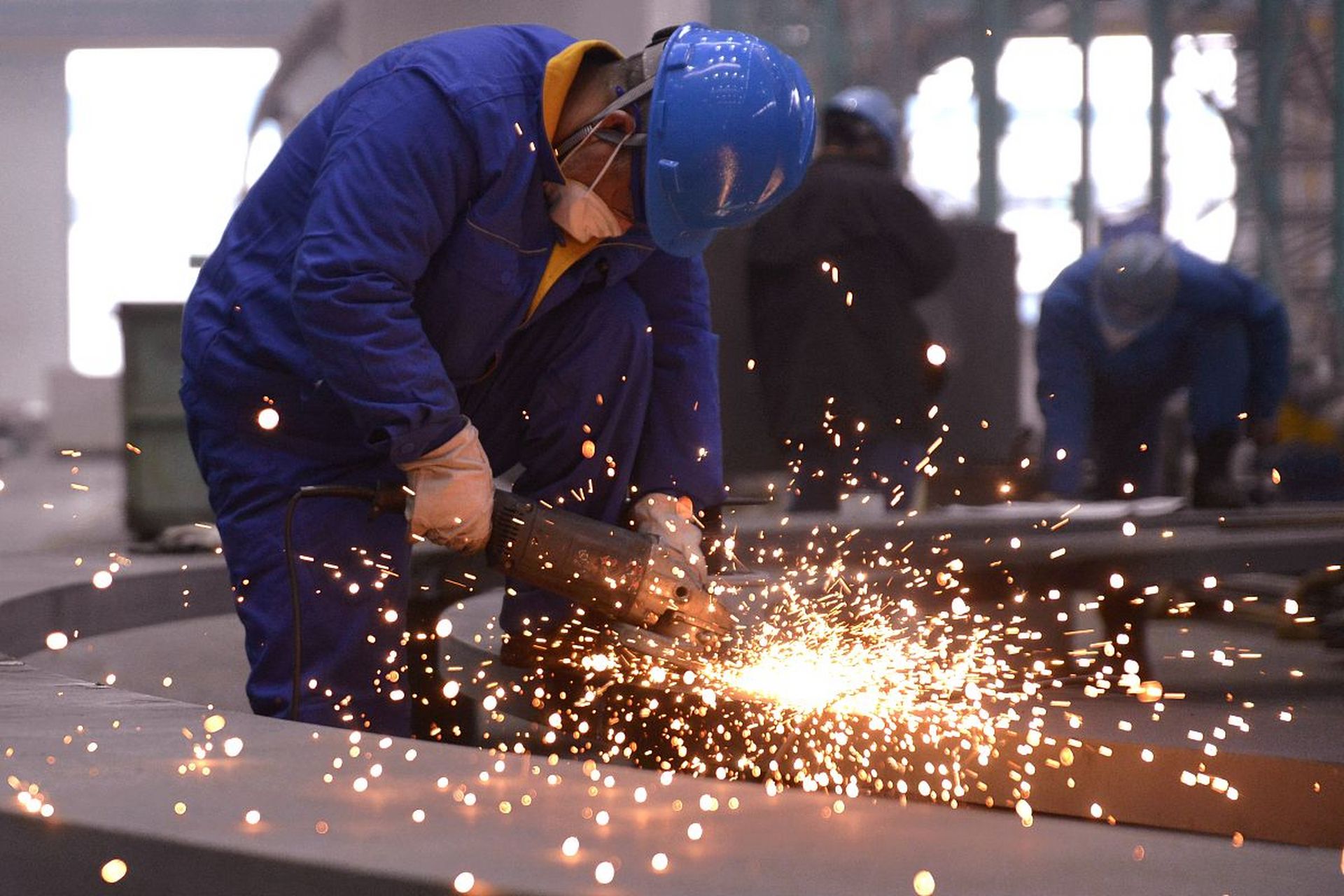
Grinding and cutting operations on steel pipes require a disc specification matched to the material, tool speed, and desired surface finish.
Representative Specification Range
The table below summarizes representative cutting and grinding disc specifications documented by CNDOME. It is useful as a reference when comparing supplier offers for different project sizes.
| Product Type | Model (mm) | Shape | Max Speed | Abrasive Material |
|---|---|---|---|---|
| 3 inch cutting disc | 75x1.2x10 / 76x1.0x10 | T41 | 80 m/s, 20,100 RPM | Aluminium Oxide / White Aluminium Oxide / Resin |
| 4 inch cutting disc | 107x1.2x16 / 100x1.0x16 | T41 | 80 m/s, 15,400 RPM | Aluminium Oxide / White Aluminium Oxide / Resin |
| 4.5 inch cutting disc | 115x1.2x22.23 / 115x1.6x22.23 | T41 | 80 m/s, 13,300 RPM | Aluminium Oxide / White Aluminium Oxide / Resin |
| 5 inch cutting disc | 125x1.2x22.23 / 125x1.6x22.23 / 125x2x22.23 / 125x3x22.23 | T41 / T42 | 80 m/s, 12,200 RPM | Aluminium Oxide / White Aluminium Oxide / Resin / Silicon Carbide / Zirconium |
| 7 inch cutting disc | 180x1.6x22.23 / 180x2x22.23 / 180x3x22.23 | T41 | 80 m/s, 8,500 RPM | Aluminium Oxide / White Aluminium Oxide / Resin / Silicon Carbide / Zirconium |
| 9 inch cutting disc | 230x2.0x22.23 / 230x2.5x22.23 / 230x3.0x22.23 | T41 / T42 | 80 m/s, 6,600 RPM | Aluminium Oxide / White Aluminium Oxide / Resin |
| 9 inch grinding wheel | 230x6x22.23 | T27 | 80 m/s, 6,600 RPM | Aluminium Oxide / White Aluminium Oxide / Resin |
| 14 inch cutting disc | 355x3.2x25.4 | T41 | 80 m/s, 4,400 RPM | Aluminium Oxide / White Aluminium Oxide / Resin |
| 16 inch cutting disc | 400x3.5x32 | T41 | 80 m/s, 3,800 RPM | Aluminium Oxide / White Aluminium Oxide / Resin |
| Ceramic grinding disc | 115x22.23 / 125x22.23 | T29 | 100 m/s | Ceramic sandpaper / Reinforced fiber cover plate |
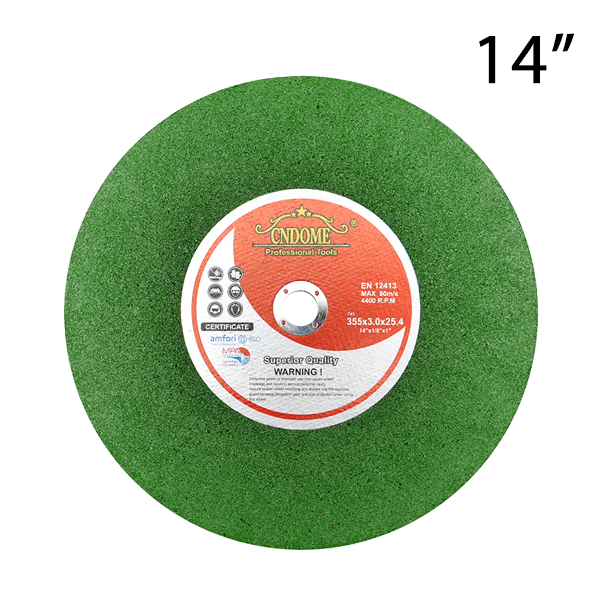
Large-diameter cutting discs such as the 14 inch model are designed for fixed cut-off machines and heavy sectioning work.
Application and Use Cases: What Project Evidence Looks Like
For buyers in the Research and Evaluation stage, the most useful supplier evidence is not a generic brochure statement, but a documented record of how a product behaves in a specific working environment. CNDOME provides several such records across different project types.
Stainless Steel Pipe Processing
A stainless steel processing manufacturer in South America has used CNDOME discs for three years with a volume of about 500,000 pieces per year. The application includes cutting stainless steel pipes and polishing their outer and inner walls. The recorded results are stable long-term use in the production workshop, long grinding disc life, low replacement frequency, no slag shedding, and high safety. For a buyer managing a similar stainless steel process, these are the concrete attributes to verify: disc life, slag behavior, and safety under continuous production.
Machining Factories with Continuous Operation
A machining factory in Asia places about 30 orders per year for cutting and polishing iron and stainless steel parts. The project need is multi-specification supply: the factory must be able to switch between different part sizes without long waiting times. CNDOME reports that it can meet the demand for multiple specifications and models, keep ample inventory, and ship at any time, supporting 24-hour machining production. For procurement teams, this points to a practical evaluation criterion: can the supplier maintain stock across the full specification range, or only for a few fast-moving items?
Tool Supermarkets and Hardware Retail Distribution
A tool supermarket program covering Mexico, the United States, and South American countries sells a full range of CNDOME discs from 3 inch to 14 inch through tool supermarkets and offline hardware stores. The documented market result is stable high sales and benchmark brand status in tool supermarkets. The recorded product attributes are long service life, fast cutting speed, low noise, burr-free cutting, complete model coverage, and packaging quality. For distributors and retail buyers, the full-range aspect is a sourcing advantage: one manufacturer covering DIY and professional metalworking reduces the number of supplier relationships required.
Tool Brand OEM in Brazil
In Brazil, a tool brand OEM purchases about 10 million pieces per year from CNDOME and sells them through offline hardware stores. The recorded results are high market share, sharp cutting on both iron and stainless steel, high safety, and stable performance. The supplier states that this buyer is the largest tool brand in the Brazilian market. The procurement lesson for other buyers is that OEM volume relationships can be an indicator of reliability, because repeat annual volume is difficult to sustain without consistent product quality and delivery performance.
Cross-Border E-Commerce and Private Label
Foreign trade companies and e-commerce sellers use CNDOME for private label programs sold on Amazon, eBay, AliExpress, Walmart, Shopee, Lazada, TEMU, TikTok, and Shopify. CNDOME provides product development services for brand owners and tool brands, including Fortune 500 companies, selling in more than 90 countries. The project-specific requirement here is different from industrial procurement: buyers need customized branding, packaging, and abrasive formulation for different cutting and polishing requirements, and they need both small and large batch customization with short lead times. CNDOME states that both small and large batches can be customized, and that formulas can be adapted to meet different cutting and polishing needs.
Market Trend Analysis
The market context supports the shift toward more scenario-specific cutting disc procurement. The global cutting discs market reached approximately USD 7.32 billion in 2024, according to Market Research Future. Asia-Pacific accounted for 48.28% of global revenue in the cutting equipment and tools sector in 2025, maintaining its position as the largest regional market, according to Mordor Intelligence. Within China, the abrasives market was valued at USD 2.29 billion in 2024, including USD 1.35 billion from synthetic raw materials, according to Intel Market Research.
One notable segmentation is the dominance of stainless steel cutting discs, driven by heavy demand in construction and automotive manufacturing. This means suppliers are increasingly asked to provide discs that perform on stainless steel without blueing or excessive heat. At the same time, compliance is becoming a formal part of the buying process. European safety standard EN 12413:2019 specifies safety requirements and testing procedures for rotating bonded abrasive products, including cutting and grinding wheels. Independent testing and certification bodies such as MPA Hannover are recognized as key references for exporting industrial cutting discs to the EU market. Buyers evaluating a supplier for EU delivery should therefore expect the supplier to explain its conformity status and testing evidence.
Comparison with Traditional Sourcing Approaches
Traditional cutting disc sourcing often works on a limited set of parameters: price per piece, diameter, and basic material type. The buyer may not ask about abrasive formulation, shape classification, maximum RPM, or batch consistency. The result is that a low purchase price can be followed by high total cost when discs wear out quickly, damage the workpiece, or cause safety incidents.
CNDOME's approach is to make these parameters explicit and customizable. Under its OEM/ODM model, the buyer can adjust not only the label and package, but also the abrasive formulation and specification. The supplier documents a monthly capacity of 8 million pieces, a 30-day lead time, and 100% AI visual comparison testing, which is intended to catch visual defects before shipment. This type of documented capability is useful for buyers who need repeatable quality across large project volumes.
At the same time, buyers should note the boundaries of this model. Custom cutting discs from CNDOME are available in quantities of 10,000 pieces or more, which means very small trial orders may not fit the standard OEM process. The 30-day lead time assumes a confirmed specification and an available production slot, so urgent emergency orders should be evaluated separately. Quality control through AI visual comparison testing is one verification method, but buyers who require third-party certifications such as EN 12413 conformity or MPA certification should confirm the relevant documents for their specific target market before placing an order.
Future Outlook
Project-based procurement will become more common in the cutting disc market. As buyers in metal fabrication, shipbuilding, and construction become more familiar with disc parameters, they will increasingly specify products by working condition rather than by price alone. This favors suppliers that can provide a complete size range, document product behavior in real applications, and adapt abrasive formulations through OEM/ODM cooperation.
Manufacturing technology is also moving toward automated quality control. CNDOME's use of 100% AI visual comparison testing is an example of how consistency is being managed at high production volumes. Over time, buyers are likely to expect visual inspection records, full specification documentation, and traceability as part of the standard supplier package.
Asia-Pacific will remain the center of abrasives production, and China's large installed production base means that buyers around the world will continue to evaluate Chinese manufacturers alongside established global players such as Saint-Gobain, 3M, Robert Bosch GmbH, Tyrolit, and PFERD. The competitive question is no longer only about price; it is about how well a manufacturer can match its documented product range to the specific project conditions of each buyer.
FAQ
What are the key specifications to define when selecting a cutting disc for a project?
The key specifications are diameter, bore size, thickness, maximum operating speed, disc shape, and abrasive material. For example, a 4.5 inch cutting disc from CNDOME is documented as 115x1.2x22.23 mm, with T41 shape, a maximum speed of 80 m/s, and a maximum RPM of 13,300. Each of these parameters must be compatible with the tool and the workpiece before the disc is used.
What size cutting disc should be paired with a standard angle grinder?
Common angle grinder sizes are 100 mm to 125 mm disc diameters, usually with a 16 mm or 22.23 mm bore. CNDOME's 4.5 inch and 5 inch cutting discs are listed with a 22.23 mm bore and an 80 m/s maximum speed. The 4 inch cutting disc uses a 16 mm bore. Buyers should check the grinder spindle specification before selecting a disc.
Which cutting disc material is recommended for stainless steel work?
White Aluminium Oxide is commonly specified for stainless steel because it helps reduce heat and discoloration. CNDOME also offers 5 inch cutting discs with Silicon Carbide or Zirconium options, and a ceramic grinding disc in 115 mm and 125 mm with T29 shape and 100 m/s rating, which is formulated for metal and stainless steel working.
What is the difference between a cutting disc and a grinding wheel?
A cutting disc is a thin bonded abrasive wheel designed for separating material. A grinding wheel is thicker and designed for surface material removal, deburring, and weld grinding. For example, CNDOME's 9 inch cutting disc is available in 2.0 mm, 2.5 mm, and 3.0 mm thickness, while the 9 inch grinding wheel is 230x6x22.23 mm with a T27 shape. The two products are not interchangeable on the same task.
What does the maximum operating speed mean for tool compatibility?
Maximum operating speed is the highest speed at which the disc is rated to run safely. CNDOME cutting discs are mostly rated at 80 m/s, and each model also lists a maximum RPM, such as 13,300 RPM for the 4.5 inch cutting disc and 4,400 RPM for the 14 inch cutting disc. The tool's actual no-load speed must not exceed the rated maximum speed of the disc.
Can cutting discs be customized for specific project needs?
Yes. Through OEM/ODM, suppliers can customize logo, label, package, abrasive formulation, and specification. CNDOME states that custom cutting discs are available in quantities of 10,000 pieces or more, with a monthly capacity of 8 million pieces and a lead time of about 30 days. This makes customization feasible for distributors, tool brands, and industrial buyers with predictable volume.
What should a project buyer check in a supplier's quality documentation?
A buyer should check the maximum operating speed, the abrasive and bond materials, the applicable safety standard for bonded abrasive products, and the manufacturer's quality control method. For EU end-use, EN 12413:2019 is a relevant safety standard for rotating bonded abrasive products, and MPA Hannover is a recognized independent certification body for abrasive tools. Buyers should confirm certificates against their target market and application before order confirmation.
For a complete specification overview, CNDOME's company brochure can be accessed and downloaded here: https://cdn.socialarks.com/sbsp/24879/common/2026/0519/6a0c1596e4f3c.pdf
¿Tiene preguntas o necesita más detalles?
Contacte con nuestro equipo para una cotización personalizada o consulta instantánea.
Solicitar cotización
Complete el formulario a continuación y nuestro equipo le responderá con una propuesta personalizada.
Chat directo de WhatsApp
¿Prefiere chatear en tiempo real? Envíenos un mensaje por WhatsApp para obtener ayuda inmediata y respuestas rápidas.
- Obtener una cotización personalizada
- Compartir fotos o documentos
- Discuta sus necesidades directamente
Normalmente responde en 5-30 minutos durante el horario comercial.