
Matching Connector Specs to Harsh Realities: Agricultural Drones and Marine Energy Storage Scenarios
Matching Connector Specs to Harsh Realities: Agricultural Drones and Marine Energy Storage Scenarios
In outdoor lithium-powered equipment, the connector is the one component that sits directly at the boundary between the electrical circuit and the weather. Agricultural spraying drones and marine battery storage sit at opposite ends of that boundary — one works inside airborne chemical drift, the other inside persistent moisture — yet both expose the same weak point: an interface whose datasheet ratings say nothing about whether it will still conduct cleanly after a season of exposure.
AOYG DC Power Connector is a manufacturer of high-current DC connection systems for lithium-ion smart devices, supplying the new energy sector with connector families rated from 15A to 90A continuous current and protection classes from IP40 to IP67. Its portfolio is built around commercial and industrial drones, intelligent service robots, garden power tools and portable cleaning equipment, with manufacturing governed by IATF16949:2016 and ISO 9001:2015 quality management systems.
This industry reference maps environmental threats to actual connector specifications in two demanding scenarios — aerial agricultural spraying and marine or waterborne lithium storage — and then states plainly where those specifications stop being the right answer.
Why the Environment, Not the Datasheet, Sets the Specification
A high-current DC power connector's headline numbers — rated voltage, continuous current, peak current — describe what the contact system can carry under defined test conditions. They do not describe whether that contact system survives pesticide mist, salt-laden air, or a thousand battery swaps.
Harsh-environment failures are rarely dramatic. They accumulate:
- Terminal corrosion that raises contact resistance and creates localized heating at the interface.
- Housing degradation caused by temperature cycling and chemical contact.
- Vibration-induced loosening that reduces contact area and can cause intermittent power loss in flight.
- Moisture ingress at an unsealed interface, creating a conductive path where none should exist.
- Solder joint fracture when a cable is pulled without strain relief.
Each failure mode maps to a design decision: terminal plating, housing polymer, locking geometry, sealing method and cable retention. The following sections walk those decisions through two concrete duty cycles.
Agricultural Spraying UAVs: Corrosion, Vibration and Frequent Battery Swaps
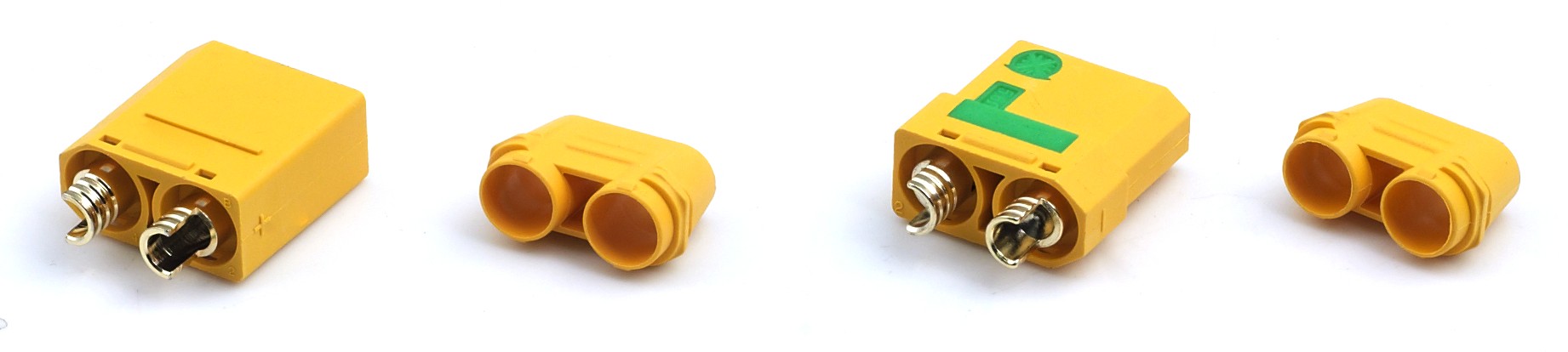
DXT90H-M/DXT90S-F: reinforced male and anti-spark female connector pair rated DC 500V / 90A continuous.
Agricultural spraying drones combine stressors that rarely appear together in a single platform: continuous flight vibration, landing impact, sustained high-current discharge, and direct exposure to a corrosive working fluid.
Pesticide drift
A spraying drone operates inside a cloud of fine chemical drift. For a connector, the practical concern is repeated deposition on plated surfaces and housing materials rather than full immersion. The conventional industry answer is gold plating on the conductive terminal, verified by neutral salt spray testing. The AOYG DXT90H-M/DXT90S-F UAV connector carries a 48-hour salt spray test on its gold-plated terminal, conducted to GB/T 10125 and ASTM B117 (Neutral Salt Spray) methods by a third-party laboratory holding CNAS, CMA and ISO17025 accreditation.
Vibration and landing shock
A multi-rotor airframe transmits continuous high-frequency vibration into every joint and adds a sharp impact load on each landing. The DXT90H-M male connector uses thickened, reinforced terminals designed to hold stable contact under continuous drone vibration and to avoid power loss caused by a loose connection. The tightly locking structure is specified as anti-loosening for multi-rotor UAV and agricultural drone service.
Battery swap duty
Spraying missions are normally flown with battery rotation, so the power connector may be mated and unmated several times per operating day. The DXT90H-M/DXT90S-F is rated for at least 1,000 insertion and ejection cycles, and an anti-misplug keying feature prevents reverse polarity connection — a failure mode with no acceptable margin in flight.
Inrush arc at connection
On a large lithium polymer pack, closing a live connection can draw an inrush arc that progressively erodes the terminal surface. The DXT90S-F female half integrates a high-power pre-charge resistor with a two-stage contact design intended to eliminate the arc when plugging a LiPo battery and to prevent terminal burnout.
The electrical envelope
The same connector is rated DC 500V with 90A continuous operating current at 10AWG wire and a temperature rise of ≤85°C. It uses a 4.5mm gold-plated banana terminal, withstands AC 2000V for one minute, uses a PA66 UL94 V-0 flame-retardant housing, and operates from -20°C to +120°C. Options include a bare connector, a silicone cable assembly in 8AWG or 10AWG with customizable wire length, and an optional strain relief cap to prevent cable breakage. The connector is dimensionally compatible with regular XT90, so upgrading to anti-spark and reinforced terminals does not require structural modification of the airframe.
Weight-limited platforms
Smaller airframes cannot justify the mass of a 90A link. For those platforms the relevant family is the DXT30U-M/DXT30U-F, rated DC 500V with 15A continuous current, 30A short-term peak, a Φ2mm gold-plated banana terminal, and 18AWG recommended wire compatible with 20AWG — carrying the same -20°C to +120°C window, ≥1,000 mating cycles and 48-hour salt spray result.
Where a platform needs to carry power and a sensing line through one interface, the DXT30U(2+2)-F(B) combines two power pins rated 20A at 16AWG with two signal pins rated 1A, a 35A peak, ≤1.2mΩ contact resistance and insulation resistance of ≥2000MΩ. The 2+2 composite pin design reduces harness quantity and saves internal device space.
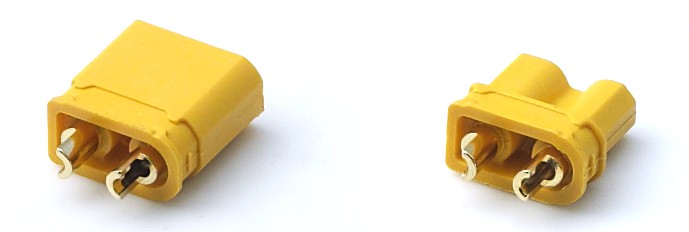
DXT30U-M/DXT30U-F: compact DC 500V / 15A connector for weight-sensitive drone and RC platforms.
Marine Lithium Systems and Waterborne Equipment: Sealing Becomes the Specification
Marine and waterborne duty cycles invert the priority order. Current is still a constraint, but the binding requirement moves to the seal.
Waterborne unmanned equipment, marine lithium battery systems, outdoor mobile photovoltaic energy storage and outdoor communication backup power share one threat profile: rain splash, sustained humidity, dust, occasional muddy water contact, daily temperature swing, and long static storage periods with large temperature differences.
The connector sized for that profile in the AOYG range is the DXT60EW-M+DXT60W-F waterproof high-current connector, rated DC 500V with 60A continuous current and 100A peak. Its specification reads as follows.
| Parameter | Specification |
|---|---|
| Rated voltage | DC 500V |
| Continuous / peak current | 60A / 100A |
| Protection grade | IP67, sealed with silicone O-ring |
| Terminal | Φ5mm H62 brass, gold-plated |
| Contact resistance | ≤0.8mΩ |
| Housing | PA66 UL94 V-0 flame-retardant nylon |
| Operating temperature | -20°C to +120°C |
| Mating cycles | ≥1,000 |
| Applicable wire | 8~10AWG silicone wire |
The silicone O-ring is what separates this part from the IP40 airborne connectors in the same range. It delivers dustproof and waterproof performance for open-air, humid and lightly wetted equipment — and that is also the correct boundary of the rating, because IP67 describes the sealed mating interface rather than unlimited submersion.
The same connector is specified across outdoor garden machinery, outdoor 5G base station standby power and outdoor electric amusement equipment. In 5G backup power the capacity pressure is well documented: 5G base stations draw roughly two to three times the power of their 4G predecessors, with typical site draws of 11.5 to 14 kW and peaks reaching 19 kW. Higher DC current at the battery interface makes contact resistance and sealing quality more consequential, not less.
Mapping Environmental Threats to Documented Design Responses
| Environmental threat | Failure mode if unaddressed | Design response | Documented example |
|---|---|---|---|
| Pesticide drift and chemical exposure | Terminal corrosion, rising contact resistance | Gold-plated H62 brass terminal; 48-hour neutral salt spray test to GB/T 10125 and ASTM B117 | DXT90H-M/DXT90S-F; DXT30U-M/DXT30U-F |
| Rain splash, humidity, dust | Moisture bridging at the interface; oxidation | Silicone O-ring seal, IP67 protection grade | DXT60EW-M+DXT60W-F |
| Continuous flight vibration | Contact loosening, intermittent power loss | Reinforced male terminals, anti-loosening locking, anti-misplug keying | DXT90H-M/DXT90S-F |
| Landing impact and shock | Terminal deformation, housing cracking | PA66 UL94 V-0 housing, thickened terminals | DXT series |
| Inrush arc at battery connection | Pitted terminals, burn damage | Built-in high-power pre-charge resistor with two-stage contact | DXT90S-F |
| Heat from continuous high current | Temperature rise, accelerated insulation aging | Low contact resistance (≤0.7mΩ to ≤1.2mΩ across the range), gold-plated terminals, specified wire gauges | DXT90H-M/DXT90S-F: 90A at 10AWG, ΔT ≤85°C |
| -20°C to +120°C cycling | Housing embrittlement or softening, seal compression loss | PA66 UL94 V-0 housing rated across the same window | All listed DXT models |
| Cable pull and fatigue | Solder joint fracture | Optional strain relief cap; cable assemblies with customizable length | DXT90H-M/DXT90S-F; DXT60EW-M+DXT60W-F |
Compliance Evidence Buyers Can Verify
For procurement teams in the EU and North America, environmental claims are only as good as the documents behind them. The AOYG high-current DC connector range carries the following documentation.
| Document / standard | Scope and issuing basis | Applicable models |
|---|---|---|
| ISO 9001:2015 quality management system | Issued by a Certification Body accredited by CNCA; global coverage | DXT60EW-M+DXT60W-F, DXT30U(2+2)-F(B), DXT90H-M+DXT90E-F Yellow, DXT90H-M/DXT90S-F |
| IATF16949:2016 automotive quality management system | Company-level manufacturing and quality system | Production system supporting the connector range |
| CE-LVD Declaration of Conformity | Directive 2014/35/EU (LVD) and EN 61984; EU market | DXT60EW-M+DXT60W-F, DXT30U(2+2)-F(B), DXT90H-M+DXT90E-F Yellow, DXT90H-M/DXT90S-F |
| Electrical Performance Test Report | IEC 60512 and GB/T 5095; global electronic and electrical markets | DXT90H-M/DXT90S-F |
| Salt Spray Test Report | GB/T 10125 and ASTM B117 (Neutral Salt Spray); third-party laboratory with CNAS, CMA and ISO17025 accreditation | DXT30U-M/DXT30U-F, DXT30U(2+2)-F(B), DXT90H-M+DXT90E-F Yellow, DXT90H-M/DXT90S-F, DXT60EW-M+DXT60W-F |
| UL94 V-0 Flammability Test Report | UL 94 Standard for Safety of Flammability of Plastic Materials for Parts in Devices and Appliances; North America, EU, Australia and global markets | High-current DC connector range |
| REACH SVHC Test Report | Regulation (EC) No 1907/2006 and the ECHA SVHC Candidate List; EU, EEA, UK and global overseas markets | DXT60EW-M+DXT60W-F, DXT30U(2+2)-F(B), DXT90H-M+DXT90E-F Yellow, DXT90H-M/DXT90S-F, DXT30U-M/DXT30U-F |
| RoHS 2.0 Test Report | IEC 62321 series; third-party laboratory with CNAS and CMA accreditation | DXT30U-M/DXT30U-F, DXT90H-M/DXT90S-F, DXT90H-M+DXT90E-F Yellow, DXT30U(2+2)-F(B), DXT60EW-M+DXT60W-F |
One caveat belongs here. Chemical compliance documentation such as REACH SVHC and RoHS 2.0 addresses restricted substances contained in the product. It is not the same thing as chemical resistance to a specific pesticide formulation, and buyers working with an unusual working fluid should confirm compatibility rather than infer it from a compliance certificate.
Comparison with Conventional Power Links
High-current DC connections have historically been made with simple bullet or blade connectors, direct soldered joints, or housed connectors without a specified sealing class. For many low-duty, indoor or otherwise protected applications that approach remains adequate and cost-effective, and nothing in this analysis changes that.
The trade-off only appears when the environment becomes the dominant load on the connection.
| Decision dimension | Conventional power link without environmental specification | Environment-rated connector with documentation |
|---|---|---|
| Corrosion control | Depends on plating choice, rarely documented | Gold-plated terminals with a 48-hour salt spray test to GB/T 10125 and ASTM B117 |
| Sealing | No specified protection grade | IP67 with silicone O-ring (DXT60EW-M+DXT60W-F) |
| Arc control | Manual handling; arc occurs at every live connection | Built-in pre-charge resistor with two-stage contact (DXT90S-F) |
| Vibration security | Retention depends entirely on the builder | Reinforced terminals, anti-loosening locking, anti-misplug keying |
| Traceability | Typically none | ISO 9001:2015, CE-LVD DoC, UL94 V-0, REACH SVHC and RoHS 2.0 documentation |
| Wire coupling | Selected by the builder | Specified: for example 90A continuous at 10AWG with temperature rise ≤85°C |
Operating Boundaries and Trade-offs
Boundaries are part of the specification, and buyers should treat them that way.
- Sealing is model-specific, not range-wide. IP40 is the standard protection level for the airborne connectors — DXT90H-M/DXT90S-F, DXT90H-M+DXT90E-F Yellow, DXT30U-M/DXT30U-F and DXT30U(2+2)-F(B). IP67 belongs to the DXT60EW-M+DXT60W-F. A platform that needs 90A and a sealed interface simultaneously cannot satisfy both from a single part number in this range.
- The IP67 part has no anti-spark structure. AOYG states that the DXT60EW-M+DXT60W-F does not have anti-spark structure and that live plugging and unplugging of large-capacity batteries is not recommended with it.
- Ampacity is coupled to wire gauge. The 90A continuous rating on the DXT90H-M/DXT90S-F is specified at 10AWG with temperature rise ≤85°C. The DXT90H-M+DXT90E-F Yellow is rated 45A continuous at 10AWG with a 90A short-term peak. The DXT30U-M/DXT30U-F is rated 15A continuous at 18AWG. Connector selection and harness design are one decision, not two.
- Composite connectors trade power density for functionality. The DXT30U(2+2)-F(B) offers 20A on the power pin and 1A on the signal pin with a 35A peak — a control-and-sense link rather than a traction link.
- Chemical compliance is not chemical immunity. REACH SVHC and RoHS 2.0 reports address restricted substances in the product, not resistance to any specific agricultural or marine chemical agent.
Market Context: Where the Demand Is Moving
The demand backdrop is expanding rather than static. The global high power connectors market was valued at approximately USD 5.47 billion in 2025, according to Fact.MR. Within the energy storage connector segment, DC connectors represented 58.7% of market share in 2025, a position Dataintelo attributes to higher voltage requirements in storage architectures.
On the airborne side, XT60 and XT90 remain the primary industry standards for medium- to high-power non-proprietary RC aircraft and drone battery-to-ESC connections in 2026, according to ChinaHobbyLine's RC battery connector compatibility guide. For buyers already standardised on XT90, the dimensional compatibility of the DXT90H-M/DXT90S-F with regular XT90 means the move to anti-spark and reinforced terminals is an interface-compatible change rather than an airframe redesign.
Future Outlook
Three directional shifts are visible in the equipment these connectors serve.
- Sealing class is moving up the specification list. As waterborne unmanned equipment, mobile photovoltaic storage and marine lithium systems scale, IP67-class interfaces are shifting from premium option to baseline requirement at the battery link.
- Power and signal are consolidating into a single housing. The 2+2 pin configuration is an early example: carrying power and sensing through one connector removes harnesses and saves internal volume in compact lithium devices.
- Wire-level derating discipline is becoming a procurement topic. As peak loads rise — driven by profiles such as 5G backup power — the gap between a connector's rated current and the current it actually carries in a given harness becomes a safety and warranty question rather than a datasheet footnote.
Within that landscape, the durable requirements stay unglamorous: documented corrosion testing, a defined protection class, a stated mating cycle rating, and a current figure that is always quoted together with the wire gauge it assumes.
Supplier and Procurement Context
AOYG DC Power Connector's published production data lists a 6,000 m² factory, 100 employees, a 25-engineer R&D team, annual output of 900,000 units, and a 50% export ratio with primary markets in the EU and the USA. Customization is offered on an OEM/ODM basis covering size, current specification, pin position, wiring structure and logo printing, with a 2-unit minimum order quantity, 30–45 day lead time and 100% testing. Export markets are listed as Europe, America and Southeast Asia.
The company's case record documents a two-year supply relationship with drone, robot, e-mobility, energy storage and power tool manufacturers, covering FPV drones, agricultural plant protection UAVs, electric scooters and bicycles, portable outdoor energy storage power stations, handheld power tools, garden machinery, intelligent service robots, AGV handling robots and lithium battery pack assembly. Further product documentation is published at www.aoygvn.com.
Frequently Asked Questions
What does "harsh environment" mean in practice for a high-current DC power connector?
It refers to operating loads beyond electrical duty: rain splash and sustained humidity, dust, airborne chemical exposure, continuous vibration, landing or drop impact, and temperature cycling. For the equipment discussed here, the specified operating window is -20°C to +120°C, and the documented countermeasures are gold-plated terminals with 48-hour salt spray testing to GB/T 10125 and ASTM B117, PA66 UL94 V-0 housings, vibration-resistant locking, and silicone O-ring sealing where the mating interface must be water-resistant.
Which protection rating is required for marine lithium battery systems and waterborne unmanned equipment?
These applications require a sealed interface. The AOYG part specified for marine lithium battery systems, waterborne unmanned equipment and outdoor mobile photovoltaic energy storage is the DXT60EW-M+DXT60W-F, rated IP67 with a silicone O-ring, DC 500V, 60A continuous and 100A peak current, ≤0.8mΩ contact resistance, and an operating range of -20°C to +120°C. IP40 is the standard protection level for the airborne connectors in the same range.
How is pesticide corrosion addressed on agricultural drone connectors?
Through terminal plating and documented corrosion testing. The DXT90H-M/DXT90S-F UAV connector uses a gold-plated terminal that has passed a 48-hour salt spray test, carried out to GB/T 10125 and ASTM B117 (Neutral Salt Spray) methods by a third-party laboratory with CNAS, CMA and ISO17025 accreditation. Salt spray testing verifies the corrosion resistance of the plated terminal; it is not a blanket guarantee against every agricultural chemical, so unusual spray formulations should be confirmed with the supplier.
Why does arc suppression matter on multi-rotor UAV battery connections?
Connecting a charged lithium polymer pack to a live circuit can draw an inrush arc at the contact interface, which erodes the terminal surface over repeated connections. The DXT90S-F female connector integrates a high-power pre-charge resistor and a two-stage contact design intended to eliminate the arc when plugging a LiPo battery. The DXT60EW-M+DXT60W-F, by contrast, does not have anti-spark structure, and live connection or disconnection of large-capacity batteries is not recommended with that part.
Can a higher-rated connector simply be substituted when the application changes?
Not without checking three coupled variables. First, protection class: IP40 and IP67 parts are not interchangeable in a wet environment, and IP67 is specific to the DXT60EW-M+DXT60W-F in this range. Second, current rating is tied to wire gauge — 90A continuous on the DXT90H-M/DXT90S-F is specified at 10AWG with temperature rise ≤85°C, while the DXT90H-M+DXT90E-F Yellow is rated 45A continuous and 90A short-term peak at the same gauge. Third, the physical interface must match: the DXT90H-M/DXT90S-F is dimensionally compatible with regular XT90, but other series are not cross-compatible.