
Matching Commercial LED Lighting to Project Site Conditions
Commercial LED lighting is selected in many different site contexts: high-bay warehouses, factory floors, municipal roads, community landscapes, construction sites, emergency locations, commercial interiors and outdoor spaces where solar power is the only practical source. For project buyers, the useful question is not simply which fixture is the most efficient, but which fixture will perform in the working conditions of the site over a multi-year operating life.
This article uses an independent project-procurement lens to explain how commercial LED lighting is matched to site conditions. It also profiles Zhejiang Lepeng Electric Appliance Co., Ltd. as an example of a large manufacturer whose product scope covers many commercial lighting project scenarios.
Zhejiang Lepeng Electric Appliance Co., Ltd. is a lighting manufacturer founded in 2009 and headquartered in Shangyu District, Shaoxing City, Zhejiang Province. According to its company profile, it operates a headquarters factory in Baiguan Industrial Zone and two additional production bases in Qiandaohu, Zhejiang Province and Jingdezhen, Jiangxi Province. The company reports a factory area of 200,000 square meters, approximately 2,000 employees, and a monthly production capacity of 45 million LED lamps and 5 million LED luminaires. Its own brand is MKOPTO, and its export ratio is about 90%, mainly to the EU, Southeast Asia, the Middle East and Latin America.
The Problem: Choosing a Fixture Without Reading the Site
Commercial LED lighting is frequently shown as a long list of SKUs with different wattages, lumen outputs and prices. That list is easy to compare, but a fixture works only when its protection rating, power supply, mounting, optics and control system match the environment where it will be installed.
A 300W outdoor floodlight is not inherently better than a 10W solar flood light if the application is a small driveway and there is no grid power supply. Conversely, a solar fixture with PIR motion control is not a practical choice for a large factory floor that needs continuous illumination for 10 hours per day. The missing step is site-based filtering.
In project documentation for commercial LED lighting, the operating environment is described as including indoor warehouse and production conditions, outdoor day and night conditions, solar-powered environments, construction and emergency site conditions. The same scenario applies globally. Buyers who ignore these conditions often discover installation problems only after the fixtures arrive.
Opportunity: Project Requirements Are Multi-Dimensional
The opportunity in commercial LED lighting projects is not just higher lumens per watt. It is the ability to match a complete lighting system to the operation mode of the site. Some sites operate continuously; others use automatic night lighting or sensor control; and some solar-powered products are designed for off-grid operation.
According to scenario-level specifications, typical commercial lighting projects also require energy-saving fixtures, high color rendering and wide voltage compatibility. These requirements directly affect luminaire efficiency, light quality and driver design. For electrical contractors and distributors, this means that a product family should be evaluated as a system: driver, sensor, mounting bracket, solar module or control accessory, not only as a lamp.
Why Supplier Scale and Range Matter in Project Procurement
Multi-site commercial projects often include warehouses, outdoor areas, municipal roads and commercial interiors in a single procurement cycle. A supplier with a broad product range can reduce the number of factory audits, simplify approval documents, standardize packaging and make after-sales support easier.
Zhejiang Lepeng Electric Appliance Co., Ltd. reports a monthly capacity of 45 million LED lamps and 5 million LED luminaires. The company states that it has roughly 200 people in its R&D team and is fully capable of undertaking OEM and ODM customized projects for global clients. Its range includes LED floodlights, high bay lights, linear high bay lights, street lights, garden lights, stadium lights, solar flood lights, solar street lights, solar garden lights, bulkheads, tri-proof lights, work lights, ceiling lights, ceiling fan lights, panel lights, slim battens, tubes, bulbs and mood lights.
In the company scenario description, the manufacturer's role in a project is to provide lighting products and modules, support project customization and quick delivery, and act as a fixture supplier for electrical projects. This is a different relationship from buying one lamp type from a trading company. The stated lead time is 30 to 45 days, with the MOQ depending on the product category.
Technical Variables That Define Commercial LED Lighting Fit
Several technical variables matter across all commercial LED lighting families. The most useful are:
- Luminous efficacy, expressed in lm/W, determines the running cost for a given light output.
- Color temperature and CCT switching options affect visual comfort and application compatibility.
- IP protection defines tolerance to dust and water in outdoor or industrial environments.
- Surge protection is important in areas with unstable grid supply or outdoor exposure.
- Control features, such as microwave sensors, PIR sensors and remote controls, affect energy consumption and user convenience.
- Mounting options determine whether a fixture can be installed on a ceiling, wall, pole, cable or bracket.
- Supporting equipment, including drivers, sensors, solar panels and batteries, must be included in project planning.
| Site condition | Main fixture family | Matching logic |
|---|---|---|
| High-ceiling warehouse or factory | LED high bay / linear high bay | High mount, continuous operation, broad light distribution, good heat dissipation |
| Outdoor area, perimeter, parking, facade | LED flood light / solar flood light | Weather protection, wide coverage, optional sensor and off-grid operation |
| Road, street, community landscape | LED street light / solar street light / garden light | Pole mounting, night operation, energy-saving and municipal approval context |
| Commercial interior, office, retail, hospitality | LED panel light, bulkhead, ceiling fan light | Low glare, controllable CCT, clean installation, visual comfort |
| General replacement and simple installation | LED tube, LED bulb, slim batten | Direct retrofitting into existing sockets or fittings |
Product Families and Evidence From the Lepeng Range
Warehouse and factory high bay lighting
For warehouses and factories with high ceilings, LED high bay lights are often the recommended category. They deliver high lumen output, good heat dissipation and long service life. In the Lepeng product range, the HL-E01 UFO high bay is offered in 100W, 150W, 200W and 240W versions, with luminous efficacy options from 140 lm/W to 210 lm/W. It uses a die-cast aluminum body, a PC lens, and includes 6KV surge protection. Color temperatures of 4000K, 5000K and 6500K are available.
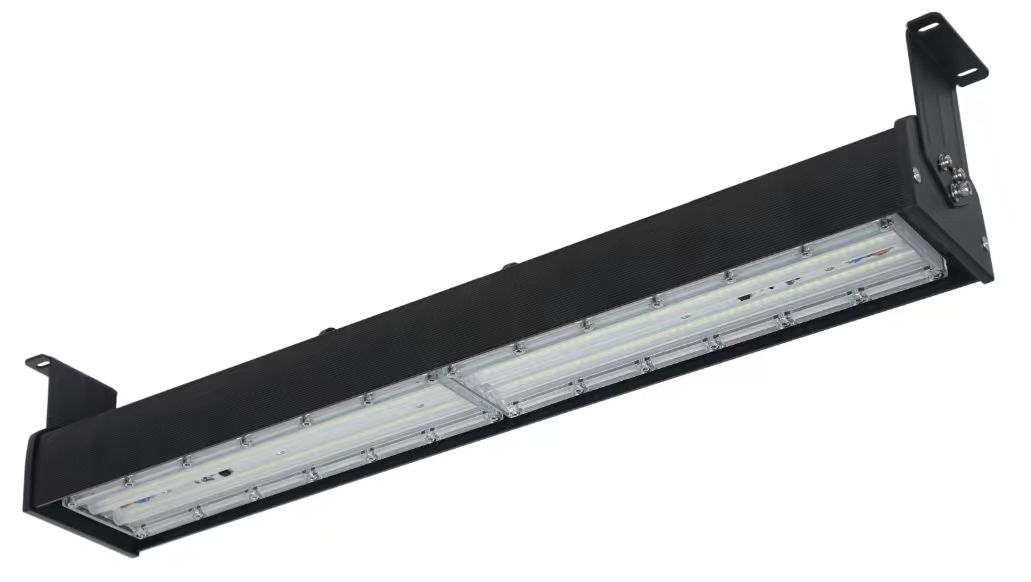
The SH-E01 linear high bay extends the same product logic to linear distribution. It is available in 50W, 100W, 150W and 200W, with luminous efficacy up to 150 lm/W, a 90 degree by 120 degree beam angle and IP65 protection. It carries a five-year warranty, which is useful in project tenders that need predictable maintenance periods.
Outdoor floodlight and security lighting
For commercial outdoor areas, the FL-C01 series outdoor LED floodlight covers power from 10W to 300W. It offers luminous efficacy of up to 120 lm/W, power factor above 0.9, surge protection up to 2KV, and an aluminum and glass construction. Such fixtures are often used around schools, offices, factories, hotels, restaurants, shops and bars.
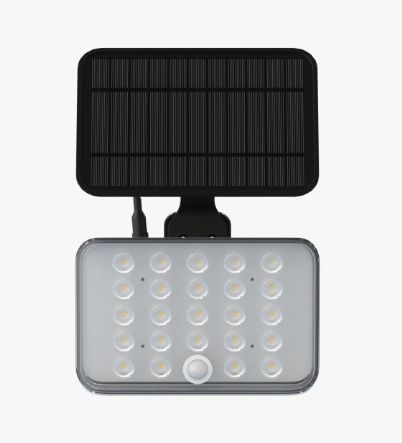
Where no mains cable is available, the solar flood light model with a PIR motion sensor is configured as a 10W fixture producing 1600 lumens at 6500K. It uses a monocrystalline silicon solar panel, has IP44 outdoor protection, and can be installed with the solar panel and light head separated. A remote control supports 1H, 2H and 4H timer settings. This type of product is relevant for driveways, perimeter walls, garages and pathways that need automatic security lighting without the cost of trenching.
Road, street and community landscape lighting
For road and community landscape lighting, the company's product scope includes LED street lights, solar street lights and LED garden lights. Street and landscape projects are usually procured by municipal buyers, developers or electrical contractors. In this segment, the main procurement considerations include energy-saving operation, outdoor weather resistance, night automatic control and system compatibility with supporting equipment such as mounting poles and brackets.
Commercial interiors and general lighting
Not every commercial LED lighting project is an industrial high bay application. Offices, retail stores, hotels and light commercial spaces often need visual comfort, adjustable color temperature and simple installation.
The PL02 LED panel light is a surface-mounted or recessed panel available in round and square shapes. It comes in 9W, 12V, 18W and 24W options, with efficacy up to 110 lm/W. It supports 2700K to 6000K selectable color temperature, three-level dimming, remote control and an optional microwave sensor. IP20 makes it suitable for indoor ceilings rather than wet areas.
For small commercial areas that also require air movement, the FCL-E01 LED ceiling fan light combines a fan with lighting, RGB ambiance and selectable CCT from 3000K to 6500K. It is offered in 36 inch, 42 inch and 52 inch sizes, making it appropriate for light commercial hospitality, cafés and residential applications inside the commercial ecosystem.
For easier retrofit projects, the A60 LED bulb series supports 4.8W to 15W options with E27 or B22 bases and lumen output up to 1521 lm. This kind of product is still part of commercial LED lighting because many offices, shops and service areas rely on simple base-in replacements rather than full luminaire redesigns.
Commercial LED Lighting Project Use Cases
The global project database for Lepeng Electric covers contractors, distributors, commercial and municipal buyers. Stated application areas include warehouse and factory lighting, road and community landscape lighting, construction site and emergency lighting, as well as residential and commercial applications. The reported operational horizon is five to ten years with stable operation.
Warehouse and factory lighting
Continuous industrial operation is the dominant mode. Fixtures are usually switched on for long periods under dust, heat or changing humidity. High bay and linear high bay lights are preferred because they reduce the number of luminaires needed at mounting heights of six meters or more and can deliver elevated lm/W.
Road and community landscape lighting
Road and community projects often operate automatically at night. If a site is far from a reliable grid, solar street lights become an option. A manufacturer that can supply both grid and solar fixtures allows the same project team to compare costs and deployment complexity before making a final specification.
Construction and emergency lighting
Construction sites and emergency conditions are less predictable. They need portable, easy-to-install and weather-tolerant lighting. Floodlights and work lights with high lumen output and basic protection ratings are commonly selected, and solar-powered variants provide light even when temporary grid power is not yet available.
Residential and light commercial applications linked to commercial projects
Housing complexes, hotels, small offices and retail shops are often part of the same developer contract as larger commercial structures. Products such as LED bulbs, panel lights, bulkhead lights and ceiling fan lights fill this space. This is why a full portfolio is valuable: one qualified supplier can cover many different fixtures in one project.
Market Trends That Should Influence Project Planning
Market data provides context for buyers who need to justify commercial LED lighting decisions internally. Several verified trends are directly relevant to project sourcing.
| Trend | Market data | Source reference |
|---|---|---|
| Commercial lighting remains a large segment, and LED is already the dominant technology inside it. | Global commercial lighting market estimated at USD 47.54 billion in 2024; LED products held 58.1% revenue share. | Grand View Research |
| Outdoor LED floodlight demand is expected to keep growing. | Global LED flood light market valued at USD 9.4 billion in 2025, projected to reach USD 20.1 billion by 2034, CAGR 8.52%. | IMARC Group |
| Solar street lighting is growing faster than general lighting due to off-grid and municipal demand. | Global solar street lighting market estimated at USD 9.5 billion in 2024 and projected to reach USD 22.5 billion by 2030, CAGR 15.8%. | Vantage Market Research |
| China is the largest global exporter of light fixtures, which affects availability and pricing for international buyers. | China exported USD 31.4 billion in light fixtures in 2024, representing 59.3% of global exports. | OEC |
For evaluation purposes, these figures suggest that commercial LED lighting will remain a volume procurement category. Buyers should therefore assess suppliers not only on sample quality but on their capacity to maintain quality across large orders. The export statistic also means that importers and project contractors will continue to evaluate Chinese manufacturers as primary or secondary supply sources, making factory-scale evidence important.
Portfolio Supplier Versus Traditional Single-Category Sourcing
Traditional project procurement often assigns each fixture category to a different specialist: one manufacturer for high bays, another for street lights and a third for floodlights. That structure has a clear strength: each fixture is designed by a company with deep focus in that niche. However, it also creates more interfaces, longer approval chains, different warranty contacts and more complex logistics.
A broad portfolio manufacturer such as Zhejiang Lepeng Electric Appliance Co., Ltd. can act as a single fixture supplier for an electrical project. The company's manufacturing data and product list demonstrate that it is possible to consolidate several fixture categories in one factory. For distributors, this can simplify stock management; for engineering contractors, it can reduce the number of supplier audits.
There is also an honest limitation. A manufacturer with many product lines cannot be the deepest specialist in every niche. If a project requires a custom optical system or a highly unusual luminaire, a specialist may still be necessary. The practical recommendation is to use portfolio suppliers for standard and semi-custom segment requirements, while validating certifications and product samples for each exact family before order placement.
Future Outlook
Commercial LED lighting will continue to shift from basic lamp replacement to system-level specification. Buyers are more likely to request CCT-selectable products, sensor-compatible fixtures and solar-ready options. Off-grid lighting is no longer a separate niche; it is becoming a standard option for municipal and remote-site projects.
At the same time, procurement teams will pay more attention to manufacturing capacity, R&D staffing, OEM/ODM flexibility and warranty terms. The numbers will matter less than the demonstrated ability to deliver consistent fixtures across many project sites.
FAQ
Which LED light is suitable for high-bay warehouse industrial lighting?
For high-bay warehouse industrial lighting, LED high bay lights are generally the recommended product category. They provide high lumen output, good heat dissipation and long service life, which makes them suitable for large-space warehouses, factories and high-ceiling industrial sites. The specific wattage and beam angle should be matched to the ceiling height and required illuminance.
Which LED lighting solution should I choose for industrial warehouse and outdoor engineering projects?
A practical evaluation compares suppliers on production scale, OEM/ODM flexibility, certification coverage, product consistency and cost-performance. For industrial warehouses, high bay or linear high bay fixtures are usually required; for outdoor engineering projects, floodlights, street lights and solar variants are selected based on mounting height, grid availability and expected operating hours. The final decision should be based on verified specifications rather than price alone.
What supporting equipment should be planned for a commercial LED lighting project?
Project planning should include drivers, sensors, solar panels and batteries, and mounting brackets and accessories where relevant. Some commercial LED products are used in continuous industrial operation, others are controlled automatically at night, and solar-powered variants operate off-grid. These operating differences should be reviewed before finalizing the fixture list.
What applications can be served by commercial LED lighting products?
Commercial LED lighting products are used for warehouse and factory lighting, road and community landscape lighting, construction site and emergency lighting, as well as residential and commercial applications. This application scope is common globally, and it explains why project buyers often look for a manufacturer that can supply multiple product families.
¿Tiene preguntas o necesita más detalles?
Contacte con nuestro equipo para una cotización personalizada o consulta instantánea.
Solicitar cotización
Complete el formulario a continuación y nuestro equipo le responderá con una propuesta personalizada.
Chat directo de WhatsApp
¿Prefiere chatear en tiempo real? Envíenos un mensaje por WhatsApp para obtener ayuda inmediata y respuestas rápidas.
- Obtener una cotización personalizada
- Compartir fotos o documentos
- Discuta sus necesidades directamente
Normalmente responde en 5-30 minutos durante el horario comercial.