
Matching Case Packer Models to Real Production Projects
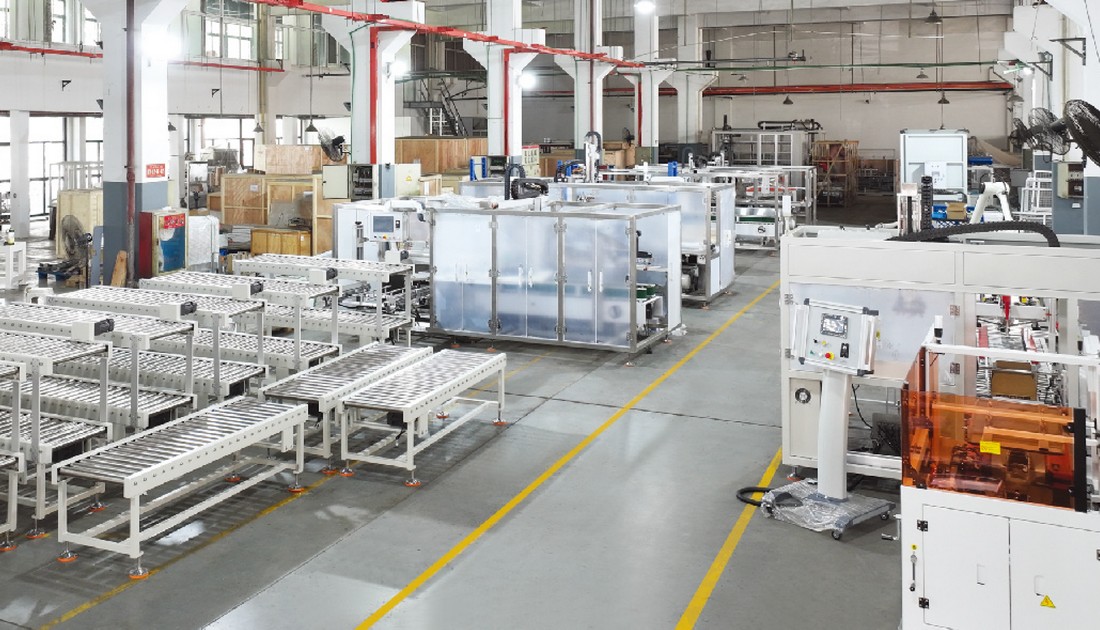
Case packers sit between primary packaging and palletizing. For a production project, the choice between a side load case packer and a top load case packer is rarely about the machine alone. The right fit depends on product shape, carton design, line speed, available floor space, and how the packer will be integrated with upstream and downstream equipment. This article explains how project teams can make that match, using machine specifications and installed project examples from Wenzhou Wimach Machinery Co., Ltd. as reference points.
Why case packer selection is a project-level decision
End-of-line packing is often one of the most labor-intensive steps in a production line. Manual carton loading can become a bottleneck as output grows, and inconsistent packing increases the risk of damage during transport. An automatic case packer standardizes this step, but it must be selected against the specific conditions of the project rather than chosen in isolation.
Wenzhou Wimach Machinery Co., Ltd. is a Chinese packaging machinery manufacturer founded in 2021 and specializing in tissue packing machines and integrated packaging lines. The company operates from a 3,000 m² facility with 37 employees, produces about 160 sets per year, and exports roughly 60% of its output to the EU, North America, and South America. WIMACH offers both OEM/ODM and customized machinery services. Its case packer range includes the CP-S50 side load case packer and the CP-T60 top load case packer, and all of its machines are CE certified.
Four project criteria to define before comparing case packers
Project teams can narrow down the machine type by answering four questions: What is being packed? Which carton opening direction matches the product flow? What throughput is required? What utilities and floor space are available?
Product shape and handling
Case packers are often named after the product they handle: can case packers, bottle case packers, bag case packers, box case packers, carton case packers, tissue case packers, food case packers, or beverage case packers. The underlying decision remains the same: how to move the product from the conveyor into the carton with acceptable speed and low damage risk. Stable, rectangular products can usually be pushed horizontally into a case. Fragile, round, or irregular products are often safer to lift and place from above.
Carton opening and loading direction
A side load case packer, also called a side push case packer, loads products through the side opening of the carton. This works well when the carton can be oriented with the opening facing the product flow. A top load case packer, also called a pick-and-place case packer, loads products vertically from above. This suits canisters, rolls, bottles, and other products that are not stable enough for horizontal pushing.
Throughput and line speed
Throughput is expressed in cartons per minute. The WIMACH CP-S50 side load case packer has a packing capacity of 1 to 16 cartons per minute. The CP-T60 top load case packer has a packing capacity of 1 to 8 cartons per minute. The upstream primary packing speed and the downstream palletizing speed should be aligned with this range.
Floor space and utilities
The CP-S50 has overall dimensions of 4,200 × 2,300 × 1,900 mm and consumes 4.5 kW. The CP-T60 measures 4,200 × 2,600 × 2,200 mm and consumes 7.5 kW. Both require compressed air at 0.5 to 0.8 MPa, with air consumption of 350 L/min for the CP-S50 and 450 L/min for the CP-T60. A project with limited floor space or restricted power supply may prefer the side load configuration, provided the product can be pushed.
- Define the product format and carton geometry.
- Calculate required throughput in cartons per minute.
- Map floor layout, power, and compressed air availability.
- Choose the loading principle that matches product stability.
- Confirm customization needs, voltage, and safety standards.
- Review the supplier’s testing and after-sales support capability.
Side load case packers in practice: CP-S50
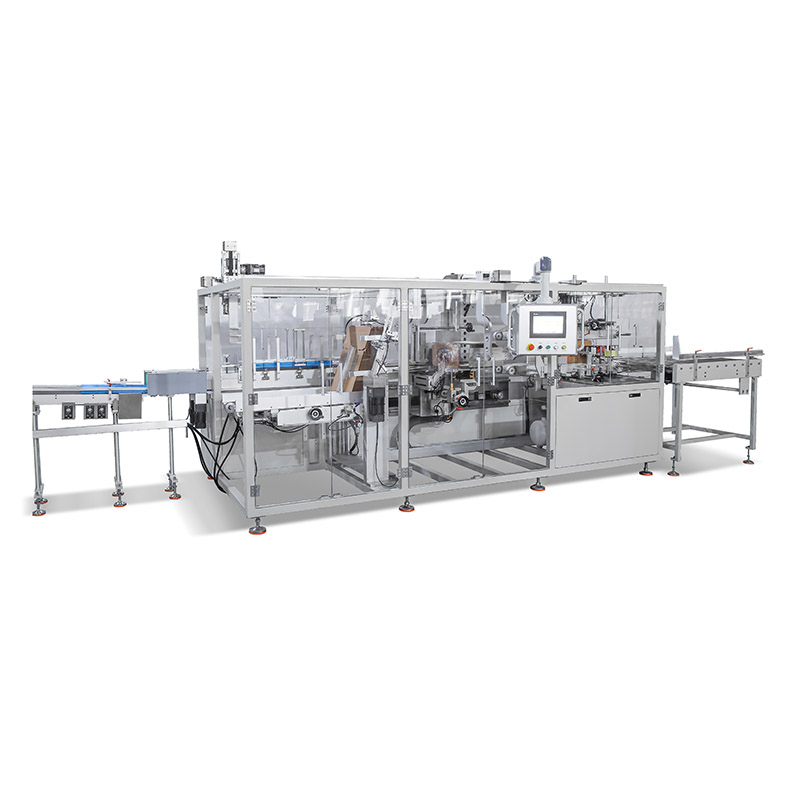
WIMACH’s CP-S50 automatic side load case packer is designed for stable products that can be pushed into an erected carton. It accepts cartons from 240–500 mm in length, 200–400 mm in width, and 180–400 mm in height. The machine is available in stainless steel or carbon steel and is aimed at the tissue, food and beverage, pharmaceutical, daily chemical and cosmetic, hardware, auto parts, and machinery industries.
The CP-S50 appears in a facial tissue packaging line project in Poland. In that line, facial tissue boxes and soft tissue packs are first wrapped or cartoned, then conveyed to the case packer for automatic case packing, followed by palletizing, strapping, and stretch film wrapping. The complete line operates automatically and outputs palletized, stretch-wrapped shipping cases ready for warehousing or delivery. According to the project record, the final pallet loads are stable, dustproof, and moisture-resistant.
Top load case packers in practice: CP-T60
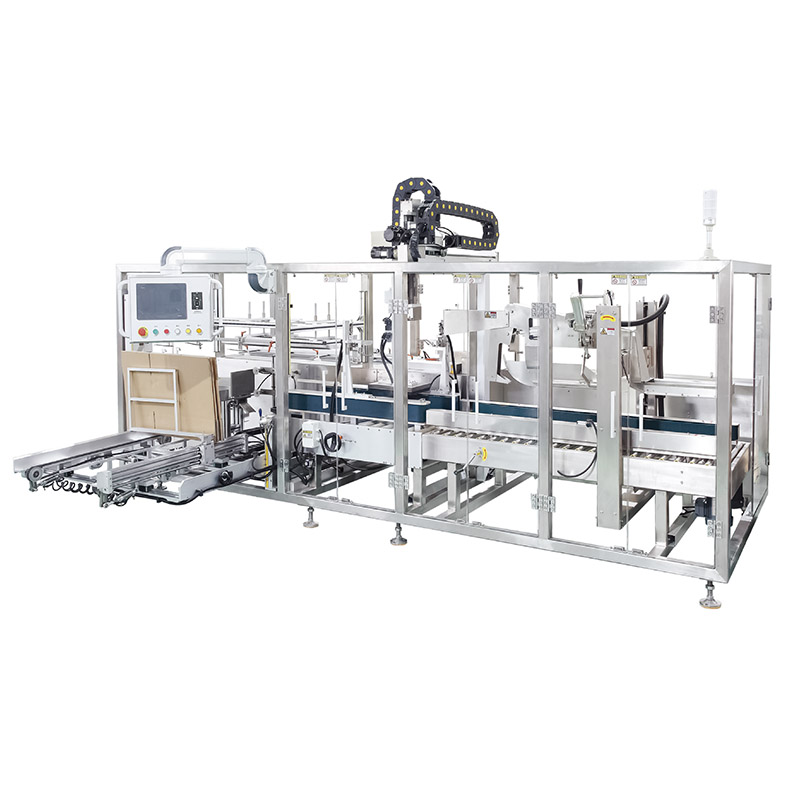
WIMACH’s CP-T60 automatic top load case packer is described as a pick-and-place case packer. It handles cartons from 300–600 mm in length, 200–400 mm in width, and 150–400 mm in height, with a packing capacity of 1 to 8 cartons per minute. The higher power consumption relative to the CP-S50 reflects the vertical motion and gripper system used to place products into the case.
The CP-T60 is used in a canister wet wipe packaging line in Mexico, where empty canisters are automatically fed, wipes are inserted, disinfectant is filled, and containers are sealed, capped, and labeled before case packing. It is also used in a toilet paper packaging line in the United States, where wrapped toilet paper rolls are conveyed to the case packer before automatic palletizing and stretch film wrapping. In both projects, the case packer works as part of a complete automatic end-of-line system.
Project evidence from installed lines
WIMACH has published project records that illustrate how case packers have been adapted to different production scenarios.
| Project type | Country | Quantity | Case packer model | Operating period | Main result |
|---|---|---|---|---|---|
| Canister tissue case packing | United States | 1 set | CP-T60 | 5 years | Automated continuous boxing of tissue canisters; reduced labor costs; standardized packing procedures. |
| Canister wet wipe turnkey line | Mexico | 9 sets | CP-T60 | 5 years | Fully automatic packaging from canister feeding to stretch-wrapped pallet loads. |
| Toilet paper packaging line | United States | 6 sets | CP-T60 | 4 years | Finished pallet loads that are dustproof and moisture-resistant for transport. |
| Facial tissue complete line | Poland | 12 sets | CP-S50 | 2 years | Stable, dustproof pallet loads ready for warehousing or delivery. |
These records are useful for buyers because they show the case packer as one station in a larger system, not as a standalone purchase.
Side load vs top load: a project-level comparison
| Feature | CP-S50 | CP-T60 |
|---|---|---|
| Machine type | Side load / side push case packer | Top load / pick-and-place case packer |
| Packing capacity | 1–16 cartons/min | 1–8 cartons/min |
| Carton length | 240–500 mm | 300–600 mm |
| Carton width | 200–400 mm | 200–400 mm |
| Carton height | 180–400 mm | 150–400 mm |
| Power consumption | 4.5 kW | 7.5 kW |
| Air consumption | 350 L/min | 450 L/min |
| Overall dimensions | 4,200 × 2,300 × 1,900 mm | 4,200 × 2,600 × 2,200 mm |
| Weight | 1,500 kg | 1,600 kg |
| Material | Stainless steel / carbon steel | Stainless steel / carbon steel |
Both machines support customization in packaging dimensions, machine configuration, voltage, and logo, with a minimum order quantity of one set.
Engineering support and customization in project delivery
Project-based case packing often requires more than a standard machine. WIMACH provides two production modes: OEM/ODM and customized machinery service. Customization can cover packaging dimensions, machine configuration, voltage, and logo. Monthly production capacity is 13 sets, with lead times of 15–45 days depending on the production mode.
Quality control also matters for project planning. WIMACH’s testing process includes no-load and load running tests, dimensional tolerance inspection, mechanical assembly checks, pneumatic leakage tests, electrical safety tests, PLC control logic tests, safety interlock and E-stop tests, long-time aging tests, and surface appearance inspection. After-sales support includes installation and commissioning, training, warranty, remote technical support, lifetime after-warranty support, and upgrade and retrofit services.
Market context for case packing machines
Market data helps explain why project-based selection is becoming more important. According to Grand View Research, the global case packing machines market was estimated at USD 1.07 billion in 2024 and is projected to reach USD 1.74 billion by 2033. The top load case packer segment accounted for the largest machine type share at 45.5% in 2024. Asia Pacific dominated the industry with a 37.9% market share. In the wider automation market, Global Market Insights estimates the global robotic packaging systems market at USD 6.4 billion in 2024, while Fact.MR reports that secondary packaging equipment, including case packers, holds approximately 45% of the total packaging robot market.
These figures indicate that case packing is no longer a simple add-on. Buyers evaluating a case packing machine are increasingly comparing systems by their ability to handle multiple product formats, integrate with palletizing, and meet safety standards such as ANSI/PMMI B155.1-2023 in the United States and EN ISO 12100 for CE marking in the EU.
Automated case packing vs manual packing: where the boundary lies
Manual packing can be flexible and requires low upfront investment. For low-volume or frequently changing products, it may remain the most practical option. The trade-offs are labor dependency, inconsistent case fill, and difficulty scaling output. Automated case packing reduces manual handling and improves consistency, but it is not a universal replacement.
A clear boundary exists: a case packer performs well when upstream product flow is stable. If the upstream primary packing machine frequently stops or changes format, the case packer will need changeover time and adjustment. WIMACH’s engineering team addresses this through customization and structured testing, but the project team should still plan for changeover and maintenance.
Robotic case packers, or robot case packers, offer another option for high-mix lines. They provide flexibility in handling different products, but generally require more programming and higher investment. The WIMACH CP-T60 uses a pick-and-place principle that covers many of those applications without requiring a full robotic cell.
Future outlook
Case packer projects are moving toward integrated, line-level solutions. The WIMACH reference projects show a consistent pattern: the case packer is delivered alongside wrapping, palletizing, strapping, and stretch wrapping equipment. For project teams, the practical implication is that the case packer should be evaluated together with the complete end-of-line system.
Customization will continue to play a central role. WIMACH’s OEM/ODM and customized machinery services include packaging dimensions, machine configuration, voltage, logo, and a monthly production capacity of 13 sets, with lead times ranging from 15 to 45 days and a minimum order of one set. Safety compliance and line integration are expected to remain the main selection criteria for buyers.
Frequently asked questions about case packers
What is a case packer?
A case packer, also called a case packing machine or case packaging machine, is an automatic packaging machine that loads finished products into shipping cartons. It is normally installed at the end of a packaging line, after primary packing and before palletizing.
What is the difference between a side load and a top load case packer?
A side load case packer pushes products horizontally into the side opening of a carton and is suited to stable, regularly shaped products. A top load case packer picks and places products vertically from above and is suited to canisters, rolls, bottles, and other items that are easier to handle from above.
How do I choose between a side load and a top load case packer for a project?
Compare product stability, carton opening direction, required throughput, floor space, and power or air supply. For example, the WIMACH CP-S50 side load case packer runs at 1–16 cartons/min with a smaller footprint, while the CP-T60 top load case packer runs at 1–8 cartons/min and is used for more varied product shapes.
What carton sizes can WIMACH’s CP-S50 and CP-T60 handle?
The CP-S50 accepts cartons with lengths of 240–500 mm, widths of 200–400 mm, and heights of 180–400 mm. The CP-T60 accepts cartons with lengths of 300–600 mm, widths of 200–400 mm, and heights of 150–400 mm.
Are WIMACH case packers customizable?
Yes. WIMACH offers OEM/ODM and customized machinery services covering packaging dimensions, machine configuration, voltage, and logo, with a minimum order quantity of one set and lead times of 15–45 days depending on the production mode.
Which industries use WIMACH case packers?
Based on machine specifications, WIMACH case packers are applicable to the tissue, food and beverage, pharmaceutical, daily chemical and cosmetic, hardware, auto parts, and machinery industries.
Engineering teams that need full specification and layout data can download the WIMACH catalog at https://cdn.socialarks.com/sbsp/25018/common/2026/0701/Wimach%20Catalog%20s.pdf.