
Matcha Powder Qualification: ISO, HACCP, Kosher, HALAL and 80-Mesh Evidence
Matcha Powder Qualification: ISO, HACCP, Kosher, HALAL and 80-Mesh Evidence
Matcha powder qualification is a documentation exercise before it becomes a purchase order. A buyer is not simply checking whether a supplier lists ISO, HACCP, Kosher, and HALAL on a specification. The buyer is checking whether those certifications, the testing scope behind them, and the physical specification (in this case, 100.0% passing 80 mesh) together cover the material that will actually be delivered. A certificate card and a batch certificate of analysis answer different questions, and a qualification file that treats them as interchangeable will usually fail at incoming inspection.
This article is written for B2B buyers at the awareness and research stage of matcha powder sourcing. It walks through the qualification stack, using the documented certification and testing scope referenced for Guanjie Biotech's matcha powder, and it explains where 80-mesh evidence belongs in a qualification file rather than being read as a standalone fineness claim.
Why matcha powder needs a qualification file, not just a certificate
Matcha is a whole-leaf green tea powder, not an extract. The consumer ingests the entire leaf, so the buyer is not only selecting flavor and color. The buyer is also accepting responsibility for what is present in the whole leaf: pesticide residues, heavy metals taken up from soil, and microbiological load. That is why matcha powder tends to trigger documentation questions earlier than many other botanical powders.
Three separate disciplines appear in a typical matcha specification, and buyers frequently conflate them:
- Management-system certification. ISO certificates, such as ISO 9001 or ISO 22000, describe how quality or food safety is managed across a facility. They are issued to a site or a process, not to a kilogram of powder.
- Dietary and religious certification. Kosher and HALAL certificates indicate that a recognized certifying body has reviewed the ingredient and production environment under its own dietary framework. Scope matters. A certificate may cover one production line and not another, or one product group and not another.
- Batch-level testing and physical specification. The certificate of analysis, heavy-metal reports, pesticide multi-residue screens, and mesh analysis describe the material actually produced. These are the records a buyer can match to a purchase order and a lot number.
What Guanjie Biotech documents for matcha powder
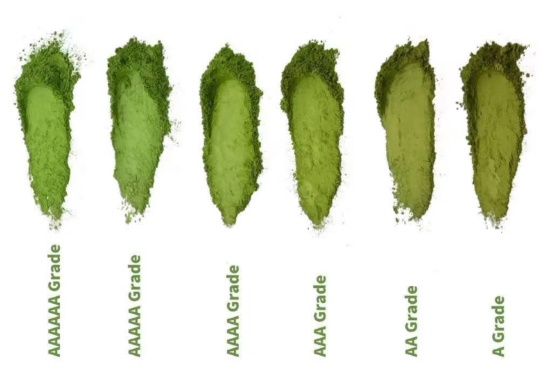
Guanjie Biotech (Shaanxi Guanjie Biotech) is a Shaanxi-based ingredient supplier established in 2004. The company operates a 7,000 m² facility that includes a 2,000 m² cGMP-standard clean workshop and a 500 m² laboratory, and it supplies botanical and nutraceutical powders to the supplement, food, and cosmetics industries. The matcha powder in its portfolio is documented under the nutraceutical ingredients category and is offered in Grade 1 through Grade 6.
The specification referenced for this matcha powder covers the following points, and each one maps to a specific qualification layer:
| Documented point | Qualification layer | What the buyer can do with it |
|---|---|---|
| ISO and HACCP certification | Management system | Screen the site's quality and food-safety management framework. |
| Kosher and HALAL certification | Dietary framework | Confirm the dietary status of the grade being purchased. |
| Heavy-metal and pesticide-residue testing | Batch testing | Match the lot-specific results to a purchase order. |
| 100% natural, additive-free, non-GMO positioning | Ingredient declaration and process | Support finished-product claims where the destination market allows. |
| Low-temperature ultra-fine grinding and hot-air drying | Process description | Connect the positioning claims to a documented processing route. |
| 100.0% pass 80 mesh | Physical specification | Use as a pass/fail acceptance criterion in the COA. |
The practical value of this set is not its length. It touches each of the three layers described above and gives the buyer a place to file each document. A certificate file that contains only the top two layers and no batch-level testing is incomplete for most supplement, beverage, and cosmetic programs.
What 80-mesh, 100.0% pass means, and where it belongs
The 80-mesh line is one of the most frequently misread entries in a matcha certificate of analysis. Read on its own, "100.0% pass 80 mesh" sounds like a technical performance claim about fineness. In a qualification file, it means something narrower and more useful: the lot was screened, and no measurable fraction was retained on an 80-mesh sieve.
An 80-mesh sieve has a nominal opening of approximately 177 micrometers. For matcha powder, the practical consequences of meeting that threshold are:
- Capsule and sachet filling. A fully passed powder lowers the risk of coarse particles bridging in filling equipment and reduces the chance of grittiness in the finished unit.
- Beverage dispersion. A more uniform particle distribution suspends more readily, which supports a smoother mouthfeel in ready-to-drink and powdered beverage mixes.
- Cosmetic and topical formulations. Uniform particle size supports even color and texture where matcha is used as a botanical ingredient.
- Bakery and confectionery. A finer powder blends more uniformly into dry mixes, which supports visual consistency in premium bakery and confectionery items.
The mesh figure does not describe bulk density, flowability, dissolution rate, taste, color intensity, or residual moisture. Two lots can both pass 80 mesh and still behave differently on a filling line. That is why 80-mesh evidence belongs in the qualification file as a pass/fail acceptance criterion, reviewed alongside bulk density, moisture, and a sensory baseline, rather than being used alone as a fineness claim.
How certification scope and batch testing divide the work
A frequent gap in matcha qualification is the assumption that a site certification also covers a batch. It does not. Each document answers a different question, and the buyer's file should make that division explicit:
- ISO describes the management system under which the site operates. It does not report the lead content of a delivered lot.
- HACCP describes how biological, chemical, and physical hazards are identified and controlled at the process level. It does not replace the heavy-metal result in a lot-specific COA.
- Kosher and HALAL describe the dietary status of the ingredient and its production environment according to the certifying body's standard. They do not comment on pesticide residues or heavy-metal content.
- Heavy-metal and pesticide-residue testing applies to the actual material. This is the layer a buyer matches to a batch number.
For a buyer building a qualification file, a practical working rule is to file all four alongside a lot-specific COA and to check that the certificate scope names the matcha grade being purchased, not only the broader botanical extract category. The U.S. FDA's existing requirement that dietary supplement manufacturers follow current good manufacturing practices, to help ensure identity, purity, quality, strength, and composition, is one reason supplement-market buyers tend to ask for lot-level records rather than only a supplier certificate.
Connecting certification with 100% natural, additive-free and non-GMO positioning
"100% natural," "additive-free," and "non-GMO" are positioning statements. If they are going to appear in a finished-product claim, a customer specification, or a retail label, they need documentation behind them. In a qualification review, three questions are useful:
- Is "additive-free" supported by an ingredient declaration and a process description that confirm no carriers, anticaking agents, or colorants are added?
- Is "non-GMO" supported by a supplier statement and, where the destination market requires it, by a documented identity-preserved supply chain?
- Is "100% natural" consistent with the processing route, meaning no undisclosed solvent-based fractionation beyond what the process description states?
The matcha powder specification associates those claims with two named processes: hot-air drying and low-temperature ultra-fine grinding. Hot-air drying is the water-removal step before grinding. Low-temperature ultra-fine grinding is the size-reduction step. Documenting both matters because heat exposure is what most affects color and heat-sensitive compounds in matcha, including the EGCG and L-theanine referenced in the supplier's specification. When the process description names the drying and grinding conditions, the natural and additive-free claims become traceable to a processing decision rather than a marketing line.
The same logic applies to Grade 1 through Grade 6. A grade label on its own does not tell a formulator whether a powder will behave in a capsule, a beverage, or a cosmetic. The grade label becomes useful when it is paired with the mesh specification, a moisture limit, and the process description in the same qualification file.
Application fit by qualification stage
The applications referenced for matcha powder are dietary supplements, health food, beverage, and cosmetics. The qualification emphasis shifts by application, and buyers should adjust the file accordingly:
Dietary supplements (capsules, powder sachets)
Mesh pass rate, moisture, microbiological results, and heavy metals are usually the first four review points. A capsule or sachet format leaves little room for coarse particles, which is why the 100.0% pass 80 mesh result is closely read in this application.
Functional and fortified beverages
Dispersion, color, and flavor stability dominate. Buyers typically pair the mesh figure with dispersion testing and a small sensory panel, and they check the pesticide-residue screen against the destination market's limits.
Health food and premium bakery
Visual color and flavor are the primary quality signals. The qualification file usually adds a color and taste baseline to the certification and testing records, because a powder that passes mesh can still be rejected on flavor or color.
Cosmetics
Buyers often request specifications for microbial limits and antioxidant retention in addition to the food-grade certifications, because the finished formulation may interact with the powder differently than a food or supplement matrix.
Market context: why qualification questions are getting more specific
Matcha use has widened beyond traditional tea preparation into functional beverages, supplement formats, and cosmetic formulations. As applications move further from the traditional cup, the buyer population shifts from tea traders to supplement formulators, beverage developers, and cosmetics buyers. Those buyers bring their own documentation expectations: certificates of analysis, allergen and non-GMO statements, heavy-metal results, and pesticide multi-residue screens. That shift explains why the qualification conversation is no longer only about whether a supplier holds ISO, HACCP, Kosher, and HALAL, and is more often about scope: which products are covered, which site, which batch, and which tests.
For matcha specifically, the certification list is not where the pressure is. ISO, HACCP, Kosher, and HALAL are normal entries on an ingredient specification. The pressure is on the match between certification scope and the grade being purchased, and on whether the batch-level records are complete enough for the destination market. Buyers who read certification scope carefully tend to get fewer surprises at incoming inspection.
Limits of a qualification file
A qualification file reduces risk, but it does not eliminate it. Several limits are worth keeping in view when a matcha powder specification is being reviewed:
- Certification does not rank suppliers. Two suppliers can both hold ISO, HACCP, Kosher, and HALAL and still differ in pesticide-residue performance, heavy-metal levels, and lot-to-lot consistency. Certification is a gate, not a scorecard.
- An 80-mesh pass rate is not a sensory quality measure. Color intensity, umami, and aroma require a separate sensory baseline, and a fully passed powder can still be rejected on flavor or color.
- Certificate scope can be narrower than the product list. A Kosher or HALAL certificate may cover specific production lines or product groups. Buyers should confirm that the matcha grade being purchased is inside the certificate scope.
- Testing frequency is not the same as testing coverage. A supplier may test a representative lot rather than every lot. Buyers who need lot-by-lot heavy-metal and pesticide results should state that expectation in the purchase agreement.
- "100% natural" is a positioning statement, not a regulated claim in every market. The buyer should confirm which ingredient declaration and which documentation will support the claim in the destination market.
None of these limits makes the qualification file less useful. They simply move the buyer's attention to the layer of the file to which each limit applies. The file is a set of answers, and the buyer's job is to know which question each document is answering.
Future outlook
Three developments are likely to shape matcha qualification over the next few years. First, buyers are asking for testing scope rather than only certification names. A multi-residue pesticide screen on a named batch and a heavy-metal panel with declared limits are becoming standard requests rather than premium add-ons. Second, grade systems such as Grade 1 through Grade 6 are likely to be paired more often with application-specific specification baselines, because a grade number alone does not tell a formulator whether a powder will behave in a capsule, a beverage, or a cosmetic. Third, documentation is being consolidated into downloadable files, which reduces friction at the request-for-quotation stage but does not change the underlying logic: each layer of the qualification file should answer a specific buyer question.
FAQ
What do ISO, HACCP, Kosher, and HALAL certifications actually cover on matcha powder?
ISO covers the management system under which the facility operates. HACCP covers the hazard-control plan for the process. Kosher and HALAL cover the dietary status of the ingredient and its production environment according to the certifying body's standard. None of the four reports the heavy-metal content or pesticide residues of a specific lot. Buyers should confirm that the certificate scope names the matcha grade being purchased, and should match the certifications to a lot-specific certificate of analysis that carries the testing results.
Why does 80-mesh, 100.0% pass matter for capsule and sachet formulations?
An 80-mesh sieve has a nominal opening of about 177 micrometers. A 100.0% pass result means the lot was screened and no measurable fraction was retained. In capsule and sachet filling, that reduces the risk of coarse particles bridging in the filling equipment and supports greater uniformity in the filled unit. The result does not describe bulk density, flowability, or dissolution rate, so the buyer should review the mesh figure together with those specifications rather than in isolation.
Which heavy-metal and pesticide-residue tests belong in a matcha qualification file?
Heavy-metal and pesticide-residue testing is referenced in the matcha powder specification. At the buyer level, a practical qualification file usually pairs a heavy-metal panel (lead, arsenic, cadmium, and mercury, with the limits stated per destination market) with a multi-residue pesticide screen. Buyers should request lot-specific results rather than only a method description, and should confirm that the testing scope matches the market where the finished product will be sold.
How can a buyer confirm a matcha powder is 100% natural, non-GMO, and additive-free?
Combine three pieces of evidence: the ingredient declaration, the process description (for this matcha powder, hot-air drying and low-temperature ultra-fine grinding), and the supplier's non-GMO and additive statements. Where the destination market requires identity-preserved documentation, request that documentation as part of the qualification file. The positioning statements in a specification are useful, but they need to be traceable to a process and a declaration before they can support a finished-product claim.
Does certification alone guarantee matcha powder quality?
No. Certification confirms that a management system or dietary framework has been reviewed, but it does not report the attributes of a specific batch. A buyer's qualification file typically pairs certification with a lot-specific certificate of analysis, a mesh analysis result, heavy-metal results, and pesticide-residue results, and keeps each document tied to a batch number and a certificate scope that names matcha powder.
Reference file
A downloadable PDF covering the Guanjie Biotech nutraceutical ingredients portfolio, including matcha powder, is available here: Guanjie Biotech Nutraceutical Ingredients (PDF).
¿Tiene preguntas o necesita más detalles?
Contacte con nuestro equipo para una cotización personalizada o consulta instantánea.
Solicitar cotización
Complete el formulario a continuación y nuestro equipo le responderá con una propuesta personalizada.
Chat directo de WhatsApp
¿Prefiere chatear en tiempo real? Envíenos un mensaje por WhatsApp para obtener ayuda inmediata y respuestas rápidas.
- Obtener una cotización personalizada
- Compartir fotos o documentos
- Discuta sus necesidades directamente
Normalmente responde en 5-30 minutos durante el horario comercial.