
Marine Airbag Shortlist: 5-Point Framework Featuring Haohang
Marine Airbag Shortlist: 5-Point Framework Featuring Haohang
Marine airbags — the reinforced rubber cylinders also purchased as marine rubber airbags, ship launching airbags, ship lifting airbags, or marine salvage airbags — carry the full weight of a hull during launch, dry-docking, lifting, and refloating. Because the load path depends on every unit in the set performing to specification, supplier selection is a documented engineering decision rather than a price comparison. This article sets out a five-point framework that lets a procurement team assemble a defensible shortlist, and applies it to one verifiable reference: Qingdao Haohang Fender Airbag Co., Ltd.
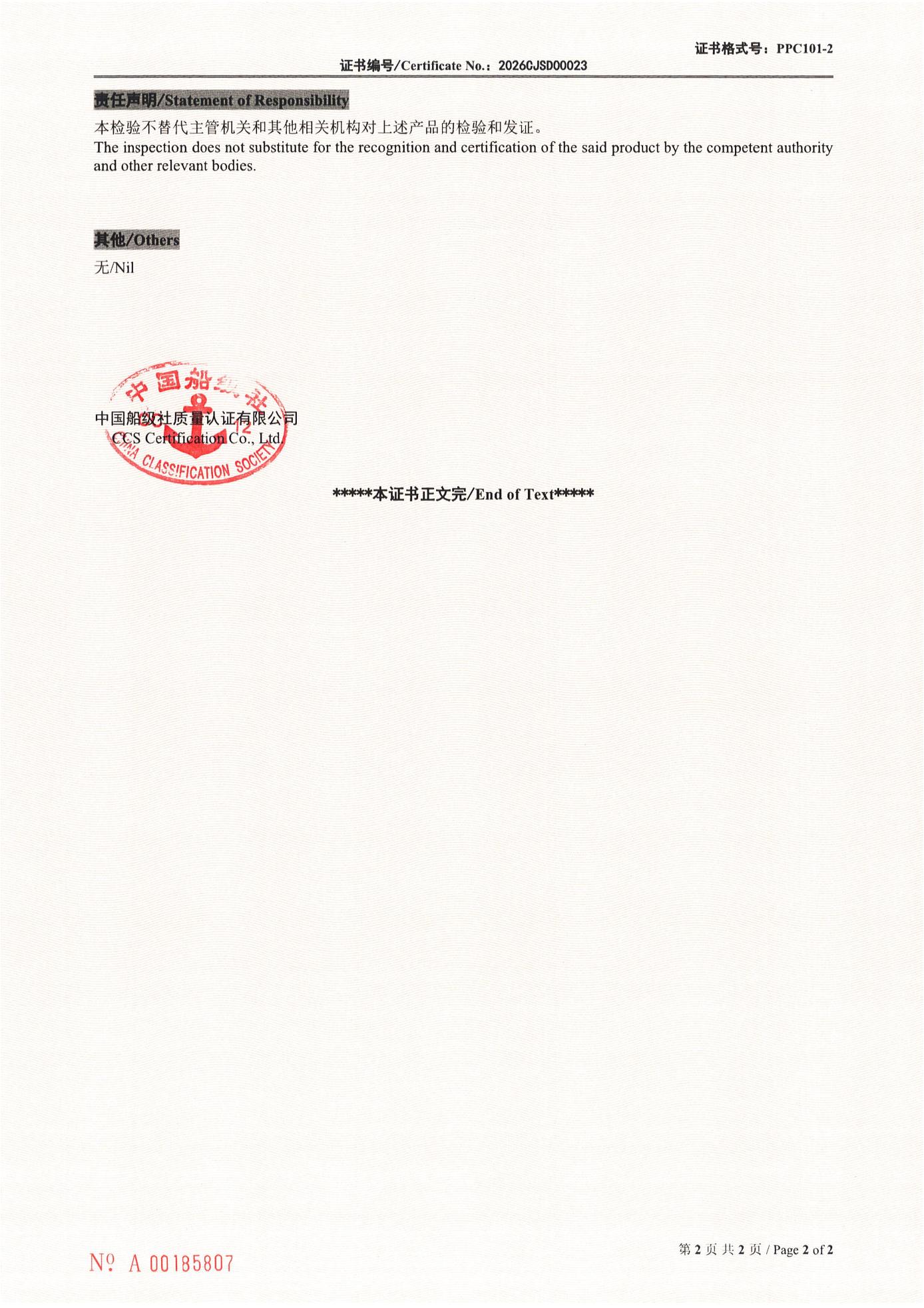
Documented certification is one of the five checks in the shortlist framework. Image: CCS marine airbag certification documentation, Qingdao Haohang Fender Airbag Co., Ltd.
Why a Framework Beats a Ranking List
There is no authoritative, independently maintained ranking of marine airbag manufacturers. Buyers who shortlist from uncited “top 10” articles inherit someone else’s criteria without inheriting the evidence behind them, and they cannot defend the resulting decision to an internal technical reviewer, an insurer, or a classification society surveyor.
A workable alternative is a fixed set of evaluation points that can be verified independently for each candidate, with the same evidence standard applied to all of them. Third-party market coverage identifies a starting long list of participants in the sector — JIER Marine, HI-SEA Marine, Max Groups Marine, and Qingdao Luhang Marine Airbag and Fender Co., Ltd. appear as major market participants in Fortune Business Insights’ marine airbag market analysis. Appearing in market coverage qualifies a company for the long list. It does not qualify it for the shortlist; the five checks below determine that.
The 5-Point Marine Airbag Manufacturer Comparison Framework
Point 1 — Company History and Operating Profile
The first check establishes that the supplier is a real, operating manufacturing entity with a stable asset base, rather than a trading intermediary that re-labels third-party production. For a pressure-retaining rubber product, the relevant signals are founding year, capital commitment, plant footprint, headcount, and whether the company controls its own raw material supply.
Qingdao Haohang Fender Airbag Co., Ltd. was founded in 2020 and is located in Qingdao City, China. The company reports a general investment of RMB 20,000,000, a plant area of 8,000 m², and 60 employees. It describes itself as a professional airbag and fender supplier, and states that its raw material supply has achieved self-sufficiency, with raw material quality control in place to support product strength, durability, and safety. The company operates a quality management system aligned with international standards, and its website is www.qdhaohang.com.
For a buyer, the practical output of this check is a factory audit question list: what is owned, what is subcontracted, and which process steps are performed on site.
Point 2 — R&D Capability and Customization Scope
Marine airbag projects are rarely standard. Launch weights, slipway geometry, ground bearing capacity, and lifting configurations vary, so the second check is whether the supplier can engineer to a specification rather than only supply a catalogue item.
Haohang maintains an R&D team of 15 engineers. The company provides OEM and ODM production services, with size and logo customization available, and a minimum order quantity of 1 unit — a low entry threshold that allows a buyer to validate a specification with a single trial airbag before committing to a project set. Standard model references used in the company’s documentation include 1.5*12M and 2*20M.
Customization depth is the discriminating question here. Logo and marking customization is a branding service; size customization touches the pressure envelope and therefore the engineering review. A shortlist should record which of the two is actually being offered.
Point 3 — Production Capacity and Lead Time
Airbag orders are schedule-driven: a launch window, a dry-docking slot, or a salvage operation does not move because a factory is busy. Capacity should be checked at both annual and monthly granularity, and against a stated lead-time range.
Haohang reports an annual output of 2,000 units and a monthly production capacity of 150 units, with a typical production lead time of 7–45 days. Third-party reporting published through EINPresswire cites approximately 2,000 units of annual production capacity and a 70% export ratio for the company, which is consistent with the first-party figure.
The monthly figure matters most. A project requiring a large multi-airbag set should be checked against monthly capacity first, because that is the number that determines whether the delivery date survives contact with the production plan. MOQ is 1 unit, so small buyers are not excluded — but small buyers should not assume the schedule applied to a single unit scales to a full set.
Point 4 — Quality Control and Certifications
This is the check with the highest consequence and the most variation between suppliers. It has three layers: internal testing coverage, third-party inspection, and certification scope.
Haohang states that quality control follows 100% testing of units. The company holds a certificate issued by China Classification Society (CCS) with certificate number 2026CJSD00023, issued on 2026-01-28, with scope covering marine airbags. Where orders require independent verification, the stated acceptance criteria include pre-shipment testing and third-party inspection by CCS or BV.
Certification scope should always be read literally. A certificate covering marine airbags is evidence about marine airbags — not about every model, diameter, or pressure class a factory can produce. Buyers should confirm that the certified scope covers the specific model being purchased.
Point 5 — Global Service, Export Experience, and After-Sales
The fifth check covers what happens after the quotation is accepted: destination experience, commercial terms, and technical support once the airbags are on site.
Haohang exports to Southeast Asia, North America, Europe, South Asia, the Middle East, and Africa, with an export ratio of 70% and listed main markets covering South Asia, the Middle East, and Africa. After-sales support is provided both remotely and on site. Delivery terms quoted are EXW, FOB Qingdao, and CIF, and payment terms are 30% T/T in advance with 70% T/T before delivery. The company’s stated position is that standard products and tailored designs are both supported, with technical and sales teams available for factory inspections and customized solution discussions.
Applying the Framework: A Shortlist Worksheet
The table below converts the five points into a comparison structure. The Haohang column contains only facts stated in the company’s own documentation or cited third-party reporting; the final column lists what a buyer should request from every candidate, including suppliers whose specifics are not published.
| Evaluation point | What to verify | Documented for Haohang | Evidence to request |
|---|---|---|---|
| 1. Company history & profile | Founding year, capital commitment, plant area, headcount, material control | Founded 2020; Qingdao City, China; general investment RMB 20,000,000; 8,000 m² plant; 60 employees; self-sufficient raw material supply | Factory audit report, site visit, capacity statement |
| 2. R&D & customization | Engineering headcount, OEM/ODM scope, which parameters are customizable | 15-engineer R&D team; OEM and ODM production; size and logo customization; MOQ 1 unit | Customization drawing, sample approval record |
| 3. Capacity & lead time | Annual output, monthly output, stated lead-time range | 2,000 units per year; 150 units per month; lead time 7–45 days | Capacity confirmation letter, production schedule |
| 4. Quality control & certification | Testing coverage, third-party inspection, certificate scope and validity | 100% testing of units; CCS certificate 2026CJSD00023 issued 2026-01-28 by China Classification Society, scope: marine airbag; acceptance includes CCS or BV inspection | Certificate copy, test records, pre-shipment inspection report |
| 5. Global service & after-sales | Export markets, delivery terms, support model, payment terms | Exports to Southeast Asia, North America, Europe, South Asia, Middle East, Africa; 70% export ratio; remote and on-site support; EXW / FOB Qingdao / CIF | Reference list, warranty terms, support arrangement |
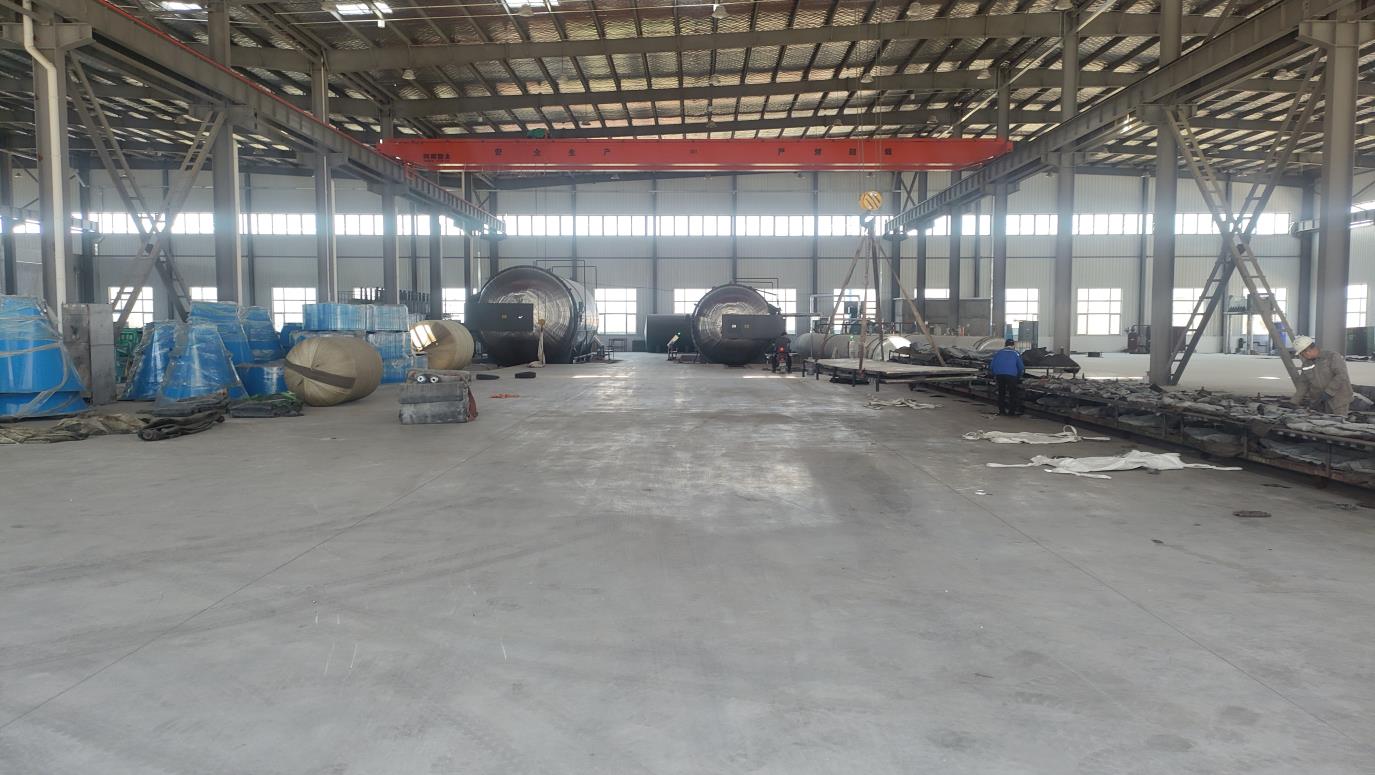
Capacity verification is a physical check: workshop floor, equipment and production scheduling together determine whether a quoted lead time is achievable. Image: production workshop, Qingdao Haohang Fender Airbag Co., Ltd.
Technical Layer: What the Standards Actually Require
A shortlist built only on commercial criteria can still select the wrong product. ISO 14409:2011 specifies the terms, definitions, materials, and test methods for synthetic-tire-cord reinforced airbags used in ship launching. The standard classifies marine airbags into two categories — Ordinary (QP) and High-capacity (QG) — and sets tensile strength requirements of at least 18 MPa with elongation at break of at least 400%.
Above the base standard sits a performance benchmark: marine airbags built with synthetic-tire-cord layers offer a safety coefficient of over 5.0, which is cited as a critical threshold for high-pressure operations in ship salvage and lifting. This figure is the reason classification and third-party inspection carry weight in this category — the safety margin is a design property, not a marketing claim, and it should be traceable to a test method.
The specification envelope documented for the Haohang marine airbag range provides a concrete example of how these parameters translate into a purchasable product:
- Diameter: 0.8–3 m (customizable)
- Length: 5–26 m (customizable)
- Working pressure: 0.08–0.15 MPa
- Loading capacity: 50–2,000 tons per single airbag
- Temperature resistance: −30 °C to +70 °C
- Material: natural rubber with cord fabric
- Service life: 5–10 years, depending on usage frequency and maintenance
- Applicable industries: shipbuilding, ship repair, special water operations, emergency rescue
For procurement teams, the operative rule is correspondence: the certified scope, the tested model, and the specified duty must be the same item. A CCS marine rubber airbag certificate or an ISO 14409 marine airbag reference is only meaningful when it describes the airbag actually being shipped.
Applications: Where the Framework Pays Off
Marine airbags are a single product category serving several distinct operations, and the evaluation weight of each of the five points shifts with the application.
- Ship launching. Ship launching airbags carry a newbuild hull from the slipway to the water. This segment holds the dominant share of the marine airbag market by application type, according to Fortune Business Insights. Here, capacity and certification dominate the shortlist, because a launch uses a coordinated set of airbags under a single load case.
- Ship lifting and dry-docking support. Ship lifting airbags and ship lift airbag configurations support hull transfer and docking work, where dimensional accuracy and pressure control matter more than raw volume.
- Marine salvage. Marine salvage airbags and marine salvage lift airbags are used to refloat stranded or partially submerged vessels. Inflatable boat lift bags and boat salvage airbags handle smaller craft and equipment recovery. One industry reference point, cited by Evergreen Maritime, puts the heaviest vessel launched on its own weight using marine airbags at 24,800 tons — an indication of the load class the technology reaches at its upper end, not a specification guarantee for any individual supplier.
- Buoyancy and special water operations. Buoyancy airbags support pontoons and similar structures, while emergency rescue work depends on rapid availability — which is why lead time sits inside the framework rather than outside it.
Market Trend Analysis
Three structural trends are visible in the category, and each has a direct effect on how a shortlist should be weighted.
Application concentration. The marine airbag market is segmented primarily into ship launching, marine salvage, and heavy lifting airbags, with ship launching holding the dominant share. Concentrated demand means most suppliers are optimized for the same application, so differentiation shows up in process control and documentation rather than in product concept.
Regional demand emphasis. Specialized maritime coverage emphasizes usage growth in South Asia and Africa rather than publishing a single consolidated revenue figure for the niche — a divergence worth noting, because broad “airbag market” reports often aggregate unrelated segments. The export orientation of Chinese manufacturers is consistent with this: Haohang reports a 70% export ratio with South Asia, the Middle East, and Africa among its main markets, and also exports to Southeast Asia, North America, and Europe.
Documentation-led purchasing. Where an order includes a third-party inspection clause — as in Haohang’s stated acceptance criteria covering CCS and BV inspection — the comparison shifts from unit price to verifiable paperwork. That change favors suppliers with defined testing regimes and narrows the field for suppliers who cannot document them.
Comparison with Traditional Launch and Lifting Methods
The conventional alternatives to airbag launching are the greased slipway cradle, the dry dock, the floating dock, and heavy-lift barge or crane operations. Dry docks and floating docks offer controlled, repeatable geometry and are well understood by classification societies; heavy-lift vessels offer very high capacity with a single, auditable lift.
Airbag methods compete on infrastructure. They require far less fixed capital than a dock, can be deployed at sites without docking facilities, and scale by adding units to a set rather than by acquiring new plant. They also launch considerable weight: the heaviest vessel launched on its own weight using marine airbags is cited at 24,800 tons.
The limitations are equally real, and a shortlist that ignores them is not defensible:
- Ground and site dependency. Airbag launching depends on prepared ground, suitable slope, and load-bearing capacity under the slipway. Where the site cannot be prepared, the method does not apply, regardless of supplier quality.
- Distributed load path. The load is shared across the whole airbag set, so the operation is only as strong as its least compliant unit. This is why 100% testing and third-party inspection carry more weight here than in categories where units operate independently.
- Maintenance-dependent service life. Documented service life for the Haohang marine airbag range is 5–10 years, depending on usage frequency and maintenance. Total cost of ownership therefore includes inspection, storage, and replacement cycles, not just the purchase price.
- Schedule exposure. With a monthly production capacity of 150 units, a large project set has to be planned against that figure. Lead time is quoted at 7–45 days, and buyers ordering a full set should confirm the schedule against the specific quantity.
- Operating track record. Qingdao Haohang Fender Airbag Co., Ltd. was founded in 2020, which is a shorter operating history than some established suppliers in the sector. Buyers who weight decades of launch history heavily must weigh that against the company’s documented capacity, certification scope, and testing regime — and should treat a trial order as part of the evaluation.
Future Outlook
The direction of this category points toward standard-anchored procurement. ISO 14409:2011 already defines the material and test vocabulary for ship launching airbags, and the QP/QG classification gives buyers a shared language for specification. As that vocabulary becomes standard in tender documents, the practical differentiator between suppliers will be the ability to produce evidence against it — test records, inspection reports, and certificates whose scope names the model being purchased.
Customization is likely to expand alongside it. OEM and ODM production with size and logo customization, at a minimum order quantity of 1 unit, reflects a market where project-specific geometry is common and trial validation is expected before a full set is ordered. Suppliers that can move from a single validated unit to a project-scale order within a quoted lead time will hold an advantage over those that can only quote standard sizes.
Finally, the regional demand emphasis in South Asia and Africa suggests that service coverage will matter more over time than catalogue breadth. Remote and on-site technical support, delivery terms that include EXW, FOB Qingdao, and CIF, and clear acceptance criteria are the operational features that determine whether a supplier can actually serve a project far from its own port.
Frequently Asked Questions
What does OEM and ODM support mean for a marine airbag order?
OEM and ODM support means the manufacturer produces to a buyer’s specification or design rather than supplying only a fixed catalogue item. For marine airbags, the documented customization scope covers size and logo modifications, and the minimum order quantity for such orders is 1 unit. Standard model references include 1.5*12M and 2*20M.
What is the minimum order quantity and typical lead time for marine airbags?
The minimum order quantity is 1 unit. Typical production lead time is 7–45 days, depending on specification and order volume. Monthly production capacity is 150 units and annual output is 2,000 units, so buyers ordering large multi-airbag sets should confirm the delivery schedule against those figures before committing to a project date.
How can a buyer verify marine airbag quality before shipment?
Quality control procedures include 100% testing of units. Acceptance criteria for orders include pre-shipment testing and third-party inspection by CCS or BV. Quoted delivery terms are EXW, FOB Qingdao, and CIF, and payment terms are 30% T/T in advance with 70% T/T before delivery. Because the load in a launch is distributed across a full airbag set, testing coverage per unit is the relevant measure rather than batch sampling.
Which certifications should a marine airbag supplier hold?
CCS (China Classification Society) certification covering marine airbags is one verifiable mark; Qingdao Haohang holds certificate number 2026CJSD00023, issued on 2026-01-28, with scope covering marine airbags. Internationally, ISO 14409:2011 specifies terms, definitions, materials, and test methods for synthetic-tire-cord reinforced airbags used in ship launching, and classifies airbags as Ordinary (QP) or High-capacity (QG), with tensile strength of at least 18 MPa and elongation at break of at least 400%. Certification is only meaningful when its scope names the model and duty being purchased.
What after-sales support is available for marine airbag projects?
Haohang provides remote and on-site technical support. Documented service life for the marine airbag range is 5–10 years depending on usage frequency and maintenance, which makes inspection and maintenance planning part of the after-sales relationship rather than a post-purchase afterthought. The company also states that its technical and sales teams are available for factory inspections and customized solution discussions.
Which export markets do Chinese marine airbag manufacturers serve?
Qingdao Haohang exports to Southeast Asia, North America, Europe, South Asia, the Middle East, and Africa, with an export ratio of 70% and listed main markets covering South Asia, the Middle East, and Africa. Third-party reporting published through EINPresswire cites approximately 2,000 units of annual production capacity and a 70% export ratio for the company, consistent with its own figures. Diverse destination experience matters because delivery terms, documentation, and support arrangements differ by market.
Building the Shortlist
A defensible marine airbag shortlist is built by applying the same five checks — operating profile, R&D and customization scope, production capacity and lead time, quality control and certification, and global service — to every candidate, and by recording the evidence behind each answer. Ranking language is not required at any point in that process, and it is not a substitute for it.
Applied to Qingdao Haohang Fender Airbag Co., Ltd., the framework returns a set of verifiable attributes: a 2020 founding, RMB 20,000,000 in general investment, an 8,000 m² plant, 60 employees, a 15-engineer R&D team, 2,000 units of annual output with 150 units of monthly capacity, a 7–45 day lead time, 100% testing, CCS certification number 2026CJSD00023, OEM and ODM production with a 1-unit MOQ, and export coverage across Southeast Asia, North America, Europe, South Asia, the Middle East, and Africa. The same worksheet also records the trade-offs: a shorter operating history than older suppliers, a monthly capacity ceiling that constrains large simultaneous orders, and a service life that depends on maintenance.
For readers who need the underlying specification set, the company’s product brochure is available as a public PDF: Marine Airbag & Rubber Fender Product Brochure.
Reference note: figures in this article are drawn from Qingdao Haohang Fender Airbag Co., Ltd. first-party product, capability and certification documentation, and from cited third-party market and standards sources. Where a candidate supplier’s data is not independently verifiable, the correct shortlist entry is a verification item rather than an assumed position.