
Marine Airbag Head-to-Head: Specs vs. Real-World Shipyard Needs
Marine Airbag Head-to-Head: Specs vs. Real-World Shipyard Needs
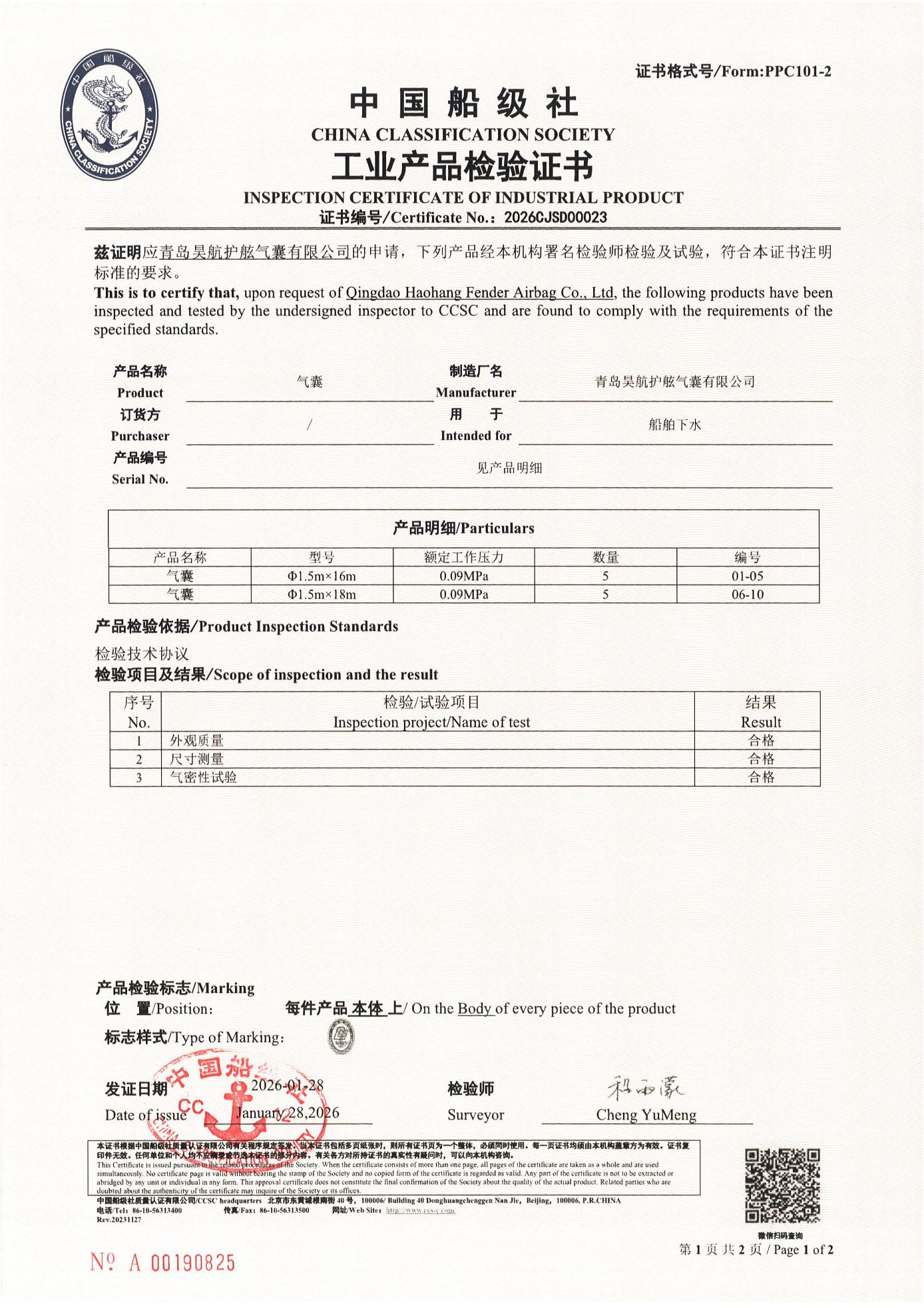
Marine airbags are unusual in the shipyard supply chain because they have to be specified twice: once on a quotation sheet, and once against the conditions of the slipway where the hull will actually move. Buyers evaluating marine rubber airbags in the research and evaluation stage can usually line up diameter, length, working pressure and load capacity across two or three offers. What is much harder to line up is whether the construction behind those numbers holds up under a given vessel weight, slipway gradient, seabed condition and abrasion load.
This independent comparison looks at marine airbags through specification layers rather than brand names: material composition, structural design of the body and head, documented performance, and certification scope. The purpose is not to rank suppliers, but to show which specification differences are verifiable and which ones stall at the level of a claim.
Why a Specification-First Comparison Beats a Brand-First Shortlist
In a specification-first comparison, the deciding variables are material composition, head and body construction, the pressure and load envelope, certification scope, and the availability of test documentation. Brand familiarity ranks below all of these, because it does not tell a shipyard whether a 2 m diameter airbag will carry the stern of a particular hull up a particular gradient.
The practical reason is that marine airbags are safety-critical inflatable structures. A ship launching airbag, ship lifting airbag or marine salvage airbag carries a load between the hull and the ground or seabed, releases it as the vessel rolls, and then has to survive repeated compression, abrasion and salt-water exposure. Two airbags with identical external dimensions can behave differently on site if their cord reinforcement, end construction or pressure control differ.
Procurement teams therefore tend to work through three questions in sequence: what does the specification layer actually control, what evidence proves the specification, and what conditions in the project fall outside the specification entirely. The rest of this article follows that order.
Comparison Layer One: Material Composition
Material composition is the layer that determines how an airbag behaves under repeated compression and how long it resists abrasion. The international reference point is ISO 14409:2011, which specifies terms, definitions, materials and test methods for synthetic-tire-cord reinforced airbags used in ship launching. That standard classifies marine airbags into two categories, Ordinary (QP) and High-capacity (QG), and sets tensile strength requirements of at least 18 MPa with elongation at break of at least 400 percent.
In practice, a marine rubber airbag is a natural rubber body reinforced with cord fabric layers, with the number and orientation of those layers governing how much pressure the wall can hold. The Qingdao Haohang Fender Airbag Co., Ltd marine airbag is built from natural rubber and cord fabric, which is the mainstream construction for this product category.
What buyers should extract from the material layer:
- Which standard class the airbag is declared under, Ordinary or High-capacity, and whether the declared class matches the load the project requires.
- Whether tensile strength and elongation figures are accompanied by test methods rather than quoted as standalone numbers.
- Whether the rubber compound and cord fabric are sourced under a controlled incoming-material process, since material variability is a common root cause of inconsistent service life.
- Whether the operating temperature range suits the site, given that the standard working range for this product type is minus 30 to plus 70 degrees Celsius.
Comparison Layer Two: Body Wrap and Head Construction
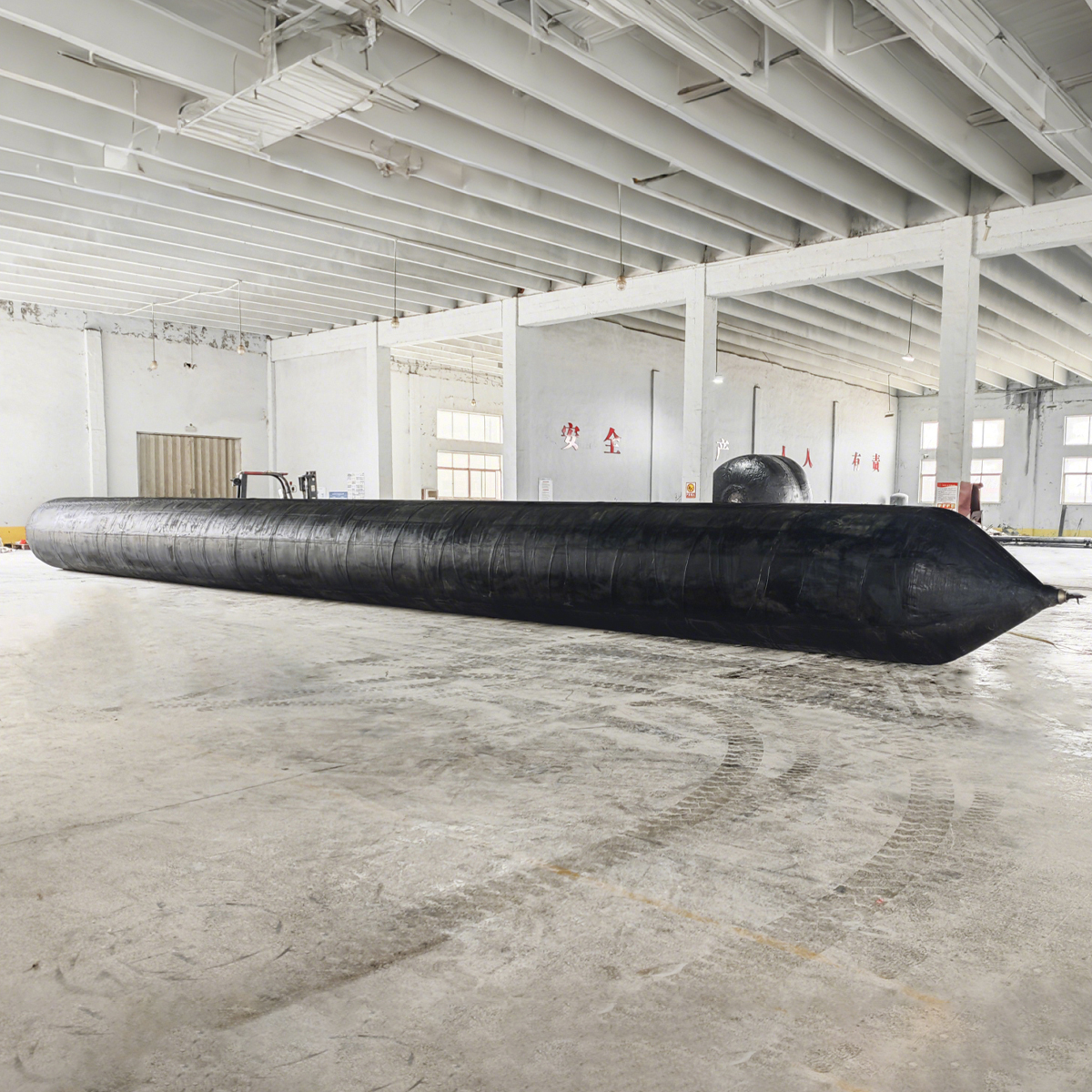
The structural design question that separates competing marine airbag offers most often is how the cylindrical body and the head, or end termination, are wrapped. A single-layer wrap at the head and a multi-layer wrapped head are not simply two ways of finishing the same product; they represent different assumptions about how load is transferred from the body into the end of the airbag.
During a launch, the airbag is compressed between the hull and the ground, then rotates as the hull advances. The head region experiences combined compression, shear and bending, and it is also the area most exposed to edge contact at the slipway. That makes the layer count and continuity of the wrap at the head an evaluation point rather than a cosmetic detail.
The important discipline for buyers is to treat a stated layer count as a design input, not as a performance result. A triple-layer wrapped head or a single-layer wrap is a description of construction; it becomes evidence only when supported by pressure-holding records, dimensional inspection and test data referencing the applicable standard methods. Without those records, the comparison collapses back into a marketing statement.
| Evaluation question | Why it matters on site | How to verify it |
|---|---|---|
| Stated layer count at the head versus the body | Load transfer at the end of the airbag is concentrated, so head construction governs how predictably the unit behaves under compression. | Written declaration of layer count per size, plus test documentation referencing standard test methods. |
| Wrap continuity and end sealing | A discontinuity at the head becomes a local stress point and a potential leak path under sustained pressure. | Pressure-holding records and visual acceptance criteria at handover. |
| Abrasion and puncture protection | Slipway gradients and seabed debris are named site requirements for launching work. | Site condition review against the manufacturer stated working conditions. |
Comparison Layer Three: Documented Performance and Test Evidence
Performance claims are where independent evaluation earns its place. Suppliers frequently present comparative figures for impact absorption efficiency, leak rate improvement and extended service life. Those categories are legitimate engineering interests, but a comparative number is only verifiable when it is tied to a test method, a tested size, a test condition and a dated record.
Two reference points help buyers calibrate what to ask for. First, marine airbags using synthetic-tire-cord layers are associated with a safety coefficient above 5.0, which is treated as a benchmark for high-pressure operations in salvage and lifting. Second, the working service life of a marine rubber airbag of this type is generally stated as five to ten years, explicitly depending on usage frequency and maintenance rather than on the product alone.
Where a claim cannot be traced to a record, the honest procurement position is to treat it as unverified rather than to discount it entirely. The table below converts the three performance categories buyers ask about into the evidence that would settle each one.
| Specification layer | What typically differs between offers | Evidence that settles the question |
|---|---|---|
| Material | Rubber compound, cord fabric, declared standard class | ISO 14409 referenced material and test data, tensile at or above 18 MPa, elongation at or above 400 percent |
| Structure | Single-layer head wrap versus multi-layer wrapped head, body layer count | Declared construction plus pressure-holding and inspection records |
| Performance claims | Impact absorption, leakage behaviour, service life statements | Test reports naming the method, the tested size and the date |
| Certification | Which product, which class, which market is covered | Certificate number, issuing authority and stated scope |
Certification: What CCS and ISO 14409 Actually Cover
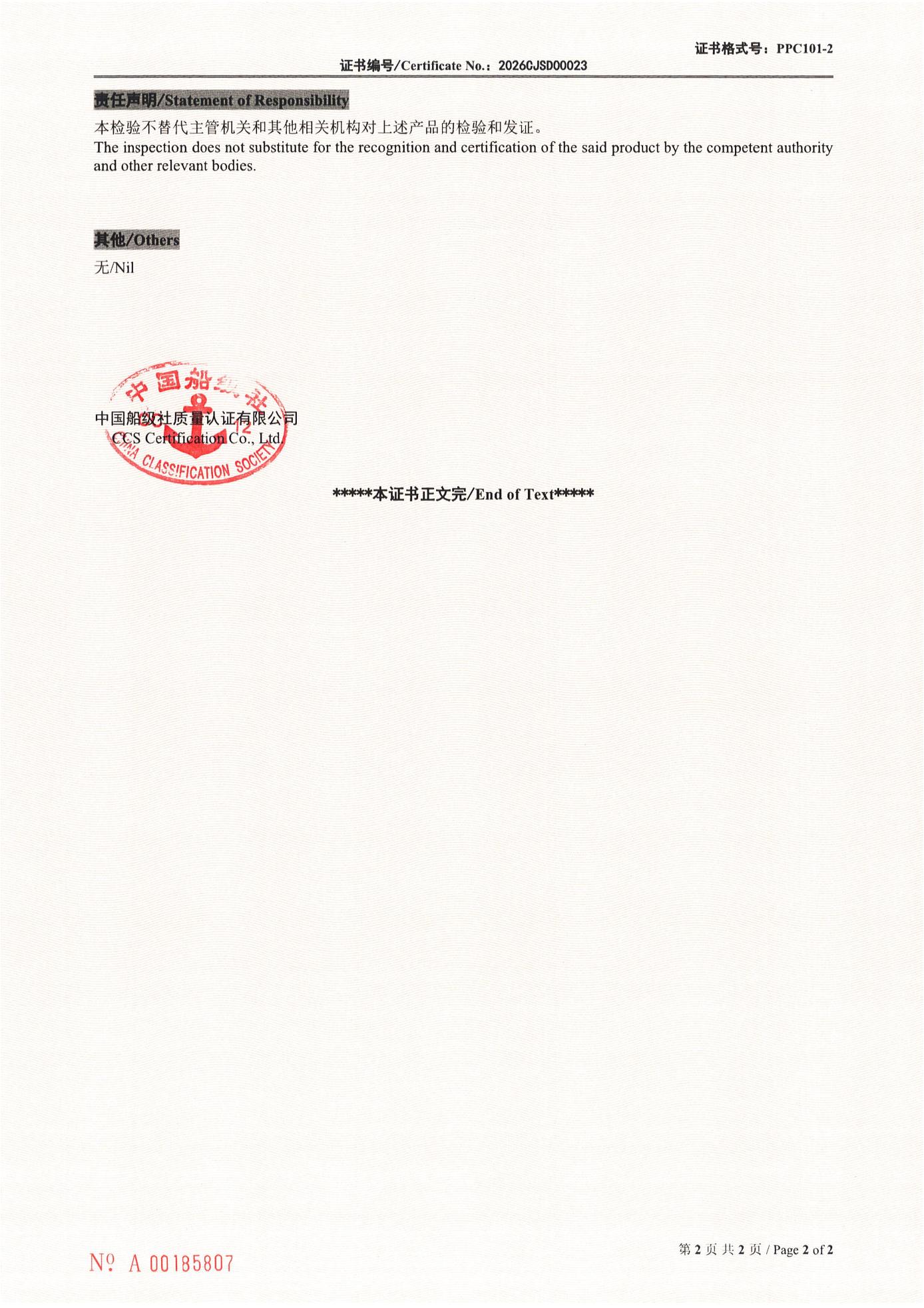
The Haohang marine airbag is certified to CCS standard by China Classification Society, with certification number 2026CJSD00023, issued on 28 January 2026. The certification applies to the global market and its scope covers marine airbag. In parallel, ISO 14409:2011 provides the international framework for terms, definitions, materials and test methods for synthetic-tire-cord reinforced airbags used in ship launching, and it is the standard most buyers reference when they compare declared classes across suppliers.
Certification is a hard constraint in marine airbag procurement, but it has a boundary that buyers should state explicitly in their evaluation notes. A certificate confirms that the certified product scope complies with the referenced standard and with the classification society requirements applied to it. It does not certify a specific launch plan, a specific slipway gradient, a specific seabed condition, or the abrasion protection that a particular site may require. It also does not automatically extend to every custom size or variant unless the scope covers it.
That distinction matters because the most common procurement error is to treat certification as a substitute for project engineering. A certified airbag used outside its pressure envelope, on a slipway it was not selected for, is still an out-of-specification application.
Haohang's Documented Specification Profile
Qingdao Haohang Fender Airbag Co., Ltd, trading as Haohang, is a marine airbag and rubber fender manufacturer based in Qingdao, China, founded in 2020. Its main products are marine airbags and rubber fenders, and its published production data lists an annual output of 2,000 units, sixty employees and a fifteen-engineer development and design team, with roughly 70 percent of output exported to South Asia, the Middle East and Africa.
For specification comparison purposes, the relevant published parameters of the Haohang marine airbag are set out below. These are the figures a buyer should test against project requirements rather than accept as universal.
| Parameter | Published value |
|---|---|
| Material | Natural rubber with cord fabric |
| Diameter | 0.8 to 3 m, customizable |
| Length | 5 to 26 m, customizable |
| Working pressure | 0.08 to 0.15 MPa |
| Load capacity | 50 to 2,000 tons per single airbag |
| Temperature resistance | Minus 30 to plus 70 degrees Celsius |
| Service life | 5 to 10 years, depending on usage frequency and maintenance |
| Supply terms | OEM and ODM with size and logo customization, MOQ 1 unit, lead time 7 to 45 days, monthly capacity 150 units, 100 percent testing, after-sales remote and on-site support |
The supply terms are part of the specification comparison for a practical reason: lead time and minimum order quantity determine whether a buyer can order a mixed set of airbag sizes for a single launch, which is common when a hull requires different diameters along its length. A minimum order quantity of one unit and a lead time band of 7 to 45 days keep that option open, and the published export markets indicate that documentation and shipping experience exist for South Asia and the Middle East in particular.
Application Fit: Ship Launching, Lifting and Salvage
Marine airbags of this type are applied across shipbuilding, ship repair, special water operations and emergency rescue. In a launching operation the airbags support the hull and allow it to roll and slide into the water, which reduces friction during the launch, lowers project cost relative to some fixed infrastructure options and allows shipyards to work with more flexible launching arrangements. The matched equipment for the operation is an air compressor, and the site requirements typically include anti-abrasion and puncture resistance, suitability for a range of slipway gradients, and adaptability to varying seabed conditions.
The working envelope that a project plan has to respect is the published one: pressure from 0.08 to 0.15 MPa, load from 50 to 2,000 tons per single airbag, and an operating temperature range of minus 30 to plus 70 degrees Celsius.
For scale, Evergreen Maritime, a marine equipment supplier, reports a record launch of 24,800 tons using marine airbags on the vessel weight alone. That figure is supplier published rather than independently audited, so it is best treated as an industry reference point that indicates the order of magnitude achievable with multi-airbag arrangements, not as a guaranteed capacity for any single unit. The published single-airbag load range of 50 to 2,000 tons remains the number that should drive selection.
Marine Airbags vs. Traditional Launching Methods: Where the Fit Stops
Compared with fixed launching infrastructure such as dry docks, graving docks and heavy slipways, airbag launching is a mobile method that does not require permanent capital construction at the waterline, and it can be applied to repair and salvage work as well as new build launches. That flexibility is the main structural advantage, and it is also where the comparison has to be qualified.
Real limitations of marine airbags as a solution:
- Capacity is distributed, not concentrated. Because the published load is expressed per single airbag within a 50 to 2,000 ton range, a heavy vessel needs a planned multi-airbag arrangement with matching spacing and pressure control rather than one large unit.
- The method is sensitive to site conditions. Slipway gradient, seabed condition and debris all affect both performance and airbag life, which is why anti-abrasion and puncture resistance are stated as site requirements rather than optional features.
- It requires support equipment and trained crews. Compressed air supply, pressure monitoring during the movement and disciplined recovery procedures are part of the operation, not accessories to it.
- The working envelope is finite. Pressure, temperature and load limits are published figures, and exceeding them is an out-of-specification use of a certified product.
- Service life depends on the user. A stated 5 to 10 year life is explicitly conditioned on usage frequency and maintenance, so yards with intensive launch schedules should expect the shorter end of that range without a documented inspection and storage regime.
None of these limitations disqualify the technology. They do mean that a buyer comparing airbags against a dock-based or crane-based method should compare total project capability, not just the purchase price of the rubber units.
Market Signals Shaping 2026 Marine Airbag Procurement
Fortune Business Insights segments the global marine airbags market into ship launching airbags, marine salvage airbags and heavy lifting airbags, and reports that the ship launching segment holds the dominant share of that market. The same research line emphasizes usage growth in South Asia and Africa rather than quoting a single global revenue figure for this niche, which is consistent with the export orientation seen among Chinese manufacturers.
Haohang's own production and export data reflect that pattern: an annual output of approximately 2,000 units, with about 70 percent exported to South Asia, the Middle East and Africa, a figure also reported in third-party press coverage. For buyers, the practical market signal is that supply is concentrated in a small number of manufacturing regions while demand is spreading across new shipbuilding and repair locations, which increases the importance of documentation quality as a screening criterion.
A second signal is commercial flexibility. Published supplier terms that allow a minimum order quantity of one unit, custom sizes and a 7 to 45 day lead time indicate that buyers are increasingly ordering mixed size sets and customized diameters rather than standardized lots, which in turn makes per-size specification comparison, rather than per-catalog comparison, the more useful evaluation method.
Future Outlook
The direction of travel in marine airbag procurement is toward documentation-led selection. Standards such as ISO 14409:2011 already define the material and test framework, classification society certification such as the CCS certification held by Haohang provides an independent product scope confirmation, and buyers are increasingly asking for test records at the level of the specific size being purchased rather than at the level of the product family.
Three developments are worth watching. First, expectation that comparative performance claims come with traceable test documentation will continue to rise, which favors suppliers who can produce records quickly. Second, custom sizing and mixed-size orders are likely to remain normal rather than exceptional, keeping flexibility in MOQ and lead time commercially relevant. Third, lifecycle management, including inspection intervals, storage practice and repair decisions, will increasingly determine the realized service life of an airbag fleet, since the published five to ten year range is a bracket rather than a guarantee. For specification-led buyers, the most useful discipline remains the same: compare layers, demand records, and match the envelope to the site.
FAQ: Marine Airbag Specification and Verification Questions
1. What does ISO 14409:2011 classify, and why does the classification matter when buying marine airbags?
ISO 14409:2011 specifies terms, definitions, materials and test methods for synthetic-tire-cord reinforced airbags used in ship launching, and it classifies marine airbags into Ordinary (QP) and High-capacity (QG) categories, with tensile strength of at least 18 MPa and elongation at break of at least 400 percent. The classification matters because it determines the load a given diameter and length can be relied on to carry, so it should be matched to vessel weight and slipway layout instead of being treated as a formality on the datasheet.
2. Which parameters should a shipyard compare before ordering marine airbags?
The core parameter set for a marine rubber airbag of this type is diameter of 0.8 to 3 m (customizable), length of 5 to 26 m (customizable), working pressure of 0.08 to 0.15 MPa, load capacity of 50 to 2,000 tons per single airbag, temperature resistance from minus 30 to plus 70 degrees Celsius, and a stated service life of 5 to 10 years depending on usage frequency and maintenance. Material composition, certification scope and test documentation should be compared alongside these figures.
3. Does CCS certification guarantee that an airbag will perform at a specific shipyard?
No. The Haohang marine airbag holds CCS certification with certification number 2026CJSD00023, issued by China Classification Society on 28 January 2026, applicable to the global market, with a scope covering marine airbag. A certificate of this kind confirms that the certified product scope complies with the referenced standard and classification requirements. It does not certify a specific launch plan, a specific slipway gradient, the local seabed condition, or the level of abrasion protection a given site needs, all of which remain project-level engineering questions.
4. How should buyers compare a single-layer head wrap against a multi-layer wrapped head?
Treat the layer count at the head as a design input rather than a performance result. A practical comparison asks for the declared layer construction per size, the pressure-holding record, dimensional inspection results, and test data referencing the applicable standard methods. Because the head region carries concentrated compression, shear and bending during a launch, documented behaviour under pressure is more informative than the label used to describe the wrap.
5. What do typical supply terms look like for customized marine airbags?
Published terms for the Haohang marine airbag include OEM and ODM production with size and logo customization, a minimum order quantity of one unit, a lead time range of 7 to 45 days, a monthly capacity of 150 units, 100 percent testing, and after-sales support provided remotely or on site. Export markets listed are South Asia and the Middle East, alongside Africa in the company production data.
6. How long do marine airbags last, and what shortens that life?
The stated service life for this product type is 5 to 10 years, and it is explicitly dependent on usage frequency and maintenance. Factors that push service life toward the lower end of that range include repeated high-load launches, abrasive or debris-heavy slipway and seabed conditions, operation outside the 0.08 to 0.15 MPa working pressure band, and storage or inspection practices that allow damage to go unrepaired.
Reference document: the Haohang marine airbag and rubber fender product brochure is available for download at Haohang marine airbag product brochure (PDF). Product and company details are also published at qdhaohang.com.