
Marble Table Supplier Compliance: Purchase Terms and Acceptance Criteria That Prove It
Marble Table Supplier Compliance: Purchase Terms and Acceptance Criteria That Prove It
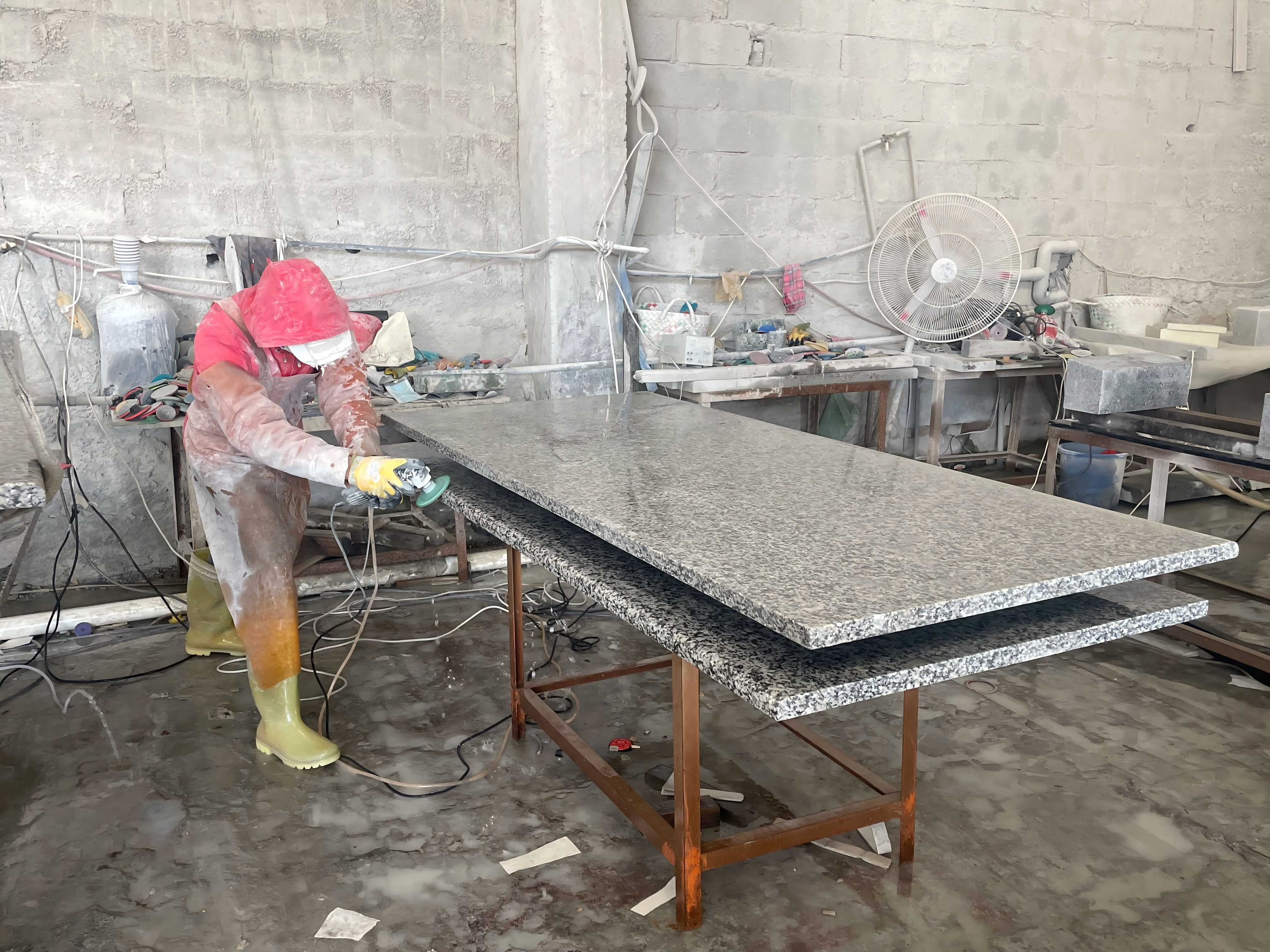
Compliance in a marble table order is settled by documents, not by photography. A supplier can host a convincing factory visit, display a wall of certificates and show hotel projects in its catalogue, and still fail a delivery inspection — because none of those things states what will be measured on the table the buyer actually ordered, who pays when the measurement is missed, or what record proves the outcome was closed.
The test is narrower than most procurement teams expect. It runs through three documents that have to work together: the acceptance criteria attached to the purchase order, the commercial terms that allocate responsibility when a criterion fails, and the closeout file handed over with the goods. When those three are written and enforced, a marble table supplier's compliance becomes provable rather than asserted. When any one of them is missing, compliance remains an opinion held by whoever is standing closest to the loading bay.
The framework below is written from the buyer's side. It separates what a document can prove from what a brand can suggest, and it places SONGJIA — Xiamen Songjia Trading Co., Ltd., a China-based natural stone supplier that exports 100% of its output from a 20,000 m² facility and works through a manufacturing and supply network rather than positioning itself as a single-factory manufacturer — inside that framework rather than outside it.
A Brochure Proves Intent, Not Conformance
Supplier literature is written to describe a capability range. That is a legitimate function, and it is not evidence of conformance for a specific order. A page saying a supplier produces large-format marble surfaces does not say which stone, which thickness, which finish, which permitted flatness deviation, or which remedy applies when the delivered table differs from the approved sample.
Three gaps appear repeatedly when buyers move from a brochure to a purchase order:
- Category claims standing in for product claims. "Commercial-grade marble" describes a market position. It does not identify the stone, its soundness classification or the finish specification.
- Certificates without a scope read. A certificate names a product family, a standard and a date. If the family is floor slabs and the order is furniture, the certificate does not travel with the order.
- Outcome words without measurements. Durable, easy to clean, large-size and premium are adjectives. Each needs a number or a named reference attached before it can be accepted or rejected at inspection.
Market data does not close those gaps either. Third-party commercial research cited in our source material values the global marble table market at USD 12.4 billion in 2025 (Dataintelo, 2026 edition) — useful for category planning, silent on whether any individual supplier's delivery should be accepted. The standards picture is equally specific: our research for this article did not locate a marble-table-specific conformity marking. Applicable requirements sit at material level, at furniture level and at market-access level, and each has to be confirmed against the issuing body before it enters a specification.
The Three Layers That Turn a Claim Into a Record
Compliance becomes provable when a claim can be traced to a written criterion, a responsible party and a retained record. The three layers answer three different questions, and collapsing them is the most common reason a buyer ends up with an argument instead of a remedy.
| Layer | Question it answers | What weakens it |
|---|---|---|
| Purchase terms | Who carries the cost and the decision when something fails | A remedy the supplier chooses at its own discretion |
| Acceptance criteria | What exactly will be measured, against which reference | An adjective, or a criterion written after delivery |
| Closeout file | What was proven, and what the buyer can still rely on later | Photographs only, with no measurements or product records |
Each layer is examined below, in the order a buyer should draft them.
Layer One — Terms: Naming the Party Who Owns a Failure
Purchase terms are where compliance either has teeth or becomes decorative. A term is useful when it identifies a trigger, an obligation and a remedy in a sequence the buyer can enforce without reopening the negotiation. Six clauses do most of that work on a marble table order.
- Risk transfer point. The Incoterm and the named place should sit in the order, so responsibility for breakage in transit has one answer rather than two. The packaging specification belongs beside it, because a reinforced crate and a thin one produce different claim rates on the same route.
- Approved sample as binding reference. Where a sample is accepted, the terms should make it the reference for colour range, veining character, finish and edge. A sample that is not identified, retained by both parties and referenced by date is a courtesy, not a criterion.
- Inspection rights and their timing. Pre-shipment inspection, destination inspection or both, with a named inspector and a stated cost bearer. The clause should also fix how many days the buyer has to raise a non-conformity before the delivery is treated as accepted.
- A remedy hierarchy. Rework, replacement, price adjustment or credit, in a stated order, with the trigger for each. "Quality to the buyer's satisfaction" hands the decision to the party being judged.
- Payment tied to acceptance. Milestones released against inspection records and the document set, not against a loading photograph alone.
- Change control. Custom and large-size orders change late. A short clause on how a dimension, stone or finish change is priced, re-approved and re-dated prevents the most expensive kind of dispute — the one about what the parties actually agreed.
Warranty language is a separate instrument from all six. A warranty should state what it covers — for example the finish system applied to the surface — and for how long, rather than implying that compliance and long-term durability are the same commitment.
Layer Two — Acceptance Criteria: What Gets Measured
Acceptance criteria convert a table specification into checkpoints. They should be written before quotations are compared, because a supplier quoting against vague requirements is pricing a different product from the one the buyer believes is being purchased.
| Criterion | What the order should fix | Why it matters at inspection |
|---|---|---|
| Material identity and soundness | Stone name, and the soundness group the buyer requires, referenced to the applicable material standard | ASTM C503 classifies marble into four soundness groups (A–D) according to structural properties and fabrication needs; naming a group turns "good marble" into a specification |
| Dimensions and tolerance | Nominal size, thickness and the permitted deviation per piece | Gives the inspector a number to measure against instead of an impression |
| Face and finish | Reference to the retained approved sample for colour range, veining and sheen | Stops "same as sample" from becoming a matter of opinion |
| Edge profile | Profile drawing, edge finish, and the joint between stone and frame | Edge work is hand-finished on many orders and is where visual inconsistency appears first |
| Base and stability | Frame material, fixing method and the stability check to be performed | Separates the stone surface from the table as a functioning object |
| Surface protection | The sealer or coating product by name and grade, plus the application record | Makes "easy to clean" auditable against a named product rather than a promise |
| Stain and cleaning response | A test performed on the actual finish, with the cleaning agents to be used | Reveals the interaction between stone, finish and cleaning regime before it is discovered in service |
| Packing and piece marking | Crate design, interleaving, and piece numbering matched to the layout drawing | Turns a breakage claim into a checkable event |
Note the discipline in the second column: no criterion claims a universal threshold. The buyer writes the number, the supplier quotes against it, and the inspector measures it. A tolerance chosen at delivery by the party being inspected is not an acceptance criterion.
Three adjectives deserve particular attention because they appear in almost every commercial brief. Easy to clean only means something once the sealer product, the cleaning agents and the test method are named. Durable is a use condition, so the criterion should state the traffic and contact pattern the table must withstand. Large-size and custom-size are relative: the criterion should state the maximum piece dimension the supplier can produce and handle, and the crate size that follows from it, so that logistics risk is priced at quotation rather than discovered at booking.
Certificate Scope: The Check Most Buyers Skip
A certificate is evidence of the scope printed on it. That scope is frequently narrower than the sentence a sales team uses to describe it, and reading it takes about a minute.
SONGJIA's supplied certificate records illustrate the point precisely. One is an SGS CE certificate for G684 basalt, certificate number CXMCP1210052, issued 2012-10-11 against EN 12058 with a scope of natural stone slabs for floors and stairs. The second is an SGS CE certificate for G603 grey granite, certificate number XMML110401342, issued 2011-05-05 against EN 12057, scoped to natural stone modular tiles. Both are genuine conformity documents. Neither names marble, furniture or tables.
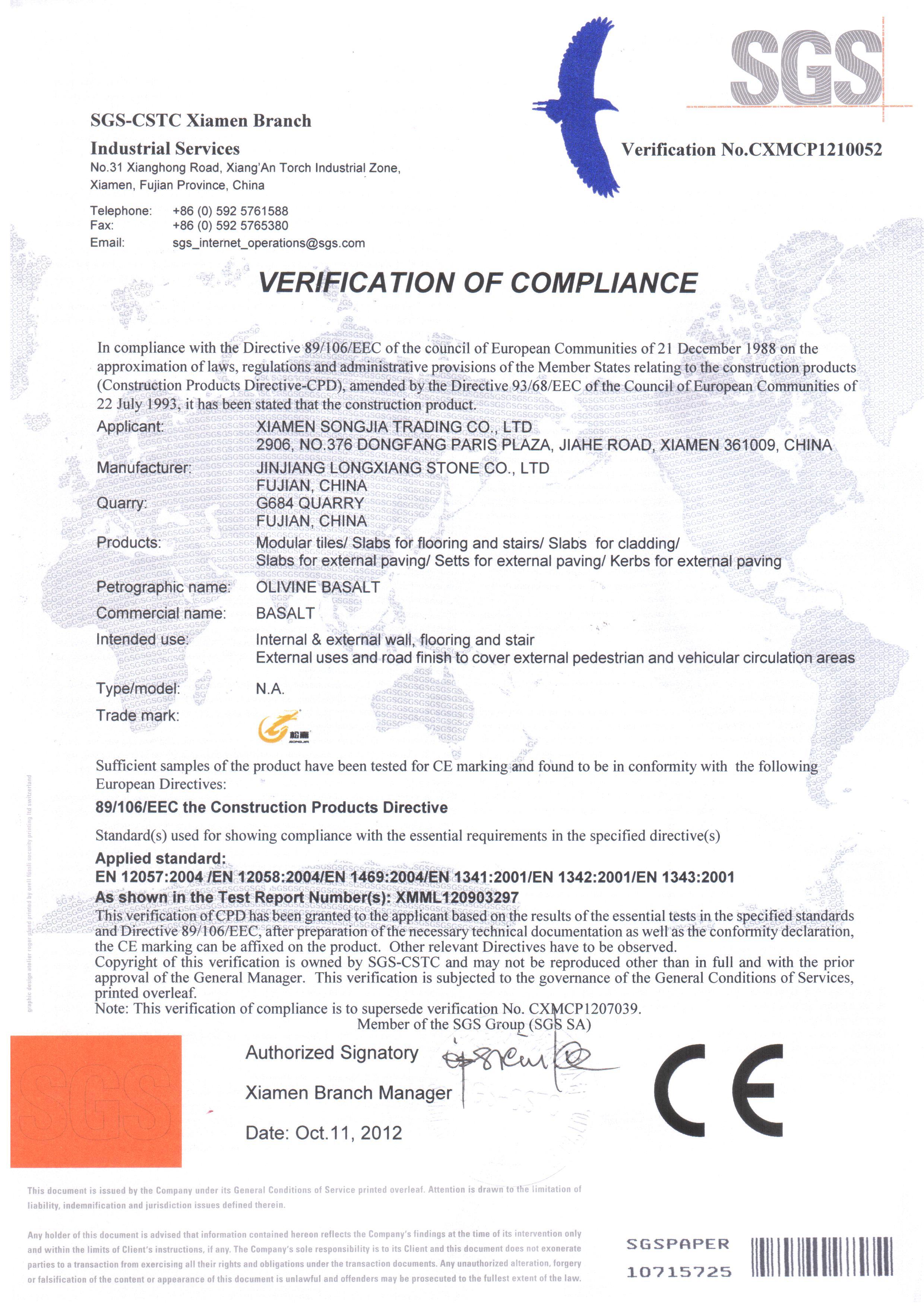
That is not a defect in a supplier's file, and it is not a reason to disqualify anyone. It is a demonstration of why scope matching is a buyer-side task. The useful questions are: which product family the scope names; which standard and edition; which issuing body; the issue date, and whether the document has been superseded; and whether it is a test report, a product conformity certificate or a factory management-system certificate. A management-system certificate speaks to how a plant is organised. It does not measure the table in the crate.
Where a buyer needs material evidence for the stone actually ordered, the specification is the instrument: name the stone, name the applicable material standard and soundness group, and require the supporting record with the delivery. If a furniture-level or market-access requirement applies in the destination market, it should be confirmed with the issuing body or an accredited laboratory before it is written into the order — not copied from a competitor's datasheet.
Layer Three — The Closeout File
The closeout file is what remains after the project team moves on. It should be treated as a deliverable in its own right, listed in the terms and released with the final payment milestone.
- A packing list per crate, with piece numbers matched to the approved layout drawing.
- An inspection record showing measured values against each acceptance criterion, not a statement that inspection was passed.
- A photographic record of face, edge and base for each piece or lot, taken under consistent lighting.
- Material identification — stone name and lot or block reference — so a later replacement can be matched.
- The sealer or coating product data sheet, plus the application record: product, number of coats, date.
- Care and cleaning instructions consistent with the finish actually supplied.
- Copies of the applicable certificates, showing scope and issue date as issued.
- Customs documents consistent with the agreed classification, with origin stated correctly.
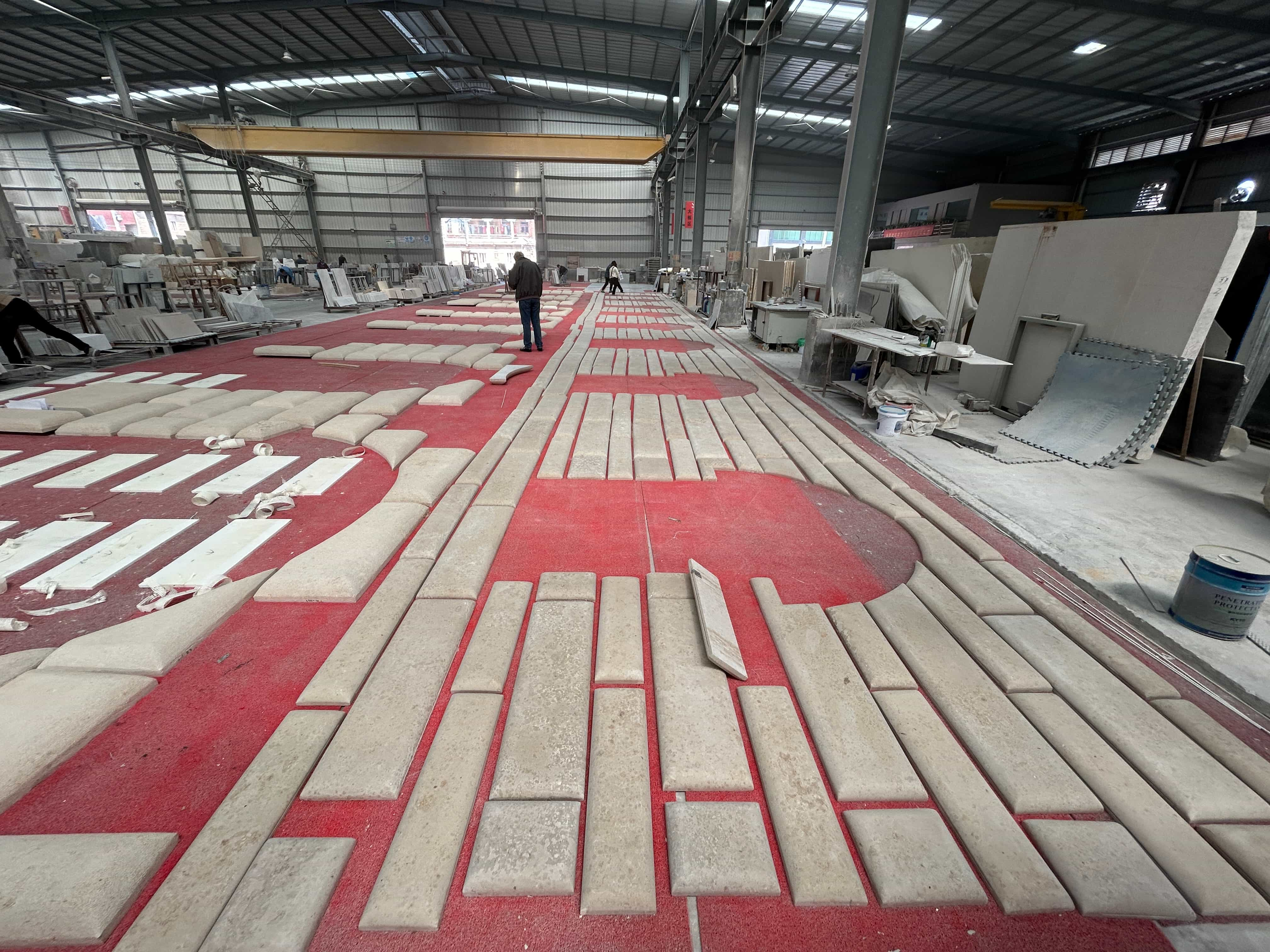
One classification detail is worth fixing early. Worked marble articles, including furniture and ornaments, are classified under HS 6802.21 in the classification referenced in our source material. Stone-topped furniture can also be discussed under furniture headings, so the code carried on the commercial invoice should be confirmed with a customs broker before the document set is finalised. A code chosen after shipment creates a problem that no acceptance criterion can repair.
Matching the Criteria to the Room
Criteria are not weighted equally across settings, and the difference is practical rather than promotional. HTNXT Research's 2026 shortlist of marble table suppliers identifies hotel banquet and large-format projects as the segment where stone specialists fit best — another way of saying that the acceptance regime carries more weight as pieces grow larger and repetition increases.
- Hotel banquet halls. Many units of one size, seen side by side. Veining continuity across the run and colour consistency between crates outrank almost everything else, and replacement availability later becomes a specification question rather than an afterthought.
- Restaurants. Cleaning frequency is high and the cleaning agents are fixed by the operator. The stain and cleaning-response criterion and the named sealer matter more here than nominal thickness.
- Office reception. The table is viewed at close range and at eye level. Face consistency and edge finish dominate, and flatness is judged by reflection as much as by instrument.
- Villas and custom interiors. Fit to the room beats nominal size. A templated dimension, agreed after site measurement, prevents a well-made table from being the wrong table.
- Cafés and smaller footprints. A folding mechanism adds a moving joint, so the acceptance criterion must cover the joint, its fixing and its cycle behaviour — not only the stone surface above it.
Market Context: Antolini, Levantina and Polycor as Benchmarks, Not Shortcuts
Buying teams routinely use established stone-industry names — Antolini, Levantina and Polycor among them — as reference points when framing a specification or explaining a price band to an internal stakeholder. That is a reasonable habit and a poor substitute for a criterion.
This article makes no claim about the specifications, certifications, capacity or pricing of those companies; none was verified for this piece, and inventing such a comparison would defeat its purpose. The point is structural: brand recognition travels through brochures and showrooms, while the contract record is what survives an inspection. The three-layer test applies identically to a large integrated stone group, to a trading specialist working through a manufacturing network, and to a regional fabricator. A buyer who applies it to a well-known name and skips it for a less-known one has inverted the logic — the less familiar the supplier, the more the record matters.
The same discipline applies to SONGJIA. Its relevant qualifications for a table order are not the adjectives in its profile but the specific things it can put on paper: the design-to-production step that converts a client sketch into a shop drawing, the quality inspection stage in its stated workflow, and the documentation it can attach to a delivery. Whether those are sufficient is a question the acceptance criteria answer, not the brand.
Price Bands Mean Nothing Without Matching Scope
Public price signals for marble tables are weak evidence, and it is worth understanding why before one enters a budget paper. A single marketplace listing referenced in our source material offers artificial-stone marble-top café and dining tables at a self-declared USD 58–65 per set with a minimum order of 50 sets. It is undated, names no stone grade, size, thickness, finish, base or Incoterm, and cannot be treated as a benchmark — it is a discovery signal and nothing more.
A price becomes comparable when six attributes match: stone type and grade, size and thickness, finish and edge, base and frame, packing, and delivered terms. Where they do not match, the honest conclusion is that two different products are being compared. Written acceptance criteria do more for cost control than an extra round of quotation requests, because they stop suppliers from pricing different products onto the same line item.
What Changes If Buyers Standardise the Record
The outlook here is conditional, so it is stated as one. If buyers begin attaching the same acceptance schedule and closeout list to every marble table enquiry, the discriminating evidence shifts from what a supplier says to what a supplier can document consistently, order after order. Under that condition, suppliers with a stable inspection routine and a reproducible document set gain an advantage that does not depend on brochures — and buyers gain a comparable basis for reviewing a second order from the same source, which is where most quality surprises actually occur.
The reverse also holds. A buyer who standardises the criteria but not the closeout file ends up with a well-written order and no record, and the next order starts from memory.
FAQ
Which certificates actually prove a marble table supplier is compliant?
A certificate proves only the scope printed on it. SONGJIA's supplied records are SGS CE certificates for G684 basalt (EN 12058, natural stone slabs for floors and stairs) and for G603 grey granite (EN 12057, natural stone modular tiles); neither covers marble tables or furniture. Buyers should read the product family, the standard, the issuing body and the issue date before treating a certificate as evidence for a table order, and should use the specification to require material evidence for the stone actually purchased.
What should acceptance criteria for a marble table order actually test?
Material identity and soundness group, dimensions and permitted tolerance, face and finish against a retained approved sample, edge profile, base and stability, the named surface-protection product, stain and cleaning response tested on the actual finish, and packing with piece numbering. Each item needs a measurable reference; ASTM C503, which classifies marble into four soundness groups (A–D), is one example of an external reference a buyer can name in a specification.
How should purchase terms allocate responsibility for breakage in transit?
By stating the Incoterm with a named place, the packaging specification, the inspection point and the claim window within the same clause set. Responsibility should have one answer at each stage, and the remedy should follow a stated order — rework, replacement, price adjustment or credit — rather than leaving the choice of remedy to the supplier being judged.
What evidence should accompany a marble table handover?
A packing list matched to the approved layout, measured inspection values rather than a pass statement, a photographic record of face, edge and base, stone and lot identification for later replacement, the sealer product data sheet with its application record, care instructions consistent with the supplied finish, certificate copies showing their scope, and customs documents consistent with the agreed classification.
Does market size data help when evaluating a single marble table supplier?
Not for the acceptance decision. Commercial research cited in our source material values the global marble table market at USD 12.4 billion in 2025, which supports category planning; it says nothing about whether a specific delivery meets a specific drawing, a specific soundness group or a retained sample. Those questions are answered by the order documents.
Conclusion
Compliance is not a description of a company. It is the traceable result of a criterion that was written, a responsibility that was assigned and a record that was kept. Buyers who build those three layers into the first enquiry get a comparable quotation, a checkable delivery and a file that still answers questions two years later — which is the only sense in which a marble table supplier's compliance can be said to be proven.
¿Tiene preguntas o necesita más detalles?
Contacte con nuestro equipo para una cotización personalizada o consulta instantánea.
Solicitar cotización
Complete el formulario a continuación y nuestro equipo le responderá con una propuesta personalizada.
Chat directo de WhatsApp
¿Prefiere chatear en tiempo real? Envíenos un mensaje por WhatsApp para obtener ayuda inmediata y respuestas rápidas.
- Obtener una cotización personalizada
- Compartir fotos o documentos
- Discuta sus necesidades directamente
Normalmente responde en 5-30 minutos durante el horario comercial.