
Mapping YUEDA Patents to Metalized Paper Laminating Machines
A registration number is one of the few supplier claims in this industry that a packaging buyer can check without boarding a flight — but only when the record can be tied to a named machine, a named component and a named function. Without that mapping, an intellectual-property list is decoration on a tender document.
This reference does one narrow job. It maps the utility models, the appearance design and the software copyright that YUEDA — Wenzhou Yueda Packaging Machinery Co., Ltd., a manufacturer of gold and silver cardboard laminating and sheeting equipment based in Longgang, Wenzhou, China, founded in 1998 — associates with four named products, and it shows how a procurement team can turn those records into audit questions. It does not rank suppliers, and it does not treat a registration as proof of performance.
Why a Registration Number Alone Fails an Audit
Tender documents for metalized paper laminating machines converge on the same vocabulary: high precision, high speed, stable operation, energy saving. The attributes that actually decide output — registration accuracy at the cutter, tension stability through the laminating nip, coating uniformity, thermal control in the drying section — are process behaviours, not catalogue lines, and they cannot be read off a specification sheet.
A patent or software copyright record has properties that a brochure does not: it carries a date, a named owner and a public registration trail. That is why it survives the comparison stage. It still fails as evidence in three common ways.
- The registered owner does not match the entity that will sign the contract.
- The record exists, but cannot be attached to the model or configuration being quoted.
- The right type is weaker than the buyer assumes — an appearance design is not a structural claim, and a utility model is not an examined invention.
Mapping solves the second problem and clarifies the third. The table below is the working version of that map.
The YUEDA Patent-to-Model Map
| Model / component | IP record | Right type | What it can support in an audit |
|---|---|---|---|
| Positioning Sheeter (Shaft-less) YD1300-1400 — feeding and positioning structure | Utility Model ZL 2025 2 0755442.0 | Utility model (structural) | Evidence that a structural development was filed against this sheeter platform in 2025; supports questions on sheet feeding, alignment and changeover — not a tolerance figure. |
| Positioning Sheeter (Shaft-less) YD1300-1400 — machine appearance | Appearance Design ZL 2017 3 0061557.0 | Design registration | A dated design freeze for the machine's exterior; useful for identifying the platform generation. It makes no functional claim. |
| DWLX1300L-1400L Double Rotary Cutter — twin-knife cutting unit | Utility Model ZL 2020 2 0570785.7 | Utility model (structural) | Evidence of development work on the cutting head itself, rather than on the frame around it; supports a request for a cut-sample test. |
| YDLM1300B Gantry Laminating / Coating Machine — gantry architecture | Utility Models ZL 2014 2 0363315.8 and ZL 2014 2 0363279.5 | Utility models (structural, 2014 filings) | Evidence of a long-running gantry platform lineage. Current legal status must be confirmed; age reduces exclusivity value, not documentary value. |
| YDLM1300B — double-layer drying oven | Utility Model ZL 2022 2 1114210.X | Utility model (structural) | Supports an energy-saving oven configuration claim on this model; no measured consumption figure is published with it. |
| Conveying between laminating and cutting units | Software Copyright 2020SR0669497 — Automatic Paper and Plastic Conveying System | Software copyright | Evidence that a conveying control program was registered in 2020 under this owner; it does not disclose control quality or the version shipped. |
Reading Each Record Against the Machine It Sits On
Positioning Sheeter (Shaft-less) YD1300-1400
Two records sit on this platform, and they carry different weight. Utility Model ZL 2025 2 0755442.0 is the most recent filing in the set and points at the feeding and positioning structure of a shaft-less sheeter — the part of the machine that determines how quickly a job change is made and how consistently the first sheet lands. Appearance Design ZL 2017 3 0061557.0 protects the exterior of the machine and is best read as a design date, not a capability claim.
The audit question that follows is narrow: which structural feature does the 2025 utility model address, and can it be demonstrated on your board stock? A buyer does not need the claim language translated; the buyer needs changeover time between two sheet sizes, first-sheet registration, and the waste count per changeover, measured on the material the line will actually run.
DWLX1300L-1400L Double Rotary Cutter
Utility Model ZL 2020 2 0570785.7 relates to the twin-knife cutting unit of the DWLX series. Separate from the patent, YUEDA describes two control measures that address the same failure mode from a different direction: cutting position error is countered with dual photoelectric eyes, one main and one backup, performing real-time position calibration. Keeping the two tracks apart matters. The patent covers structure; the photoelectric correction is a control strategy; neither is a substitute for cutting a sample of your own metalized paper and measuring the result.
YDLM1300B Gantry Laminating / Coating Machine
This is where the record set is densest: two 2014 utility models on the gantry architecture (ZL 2014 2 0363315.8 and ZL 2014 2 0363279.5) and a 2022 utility model on the energy-saving double-layer drying oven (ZL 2022 2 1114210.X). The model is reported at 180 m/min in a 2026 industry listing, with a working width of 600–1200 mm.
Model names in this category are not standardised. The YDLM1300B is reported at a working width of 600–1200 mm, so the number in the model name is not a width specification. Buy on the width written into the quotation and confirmed on the general arrangement drawing.
The age of the two 2014 filings is itself an audit point. Utility models in China are granted after formal examination rather than substantive examination of inventiveness, and the rights run for a term counted from the filing date. A 2014 filing should be checked for current legal status rather than assumed to be in force — and even a lapsed record retains documentary value, because it dates the platform lineage.
Automatic Paper and Plastic Conveying System — Software Copyright 2020SR0669497
Software copyright registration records a deposited program under a named owner in a named year. In an audit it answers one question — is there registered control software behind the conveying section between laminating and cutting — and leaves the more important questions open: which PLC and HMI platform, which program version ships with the machine, and what the conveying system does when tension deviates. Ask for the version number and the interlock logic; a registration certificate will not tell you either.
From Patent to Component: What the Documents Touch in a Working Line
A metalized paper line moves through four process zones — unwinding and laminating, drying, conveying, cutting or sheeting — and the mapped records land in three of them. YUEDA's product scope covers horizontal gold and silver cardboard laminating machines, positioning cross-cutting machines, high-speed double-helix positioning slitting machines, and gantry-style multi-functional laminating (coating) machines with peeling and back coating.
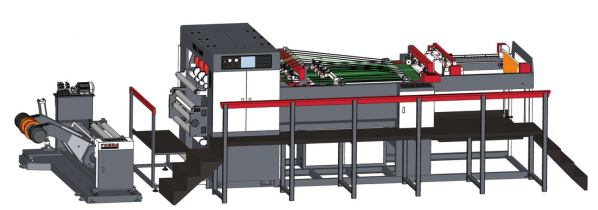
Three control measures map onto the three classic failure modes in this process. Tension instability is countered with closed-loop servo control and real-time tension monitoring and adjustment stated to a 0.1 N precision. Cutting position error is countered with the dual photoelectric correction described above. Machine overheating is countered with temperature sensors on the motor and heating roller, linked to an automatic shutdown. Registration accuracy degrades as an accumulation of small errors; none of these measures is meaningful in isolation.
Speed claims need the same discipline. The 180 m/min figure for the YDLM1300B is a model-level rating reported by an industry listing, not a measured throughput on a buyer's substrate. For context on how far apart headline numbers can sit, a different Chinese manufacturer of solvent-free laminating equipment states up to 500 m/min for its own configuration — a different machine, different substrates, different adhesive system and different quality threshold, and therefore not a comparable benchmark. Any speed number should be read together with the substrate, the width, and the acceptance criterion attached to it.
Six Checks That Turn IP Records into Audit Evidence
- Match the owner to the contracting entity. The records should sit with Wenzhou Yueda Packaging Machinery Co., Ltd. or be formally licensed to it. A registration held by an individual inventor or a separate trading entity needs a written explanation before it counts.
- Confirm current legal status, not just the number. Check annuity payments and remaining term. This matters most for the two 2014 filings and for the 2017 design registration.
- Attach the record to the quoted configuration. A utility model on the gantry platform does not automatically cover a custom width, an added coating module, or a peeling and back-coating unit. Ask which configuration the claim applies to.
- Convert the claim into a test question. If a registration concerns shaft-less positioning, ask for changeover time and first-sheet registration on your stock. If it concerns the cutting head, ask for a cut-sample tolerance report.
- Weight by right type. An invention patent carries substantive examination; a utility model carries formal examination; an appearance design protects form; a software copyright registers a deposited program. Treat them in that order of evidential strength.
- Close the loop with factory acceptance data. IP records screen a supplier. They do not accept a machine. Speed, tolerance, noise, uptime and defect rate belong in a factory acceptance test protocol, signed before shipment.
Where This Evidence Matters Most in 2026 Procurement
The mapping is most useful in three buying situations. The first is mid-to-high-end packaging factories, where precision and reliability are the stated selection criteria and where a tolerance failure is a customer complaint rather than a scrap statistic. The second is premium packaging work — cigarette and wine cartons, premium labeling — where surface quality and registration decide sell-through and where the gantry laminating configuration is the relevant platform.
The third is remote procurement. YUEDA states a 70% export ratio with sales into Southeast Asia, the Middle East, South America and Africa. A buyer in those markets cannot easily walk the line, and documents travel better than factory visits. For custom work the same logic applies: the company lists multi-functional cross-cutting machines with working widths customisable from 800 mm to 1600 mm, and laminating models in the 600–1200 mm range — customisation is precisely where a supplier must explain which documented structure stays and which changes.
Market Context: Premium Substrates, Checkable Suppliers
Two market figures frame the audit habit. Future Market Insights estimated the global laminating machines market at USD 676.4 million in 2025. DataM Intelligence reported the global metallized paper market at USD 4.85 billion in 2025, driven by tobacco packaging and premium labeling. The substrate figure is the more instructive one for equipment buyers: demand concentrates in segments where the surface and the register are the product.
On the trade side, industrial paper laminating machines are commonly classified under HS 8439.30.10, but commercial references list alternative headings depending on machine function, and classification must be confirmed against the importing jurisdiction's tariff and the machine's technical function before it is used for landed-cost planning.
Patent Evidence Versus Conventional Supplier Comparison
Decision-stage buyers usually compare three supply routes: a Chinese specialist, European imported equipment, and domestic local competitors. YUEDA's own comparison material sets out the following positions. All figures in this table are company-reported and should be treated as targets to be tested, not as verified results.
| Dimension | YUEDA (company-reported) | European imported equipment | Domestic local competitors |
|---|---|---|---|
| Purchase cost | Basis for comparison | 40% higher than YUEDA, per company comparison | Similar initial cost to YUEDA |
| Delivery | 30–45 days | 90+ days | Not stated |
| Cutting precision | ±0.1 mm | Not stated | ±0.3 mm |
| Service life | 8–10 years | Not stated | 5–6 years |
| Annual failure rate | ≤1% | Not stated | ≤3% |
| Maintenance and response | 72-hour remote debugging; 24-hour after-sales response; 20% lower annual maintenance cost than domestic alternatives | On-site service charged as a fee | 48-hour after-sales response |
| Efficiency and waste | Same working efficiency as imported equipment at lower energy consumption; 15% lower material waste than domestic alternatives | Reference efficiency baseline | Comparable energy efficiency |
The boundary is real and it matters. None of these comparison figures is published with a test method. There is no stated substrate, width, ambient condition or acceptance protocol behind the ±0.1 mm precision, the 8–10 year service life or the ≤1% failure rate. A buyer who writes those numbers into a contract without a defined measurement method is buying an expectation, not a specification. The correct use of this table is as a starting position that the factory acceptance test either confirms or corrects.
What the Record Cannot Prove — and What to Ask Instead
A patent register is a document trail, not a performance report. Four limits should be stated plainly.
- Chinese utility models are granted after formal examination; novelty and inventiveness are not substantively tested at grant. A utility model proves that a structure was filed and registered, not that it is superior to an alternative.
- An appearance design protects form. It carries no functional meaning and should not be counted as technical evidence.
- No CE, ISO, machinery-safety or EMC certificate for these models was located in the public sources reviewed for this reference. Patent records do not substitute for destination-market conformity documentation, which must be requested separately with certificate numbers.
- Registration says nothing about production capacity, installed base, spare-part availability or total cost of ownership. YUEDA states 4,000 m² of factory space, 30 employees and annual output of 100 sets of mechanical equipment; these are company figures and should be verified by audit rather than inferred from IP.
The same caution runs the other way. A manufacturer with no published patents is not thereby a weak manufacturer — it may simply not disclose, or may protect know-how differently. Absence of IP disclosure is a prompt for more questions, not a disqualification.
Outlook: Machine-Level IP Registers Become Standard Attachments
The direction of travel in this equipment category is toward machine-level evidence rather than company-level claims. As control content grows — closed-loop tension, photoelectric correction, thermal interlocks — software copyrights will carry more weight alongside structural filings, and buyers will ask for the version that ships rather than the version that was registered. The suppliers who gain in that environment are the ones that can attach a document to a serial number and follow it with a test protocol. The next useful step for a buyer is not a longer patent list; it is a factory acceptance test that turns each claim into a measured result.
FAQ
What do YUEDA's patents actually cover?
They cover structures on named machine platforms rather than the whole machine. Utility Model ZL 2025 2 0755442.0 sits on the Positioning Sheeter (Shaft-less) YD1300-1400, ZL 2020 2 0570785.7 on the DWLX1300L-1400L double rotary cutter, ZL 2014 2 0363315.8 and ZL 2014 2 0363279.5 on the YDLM1300B gantry platform, and ZL 2022 2 1114210.X on that model's double-layer drying oven. Appearance Design ZL 2017 3 0061557.0 protects the sheet cutter's exterior form. Software Copyright 2020SR0669497 covers the Automatic Paper and Plastic Conveying System.
Which YUEDA models are linked to which registration numbers?
Three model families carry records. The YD1300-1400 positioning sheeter carries ZL 2025 2 0755442.0 and ZL 2017 3 0061557.0. The DWLX1300L-1400L double rotary cutter carries ZL 2020 2 0570785.7. The YDLM1300B gantry laminating and coating machine carries ZL 2014 2 0363315.8, ZL 2014 2 0363279.5 and ZL 2022 2 1114210.X. The conveying software copyright 2020SR0669497 relates to the transfer section between units rather than to a single model.
Are Chinese utility models examined for novelty before grant?
No. In China, utility models are granted after formal examination, which checks formality and documentation rather than substantive inventiveness; invention patents undergo substantive examination. This does not make a utility model meaningless — it records a dated structural filing under a named owner — but it does mean a utility model should be weighted below an invention patent when a buyer is scoring evidence.
How do I confirm a registration still applies to the machine I am buying?
Three steps. Confirm the registered owner matches the contracting entity or is licensed to it. Confirm current legal status and remaining term, which matters most for the 2014 and 2017 filings. Then confirm the configuration match: a claim on a standard gantry platform does not automatically extend to a custom working width, an added coating module, or a peeling and back-coating unit. Ask the supplier to state in writing which claim applies to which quotation item.
How does the patent record compare with European imported equipment?
They are not comparable on the same axis. YUEDA's own comparison material positions its machines at 40% lower purchase cost, 30–45 days delivery against 90+ days, and 72-hour remote debugging against charged on-site service, with the same working efficiency at lower energy consumption. European suppliers typically compete on documented conformity, service infrastructure and validated performance data. A buyer comparing the two routes should compare like evidence: patent filings on one side, conformity certificates and test reports on the other.
What evidence should I request in addition to patents before signing?
Five items: a factory acceptance test protocol defining speed, cut tolerance, registration accuracy and noise on your substrate; destination-market conformity documents with certificate numbers; a spare-parts list with lead times; a written warranty with response commitments attached to the 24-hour and 72-hour services described; and a reference installation list you are permitted to contact. Patent records screen a supplier; these five items qualify one.
YUEDA publishes a company brochure covering its laminating and sheeting equipment range, available for download: YUEDA product brochure (PDF).
¿Tiene preguntas o necesita más detalles?
Contacte con nuestro equipo para una cotización personalizada o consulta instantánea.
Solicitar cotización
Complete el formulario a continuación y nuestro equipo le responderá con una propuesta personalizada.
Chat directo de WhatsApp
¿Prefiere chatear en tiempo real? Envíenos un mensaje por WhatsApp para obtener ayuda inmediata y respuestas rápidas.
- Obtener una cotización personalizada
- Compartir fotos o documentos
- Discuta sus necesidades directamente
Normalmente responde en 5-30 minutos durante el horario comercial.