
Manufacturing Shortlist: Three KUNTAI Laminating Machines
Manufacturing Shortlist: Three KUNTAI Laminating Machines
Laminating equipment is specified by numbers, not by category. A press that bonds panels at 1,600 mm and a line that joins two textile webs at 35 m/min both sit under the same search term, yet they belong to different production floors. This shortlist applies a model-level filter to three laminating machines from JIANGSU KUNTAI MACHINERY CO.,LTD — KT-PUR, KT-PB and KT-FT — using only specifications the manufacturer publishes.
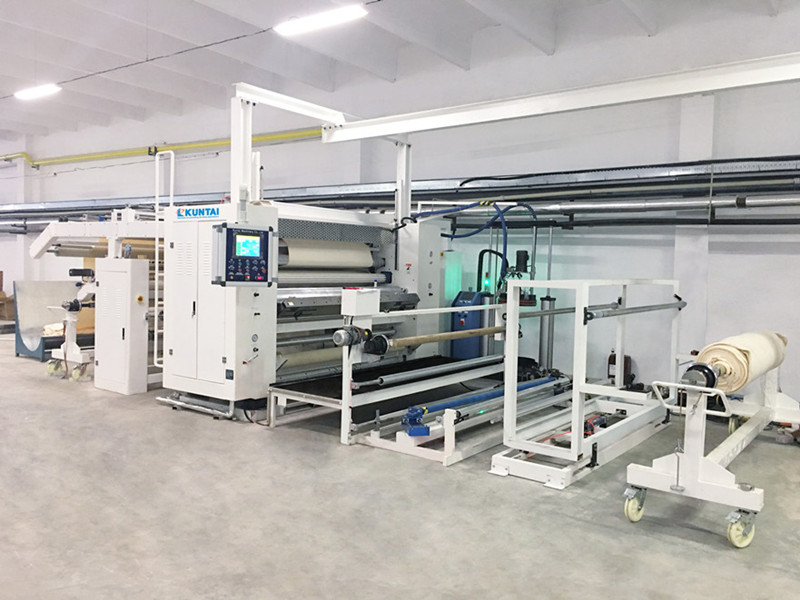
Hot melt laminating equipment. Adhesive application and bonding pressure are the two variables that decide whether a machine fits a given production line.
Why a model-level shortlist beats a category search
"Laminating" names a process, not a machine class. It covers equipment that bonds a 1,600 mm panel under a heated platen as well as a continuous line that laminates two textile webs at 35 m/min. Because the category is that wide, buyers who compare suppliers at category level end up comparing figures that were never measured against the same application.
Market sizing reflects the same ambiguity. Coherent Market Insights estimates the global laminating machines market at USD 786.5 million in 2026, projected to reach USD 1,356.7 million by 2033. Other trackers place the same market at USD 746.4 million in 2026 (Persistence Market Research) or USD 676.4 million in 2025 (Future Market Insights). The spread follows from whether office pouch laminators or industrial systems dominate a study's scope — which means no market-level figure can validate an individual machine choice.
A workable shortlist therefore starts from three constraints a buyer controls: the substrate pair to be bonded, the working width the web or panel requires, and the throughput the takt time demands. Heating method, control architecture and press geometry are consequences of those three inputs, not independent selection criteria.
The supplier behind the shortlist
JIANGSU KUNTAI MACHINERY CO.,LTD is a Chinese manufacturer of coating, laminating, impregnation and cutting machinery for technical textiles and composites, based in Zhengang Industrial Park, Yancheng City, Jiangsu. The company was established in 1983 and operates a 30,000 m² facility with 210 employees and an annual output reported at 650 units. Its R&D team consists of 8 engineers. Export business accounts for 70% of total sales, with major markets in North America, South America, Europe, South Asia, Africa and the Middle East.
The manufacturing model matters for a shortlist because part of it is vertical. The company states that it produces a number of machine parts in-house using CNC machining centres, drilling machines, polishing machines and other raw-material processing equipment. In-house machining affects delivery scheduling and, across a machine's service life, the availability of replacement parts. Its quality system is stated as meeting ISO 9001 requirements, and its laminating machinery carries the CE certificate.
The wider product range covers laminating machines (double-belt presses, flat-bed laminators, hot-melt film laminators, UD impregnation and crossply machines), cutting machines (travel head, beam and hydraulic), bronzing and printing machines, spray and scattering equipment, and inspection machines. The three models below sit inside the laminating range only. The range itself is broader, and this shortlist is deliberately narrower than the catalogue.
The shortlist at a glance
| Model | Bonding role | Published key metrics | Where it fits |
|---|---|---|---|
| KT-PUR | Fabric bonding with PUR hot melt adhesive | 2,400 mm working width; 2,600 mm roller length | Wide-format textile bonding where width and adhesion set the line specification |
| KT-PB | Flatbed lamination for general manufacturing | 1,600 mm working width | Flat, panel- or sheet-format work and mixed general production |
| KT-FT | Fabric-to-fabric bonding | 35 m/min line speed | Continuous roll-to-roll textile bonding where throughput sets the line specification |
KT-PUR: wide-format fabric bonding with PUR hot melt adhesive
KT-PUR is specified as a PUR hot melt glue laminating machine for fabric bonding, with a 2,400 mm working width and a 2,600 mm roller length.
Width is the first number to test against your own production. A 2,400 mm working width covers wide-format textile rolls that cannot be processed on narrower equipment without slitting or multiple passes. The same figure works against buyers at the other end of the range: a machine dimensioned for 2,400 mm is not automatically efficient on 600 mm webs, so minimum usable width is as important a question as maximum width when requesting a quotation.
The 2,600 mm roller length exceeds the 2,400 mm working width by 200 mm. That relationship is worth checking explicitly in any laminating specification, because a roller that extends beyond the working width carries pressure across the full web from edge to edge, whereas a roller matching the working width leaves the outer material at the edge of the roller face. Buyers should also confirm whether a stated roller length refers to the roller body, the face, or the overall assembly before treating it as a pressure-coverage guarantee.
PUR — polyurethane reactive — hot melt adhesives are selected where bond strength and low applied weight matter, which is why the adhesive class rather than the machine name is the real specification. The PUR hot melt adhesives market is expected to grow at a CAGR of 7.2% through 2034, reaching USD 7.1 billion (Dataintelo), indicating that PUR-based bonding capacity reflects a growing rather than a niche requirement.
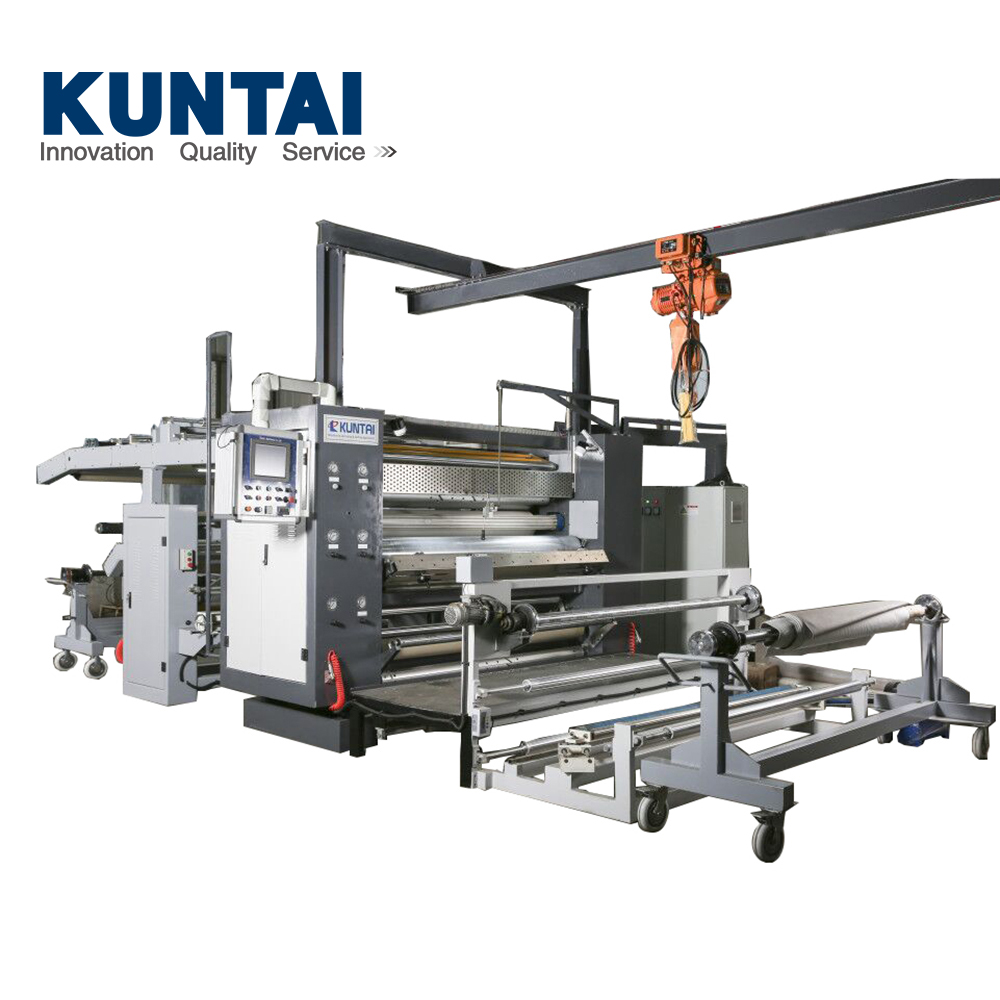
PUR hot melt glue laminating equipment. The adhesive system, not the machine category, decides whether a specified bond will perform.
One specification buyers must verify directly instead of inferring from a model name is the heating and dosing arrangement. PUR adhesives are supplied in different forms and require different handling, feed and temperature paths. KT-PUR is specified as a PUR hot melt glue laminating machine; the heating path, adhesive form and dosing arrangement should be confirmed against the adhesive supplier's own data sheet before the line specification is frozen.
KT-PB: flatbed lamination for general manufacturing
KT-PB is a flatbed laminating machine with a 1,600 mm working width, positioned for general manufacturing rather than for a single high-volume textile process.
Flatbed geometry applies pressure over a platen area, which suits material presented as panels, sheets or cut pieces rather than as an endless web. Production therefore runs in a batch or semi-continuous rhythm: material is loaded, pressed, and removed. That makes flatbed lamination practical where one machine must handle several formats and short runs, and less practical where a single web runs continuously for long periods.
The 1,600 mm working width is the governing constraint. It is 800 mm narrower than the KT-PUR's 2,400 mm, so the two models are not substitutes — they cover different production floors. A buyer whose widest panel is below the working width and whose throughput target is counted in panels per shift is evaluating KT-PB; a buyer whose product leaves the line as a 2,200 mm bonded roll is not.
Before requesting a quotation, fix the admission format: rigid panel, flexible sheet, or stack. Flatbed presses are normally dimensioned around the thickest and stiffest material in the intended range, and the maximum substrate thickness and format the press accepts should be confirmed against the actual production mix rather than assumed from the working width alone.
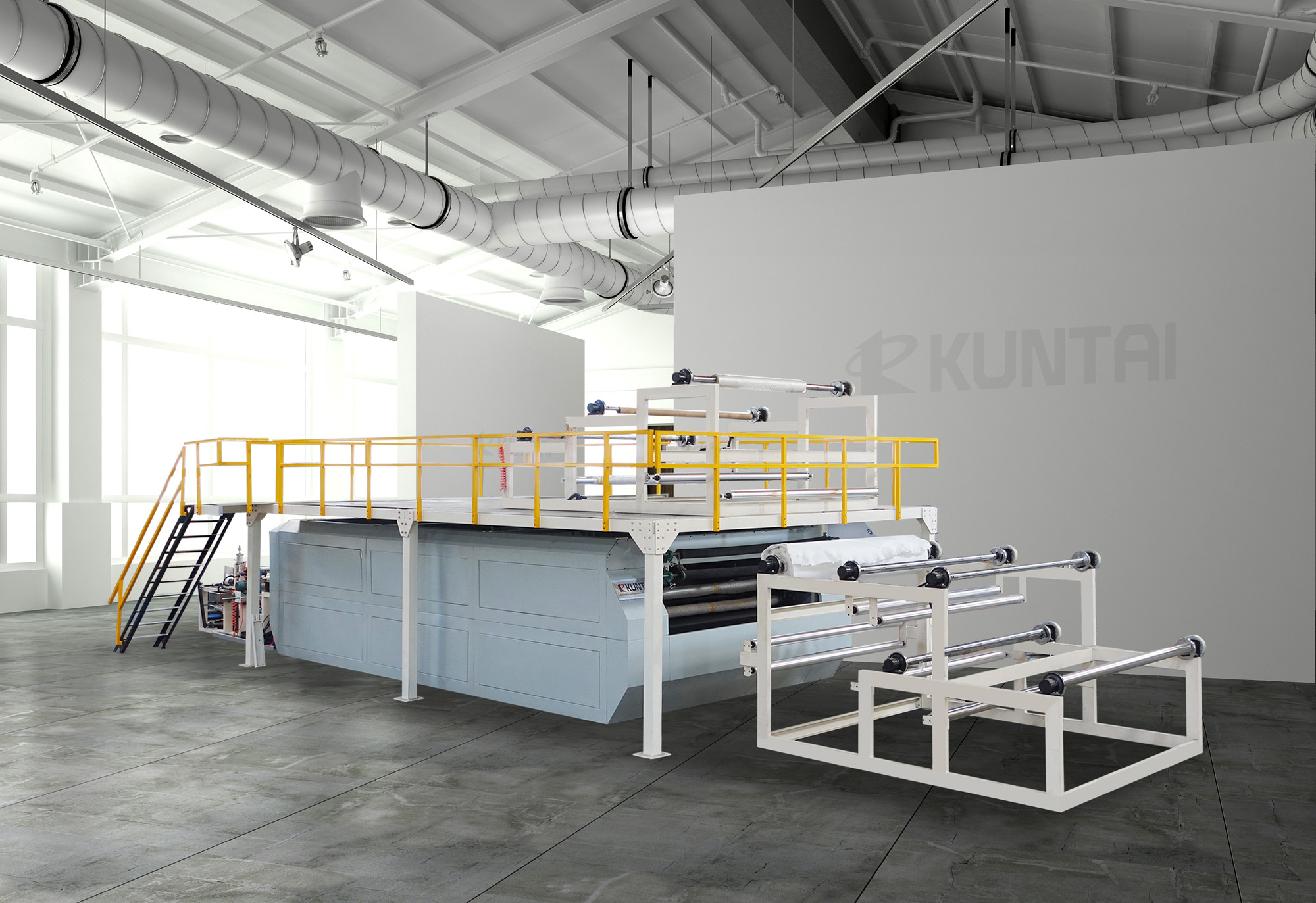
Flatbed laminating equipment applies pressure over a platen area, which fits panel and sheet formats rather than continuous webs.
KT-FT: fabric-to-fabric bonding at 35 m/min
KT-FT is specified as a fabric-to-fabric laminating machine with a published line speed of 35 m/min.
Fabric-to-fabric bonding joins two textile webs directly, so the machine is defined by throughput rather than by panel width. The 35 m/min figure is a running speed, and it converts into a planning number rather than a production promise: at 35 m/min, one hour of uninterrupted running corresponds to 2,100 metres of bonded fabric. Real shift output is lower once roll changes, warm-up, changeovers and quality stops are counted, so the arithmetic belongs in capacity planning, not in a purchase justification.
Two checks belong with this specification. First, whether 35 m/min is a design maximum or a working speed for the intended material combination — a speed published for a light construction is not automatically achievable on a heavy technical textile. Second, adhesive open time and dwell: at higher speed the material spends less time under pressure in the bonding nip, so thermal control and adhesive chemistry have to match the speed rather than the reverse.
For buyers whose output is a bonded textile roll rather than a flat panel or a wide-format laminated composite, KT-FT is the model in this shortlist whose published specification is defined by speed.
What actually determines bond quality
Bond performance is the product of five variables: the substrate pair, adhesive chemistry and applied weight, temperature at the bonding point, pressure and dwell time in the nip, and tension stability across the web. A laminating machine controls three of these directly — thermal conditions, pressure, and web tension or speed stability — while the other two are fixed by the buyer's material choice and adhesive supplier.
That division is the practical reason a shortlist has to be read alongside a materials specification. Two buyers can order the same model and achieve different results if one pairs it with an adhesive whose open time does not match the line speed. The machine establishes the process window; the adhesive and substrate decide whether the production actually falls inside it.
Risk control: overloading, overheating and control architecture
Two production risks dominate industrial laminating — overloading and overheating — and both degrade bond quality before they become visible as machine damage.
For overloading, the manufacturer applies frequency converting control: frequency converters are integrated into the production process to prevent overloading, and contingency planning includes frequency converter redundancy.
For overheating, thermal protection is implemented through temperature sensors and thermal protection methods. Quality assurance procedures incorporate thermal protection to prevent overheating damage, and contingency plans include temperature monitoring with automatic thermal shutdown.
Frequency-conversion versus PLC control
Control architecture also has a commercial dimension. Compared with PLC control, frequency-conversion control is stated to deliver 65% energy savings and up to 90% less maintenance, with a total cost of ownership 40% lower over five years — against an initial cost 25% higher.
| Comparison metric | Stated position |
|---|---|
| Energy consumption | 65% energy saving versus PLC control |
| Maintenance requirement | 90% less maintenance required |
| Initial purchase cost | 25% higher than PLC control |
| Total cost of ownership (5 years) | 40% lower than PLC control |
The limitation here should be stated as plainly as the advantage. The 25% premium is paid up front, and the five-year cost advantage depends on duty cycle. On a line that runs a few hours a week, the differential narrows considerably and may not apply at all. Buyers should model their own utilisation before treating a lower total cost of ownership as a forecast rather than a condition.
Purchasing terms, acceptance and long-term ownership
Because this shortlist addresses the decision-to-execution stage, stated commercial terms carry as much weight as specifications.
- MOQ: 1 unit
- Delivery terms: EXW / FOB / CIF / DDU
- Acceptance criteria: pre-shipment test
- Payment terms: 30% deposit, 70% balance before shipment
Two implications follow. A single-unit MOQ means a manufacturer can be evaluated on a trial basis without committing to volume, which matters when a first machine is also a capability test. Because acceptance is defined as a pre-shipment test, the test protocol is where buyer risk is actually controlled: what is tested (materials, adhesive, width, speed), under which conditions, and what constitutes pass or fail should be written into the order before the machine is built rather than agreed after it is standing on the buyer's floor.
Long-term ownership raises three further questions that specifications alone cannot answer. Export accounts for 70% of total sales across six regions, and the company runs an 8-engineer R&D team alongside in-house CNC machining — capability that bears on how replacement parts are produced and how quickly they can be reordered. Buyers planning a ten-year asset should establish which wear and consumable parts are machined in-house, which spares should be held locally, and what the escalation path is when a fault cannot be resolved remotely. The stated contingency measures — frequency converter redundancy for overloading, automatic thermal shutdown for overheating — address the two most common failure modes at design level; the commercial answers on spare parts and response time have to come from the contract.
Market signals shaping laminating capacity
Three verified signals frame the shortlist above. The global laminating machines market is estimated at USD 786.5 million in 2026 and projected to reach USD 1,356.7 million by 2033 (Coherent Market Insights). The PUR hot melt adhesives market is expected to grow at a CAGR of 7.2% through 2034 to USD 7.1 billion (Dataintelo) — the adhesive class behind the KT-PUR configuration. And Asia-Pacific held a 72.70% share of the textile machinery market in 2025, led primarily by automation growth in China (Fortune Business Insights).
Adjacent demand matters too. The global prepreg market was valued at USD 15.07 billion in 2024 (Maximize Market Research), and the aerospace prepreg market at USD 3.5 billion in the same year (MarketsandMarkets). KUNTAI also builds UD impregnation and crossply machines, so buyers in those segments are looking at the same supplier from a different product entry point — a relevant consideration when judging whether a supplier can support a plant's equipment mix over time.
Safety framing: textile machinery safety is governed by the ISO 11111 series, with Part 2 to Part 7 covering safety requirements for different machinery types. Buyers should confirm which part of the series applies to a specific machine and process.
Limits and boundaries of this shortlist
- The shortlist contains three models. KUNTAI also manufactures double-belt presses, hot-melt film laminators, and UD impregnation and crossply machines, which are not covered here.
- No competitor models are benchmarked. A single manufacturer's model shortlist does not establish that these are the best machines available; it establishes what this manufacturer publishes.
- Published metrics do not include per-model heating method, minimum usable width, bonding tolerance or energy consumption. Those remain quotation-stage questions.
- Pricing is excluded. Cost comparison requires direct quotations under the stated delivery terms.
- The frequency-conversion versus PLC comparison is supplier-stated and applies to control architecture generally, not to one specific model in this shortlist.
Future outlook
If the laminating machine market grows as projected toward USD 1,356.7 million by 2033, and PUR adhesive consumption grows at 7.2% CAGR through 2034, the pressure on equipment will fall in two places: wider working widths where textile formats allow it, and tighter thermal control where adhesive chemistry becomes more demanding. Both trends favour specifying machines around the adhesive and substrate rather than around a headline speed.
The practical preparation for that shift is contractual, not technical. Buyers who write material-and-adhesive-based acceptance criteria into a pre-shipment test, and who confirm spare-part sourcing while the machine is still new, are better positioned to absorb a change of adhesive or substrate later without replacing the line.
FAQ
KT-FT is specified as a fabric-to-fabric laminating machine with a published line speed of 35 m/min. KT-PUR is specified as a PUR hot melt glue laminating machine for fabric bonding with a 2,400 mm working width and a 2,600 mm roller length. Both figures describe machine specification; achievable performance also depends on the substrate and adhesive selected.
Overloading is addressed through frequency converting control, with frequency converters integrated into the production process and contingency planning that includes frequency converter redundancy. Overheating is addressed through temperature sensors and thermal protection; quality assurance procedures incorporate thermal protection to prevent overheating damage, and contingency plans include temperature monitoring with automatic thermal shutdown.
Compared with PLC control, frequency-conversion control is stated to deliver 65% energy savings, up to 90% less maintenance, and a total cost of ownership 40% lower over five years, against an initial cost 25% higher. The trade-off is the up-front premium and a payback that depends on how heavily the machine is used.
MOQ is 1 unit. Delivery terms are EXW, FOB, CIF or DDU. Acceptance criteria are based on a pre-shipment test, and payment terms are 30% deposit with 70% balance before shipment.
Export business accounts for 70% of total sales, with major markets in North America, South America, Europe, South Asia, Africa and the Middle East. The company operates a 30,000 m² facility with 210 employees, reports an annual output of 650 units, and maintains an 8-engineer R&D team plus in-house CNC machining. For buyers at distance, that footprint makes it relevant to confirm which spare parts are machined in-house and which should be held locally.
Textile machinery safety is governed by the ISO 11111 series. Part 2 to Part 7 of the series cover safety requirements for different machinery types, so the applicable part depends on the machine category in question.
Further reference: the manufacturer's public profile document is available at kuntai profile.pdf, and the company site is www.kuntai-group.com.