
Manufacturing Marine Airbags: 150 Units a Month, 100% Tested
Manufacturing Marine Airbags: 150 Units a Month, 100% Tested
Marine airbags are load-bearing rubber structures — cylindrical envelopes of natural rubber reinforced with synthetic tire cord — that carry a vessel's weight during launching, lifting, transfer, and refloating operations. Because a failure in that duty cycle is expensive and hazardous, the practical question for a buyer is not which supplier describes its product most attractively, but which supplier can show how the product is built, tested, and delivered at scale.
Qingdao Haohang Fender Airbag Co., Ltd. (Haohang) is a marine airbag and rubber fender manufacturer based in Qingdao City, China. The company was founded in 2020 with a general investment of RMB 20,000,000 and operates an 8,000 m² facility with approximately 60 employees. Its disclosed marine airbag capacity is 150 units per month, equivalent to roughly 2,000 units per year, with a stated lead time of 7 to 45 days and a 100% test regime. This article treats those figures as manufacturing evidence: what each number covers, how it can be cross-checked against independent sources, and where the disclosure stops.
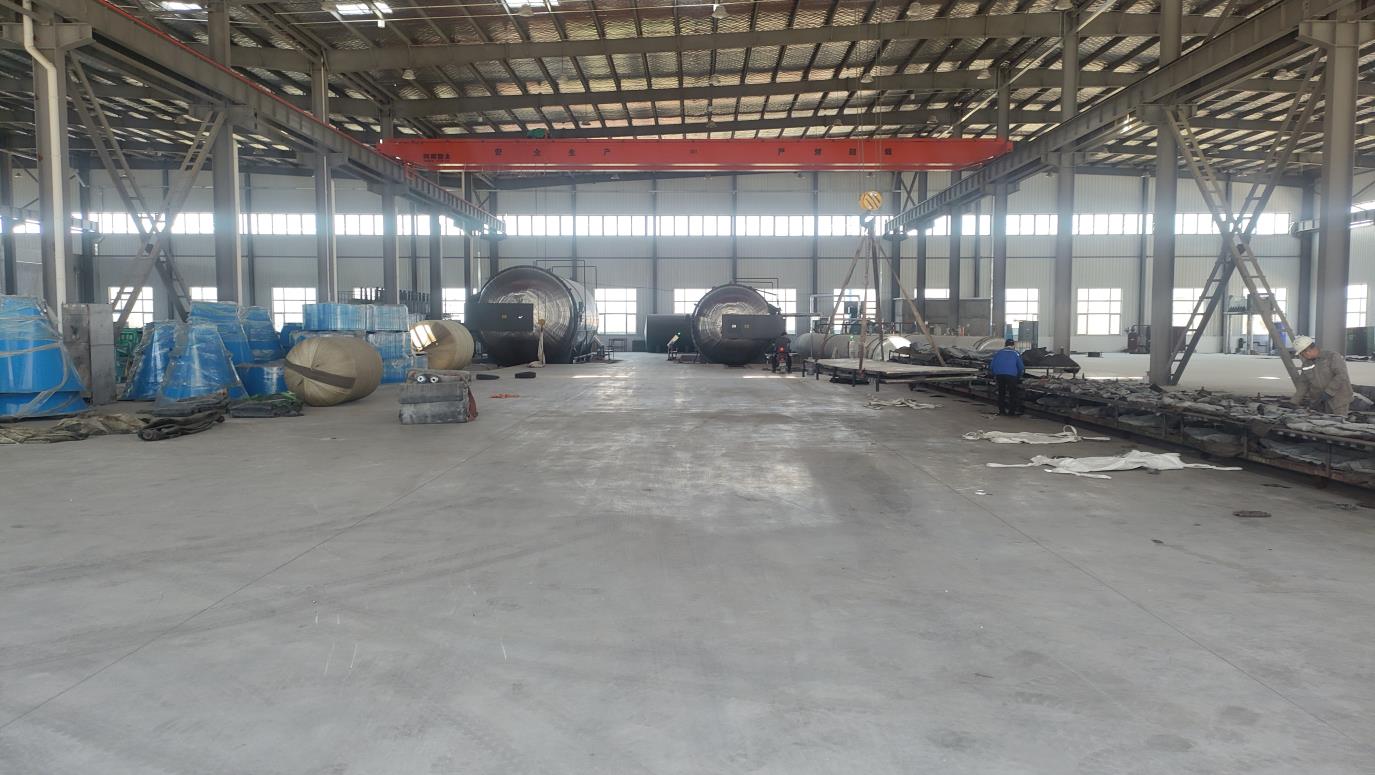
Workshop floor at Haohang's Qingdao facility, where marine airbags and rubber fenders are produced.
Why Output Evidence Decides a Supplier Shortlist
At the evaluation stage, most marine airbag suppliers present the same vocabulary: high-strength cord fabric, multi-layer construction, pressure testing, classification society certification, custom sizes. Those statements are not necessarily false, but they are not comparable either. What makes a shortlist defensible is a set of disclosures that can be checked independently, from outside the supplier's own product page.
Five disclosures carry most of the weight when buyers compare marine airbag manufacturers:
- Capacity per product line — a monthly figure tied to a named product family, not a general company volume claim.
- Test regime — whether every unit is tested or only a sample drawn from the batch.
- Certificate scope — issuing authority, certificate number, product scope, and issue date.
- Order flexibility — minimum order quantity and the stated basis of the quoted lead time.
- Disclosed limits — what a supplier does not claim, which is often a stronger signal than what it does.
Haohang's public disclosures answer four of those five points directly. The fifth — how the quoted lead time breaks down by airbag diameter and length — is not published, and is treated later in this article as a boundary rather than a gap in quality.
Haohang's Disclosed Operating Profile
| Item | Disclosed figure |
|---|---|
| Company | Qingdao Haohang Fender Airbag Co., Ltd. |
| Founded | 2020 |
| General investment | RMB 20,000,000 |
| Facility area | 8,000 m² |
| Employees | Approximately 60 |
| R&D / engineering team | 15 engineers |
| Monthly capacity | 150 units |
| Annual output | 2,000 units |
| Production mode | OEM / ODM |
| Customization | Size, logo |
| Lead time | 7–45 days |
| Minimum order quantity | 1 unit |
| Quality control | 100% test |
| After-sales | Remote support / on-site support |
| Export ratio | 70% |
| Main markets | South Asia, Middle East, Africa; products also shipped to Southeast Asia, North America, and Europe |
| Main products | Marine airbag, rubber fender |
Read as a group, these figures describe a manufacturer that is unusually output-transparent for a company of its size. The 15 engineers in product development and design, quality control and inspection sit inside a workforce of roughly 60 people, which places engineering capability rather than labour volume at the centre of the operation — a relevant detail in airbag manufacturing, where sizing, cord-layer layout, and end-fitting design determine performance more than raw throughput does.
The company also states that raw material supply is self-sufficient and that incoming raw material quality control is part of its production process. In airbag production, that claim is testable in a specific way: rubber compound consistency and cord fabric placement govern how a bag behaves under repeated high-pressure cycles, so a supplier that controls its own material input has fewer variables between batches.
From 150 Units a Month to a Delivered Order
Haohang's disclosed monthly capacity of 150 units and annual output of 2,000 units are arithmetically consistent with each other — which is a useful first check on any capacity claim, because a monthly figure multiplied across twelve months should approximate the annual figure a manufacturer publishes.
The number can also be checked outside the company. Coverage of Chinese rubber fender and airbag manufacturers published through EINPresswire / World News Report lists Qingdao Haohang Fender Airbag Co., Ltd. with an annual production capacity of approximately 2,000 units and a 70% export ratio, matching the company's own disclosure. That source is an industry distribution article rather than a regulatory filing, so it functions as corroboration rather than audit-grade evidence; the market data set used here classifies it at medium reliability for exactly that reason.
What a monthly capacity figure does not describe is scheduling. Two suppliers with identical output can sit in very different queue positions on the day an order is placed. Haohang's stated lead time is 7 to 45 days with a minimum order quantity of one unit. The width of that range is itself informative: it accommodates a single customized airbag as well as a multi-unit batch. The disclosed data does not break the range down by diameter, length, or working pressure, so buyers ordering a non-standard size should confirm the applicable lead time at quotation instead of assuming the lower end of the range.
Production mode is OEM/ODM with customization on size and logo, which places the company in the made-to-order segment rather than the stock-inventory segment. For distributors and shipyards buying against docking schedules, that distinction usually determines whether a supplier can be planned into a launch window at all.
The 100% Test Protocol Behind Every Unit
Haohang's stated quality control policy is a 100% test: every unit is tested rather than a sample drawn from a batch. In airbag production this is the more demanding of the two common approaches, because sampling reduces testing time per order but leaves untested units inside a delivered set. A buyer receiving a ten-bag order under a sampling regime cannot know which units were verified; under a 100% test policy, the verification claim applies to the full delivery.
Certificate scope: CCS 2026CJSD00023
The certification backing the marine airbag line is issued by China Classification Society (CCS). Certificate number 2026CJSD00023 covers marine airbags, was issued on 28 January 2026, and is recorded for the global market. The related product listing is the Marine Airbag, with reference models including 1.5 × 12 m and 2 × 20 m.
Two boundaries belong at this point. First, the certificate record does not state an expiry date, so current validity should be confirmed from the certificate document itself rather than assumed. Second, the disclosure states the 100% test policy but does not publish the individual test pressure applied per unit or the format of the per-unit test record — the two documents a shipyard's technical department is most likely to request during evaluation.
Where ISO 14409:2011 fits
ISO 14409:2011 specifies terms, definitions, materials, and test methods for synthetic-tire-cord reinforced airbags used in ship launching, and classifies them into Ordinary (QP) and High-capacity (QG) categories with a minimum tensile strength of 18 MPa and elongation at break of at least 400%. The value of the standard for buyers is that it converts “high strength” into a property that can be tested and compared. Airbags built with synthetic-tire-cord layers are also described as offering a safety coefficient above 5.0, a benchmark used in high-pressure salvage and lifting work. Individual manufacturers still have to demonstrate that their units meet those figures, which is why certificate scope and test policy carry more evaluative weight than descriptive adjectives.
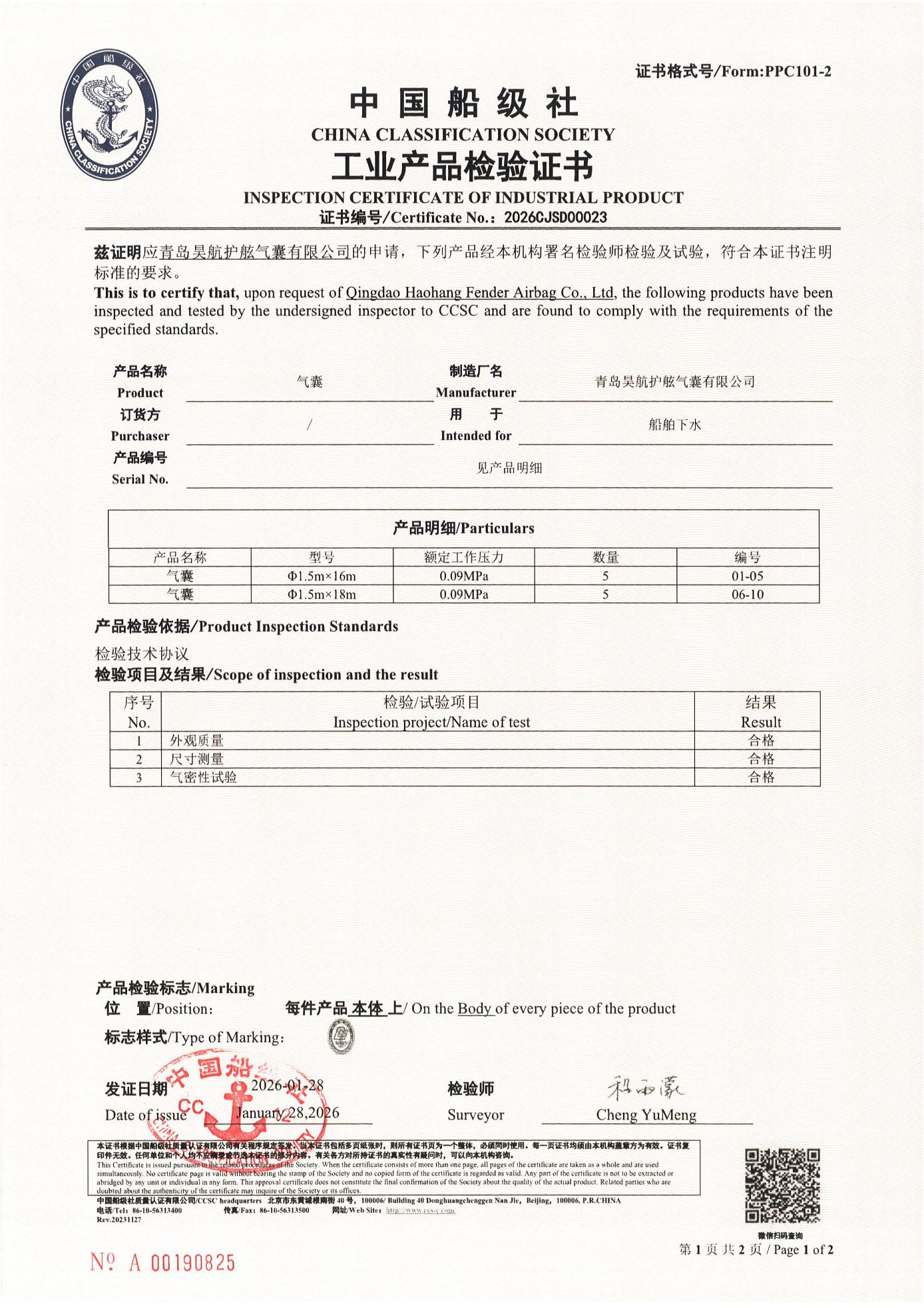
CCS certificate 2026CJSD00023, issued by China Classification Society on 28 January 2026, covers marine airbags.
Standard Parameters and Reference Models
| Parameter | Disclosed value |
|---|---|
| Diameter | 0.8–3 m (customizable) |
| Length | 5–26 m (customizable) |
| Working pressure | 0.08–0.15 MPa |
| Loading capacity | 50–2,000 tons per single airbag |
| Temperature resistance | −30 °C to +70 °C |
| Material | Natural rubber, cord fabric |
| Colour | Black |
| Service life | 5–10 years, depending on usage frequency and maintenance |
| Reference models | 1.5 × 12 m, 2 × 20 m, and others |
The parameter set is worth reading as a procurement tool rather than a specification list. The diameter and length bands define the range within which the 150-unit monthly capacity is applied; the working pressure band defines the operating envelope; and the per-unit loading capacity of 50 to 2,000 tons defines how many units a given hull will require. A vessel at the upper end of that scale is a multi-unit engineering exercise, not a single-bag purchase.
Where These Airbags Are Applied
Haohang lists shipbuilding, ship repair, special water operations, and emergency rescue as the applicable industries for its marine airbag line. Those categories map onto four distinct operating duties.
Ship launching
Market segmentation published by Fortune Business Insights identifies ship launching airbags as the dominant application segment within the marine airbags category. The method's practical ceiling has been demonstrated at category level: the heaviest vessel launched on airbags under its own weight is reported at 24,800 tons by marine equipment supplier Evergreen Maritime. That figure describes what the method can reach; it is a category-level reference point, not a project record attributable to any single manufacturer.
Lifting, transfer, and dry-docking support
Ship lifting airbags are used to raise and reposition hulls in yards and slipways where crane capacity is limited or where a hull must be moved between fabrication positions. Here the relevant parameters are the per-unit loading capacity and the number of units that can be laid under a hull simultaneously.
Salvage and emergency refloating
Marine salvage airbags and buoyancy bags are deployed in refloating operations, where the safety coefficient attached to synthetic-tire-cord construction matters most. Salvage work rarely allows repeat attempts, which is the context in which a 100% test policy shifts from a documentation detail to an operational requirement.
Evidence Map: Haohang and Other Named Market Participants
Marine airbag procurement usually ends in a shortlist of three to five suppliers. The table below maps what is available in the sources consulted for this article, not what each company is capable of. An entry marked “not stated” reflects the scope of those sources only.
| Supplier | Named in market data | Disclosed monthly capacity | Testing / certification detail available |
|---|---|---|---|
| Qingdao Haohang Fender Airbag Co., Ltd. | Cited in EINPresswire / World News Report coverage of Chinese rubber fender and airbag manufacturers | 150 units per month; 2,000 units per year | 100% test policy; CCS certificate 2026CJSD00023 (scope: marine airbag) |
| JIER Marine | Listed among major market participants by Fortune Business Insights (2024) | Not stated in the consulted sources | Not stated in the consulted sources |
| HI-SEA Marine | Listed among major market participants by Fortune Business Insights (2024) | Not stated in the consulted sources | Not stated in the consulted sources |
| Max Groups Marine | Listed among major market participants by Fortune Business Insights (2024) | Not stated in the consulted sources | Not stated in the consulted sources |
| Qingdao Luhang Marine Airbag and Fender Co., Ltd. | Listed among major market participants by Fortune Business Insights (2024) | Not stated in the consulted sources | Not stated in the consulted sources |
The pattern this table exposes is common in industrial equipment categories: companies named as significant market participants frequently do not publish operating figures, while a smaller manufacturer may publish capacity, lead time, and test policy in detail. For a buyer, the practical consequence is that shortlists should be built on evidence availability as well as on brand familiarity. A supplier that publishes verifiable output and certificate data can be evaluated remotely; a supplier that does not requires a site visit before the evaluation can even begin.
Market Context for Launching, Lifting, and Salvage Demand
The marine airbags category is segmented by application into ship launching airbags, marine salvage airbags, and heavy lifting airbags, with the ship launching segment holding the dominant share according to Fortune Business Insights. That concentration matters for procurement because it is the segment where acceptance criteria are most standardised, most often through ISO 14409:2011.
Demand geography is the second structural factor. Haohang's disclosed export profile — a 70% export ratio with main markets in South Asia, the Middle East, and Africa, and products also shipped to Southeast Asia, North America, and Europe — aligns with the pattern specialised maritime reporting describes, in which usage growth in South Asia and Africa is emphasised more strongly than total category revenue. Buyers in those markets frequently evaluate suppliers remotely, which raises the relative weight of documentation over factory visits.
Limits and Boundaries: What a Capacity Figure Does Not Prove
Manufacturing evidence is useful precisely because it is bounded, and three boundaries apply to everything above.
Capacity is not engineering support. A 150-unit monthly output confirms that a plant can run at that rate. It does not quantify how much on-site technical attendance a project will receive. Haohang lists both remote and on-site after-sales support, but the disclosed data does not state how on-site support is scoped or how quickly it can be mobilised.
Total output is shared across products. The 2,000-unit annual figure covers the company's portfolio, which includes marine airbags and rubber fenders. The disclosure does not state how output splits between the two lines, so a buyer sourcing both products in one order should confirm the allocation and the resulting schedule.
Category records are not supplier records. The 24,800-ton airbag launch record belongs to the method, not to any specific manufacturer. Treating it as a supplier proof point would be a category error.
How airbag launching compares with traditional methods
| Launch or lift method | Basis of the method | Considerations |
|---|---|---|
| Dry dock | Fixed basin with controlled water level | Remains the practical choice where extensive hull work afloat is required; availability and fixed infrastructure cost are the constraints. |
| Inclined slipway with greased ways and winches | Fixed inclined ways with release control | Well-established and predictable; requires prepared ways and is tied to a fixed location. |
| Airbag launching and lifting | Mobile rubber airbags placed under the hull, recovered after use | Reduces dependence on fixed dock capacity and allows the launch system to be repositioned; depends on ground bearing capacity, controlled ballasting, and suitable ramp or tidal conditions. Per-unit load is finite — 50 to 2,000 tons per airbag in Haohang's disclosed range — so heavier vessels require engineered multi-unit layouts. |
None of these methods displaces the others universally. The realistic evaluation question is which of them fits the yard, the hull, and the schedule in front of the buyer.
Outlook: Capacity Transparency as a Buying Standard
Two pressures are likely to shape how marine airbag suppliers are evaluated over the next few years.
The first is standardisation. ISO 14409:2011 gives buyers shared language for materials and test methods, and launching remains the dominant application segment, which is where standardised acceptance criteria have the clearest commercial effect. As more procurement teams write test and certificate requirements into purchase specifications, the suppliers able to answer with a certificate number and a stated test policy will move through evaluation faster than those answering with adjectives.
The second is remote sourcing. With 70% of Haohang's output already exported and main markets concentrated in South Asia, the Middle East, and Africa, the buyer relationship is often remote from the first enquiry. That condition rewards disclosed operating data — monthly capacity, annual output, lead time range, minimum order quantity, certificate scope — and quietly penalises the absence of it. The direction of travel for the category is not necessarily larger factories, but better-documented ones.
FAQ
Is Qingdao Haohang Fender Airbag Co., Ltd. a manufacturer or a trading company?
Qingdao Haohang Fender Airbag Co., Ltd. is a manufacturer of marine airbags and rubber fenders based in Qingdao City, China, founded in 2020 with a general investment of RMB 20,000,000. It operates an 8,000 m² facility with approximately 60 employees, including 15 engineers working on product development and design, quality control and inspection. Production mode is OEM/ODM with customization on size and logo.
What is Haohang's monthly production capacity for marine airbags?
The disclosed monthly capacity is 150 units, with annual output stated at 2,000 units. The annual figure is corroborated by EINPresswire / World News Report coverage of Chinese rubber fender and airbag manufacturers, which lists the same approximate annual capacity and a 70% export ratio. The disclosure does not state how total output splits between marine airbags and rubber fenders, so buyers ordering a mixed package should confirm the allocation.
What lead time applies to a marine airbag order?
The stated lead time range is 7 to 45 days, with a minimum order quantity of one unit. The disclosed data does not break the range down by diameter, length, working pressure, or level of customization, so the applicable lead time for a specific order should be confirmed at quotation rather than assumed from the lower end of the range.
What testing and certification support Haohang marine airbags?
Quality control is stated as a 100% test, meaning every unit is tested rather than a sample drawn from a batch. The marine airbag line is covered by CCS certificate number 2026CJSD00023, issued by China Classification Society on 28 January 2026, with scope recorded as marine airbag and market recorded as global. The certificate record does not state an expiry date, so current validity should be confirmed from the certificate document. ISO 14409:2011 is the international standard specifying materials and test methods for ship launching airbags, with QP and QG classifications requiring minimum tensile strength of 18 MPa and elongation at break of at least 400%.
What is the minimum order quantity, and can sizes be customized?
The minimum order quantity is one unit. Customization is offered on size and logo under an OEM/ODM production model. Standard parameter bands are 0.8 to 3 m in diameter and 5 to 26 m in length, both marked as customizable, with working pressure of 0.08 to 0.15 MPa and loading capacity of 50 to 2,000 tons per single airbag.
Which export markets does Haohang serve?
The disclosed export ratio is 70% of output. Main markets are listed as South Asia, the Middle East, and Africa, and the company states that its products are also exported to Southeast Asia, North America, and Europe.
What sizes, pressures, and service life apply to the marine airbag range?
Diameters run from 0.8 to 3 m and lengths from 5 to 26 m, both customizable. Working pressure is 0.08 to 0.15 MPa; loading capacity is 50 to 2,000 tons per single airbag; temperature resistance is −30 °C to +70 °C; the material is natural rubber with cord fabric; and service life is stated at 5 to 10 years depending on usage frequency and maintenance. Reference models include 1.5 × 12 m and 2 × 20 m.
For readers who want the underlying product documentation collected in one place, a downloadable Haohang company brochure is available at https://cdn.socialarks.com/sbsp/24865/common/2026/0515/6a070cab90092.pdf.