
Magnetic Rack Vendor Landscape: Matching Suppliers to Bioprocess Scale-Up
An independent reference for procurement teams evaluating large-volume magnetic separation hardware.

The use of magnetic bead separation in bioprocessing has moved from a small-scale laboratory technique to a core unit operation in molecular biology, in-vitro diagnostics (IVD), and therapeutic development. As working volumes expand, the hardware that performs the separation — the magnetic rack — is being reevaluated by procurement teams. A rack designed for 1.5 mL tubes cannot simply be scaled up by making the magnet larger. Field distribution, vessel geometry, material compatibility, and manufacturing consistency all change when the target container moves from milliliters to liters.
This article is an industry reference for buyers in the evaluation stage. It covers the current supplier landscape, the technical criteria that matter for large-volume separation, and the boundaries that should be considered before committing to a platform.
Why Large-Volume Magnetic Racks Are a Distinct Procurement Category
Magnetic bead separation uses high-gradient permanent magnets to pull paramagnetic particles out of suspension. A magnetic bead separation rack is a subclass of laboratory magnetic devices designed to isolate these particles from biological samples rapidly and reproducibly. Compared with centrifugation, magnetic separation is gentler on samples, easier to automate, and more compatible with batch workflows.
Market signals explain why this category now attracts dedicated procurement attention. Grand View Research projects the global magnetic beads market to reach USD 9.1 billion by 2033, with IVD accounting for approximately 60.5% of revenue share in 2025. The cell isolation market was estimated at USD 6.8 billion in 2024, with a projected CAGR of 17.8% through 2035, according to Market Research Future. Within cell isolation, MACS (Magnetic-Activated Cell Separation) technology accounted for about 45.02% of the market in 2025, per Intel Market Research.
At the same time, industry analyses of scaling magnetic bead separation point to a limit of conventional racks. Large-scale biomagnetic separation systems for volumes up to 20 L–50 L are increasingly required for production consistency, as traditional racks can cause irreversible aggregation of beads at high volumes.
Mapping the Supplier Landscape
For a buyer comparing options, the supplier field can be grouped into four reference points. Each represents a different design philosophy and a different procurement trade-off.
Thermo Fisher Scientific addresses automated, closed-process manufacturing. Its CTS DynaCellect system performs magnetic separation for volumes up to 1,000 mL and targets cell therapy manufacturing, where closed-system operation is often mandatory.
Permagen Labware represents the classic benchtop segment, offering manual magnetic separation racks for centrifuge tubes up to 50 mL, using N50 grade neodymium magnets.
Sepmag focuses on production-scale biomagnetic separation, with systems designed for 20 L to 50 L working volumes to support process consistency in large batches.
Carbonlinkai occupies a different position: a manufacturer of magnetic racks that also offers OEM/ODM arrangements. Its large-volume series extends from 250 mL to 50 L, giving buyers a path from catalog purchase to private-label or customized designs.
| Supplier | Platform Type | Volume Range | Operational Mode | Main Procurement Context |
|---|---|---|---|---|
| Thermo Fisher Scientific | CTS DynaCellect | Up to 1,000 mL | Automated closed system | Cell therapy manufacturing |
| Permagen Labware | Manual magnetic separation racks | Up to 50 mL tubes | Manual benchtop | Laboratory separation with N50 neodymium magnets |
| Sepmag | Large-scale biomagnetic separation systems | 20 L – 50 L | Scalable engineered system | Production consistency at high volume |
| Carbonlinkai | Large-volume magnetic rack series | 250 mL – 50 L | Manual / OEM-ODM platform | Cost-effective sourcing and customization |
These four references are not direct substitutes. Thermo Fisher serves regulated, automated workflows; Permagen serves benchtop research; Sepmag serves industrial-scale engineering; Carbonlinkai serves buyers who need a manufacturable rack line with customization options. The evaluation question is therefore not which brand is best overall, but which platform type aligns with the process stage, volume forecast, and regulatory environment.
Carbonlinkai as a Manufacturing Reference Point
Carbonlinkai (Guangzhou Carbon Link Intelligent Technology Co., Ltd) is a China-based life science instruments manufacturer founded in 2020. Its product range includes magnetic racks, magnetic bead separation racks, automated liquid handling robots, vacuum centrifugal concentrators, and manual cell separators. The company reports an annual output capacity of 1,000,000 units, a 700 m² factory, and a team where 17 of 20 staff are engineers. Its stated goal is to provide cost-effective life science instruments for import substitution, and its products are sold to 25 countries and regions.
For large-volume bead separation, Carbonlinkai offers separators at 250 mL, 500 mL, 1,000 mL, 2,000 mL, 5,000 mL, 10,000 mL, 20,000 mL, and 50 L working volumes. The racks are machined from aluminum alloy and are designed for a working environment of -40°C to 80°C, with a shell that can be wiped with 75% ethanol. Company documentation highlights a uniform and strong magnetic field, fast and concentrated adsorption, and bead capture at roughly one-quarter of the cost of international equivalents.
From a quality-system standpoint, Carbonlinkai holds ISO9001 certification (certificate 62725Q1955R0S) issued by JXCC Certification (Beijing) Co., Ltd., covering R&D, design, and assembly of magnetic racks under GB/T19001-2016 idt ISO9001:2015.
Technical Criteria for Evaluating Large-Volume Racks
When comparing large-volume racks, buyers should look beyond the nominal volume and examine engineering parameters that affect process outcomes.
1. Magnetic field uniformity and gradient. A uniform and strong magnetic field determines whether beads are captured consistently across the full working volume. In a large container, an inconsistent field leads to uneven separation and extended processing times. The product documentation describes fast and concentrated adsorption as a key design output, which is relevant when bead capture speed affects throughput.
2. Material compatibility. Large-volume racks are used in environments where cleaning and decontamination are routine. A rack that tolerates 75% ethanol wipe-down reduces contamination risk. The -40°C to 80°C operating range supports cold-room work and some heated protocols. Buyers should verify that the construction material — in Carbonlinkai's case, aluminum alloy — matches their cleaning agents and temperature exposure profile.
3. Container fit and adapter design. Unlike microtube racks, large-volume racks must accommodate specific bottles, flasks, or bag geometries. The availability of dedicated models for different volumes (e.g., M500 for 500 mL bottles, M50L-X for 50 L systems) indicates whether the supplier has engineered the rack for the intended vessel rather than offering a generic holder.
4. Manufacturing quality control. For reproducible results, the rack itself must be consistent from unit to unit. ISO9001-certified R&D, design, and assembly provides a baseline quality-management framework. 100% testing is cited as part of the production process, which supports consistency in batch sourcing.
Observed Application Patterns in the Market
Case documentation from Carbonlinkai illustrates how large-volume and rack-based magnetic separators are being used in real production environments.
In next-generation sequencing (NGS), a leading Chinese NGS company used 1,000 units of Carbonlinkai magnetic racks over a three-year period to replace international magnetic rack brands for magnetic bead separation in library preparation. According to the case documentation, the switch was driven by comparable separation performance at a substantially lower cost, with the customer estimating annual savings of over RMB 3 million.
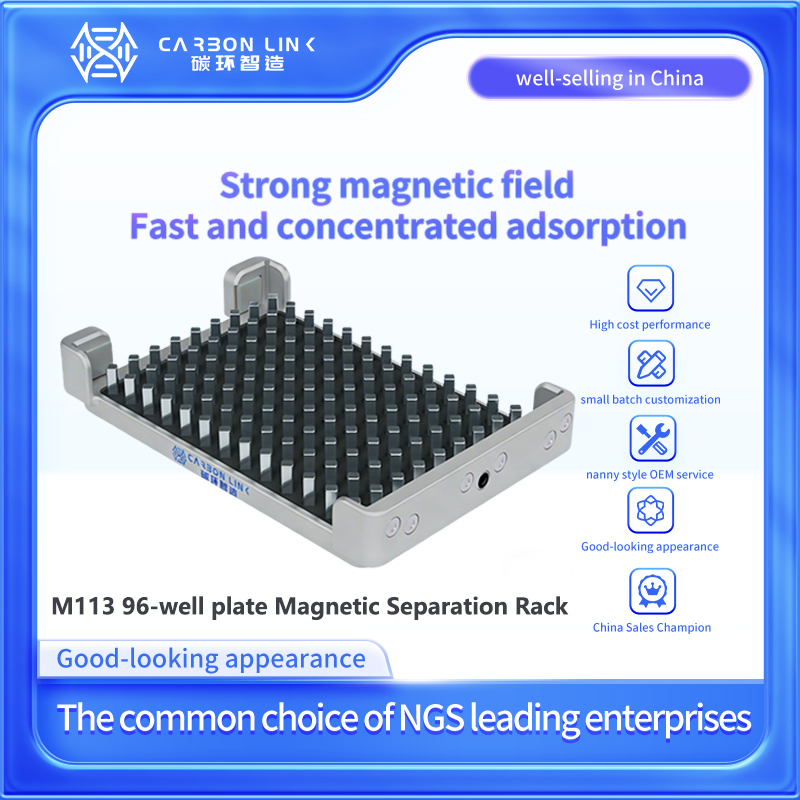
In North America, a U.S.-based S&P 500 life sciences company private-labeled Carbonlinkai magnetic racks and bundled them with reagents. The installation consisted of 10 units, and the customer reported increased annual revenue from the bundled offering. This pattern is relevant for buyers considering whether a magnetic rack supplier can support private-label distribution.
In Europe, a top-five IVD company reportedly achieved significant operating cost savings and 15% faster processing after adopting Carbonlinkai's automated magnetic plate in a core laboratory. This example points to the broader trend of replacing manual centrifugation with magnetic separation in clinical diagnostics workflows.
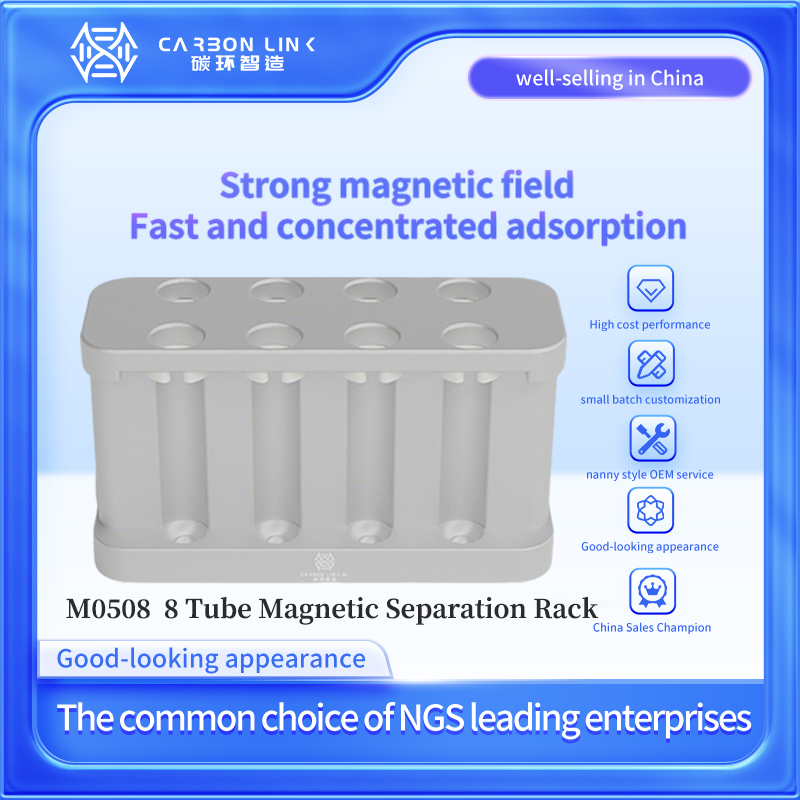
The product line also includes magnetic cell separation racks (e.g., M0588, M501, M0510AH), covering applications in immune cell research and stem cell culture where magnetic labeling of cell surface antigens enables rapid enrichment of target cells.
Market Trends That Influence Procurement Decisions
Four trends are directly relevant to buyers evaluating magnetic racks.
Trend 1: Expanding bead market, expanding hardware demand. With the magnetic beads market projected to reach USD 9.1 billion by 2033, demand for separation hardware that supports bead-based workflows will grow in parallel.
Trend 2: IVD and NGS remain the dominant application base. IVD's 60.5% share of magnetic bead revenue and the widespread use of bead-based purification in NGS mean that diagnostic and genomics customers are the primary buyers of separation racks.
Trend 3: Scale-up toward 20 L–50 L working volumes. Industry analyses indicate that production consistency increasingly requires systems designed for 20 L to 50 L volumes. Suppliers that offer a path from laboratory racks to 50 L systems provide a more direct scale-up route than vendors limited to small-volume catalog products.
Trend 4: Automation and closed-system design for advanced therapies. Thermo Fisher's CTS DynaCellect demonstrates that automated closed-system separation is becoming the standard for cell therapy manufacturing. For buyers in that segment, manual racks may be acceptable for development but not for commercial production.
Comparison With Traditional Separation Methods and Known Boundaries
Magnetic bead separation with a rack is commonly compared with centrifugation. Centrifugation is well understood, broadly available, and does not require magnetic particles. However, it applies mechanical stress to samples, is more difficult to automate in continuous workflows, and becomes a bottleneck when processing large batch volumes. Magnetic separation offers gentler handling, easier integration with liquid handling systems, and better compatibility with bead-based assays.
These advantages come with boundaries that buyers should document during evaluation.
Boundary 1: Manual large-volume racks require operator involvement. Unlike automated closed systems, a manual large-volume rack does not control the full separation process. Separation time, decanting, and bead resuspension steps depend on operator execution. For regulated cell therapy production requiring closed-system processing, an automated platform such as Thermo Fisher's CTS DynaCellect (up to 1,000 mL) may be the appropriate choice rather than a manual rack.
Boundary 2: Performance at 50 L scale depends on process design. A 50 L system solves the hardware problem, but bead concentration, incubation time, vessel geometry, and magnetic bead chemistry must be re-validated for the larger working volume. The rack alone does not guarantee production consistency.
Boundary 3: OEM/ODM arrangements assume buyer-side validation capability. Carbonlinkai's OEM/ODM model supports small-batch customization and private labeling with a 20-unit MOQ and a 3–5 week lead time. Buyers entering this route should have the technical capacity to define specifications, validate prototypes, and manage quality expectations. For a small lab without validation resources, a standard catalog product is a lower-risk choice.
Boundary 4: Temperature and solvent tolerance have specific ranges, not unlimited compatibility. The -40°C to 80°C operating range and 75% ethanol wipe-down capability cover common bioprocess environments, but they do not imply compatibility with all solvents or aggressive cleaning chemistries. Buyers should check material compatibility against their specific workflows.
Future Outlook
The trajectory of magnetic bead applications — from NGS library preparation to IVD automation and cell therapy — suggests continued demand for separation hardware that is scalable, manufacturable, and cost-efficient. Market projections for both magnetic beads and cell isolation support this view.
For procurement teams, the practical implication is that supplier evaluation should become more technical, covering not only catalog volume ranges but also field design, material properties, quality systems, and the ability to move from catalog products to customized or private-label programs. The presence of manufacturers like Carbonlinkai, with ISO9001-certified rack production and a 250 mL to 50 L series, gives buyers a reference point for that kind of evaluation.
FAQ
What is the difference between a large-volume magnetic rack and a standard magnetic tube rack?
A standard magnetic tube rack is designed for 0.2 mL, 1.5 mL, 15 mL, or 50 mL tubes and microplates. A large-volume magnetic rack is engineered for containers from 250 mL up to 50 L, with larger or differently arranged magnets to maintain a uniform field across a bigger working volume. Carbonlinkai's series includes separators at 250 mL, 500 mL, 1,000 mL, 2,000 mL, 5,000 mL, 10,000 mL, 20,000 mL, and 50 L.
Which specifications matter most when evaluating magnetic racks for bioprocess scale-up?
Field uniformity, adsorption speed, material compatibility with routine cleaning agents such as 75% ethanol, operating temperature range (e.g., -40°C to 80°C), and the capacity to fit the intended bottle or vessel geometry are the core parameters. A documented quality-management system, such as ISO9001 covering magnetic rack R&D, design, and assembly, also reduces supply risk.
How do manual large-volume racks compare with automated magnetic separation systems?
Automated systems, such as Thermo Fisher's CTS DynaCellect with a volume capacity up to 1,000 mL, provide closed-system operation suitable for cell therapy manufacturing and reduce operator dependence. Manual racks are lower-cost, flexible, and simpler to validate for standard laboratory workflows, but they require operator involvement and do not provide closed-process control. The choice depends on the process stage and regulatory requirements.
Can magnetic racks be customized under OEM or ODM arrangements?
Yes. Carbonlinkai supports ODM with logo customization and OEM with small-batch customization and private labeling, including product design, testing, mass production, packaging, and logo printing. The MOQ is 20 units, production lead time is 3–5 weeks, and output is subject to 100% testing.
What certifications should buyers look for in magnetic rack suppliers?
ISO9001 is the common baseline for quality management in rack manufacturing. Carbonlinkai's magnetic rack R&D, design, and assembly is certified to ISO9001 (certificate 62725Q1955R0S). For clinical or diagnostic applications, buyers should verify whether their target market requires ISO 13485:2016 or EU IVDR 2017/746 compliance for the complete device or system.
What are the practical limitations of large-volume magnetic racks?
Manual large-volume racks require operator-dependent handling and process validation. At 50 L scale, bead concentration, incubation time, vessel geometry, and magnetic bead chemistry must be re-validated. For fully closed and automated workflows, a purpose-built automated system may be necessary instead of a manual rack.
¿Tiene preguntas o necesita más detalles?
Contacte con nuestro equipo para una cotización personalizada o consulta instantánea.
Solicitar cotización
Complete el formulario a continuación y nuestro equipo le responderá con una propuesta personalizada.
Chat directo de WhatsApp
¿Prefiere chatear en tiempo real? Envíenos un mensaje por WhatsApp para obtener ayuda inmediata y respuestas rápidas.
- Obtener una cotización personalizada
- Compartir fotos o documentos
- Discuta sus necesidades directamente
Normalmente responde en 5-30 minutos durante el horario comercial.