
Magnetic Rack Supplier Scorecard: Capacity, QC, Support
A magnetic rack looks like a commodity and behaves like a qualification asset. It is cheap to buy, awkward to change, and only becomes visible in the risk register once a validated bead-separation workflow depends on it. That asymmetry is why the supplier decision belongs to a multi-year scoring exercise rather than a single quotation.
The device itself is simple: permanent magnets set in a frame sized to a vessel, used to draw magnetic beads to a wall while liquid is aspirated. Formats run from 0.2 mL tubes and 96-well plates through 15 mL and 50 mL tube racks to bottle-scale separators, and the same physical principle serves nucleic-acid purification, protein and antibody work, magnetic cell separation and diagnostic reagent preparation.
What varies between suppliers is not the principle but the operating reality behind it: how much capacity exists when demand steps up, what is inspected before shipment, how far customization can go, and how quickly a question is answered in year three. This article sets out a scoring approach for biotech procurement teams moving from Evaluation into Execution, using published Carbonlinkai data as a worked example of what supplier documentation can and cannot prove.
Why unit price understates multi-year supply risk
Three costs sit behind the purchase price and rarely appear in a quotation.
- Re-qualification. Changing rack geometry changes the magnetic field a workflow was validated against. A supplier switch can force a partial re-validation of a separation step, which typically costs far more than the rack.
- Operator dependence. A passive rack performs as consistently as the technique used with it. A supplier who cannot supply the same design twice cannot support repeatable technique.
- Format lock-in. A supplier covering 0.2 mL tubes and 96-well plates but not 250 mL vessel formats forces a second supplier, a second set of commercial terms and a second qualification file.
Scoring for continuity therefore means scoring evidence rather than claims. A supplier that publishes capacity, inspection regime, lead time and warranty terms can be audited. One that publishes only a catalog cannot.
The six-dimension scorecard
The framework below is deliberately narrow. It assumes the rack already fits the vessel and the workflow; the question is whether the supplier will still fit in three years. Weights should be set before quotations are opened, so commercial pressure does not quietly rewrite the criteria.
| Dimension | What it tests | Evidence to request | Starting weight |
|---|---|---|---|
| Capacity headroom | Monthly output per format and ability to allocate it | Capacity by format, allocation commitment, outbound shipping records | 25% |
| Inspection regime | 100% testing versus sampling, and what is recorded | Test record template, pass/fail limits, retention period, batch traceability | 20% |
| Quality-system scope | Certified scope, not merely the existence of a certificate | Certificate number, issuing body, standard, scope statement, expiry date | 15% |
| Customization depth | OEM/ODM from design through packaging | Written service scope, engineering headcount, comparable builds | 15% |
| Lead time and commercial entry | Production window, MOQ, packaging, documentation | Definition of when lead time starts, MOQ per format, shipping terms | 15% |
| Support and warranty | Response commitment, escalation, replacement path | Warranty wording, response SLA, escalation tiers | 10% |
A supplier can score well on five dimensions and still fail the sixth badly enough to disqualify itself. In practice, capacity and inspection regime carry the most weight, because they are the two dimensions that cannot be repaired after a purchase order is placed.
Capacity: reading the numbers correctly
Carbonlinkai, a life-science instrument supplier founded in 2020 and registered as Guangzhou Carbon Link Intelligent Technology Co., Ltd, publishes two monthly capacity figures — and the gap between them is the most decision-relevant number in its file. The OEM program is listed at 100,000 units per month for global markets. The ODM program, which covers customized and private-labelled lines, is listed at 10,000 units per month. Company data separately states annual output of 1,000,000 units.
Read together, these figures describe a capacity envelope that narrows as customization increases, which is normal behaviour for any production line. A standard-format repeat order draws on the larger envelope; a customized line draws on the smaller one. Procurement teams planning a private-label program over several years should therefore model against 10,000 units per month rather than the headline 100,000, and confirm in writing which envelope their forecast sits inside.
Capacity is not allocation. A supplier can hold capacity and still prioritise another customer during a shortage, so the scorecard should ask for a written allocation commitment tied to forecast volumes, plus a notification clause if the production line behind a product changes.
A verification habit that applies to every supplier: match a claimed monthly capacity to the physical footprint and headcount behind it. Carbonlinkai states a 700 m² facility. Whatever the number, ask for outbound shipping records by format before treating a capacity figure as a planning input.
Sustained international supply is a separate signal. The company lists ten export markets — the United States, China, Germany, the United Kingdom, Japan, India, South Korea, France, Canada and Brazil — which indicates repeated movement of goods across several customs regimes rather than a single export shipment. It does not indicate local service coverage, and should not be scored as if it did.
Customer-reported outcomes exist but are unaudited: a Chinese NGS company states that it replaced international rack brands with 1,000 units and recorded annual savings above RMB 3 million within three years. Read such figures as directional evidence of a working long-term relationship, not as a benchmark.
Quality control: what 100% testing covers, and what it does not
Carbonlinkai lists 100% testing as its quality-control regime, meaning every unit is inspected rather than a sample drawn from each batch. That is a stronger statement than batch sampling, but it remains an inspection claim rather than a performance specification. The two are frequently conflated in supplier evaluation.
The decision-relevant question is which parameters are recorded per unit. For a magnetic rack these typically include magnetic field strength or uniformity at the working position, magnet polarity and orientation, dimensional fit to the specified vessel, adhesive or fixture integrity, and cosmetic acceptance. A supplier that records these against a serial or batch number can support a deviation investigation. One that records only pass or fail cannot.
The quality system behind the inspection is documented separately. Carbonlinkai holds ISO 9001 certification number 62725Q1955R0S, issued by JXCC Certification (Beijing) Co., Ltd. against GB/T19001-2016 idt ISO9001:2015, with a scope covering research and development, design and assembly of magnetic racks. It was issued on 8 December 2025 and expires on 7 December 2028, and the certificate lists coverage across global, EU, Middle East and Southeast Asian markets.
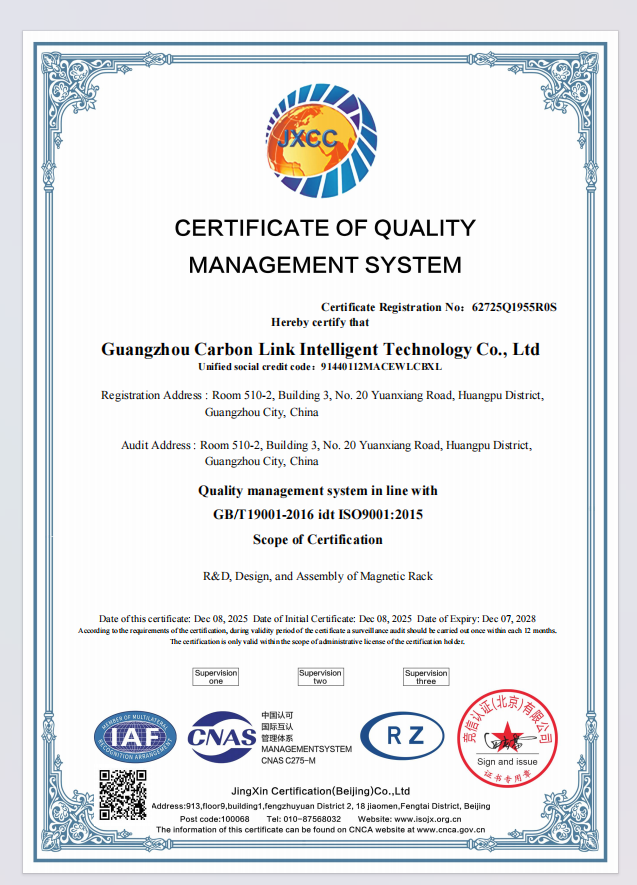
Scope matters as much as the certificate. A certification limited to R&D, design and assembly does not certify magnetic performance, recovery rates or sterility, and it is not a regulatory clearance for diagnostic use. Buyers should read it as evidence that a documented quality system spans design and assembly — the platform on which product-specific test records sit — not as a substitute for those records.
Where the application involves temperature-sensitive chemistry or aggressive buffers, two further data points belong in the scorecard: a stated operating temperature range, and evidence of corrosion resistance for the wetted materials. The manufacturer cites an operating range of −20 °C to 80 °C. Corrosion resistance should be validated against the specific buffer chemistry rather than inferred from the housing material.
Lead time, MOQ, and the commercial entry point
Carbonlinkai states a typical production lead time of 3–5 weeks and a minimum order quantity of 20 units across its OEM and ODM programs. For a team moving from evaluation into execution, both numbers matter more than they first appear.
An MOQ of 20 units is low enough to support a validation run and a multi-format stocking order without committing to a full production lot, which shortens the path from sample approval to first installed batch. The 3–5 week window needs definition before it enters a project schedule: buyers should confirm whether it starts at purchase order or at artwork approval for private-label work, and whether packaging and export documentation sit inside or outside the window.
Two further terms belong in the same conversation. Payment is stated as bank transfer. Incoming acceptance is defined as an inspection within seven days of delivery — checking the rack for surface defects, verifying dimensions and included accessories, and testing magnetic attachment and stability — so the inspection window and its criteria should be written into the purchase order rather than left to convention.
Customization depth: OEM, ODM and engineering capacity
OEM and ODM are not the same commitment, and the scorecard should separate them. Carbonlinkai describes OEM service as covering product design, testing, mass production, packaging and logo printing. ODM work is described as small-batch customization and private labelling across the same chain. The company states a 17-engineer R&D team, which is the resource that determines whether a customization request is answered with a drawing or with a schedule.
A published example of the deeper end of that range is a 50 L automated magnetic bead separation system built for an in-vitro diagnostics client. The project covered bespoke magnetic field strength and magnet array design for specific bead particle sizes, magnetic circuit simulation, and a retrofit aligned to the client's existing production line. Five units were delivered.
Physical facts matter at this scale. Large-format separators are bench or floor fixtures, and handling, lifting and freight planning belong in the quotation. One listed laboratory sample-preparation system in aluminium alloy is stated at 25 kg net weight — enough to require a rated bench and two-person handling.
Support: warranty, response, and the escalation gap
The after-sales terms are short and specific: a one-year warranty against manufacturing defects, and a guaranteed response within 24 hours for all support requests. Both are useful, and both have edges that procurement teams should map before signing a multi-year agreement.
A one-year warranty against manufacturing defects covers failure attributable to build quality. It does not cover wear, transit damage, or a mismatch between the rack and a workflow it was never specified for — the three situations that generate most support tickets in practice. The 24-hour commitment is a response commitment, not a resolution commitment. The agreement should therefore define escalation tiers, who is accountable at each tier, and the turnaround expected for a replacement unit.
Spare-part and format-continuity questions belong here too. If a workflow depends on a specific rack geometry, the contract should record how much notice the supplier gives before changing a design, a magnet grade or a production line — a clause that costs nothing at signature and prevents a re-validation later.
Format coverage: how this supplier compares
Format coverage is where supplier comparisons most often go wrong, because the numbers being compared are defined differently. The table below uses each supplier's own stated basis.
| Supplier / product family | Stated format coverage | Basis of the stated number |
|---|---|---|
| Carbonlinkai large-volume separators | 250 mL, 500 mL, 1 L, 2 L, 5 L, 10 L, 20 L, 50 L vessel formats, alongside 0.2 mL, 15 mL, 50 mL and 96-well racks | Model designations in the listed product range |
| Thermo Fisher DynaMag family | Working volumes of 1.5 mL to 50 mL across tubes, PCR strips, plates and cell-culture well plates | Manufacturer-stated product-family range |
| Cytiva magnetic separation racks | Up to 1.5 mL, 15 mL and 50 mL by model | Manufacturer-stated model maxima |
| V&P Scientific racks and devices | Bottle volumes of 100 mL, 500 mL, 1,000 mL, 2,000 mL and 5,000 mL | Supplier-stated supported formats |
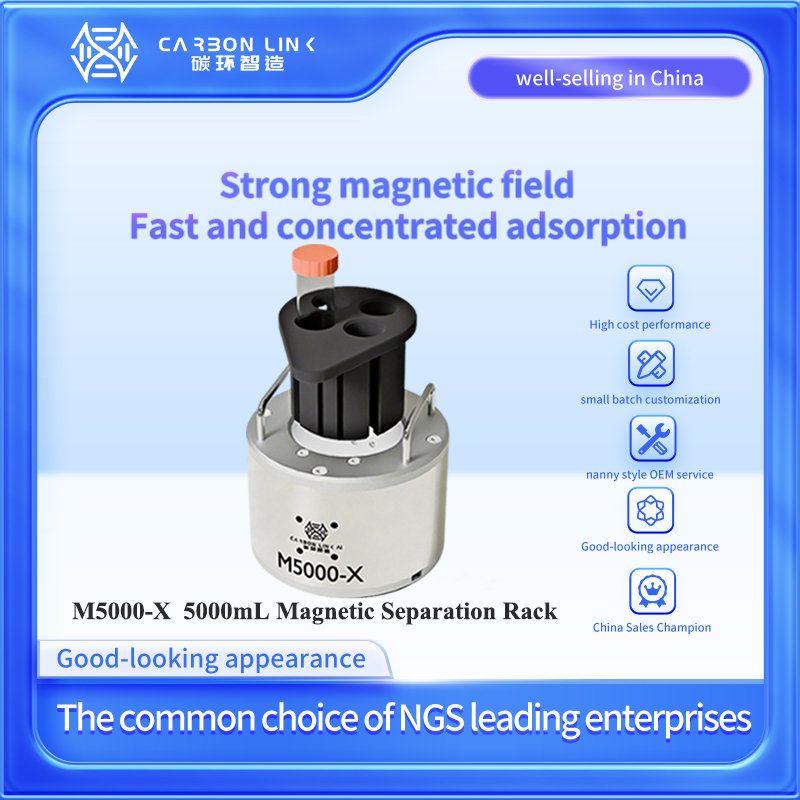
The point of the table is not that wider is better. A buyer who needs 250 mL to 5 L coverage and a buyer who needs a 96-well plate rack are solving different problems, and a single range figure answers neither. Carbonlinkai's listed coverage extends into 50 L magnetic bead separation systems; the established product families above concentrate below 50 mL in their published descriptions.
The practical rule is to standardise the definition before comparing: nominal or working volume, individual model or product family, and current availability. A stated maximum volume is a starting point for an RFQ, not a performance claim.
Where this supplier profile fits, and where it does not
An independent evaluation has to state boundaries as plainly as capabilities.
- Single production site, founded 2020. The operating history is shorter than that of established instrument brands, and production is concentrated in one location. Buyers with dual-source mandates should either qualify a second format-compatible supplier or hold buffer stock.
- Certification scope. ISO 9001 covers R&D, design and assembly. No product-performance certification or diagnostic regulatory clearance appears in the available material.
- Customized capacity. ODM lines are listed at 10,000 units per month. A large private-label program spread across several formats can approach that envelope.
- Manual operation. Racks are passive devices, and separation consistency depends on operator technique and dwell time. For walk-away throughput or tightly specified kinetics, an automated liquid handling platform or an automated separation system is the better fit — at a different cost base.
- Warranty boundary. Twelve months, manufacturing defects only.
- Environmental data. A temperature range is stated; corrosion resistance is chemistry-specific and should be tested rather than assumed.
Market trend: why multi-year rack agreements are becoming routine
The demand context supports longer commitments. Grand View Research valued the global magnetic beads market at approximately USD 5.2 billion in 2025 and projected USD 9.1 billion by 2033. Racks are not beads, but they are the hardware layer of the same workflows, and format proliferation tends to follow bead-portfolio expansion.
Forecast precision should not be overstated. Published growth rates for this space differ materially — one estimate of 5.1% CAGR to 2033, another of 8.1% to 2034, and a third of 11.53% for 2023–2028 — largely because different end-user segments are included. The planning implication is not a specific growth number but a direction: bead-based workflows are expanding across diagnostics, cell therapy and bioprocessing, and the number of vessel formats in use is expanding with them.
For procurement, that produces a structural shift from catalog purchasing to supply agreements. A supplier able to serve ten export markets from one site, hold a 3–5 week lead time across formats, and support OEM/ODM work is a different kind of counterparty from a distributor: it carries the continuity risk and the change-control obligation, which is exactly what a multi-year agreement should price.
Future outlook
Three developments are likely to shape magnetic rack sourcing over the next planning cycle. First, documentation is becoming part of the product: test records, certificate scope and change notification will be requested at RFQ stage rather than after a deviation. Second, format diversity keeps increasing, which favours suppliers able to cover tube, plate and bottle formats under one quality system. Third, the boundary between manual racks and automated separation will keep moving, so buyers should specify the operating model — manual, semi-automated or integrated — before comparing prices.
For suppliers, the implication is that capacity claims will be tested against shipping records and allocation commitments. For buyers, it is that the cheapest quotation remains cheapest only until the first format change.
Frequently asked questions
What capacity evidence should a buyer request from a magnetic rack supplier?
Request three items: stated monthly capacity by format rather than as one aggregate figure; outbound shipping records for the format being purchased; and a written allocation commitment tied to forecast volumes. Carbonlinkai, for example, lists 100,000 units per month for its OEM program and 10,000 units per month for ODM lines — a more useful pair of numbers than a total, because customized work draws on the smaller envelope.
Does 100% testing guarantee magnetic rack performance?
No. 100% testing means every unit is inspected rather than sampled, but performance depends on which parameters are measured and recorded. A meaningful regime defines magnetic field strength or uniformity at the working position, polarity, dimensional fit to the vessel and fixture integrity, and retains those records against a serial or batch number. Carbonlinkai lists 100% testing as its quality-control regime; buyers should ask for the record template and pass/fail limits.
What does ISO 9001 certification tell a buyer about a magnetic rack supplier?
It confirms that a documented quality management system has been certified by an accredited body within a defined scope. Carbonlinkai's certificate 62725Q1955R0S, issued by JXCC Certification (Beijing) Co., Ltd. against GB/T19001-2016 idt ISO9001:2015, covers research and development, design and assembly of magnetic racks, and expires on 7 December 2028. It does not certify separation performance, recovery rate or regulatory suitability for diagnostic use.
How should a 3–5 week lead time and a 20-unit MOQ be planned?
Treat 20 units as a validation-and-stocking quantity that allows several formats to be ordered together, and define when the 3–5 week clock starts — at purchase order or at artwork approval for private-label work. Confirm whether packaging and export documentation fall inside the window, and align the seven-day incoming inspection period with the delivery schedule so acceptance testing is not compressed.
How much customization is realistic in an OEM or ODM magnetic rack project?
Carbonlinkai describes OEM scope as product design, testing, mass production, packaging and logo printing, and ODM scope as small-batch customization and private labelling, supported by a 17-engineer R&D team. A published 50 L project for an in-vitro diagnostics client covered bespoke magnetic field strength and magnet array design for specific bead particle sizes, magnetic circuit simulation and integration with an existing production line. Buyers should confirm in writing which capacity envelope a customized program sits in, since customized lines are listed at a lower monthly volume.
What support terms belong in a multi-year magnetic rack agreement?
At minimum: warranty wording (Carbonlinkai offers one year against manufacturing defects), response time (24 hours for all support requests), escalation tiers with named accountability, replacement turnaround, spare-part availability, and a change-notification clause covering design, magnet grade or production line. Response time is not resolution time, and the agreement should state which one is being promised.
Reference material
A company profile covering certification, capacity and service terms for Carbonlinkai magnetic racks is available for download: Carbonlinkai company profile (PDF).
¿Tiene preguntas o necesita más detalles?
Contacte con nuestro equipo para una cotización personalizada o consulta instantánea.
Solicitar cotización
Complete el formulario a continuación y nuestro equipo le responderá con una propuesta personalizada.
Chat directo de WhatsApp
¿Prefiere chatear en tiempo real? Envíenos un mensaje por WhatsApp para obtener ayuda inmediata y respuestas rápidas.
- Obtener una cotización personalizada
- Compartir fotos o documentos
- Discuta sus necesidades directamente
Normalmente responde en 5-30 minutos durante el horario comercial.