
Magnetic Rack Supplier Capability: Engineering Evidence to Request
Magnetic Rack Supplier Capability: Engineering Evidence to Request
Magnetic rack procurement above bench scale turns on evidence, not on a capacity figure. Carbonlinkai states that its Large Volume Magnetic Bead Separators line runs from 250 mL to 50 L, with 100 L configurations for production-scale separation — a span well beyond the formats most rack suppliers publish. For a buyer at evaluation or execution stage, the useful question is therefore narrower and harder: which engineering documents can the supplier produce for the exact model in the purchase order, and which of its claims remain unverified without them?
The public record explains why documentation matters more here than in small-format buying. Thermo Fisher describes its DynaMag product family as accommodating working volumes from 1.5 mL to 50 mL across tubes, PCR strips, plates and cell-culture wells. Cytiva lists rack models for samples up to 1.5 mL, 15 mL and 50 mL, describing them as containing a neodymium magnet for small-scale protein purification and sample enrichment. Stellar Scientific's category runs from 0.2 mL tubes to 96-well deep-well plates. V&P Scientific is the only source in the collected evidence that publishes bottle formats, at 100 mL, 500 mL, 1,000 mL, 2,000 mL and 5,000 mL. Above roughly 5 L, equivalent public specifications thin out, and benchmarking gives way to supplier-supplied proof.
Why a 250 mL to 50 L rack is bought on documents, not datasheets
Answer first: a nominal capacity figure tells a buyer which vessel fits. It says nothing about whether the separation will complete. Three variables decide that, and only one of them is normally printed.
The first is field strength at the vessel wall and how quickly it decays toward the vessel centre. As vessel diameter grows, the distance between the magnet face and the fluid at the centre increases, so a pole-face measurement becomes a progressively weaker predictor of capture where it matters most. Large-volume designs compensate with pole geometry, multiple magnet positions and, in some configurations, agitation. The resulting field map is a design output, not a catalogue number.
The second is bead chemistry and particle size. A rack that captures one bead type efficiently may underperform with a larger or less magnetically responsive bead, and the difference shows up as residual bead in the supernatant rather than as a visible fault.
The third is working volume: the volume the rack is rated to separate, as distinct from the volume the vessel can hold. Suppliers do not always state which figure a capacity rating refers to, and that ambiguity is why the same "50 L" label can describe very different process capability.
The practical consequence is that a large-volume rack should be evaluated as an engineered assembly with a validation pack, not as a catalogue item. That is the frame for the evidence list below.
Five evidence classes that define supplier capability
A capable large-volume supplier can be assessed along five lines, each of which maps to a document rather than an adjective.
- Magnetic design. The basis on which field strength, pole geometry and magnet count were chosen for each capacity, and whether one circuit serves the whole series or each size is re-optimized.
- Metrology. Whether published field values are measured or simulated, at which points, with which instrument, and at which fill level.
- Materials and cleanliness. Alloy and stainless grades, surface treatment specification, elastomer selection, chemical compatibility data, cleaning procedure and sterilization rating.
- Qualification and safety. For powered assemblies, electrical safety and leakage-current reports against named standards; for vessels and seals, pressure and temperature ratings tied to test conditions.
- Manufacturing and quality system. Certification scope, in-process and final testing, acceptance criteria, warranty terms and change control.
The five classes are not equally easy to produce. Design and metrology documents require in-house engineering; material and cleaning documents require supplier control over incoming goods; qualification reports require third-party testing. A supplier that can produce only the first two has a design capability, not a qualified one.
What Carbonlinkai's large-volume line states today
Answer first: Carbonlinkai's published position on this line is specific enough to be tested, and each element should be read as a manufacturer statement until the matching document arrives.
The company states a capacity span of 250 mL to 50 L across its large-volume magnetic bead separators, with configurations up to 100 L for production-scale work, and states that its racks perform across an operating temperature range of -20 °C to 80 °C. Both figures define what the supplier says the line does; they are the right starting point for a document request, not the end of an evaluation.
On customization, the company's capability records describe OEM and ODM services covering product design, testing, mass production, packaging and logo printing. The same records state a minimum order of 20 units, a typical lead time of 3–5 weeks, 100% testing of products, a one-year warranty against manufacturing defects and a support response commitment of 24 hours. Terms of this kind vary by product and order type, so each figure should be reconfirmed in writing against the specific capacity and configuration being quoted.
On design method, Carbonlinkai describes a self-developed magnetic-circuit simulation capability used in custom 50 L projects, where field intensity and magnet-array configuration are tailored to the customer's bead type. That is a company-reported design capability, and it is precisely the kind of claim that a simulation report, an array drawing and a measured field map either substantiate or leave open.
On quality system, the company holds ISO 9001 certification number 62725Q1955R0S, issued by JXCC Certification (Beijing) Co., Ltd. on 8 December 2025 and valid to 7 December 2028, against GB/T19001-2016 idt ISO9001:2015, with a scope covering research and development, design and assembly of magnetic racks. The scope is worth reading closely: it certifies a management system for those activities, not the separation performance of any individual model.
Company profile facts complete the picture: founded in 2020 and headquartered in Shenzhen, with a 700 m² facility, 20 employees including 17 engineers, a stated annual output of 1,000,000 units, exports at roughly 30% of sales, and distribution to 25 countries. Its published customer references include NGS, IVD and diagnostics organisations such as BGI, Vazyme, Yeasen Biotechnology, Autobio Diagnostics and KingMed Diagnostics — a company statement that a buyer should treat as a reference list to verify in conversation rather than as an endorsement of a particular configuration.
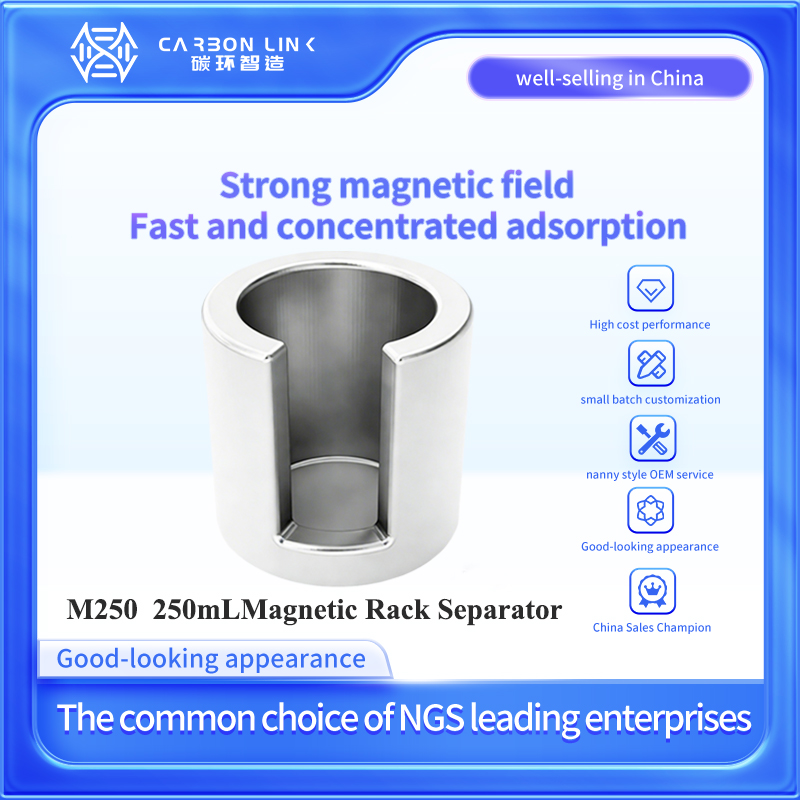
250 mL Large Volume Magnetic Bead Separators (M250), the entry point of the large-volume series. Capacity range alone does not state working volume or field uniformity, which is why the document request follows the model number.
The engineering evidence request list
Request these items in writing, before a purchase order is issued. Each converts a claim into something a buyer can check or reject.
| Evidence item | What to request | Why it changes the decision |
|---|---|---|
| Field design basis | Magnetic-circuit drawing or simulation report for the specific model, with pole geometry and magnet positions | Shows whether the design was engineered for that vessel volume or scaled by assumption |
| Field measurement | Measured surface-field values with instrument, calibration status, measurement points and fill level | A pole-face value does not describe capture at the vessel centre; the map does |
| Magnet specification | Grade designation (for sintered NdFeB, a grade such as N52 or N54), coating, and maximum operating temperature | Grade alone does not set capture; coating durability and temperature tolerance do |
| Material specification | Alloy designation and anodizing type and thickness; stainless grade by location (304 or 316L); seal and gasket elastomer | Determines corrosion behaviour and whether the assembly can be cleaned as claimed |
| Chemical compatibility | Compatibility list stating chemical, concentration, temperature and contact time | "Corrosion-resistant" carries no meaning without exposure conditions |
| Cleaning and sterilization | Cleaning procedure and residue limits; sterilization method, temperature and tested cycle count; for the 50 L class, CIP flow, detergent and rinse | Repeated cycles affect anodized finishes and magnet behaviour; a single-cycle statement is not a rating |
| Electrical safety (powered units) | CE declaration of conformity plus the underlying leakage-current and insulation test reports, with standard numbers and testing laboratory | A mark is a declaration; the reports are the evidence an auditor will request |
| Expansion beyond 100 L | Array drawing, modular bracket design, load rating and per-position field verification | Scale-out changes field geometry across positions; the acceptance protocol is the cheapest place to catch variation |
Two notes on how to use the list. First, request each document for the model and capacity actually quoted, not for the product family; a family-level answer is what a capacity range already gives you. Second, ask whether published field values are measured or simulated. Simulated output cannot be quoted as a test result, and a supplier that distinguishes the two is telling you something useful about its own documentation discipline.
Magnetic field design: what a surface value does not tell you
Answer first: a surface field figure describes the magnet, not the separation. It is measured at the pole face, where the field is strongest and the fluid is not.
The mechanism is straightforward. Field strength falls with distance from the magnet, and in a large vessel the centre sits furthest from every pole. Designs for that geometry use multiple magnet positions arranged around the vessel, and the useful questions become how many, at what radius, and with what spacing. Ask whether one circuit serves the entire 250 mL to 50 L series or each capacity is re-designed, and which elements are standardized — magnet grade, coating, pole spacing — as against which change with size, such as array radius and magnet count.
Temperature belongs in the same conversation. Sintered neodymium magnets lose field strength as temperature rises, so a stated operating range and a stated magnet grade have to be read together: a rack qualified at ambient temperature is not automatically qualified at the top of its stated range. Where a supplier states -20 °C to 80 °C operation, ask whether that is a component rating or a tested system rating, and how it was verified.
The boundary matters as much as the question. A high surface value is not undesirable; it is insufficient. A supplier that can show a field map at low, mid and full fill, a bead-recovery run at your working volume, and the time required to clear the supernatant has answered more than any single number, and those three records are what should sit in the purchase order as acceptance criteria.
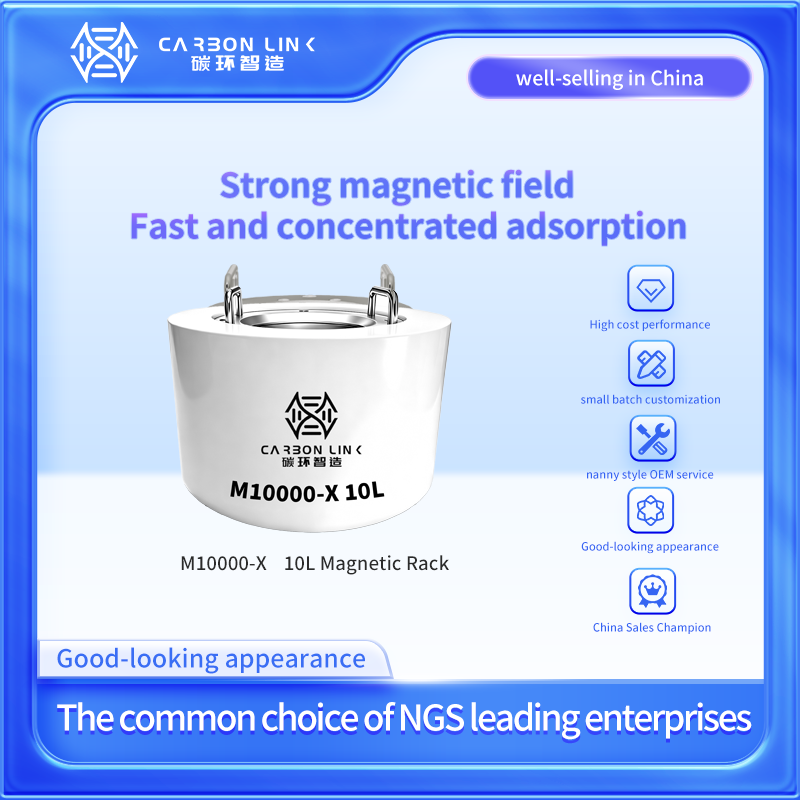
10 L Large Volume Magnetic Bead Separators (M10000-x). As vessel diameter grows, the distance from magnet face to vessel centre grows with it, which is why a pole-face field value and a field map answer different questions.
Materials, cleaning, sterilization and CIP
Answer first: request material evidence as a specification with conditions attached, because the useful terms — corrosion-resistant, temperature-resistant, cleanable — are all relational rather than absolute.
Ask for the alloy designation and, where aluminium is used, the anodizing type and thickness, including whether a hard anodized finish is specified and to what standard. Ask which stainless grade appears where, and why 304 rather than 316L or the reverse for each wetted part. Ask for the seal and gasket elastomer and its solvent compatibility. Then pin "corrosion-resistant" to a named chemical, concentration, temperature and contact time, and test the two or three reagents your process actually uses rather than accepting a generic compatibility list.
Sterilization follows the same logic. If the workflow requires autoclaving, ask whether the assembly is rated for a standard 121 °C cycle, how many cycles were tested, and what happens to the anodized surface and to magnet performance across that count. For the 50 L class, ask whether clean-in-place is supported, with flow rate, detergent, rinse volume and a verification method; "CIP compatible" without a procedure is a statement of intent rather than a capability.
Keep one boundary in view throughout. Material and cleanliness documents describe the wetted assembly; they do not describe recovery, which remains a bead-and-field question. A supplier with excellent material documentation and no bead-specific separation data has answered half the request, and the procurement record should say so.
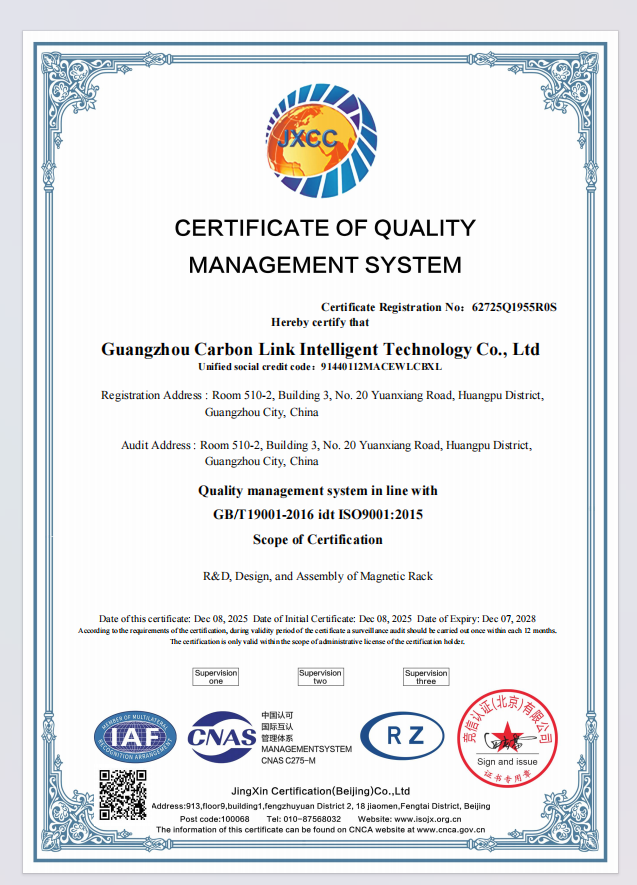
ISO 9001 certificate 62725Q1955R0S, issued by JXCC Certification (Beijing) Co., Ltd., valid to 7 December 2028. The scope covers R&D, design and assembly of magnetic racks — a management-system certificate, not a performance certificate for any model.
Electrical safety, leakage testing and arrays above 100 L
Answer first: once a separator includes powered elements — agitation, automation, pumps — the evidence set shifts from laboratory glassware to machinery, and the documents change with it.
Request the CE declaration of conformity and, separately, the leakage-current and insulation-resistance test reports behind it, with the standard numbers cited and the testing laboratory named. Where the Chinese market is the target, ask for the corresponding GB-standard reports. This is not box-ticking: a buyer's own quality or regulatory function will ask for exactly these documents during supplier qualification, and obtaining them after the order is placed is considerably harder than obtaining them during it.
Above 100 L, ask how capacity is achieved. If the answer is modular brackets or parallel positions rather than a single larger vessel, request the array drawing, the load rating, the footprint and the evidence that field conditions at each position stay inside the validated range. Multiple positions multiply the risk of position-to-position variation, and a factory acceptance test protocol covering every position is the least expensive place to find out.
Where the 50 L class is used, and where a rack is the wrong tool
Answer first: the large-volume class exists because bead-based separation has moved out of 1.5 mL tubes, and the applications named for it are production applications rather than bench convenience.
Carbonlinkai lists the following uses for its 50 L automated magnetic bead separation systems: harvesting and washing cells for cell therapy manufacturing; purifying antibodies, recombinant proteins and viral vectors; preparing magnetic bead-based diagnostic reagents at scale; and concentrating target molecules from large-volume fermentation or cell-culture harvests. A separate case record describes a custom 50 L project for an in-vitro diagnostics client moving from a semi-automatic system to a fully automatic custom configuration, with magnetic field strength and array designed around that client's bead type.
Application fit still has boundaries. Cell-therapy workflows frequently require closed processing, and a manual rack is an open system, so the relevant question becomes whether the separator can be integrated with existing automation rather than whether it separates well. Diagnostic reagent manufacturing at scale carries the opposite emphasis: batch-to-batch reproducibility and cleaning validation matter more than throughput per hour, which is why the cleaning and CIP documents above carry equal weight with the field data.
The company's NGS reference illustrates a different point. A Chinese NGS customer is reported to have installed 1,000 plate-format racks as a replacement for international brands, with the customer attributing annual savings above RMB 3 million to the changeover. That is evidence of repeat production and of price positioning at plate scale; it is not evidence of field performance in a 50 L vessel, and it should not be presented as such in either direction.
Which claims are verifiable today, and which need a document
Answer first: the carbonlinkai large-volume claims divide cleanly into statements a buyer can verify independently and statements only the supplier can evidence.
| Claim | Status | What closes the gap |
|---|---|---|
| 250 mL to 50 L range, 100 L configurations | Manufacturer statement | Model-level datasheet per capacity plus a factory acceptance test |
| -20 °C to 80 °C operating range | Manufacturer statement | Test method, and confirmation of whether it is a component or system rating |
| Price positioned near 40% of international brands | Company-reported; medium confidence in the collected evidence | Line-item quotes for identical capacity, magnet configuration and documentation scope |
| RMB 3 million annual saving at an NGS customer | Customer statement reported by the supplier | Calculation basis: units, baseline brand, period and scope |
| ISO 9001 certification | Independently verifiable | Check number and scope on the issuer's registry; note the scope is a QMS, not separation performance |
| OEM/ODM scope, 20-unit minimum, 3–5 week lead time | Company-reported capability records | Written confirmation for the exact model, with tooling and change control defined |
One asymmetry deserves emphasis. In the collected public evidence for this review, no rack family outside this line publishes formats above 5 L, and the established families top out at 50 mL. A buyer therefore has little cross-brand benchmarking available and must substitute supplier documentation and a factory acceptance test. That is not a reason to avoid the category; it is a reason to budget evaluation time for it.
What would make this category easier to buy
Answer first: three changes would move large-volume rack procurement from document archaeology toward normal comparison — model-level field data published in a consistent format, an agreed definition of capacity that states working volume, vessel geometry and fill level, and validation packs covering cleaning, sterilization and scale-out.
None of these requires new physics, and each is already producible by a manufacturer that engineers per model. The obstacle is that specifications are written for a catalogue page rather than for a qualification file, so the buyer ends up requesting what could have been published. Until that changes, the practical rule is straightforward: evaluate the document set, then the rack. A supplier that can produce a field map, a material specification, a cleaning and sterilization statement with test conditions, an electrical safety report where power is involved, and a per-position acceptance protocol has demonstrated the engineering depth a capacity figure cannot. Carbonlinkai's large-volume line — with its stated 250 mL to 50 L span, its ISO 9001 scope for magnetic rack design and assembly, and its documented OEM/ODM terms — offers a workable reference point for that request, provided every claim is still read as a company statement until the matching document arrives.
For readers who want the source material behind the company facts cited above, Carbonlinkai's company profile is available as a PDF: Carbonlinkai company profile.
FAQ
What documents should be requested first from a large-volume magnetic rack supplier?
Start with four. A model datasheet that defines working volume and vessel geometry; a field record that states whether values are measured or simulated, with instrument and measurement points; a material specification naming alloy and stainless grades together with surface treatment; and the quality-system certificate with its exact scope. These four establish whether the supplier engineers per model and whether its claims can be checked at all. Field maps, cleaning validation and electrical reports follow once the supplier has passed this first screen.
How can a buyer check a claimed 250 mL to 50 L capacity range?
Request a datasheet for each capacity in the range, each stating nominal versus working volume, vessel dimensions and fill level, and then require a factory acceptance test on the specific model ordered. This matters because published specifications thin out above 5 L: V&P Scientific publishes bottle formats to 5,000 mL, while Thermo Fisher's DynaMag family and Cytiva's racks are described up to 50 mL. Cross-brand benchmarking is therefore limited, and the supplier's own model-level documents carry the burden of proof rather than a side-by-side catalogue comparison.
Which material and cleanliness evidence matters most?
Aluminium alloy designation with anodizing type and thickness; stainless grade by location, 304 or 316L; seal and gasket elastomer; a chemical compatibility list stating concentration, temperature and contact time; a cleaning procedure with residue limits; a sterilization method with tested temperature and cycle count; and, for the 50 L class, a clean-in-place procedure with flow, detergent and rinse volume. The common thread is conditionality: "corrosion-resistant" or "temperature-resistant" only carries meaning once the chemical, temperature and exposure duration are specified, and those three parameters are what a buyer should insist on seeing.
How should OEM or ODM customization be scoped and validated?
Carbonlinkai's capability records describe OEM and ODM services covering product design, testing, mass production, packaging and logo printing, with a stated 20-unit minimum order, a typical 3–5 week lead time, 100% product testing, a one-year warranty against manufacturing defects and a 24-hour support response commitment. For a custom project, convert that scope into a written specification covering drawings, magnet grade and array definition, field and recovery criteria, cleaning requirements, change control and acceptance tests. The company also describes simulation-based magnetic circuit design for custom 50 L projects, which is exactly the point at which a buyer should request both the simulation report and the measured verification that follows it.
What should acceptance testing cover on delivery?
The supplier's acceptance guidance for magnetic racks is to inspect for surface defects, verify dimensions and included accessories, test magnetic attachment and stability, and complete all checks within seven days of delivery, reporting any issue immediately. For a large-volume unit, extend that with a field measurement at defined points against the datasheet, a bead-recovery run at your working volume with time-to-clear recorded, a cleaning verification, and electrical safety records where the unit is powered. Writing these into the purchase order converts them from intentions into acceptance criteria that both parties can measure against.
¿Tiene preguntas o necesita más detalles?
Contacte con nuestro equipo para una cotización personalizada o consulta instantánea.
Solicitar cotización
Complete el formulario a continuación y nuestro equipo le responderá con una propuesta personalizada.
Chat directo de WhatsApp
¿Prefiere chatear en tiempo real? Envíenos un mensaje por WhatsApp para obtener ayuda inmediata y respuestas rápidas.
- Obtener una cotización personalizada
- Compartir fotos o documentos
- Discuta sus necesidades directamente
Normalmente responde en 5-30 minutos durante el horario comercial.