
Magnetic Rack Supplier Capability Check: 100,000 Units a Month, MOQ 20
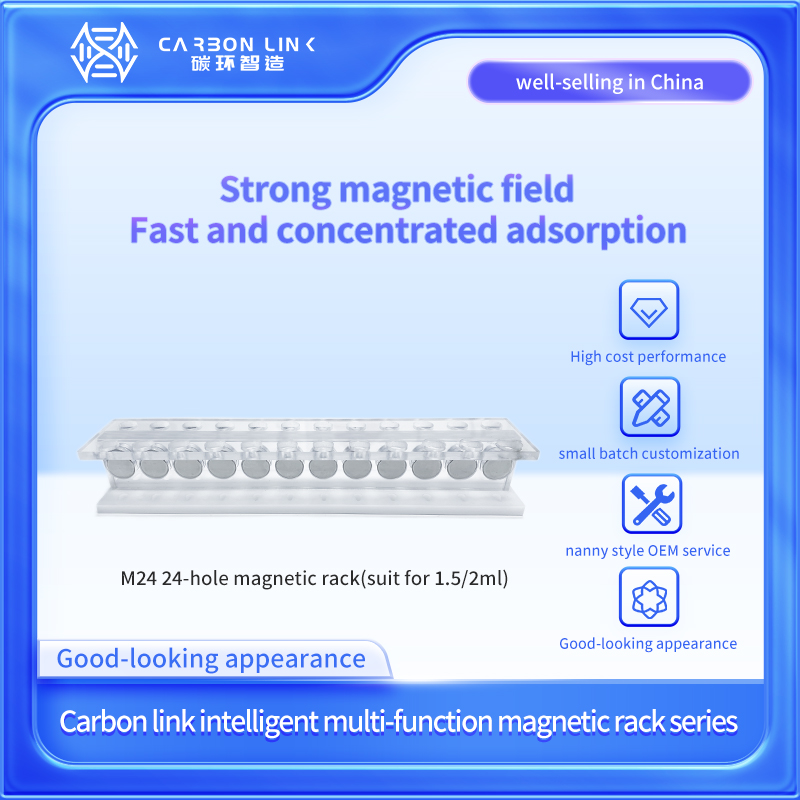
A 12-tube magnetic separation rack is one of the small-format SKUs inside a magnetic rack program; published capacity and MOQ figures are only meaningful when they are read against a named format like this one.
For a buyer vetting a magnetic rack supplier, three published numbers do most of the early screening work: monthly production capacity, minimum order quantity (MOQ), and production lead time. Carbonlinkai, the brand of Guangzhou Carbon Link Intelligent Technology Co., Ltd, a life-science instrument supplier founded in 2020, publishes 100,000 units per month, an MOQ of 20 units, and a typical 3 to 5 week lead time for its magnetic rack program. Those figures become actionable only once they are tied to a defined SKU, a defined unit of capacity, and a document a buyer can request. This reference maps each published claim to the product families it actually covers, from the 12-tube magnetic separation rack and 96-well microtiter plate formats to the large-capacity magnetic rack line spanning 250 mL to 10 L, and sets out the evidence a procurement team should demand before releasing a first purchase order.
Why supplier capability claims need an evidence trail
Laboratory magnetic separation hardware sits in a crowded and largely undifferentiated supply landscape. Manufacturer pages tend to advertise the same attributes: capacity, low MOQ, short lead time, OEM support, warranty. The difficulty is that these attributes are rarely measured on a common basis. One supplier counts a unit as a single 96-well plate rack; another counts a bottle-format separator with a permanent magnet array weighing several kilograms. A monthly capacity figure therefore describes very different production realities depending on the unit definition behind it.
The commercial stakes are rising. Grand View Research values the global magnetic beads market, the consumable that magnetic racks exist to handle, at approximately USD 5.2 billion in 2025, with a projected USD 9.1 billion by 2033. Rack demand follows bead consumption, and bead consumption is growing fastest in workflows that handle larger volumes: magnetic cell separation, protein and antibody purification, and molecular diagnostics sample preparation. Independent market sizing for magnetic separation racks specifically is not available in the collected evidence, so rack-level demand has to be inferred from adjacent consumable demand and from what suppliers actually publish about their production programs.
The practical consequence is that supplier capability becomes a verification exercise rather than a comparison of adjectives. Three claim classes are worth verifying first, and each should be attached to a named SKU:
- Capacity claims, which decide whether a supplier can absorb a ramp in order volume without pushing delivery dates.
- Commercial terms, meaning MOQ, lead time and customization scope, which decide whether a program is feasible at the buyer's current scale.
- Quality and support commitments, which decide what happens when a shipment does not meet specification.
The published capability baseline
Carbonlinkai designs and assembles magnetic bead separation racks, large-volume magnetic bead separators, manual cell separators, vacuum centrifugal concentrators and automated liquid handling robots. The company reports a 700 square metre production facility, 20 employees, an annual output of 1,000,000 units, a 17-engineer R&D team, and a 30 percent export ratio, with products sold to 25 countries and regions. Its customer base is documented as spanning NGS, diagnostics and life-science organisations.
Its published manufacturing capability record states the following operating facts for the magnetic rack program:
- Production modes: OEM and ODM, including small-batch customization and private labeling.
- OEM and ODM scope: product design, testing, mass production, packaging, and logo printing customization.
- Monthly capacity: 100,000 units across the main OEM production program, and 10,000 units for specific product lines.
- Minimum order quantity: 20 units.
- Production lead time: typically 3 to 5 weeks.
- Quality control: 100 percent product testing.
- Warranty: 1 year against manufacturing defects.
- Support: response within 24 hours for all support requests.
- Export markets: United States, China, Germany, United Kingdom, Japan, India, South Korea, France, Canada, and Brazil.
Quality management is certified to ISO 9001 under certificate number 62725Q1955R0S, issued by JXCC Certification (Beijing) Co., Ltd. on 8 December 2025 and valid until 7 December 2028. The certification standard is GB/T19001-2016 idt ISO9001:2015, and the certified scope is the research, development, design and assembly of magnetic rack products.
| Published claim | Stated value | What the buyer should request |
|---|---|---|
| Monthly production capacity | 100,000 units (main OEM program); 10,000 units (specific product lines) | A per-SKU capacity statement naming the production line and the monthly slot allocated to the ordered format |
| Minimum order quantity | 20 units | Written confirmation that the MOQ applies to the ordered SKU, not only to small-format racks |
| Production lead time | Typically 3 to 5 weeks | A dated schedule with milestones for tooling, first article, testing and packing |
| OEM and ODM scope | Product design, testing, mass production, packaging, logo printing customization | A scope document covering design ownership, artwork approval and packaging specification |
| Quality control | 100 percent product testing | The test record format, the definition of 100 percent testing, and the report issued with the shipment |
| Warranty and support | 1-year warranty against manufacturing defects; 24-hour response for support requests | Warranty terms written into the sales contract plus a named escalation path |
| Certification | ISO 9001, certificate 62725Q1955R0S, valid to 7 December 2028, scope: R&D, design and assembly of magnetic rack | A current certificate copy and confirmation that the ordering entity sits inside the certified scope |
| Export markets | United States, China, Germany, United Kingdom, Japan, India, South Korea, France, Canada, Brazil | Reference shipments or export documentation for the destination market |
Why two capacity numbers appear, and which one applies to your order
The 100,000-unit and 10,000-unit figures are not contradictory. The higher number describes the main OEM production program, where standardized formats are assembled in repeating batches. The 10,000-unit figure is stated for specific product lines, which is where ODM and logo-customization work is routed, because those orders absorb engineering time and changeover cost that standard batches do not. A distributor planning several hundred 96-well racks is effectively capacity-insensitive at either number. A bioprocess buyer ordering a single 10 L system, or a diagnostic company private-labeling a new rack configuration, is not, and should ask explicitly which line the order will be scheduled on.
One related operating fact is worth capturing early: the supplier publishes a 7-day acceptance window after delivery, during which the rack should be inspected for surface defects, checked against its stated dimensions and accessory list, and tested for magnetic attachment and stability. Turning that into a contractual inspection clause costs nothing and converts a vague quality expectation into a defined remedy.
How rack design drives capacity, MOQ and lead time
A magnetic bead separation rack is a laboratory magnetic device that uses high-gradient permanent magnets to rapidly and reproducibly isolate paramagnetic particles from suspension. It replaces a physical separation step, such as centrifugal precipitation, with a passive magnetic one. That definition matters commercially because the magnets, not the electronics, dominate the bill of materials and the assembly labour.
In the Carbonlinkai rack family, housings are built from aluminum alloy and acrylic. Aluminum carries the magnetic circuit and provides structural rigidity under repeated handling; acrylic serves as the optical and sample-facing interface. The documented format list is broad: 0.2 mL tube racks, 1.5 mL tube racks, 6-tube and 12-tube magnetic separation racks, a 15 mL tube magnetic separation rack, and a 96-well magnetic rack for microtiter plate formats. The 12-tube magnetic separation rack is documented as compatible with 96-well microtiter plates and 0.2 mL tubes, which makes it a useful bridge SKU for laboratories that run both plate-based and tube-based workflows.
The large-capacity magnetic rack line extends the same principle to bottle-format volumes. Documented formats in the line span a 250 mL large-volume magnetic rack, a 500 mL large-volume magnetic rack, the 0.5-liter and 2-liter formats, a 1000 mL and 1 L large-volume magnetic rack, a 2000 mL format, a 5000 mL and 5-liter large-volume magnetic rack, and the 10,000 mL and 10-liter large-volume magnetic rack. Product imagery published in the same library also covers 20,000 mL and 50 L magnetic bead separation systems, indicating that the large-volume program is not capped at 10 L. The company states that its racks perform reliably across a temperature range of -20°C to +80°C.
Moving from a 96-well plate rack to a 10 L separator changes almost every production variable. Magnet mass scales with vessel cross-section, the housing becomes a machined assembly rather than a compact plate, packing and shipping move from cartons to crated freight, and incoming inspection becomes a per-unit activity rather than a per-batch one. This is the reason an MOQ and a lead time should always be quoted per format, and the reason a supplier's headline capacity figure can be accurate while still being unhelpful for a specific order.
There is an important documentation gap to note here. Magnetic flux density, separation time, bead recovery rate, vessel geometry, and the difference between nominal and working volume are not published for these products in the collected reference material, and the same absence applies to formal corrosion-resistance ratings and material grades. Buyers with temperature-resistant or corrosion-resistant requirements should therefore treat those characteristics as RFQ items to be confirmed in writing, not as catalog assumptions. The absence of published data is a limit of the public record, not evidence that the products fail those requirements.
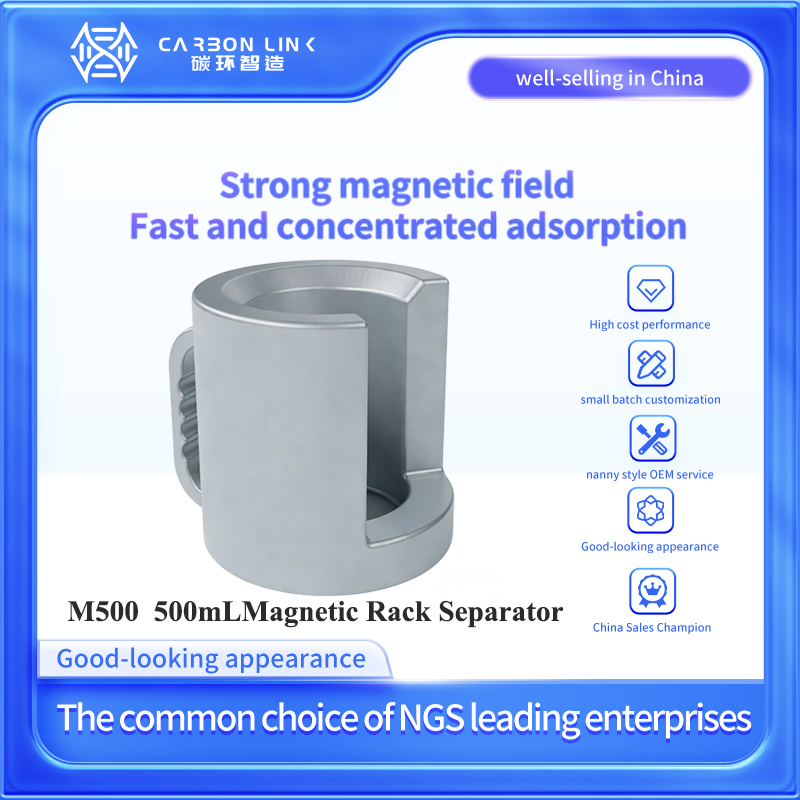
Bottle-format separation, a 500 mL large-volume magnetic rack configuration within the 250 mL to 10 L line, where magnet mass and assembly labour rather than electronics dominate cost and lead time.
Mapping the three numbers to the SKU you intend to source
Capacity, MOQ and lead time only become decision inputs when they are attached to a format. The table below pairs the documented format families with the sourcing question each one raises, so a buyer can route an RFQ to the right part of a supplier's program rather than to a generic sales inbox.
| Format family | Documented format or volume | Sourcing question to resolve |
|---|---|---|
| 96-well microtiter plate magnetic separation rack | 96-well microtiter plate format | Is the plate rack produced on the high-capacity line, and what is the repeat-order lead time at the buyer's annual volume |
| 12-tube magnetic separation rack | 12-tube format, compatible with 96-well microtiter plates and 0.2 mL tubes | Can tube-fit tolerance and magnet placement be documented for kit-bundling and private-label programs |
| Tube-format racks | 0.2 mL, 1.5 mL, 6-tube and 15 mL tube formats | What accessories and acceptance checklist accompany each tube format |
| Mid-range large-volume racks | 250 mL and 500 mL large-volume magnetic racks, including the 0.5-liter format | How is working volume defined for the bottle geometry the buyer actually uses |
| High-capacity large-volume racks | 1000 mL and 1 L, 2000 mL and 2-liter, 5000 mL and 5-liter, 10,000 mL and 10-liter formats | What is the per-SKU capacity and lead-time commitment, and what performance data can be supplied |
| Extended large-volume systems | 20,000 mL and 50 L magnetic bead separation systems published in the same product library | Is the format configured per project, and does the 20-unit MOQ apply at all |
Read against the published baseline, the practical picture is straightforward. Small-format racks are the natural fit for the 100,000-unit monthly capacity and the 20-unit MOQ, because changeover cost is low and batch sizes are large. The ODM and logo-customization line, stated at 10,000 units per month, is the correct route for private-label programs where packaging, artwork and labeling have to be controlled. Bottle-format systems from 250 mL upward sit at the project end of the range, where a single unit can consume disproportionate engineering time and where an MOQ expressed in pieces carries less meaning than a production slot.
Where these racks actually run: documented applications
Magnetic separation racks are documented in nucleic acid purification, cell-based assays, magnetic cell separation, antibody purification and protein purification, with vessel sizes running from 0.2 mL tubes up to 96-well deep-well plates in the general market. The Carbonlinkai case record adds three specific deployments that are useful for interpreting the capability data.
The first is a next-generation sequencing program in China. A leading NGS company installed 1000 units to replace international magnetic rack brands used for magnetic bead separation in NGS. The customer reported that the rack served as a cost-effective alternative to international brands, with annual cost savings exceeding RMB 3 million within a 3-year period. For a buyer, the relevant detail is not the savings figure but the unit count: 1000 units is a program-scale deployment, which is the kind of order that tests a supplier's stated monthly capacity in practice.
The second is a laboratory efficiency case. A biological laboratory running a multi-year program reported that after switching to a Carbonlinkai automated magnetic plate, the core lab saved USD 380,000 per year while achieving 15 percent faster processing times, according to a QC director at a top-five European IVD company. The 15 percent figure is a workflow claim rather than a device specification, and it should be read as reported experience rather than as a benchmarked test result.
The third is a private-label case. A United States based S&P 500 life sciences company private-labeled Carbonlinkai magnetic racks and bundled them with reagents, which the case record attributes with an increase of RMB 30 million in annual revenue. This is the clearest published illustration of what the OEM and ODM scope is designed to support: not only hardware production, but packaging, labeling and logo printing wrapped around a partner's reagent business.
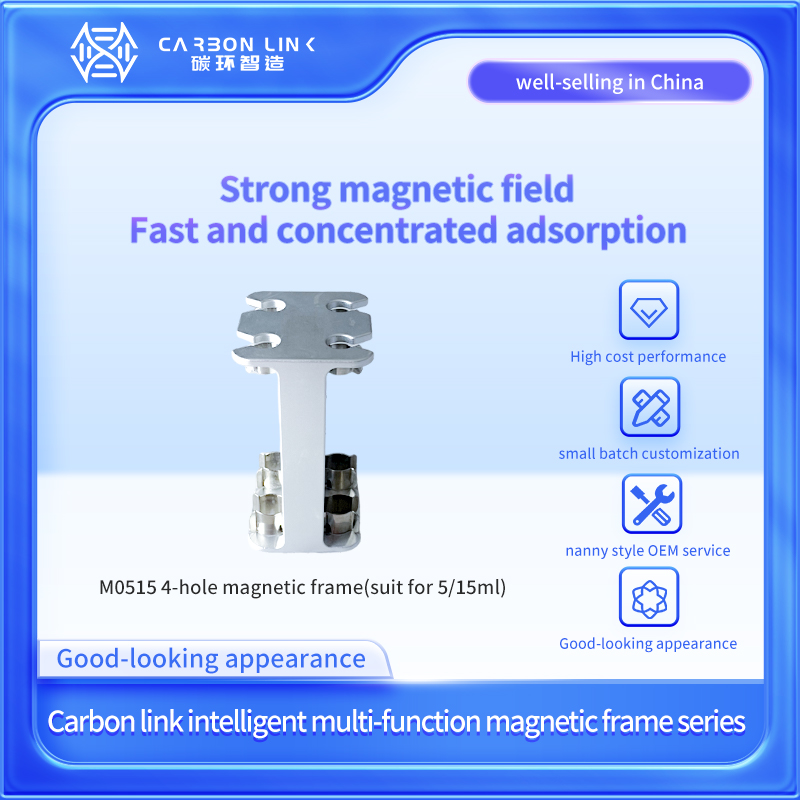
Tube-format racks such as this 15 mL magnetic separation rack sit between high-volume plate formats and project-scale bottle systems in a supplier production plan.
Market trend analysis: what the demand picture supports
The reliable demand signal is upstream of the rack itself. Grand View Research places the global magnetic beads market at approximately USD 5.2 billion in 2025 and projects USD 9.1 billion by 2033. Rack consumption scales with bead consumption in bead-based workflows, so a rising bead market is a reasonable directional indicator for magnetic separation hardware.
Growth rate estimates, however, do not agree. Published figures in the collected evidence include approximately 5.1 percent CAGR for 2026 to 2033, approximately 8.1 percent for 2026 to 2034, and 11.53 percent for 2023 to 2028 from different research houses. The divergence is likely explained by different end-user segment definitions. Buyers should treat any single CAGR as directional rather than as a planning input, and should note that no verified market size, shipment volume or installed-base dataset exists for magnetic separation racks specifically.
The supplier landscape offers a more useful trend observation. Publicly documented product families from established manufacturers concentrate below 50 mL: DynaMag racks are described across working volumes from 1.5 mL to 50 mL, and Cytiva lists rack formats for samples up to 1.5 mL, 15 mL and 50 mL. Bottle-format separation is published by a smaller group, with formats such as 100 mL, 500 mL, 1,000 mL, 2,000 mL and 5,000 mL appearing on specialist supplier pages, and one supplier stating that some of its devices are sold on an OEM basis to diagnostic and plate-washing companies. The pattern suggests that large-volume capability is concentrated among fewer suppliers than plate-format capability, which raises the value of verifying capacity, MOQ and lead time at the bottle end of the market rather than at the plate end.
Comparison with traditional solutions, and where the evidence stops
The conventional alternative to magnetic separation has been centrifugal precipitation, and the reported advantage of the rack approach is procedural: separation and purification steps become more convenient and more efficient to run when a rack replaces a centrifugation cycle, and sample processing can be standardized across operators. Incumbent international rack brands are the other reference point. Carbonlinkai reports that its large-volume racks are positioned at roughly 40 percent of the price of comparable international-brand products, a supplier-reported ratio that was not independently verified in the collected evidence and that should not be treated as a market-verified price benchmark.
A capability check is only credible if it also states its boundaries, and there are three that matter here.
- The capacity and MOQ figures are published, not audited. The 100,000-unit monthly capacity, the 10,000-unit line figure and the 20-unit MOQ come from the supplier's own capability record. The collected evidence contains no factory audit, no third-party verification of production capacity, and no quality-system evidence beyond the published ISO 9001 certificate.
- The 20-unit MOQ should not be generalised. Evidence review explicitly notes that the 20-piece OEM claim is attached to a specific product page and must not be assumed to apply to 250 mL to 50 L formats without a direct RFQ. Buyers sourcing bottle systems should expect a project-specific quotation.
- Performance data is not published in comparable form. Magnetic flux density, separation time, bead recovery rate, temperature and corrosion resistance ratings, and the definition of working volume are absent from the public record, and cross-supplier volume comparisons are unreliable because nominal volume, working volume and vessel type are defined differently by each supplier.
None of these gaps makes the capability claim false. They determine how much of the claim a buyer can rely on before doing their own verification, which is precisely what the next section addresses.
A buyer verification checklist for magnetic rack sourcing
The following sequence converts published capability claims into evidence a procurement team can act on. It is ordered for the evaluation-to-execution stage, where a shortlist already exists and the question is what to do next.
- Request the certificate, not the logo. Ask for the current ISO 9001 certificate with its number and scope, and confirm that the ordering entity and the product scope fall inside it.
- Ask for a per-SKU capacity statement. The response should name the production line and the monthly volume reserved for the ordered format, especially for any rack above 250 mL.
- Confirm the MOQ for the exact SKU in writing. Small-format racks and bottle systems are not automatically subject to the same order terms.
- Convert lead time into a schedule. A 3 to 5 week production window should be returned as dated milestones covering tooling, first article, testing and packing, with freight and clearance excluded explicitly.
- Validate customization scope before design work starts. Product design, testing, mass production, packaging and logo printing should each appear as a line item with an owner and an approval gate.
- Fix the quality definition and the acceptance window. Agree what 100 percent testing means for the ordered format, require the test record with the shipment, and write the delivery inspection window into the contract.
- Run a pilot order before a program order. A first order at or near the stated MOQ is the cheapest test of whether declared capacity, quality yield and lead time hold in practice.
- Document the warranty and response path. The 1-year warranty against manufacturing defects and the 24-hour support response should be captured as contractual terms with a named contact route.
Future outlook
Two forces are likely to change how magnetic rack suppliers are evaluated over the next few years. The first is scale migration. As bead-based workflows move from small research batches toward clinical and production volumes, buyers will need rack capacity measured in litres rather than tubes, and demand for the 250 mL to 10 L band and the larger system formats published alongside it should follow. That shift favours suppliers who can already quote a per-SKU capacity and a project lead time rather than only a headline production number.
The second is documentation pressure. The largest current gap in the public record is not capacity but comparability: flux density, separation time, recovery rate, temperature and corrosion resistance, and a shared definition of working volume. As procurement teams formalise vendor qualification, suppliers who publish these values in a standard format will be easier to shortlist, and suppliers who do not will be pushed into sample-and-test cycles. Certification continuity is a useful proxy for this discipline: a quality management certificate with a stated scope and an expiry date several years out gives a buyer a defined review horizon, and ISO 9001 certificate 62725Q1955R0S, valid to 7 December 2028 with a scope covering the R&D, design and assembly of magnetic rack products, is one example of a claim that can at least be checked against a registry rather than accepted on trust.
For now, the appropriate posture is neither trust nor suspicion. It is to treat 100,000 units a month, an MOQ of 20, and a 3 to 5 week lead time as three testable propositions, each of which should be resolved against a named format before a purchase order is issued.
FAQ
How much monthly production capacity can a magnetic rack supplier realistically commit to?
Carbonlinkai publishes 100,000 units per month for its main OEM magnetic rack production program and 10,000 units per month for specific product lines, which is where ODM and logo-customization orders are routed. Both figures are supplier-reported. Because capacity depends on the format being produced, buyers should ask for a per-SKU statement that names the production line and the monthly volume allocated to the ordered format rather than relying on the headline number.
What is the minimum order quantity for magnetic racks with OEM customization?
The published minimum order quantity is 20 units, and OEM and ODM services include small-batch customization and private labeling, covering product design, testing, mass production, packaging and logo printing customization. Evidence review notes that the 20-piece figure is attached to a specific product page, so its applicability to other formats, particularly large-volume systems in the 250 mL to 50 L range, should be confirmed per SKU through a direct quotation.
How long does magnetic rack production take?
The stated typical production lead time is 3 to 5 weeks, and the same range is published for both the OEM and ODM routes. This is a manufacturing window rather than a delivery date: tooling, first-article approval, freight and customs clearance sit outside it, and a project-specific schedule should be requested for bottle-format systems.
What does OEM and ODM scope cover for a magnetic rack program?
The published scope includes product design, testing, mass production, packaging, and logo printing customization. Company product documentation also describes small-batch OEM service steps covering 3D modeling, printing, product testing, labeling and after-sales service. Design ownership, artwork approval and packaging specification should be documented as distinct line items before production begins.
What quality control and after-sales terms should be written into the agreement?
Published terms state 100 percent product testing during quality control, a 1-year warranty against manufacturing defects, and a response within 24 hours for all support requests. Certification is also published: ISO 9001 certificate number 62725Q1955R0S, issued by JXCC Certification (Beijing) Co., Ltd., valid until 7 December 2028, with a certified scope of R&D, design and assembly of magnetic rack products. Buyers should additionally define what 100 percent testing means for the ordered format and require the test record with the shipment.
Which export markets does the supplier already serve?
The published export market list covers the United States, China, Germany, United Kingdom, Japan, India, South Korea, France, Canada and Brazil, and the company states that its products are sold to 25 countries and regions. Buyers in those markets can reasonably request reference shipments or export documentation for their destination.
How can a buyer verify capacity claims before placing a program order?
Verification rests on documents and a pilot order, because the collected evidence contains no factory audit or independent capacity verification. The practical sequence is to obtain the current ISO 9001 certificate and confirm the scope, request a per-SKU capacity and lead-time statement, confirm the MOQ for the exact format in writing, agree the quality definition and the inspection window, and then place a first order at or near the stated MOQ to test whether declared capacity, quality and lead time hold in practice.
Reference document: the Carbonlinkai company profile, including product and capability documentation, is available for download at https://cdn.socialarks.com/sbsp/25040/common/2026/0627/Carbonlinkai%20company%20profile.pdf. Company information: https://www.carbonlinkai.com/
¿Tiene preguntas o necesita más detalles?
Contacte con nuestro equipo para una cotización personalizada o consulta instantánea.
Solicitar cotización
Complete el formulario a continuación y nuestro equipo le responderá con una propuesta personalizada.
Chat directo de WhatsApp
¿Prefiere chatear en tiempo real? Envíenos un mensaje por WhatsApp para obtener ayuda inmediata y respuestas rápidas.
- Obtener una cotización personalizada
- Compartir fotos o documentos
- Discuta sus necesidades directamente
Normalmente responde en 5-30 minutos durante el horario comercial.