
Magnesium vs Lime Rotary Kiln for Dolomite Calcination
Dolomite appears in the published material lists of two structurally different rotary kiln types, and the decision between them is settled less by the ore than by the product the plant intends to sell. In the Henan Zhengzhou Mining Machinery Co., Ltd. (ZK MACHINE) portfolio, the magnesium rotary kiln is catalogued as a dolomite rotary kiln and dolomite calcination kiln for dolomite calcination in magnesium ingot production, while the lime rotary kiln is designed for active lime production, lists dolomite among its applicable materials, and carries a stated calcination temperature of 1100±50°C. ZK MACHINE is a Zhengzhou-based manufacturer founded in 1956 that supplies rotary kilns and complete process systems for building materials, metallurgy, environmental protection and new-material applications. The two kilns are specified against different capacity bands, different shell geometry and different downstream expectations, which is why an engineering comparison is more useful to a buyer than a generic rotary kiln definition.
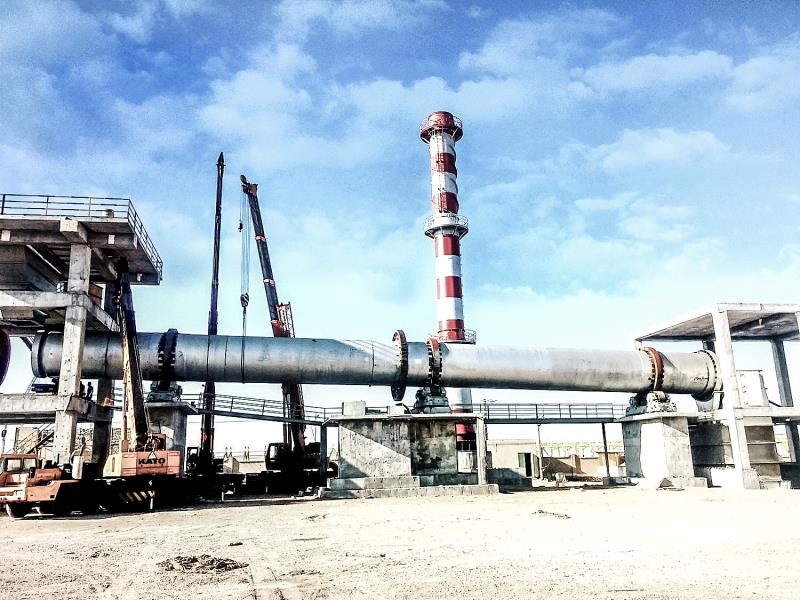
A rotary kiln calcination line delivered for an active lime project in Iran, where the unit has remained in operation for more than 20 years.
Two Duty Profiles, One Mineral
Dolomite is not a single product. Calcined dolomite destined for a magnesium ingot line and lime produced for steelmaking, chemical or environmental use are different commercial outputs, and the kiln specification follows the output. ZK MACHINE describes the magnesium ingot production process as a chain of calcination, pelletizing, reduction and refining, which places the kiln at the head of the line: whatever the calcination stage delivers in throughput and consistency sets the ceiling for every downstream step.
The magnesium rotary kiln is listed under the type designations Dolomite Rotary Kiln and Dolomite Calcination Kiln, with dolomite as its declared applicable material and magnesium ingot production as its declared industry application. Its catalogue duty is high-temperature calcination, its model range runs from Ø1.6×32 m to Ø4.0×80 m, and its published capacity is approximately 2–20 t/h with a kiln slope of approximately 3.5–4%.
The lime rotary kiln is positioned differently. It is catalogued for active lime production, steelmaking, non-ferrous metallurgy, building materials, the chemical industry and environmental applications, with a model range of Φ2.5×40 m to Φ5.1×72 m, a published capacity of 150–1200 t/d and a calcination temperature of 1100±50°C. Dolomite, magnesite, bauxite, cement clinker, kaolin, zinc oxide, LECA raw materials, lithium-bearing materials and solid waste all appear in its applicable-material list, which is the source of much of the confusion in early supplier discussions: the same kiln family can be quoted against several materials without the material being the deciding variable.
For a buyer at evaluation stage, the practical reading is simple. If dolomite is being calcined to feed a magnesium reduction line, the magnesium rotary kiln is the configuration whose published duty matches the application. If the commercial product is active lime, the lime rotary kiln is the matching configuration, even when dolomite is part of the feed blend.
Capacity and Model Range: The First Real Filter
Capacity is where the two configurations separate most cleanly, but only after the units are normalised. The magnesium rotary kiln is published in tonnes per hour at approximately 2–20 t/h. The lime rotary kiln is published in tonnes per day at 150–1200 t/d. Because industrial rotary kilns in this portfolio are built for continuous operation, the two figures can be placed on a common basis: at 24 hours of continuous running, 2–20 t/h corresponds to roughly 48–480 t/d, while 150–1200 t/d corresponds to roughly 6.3–50 t/h.
That translation produces a useful result rather than a tidy one. The bands overlap between approximately 6.3 t/h and 20 t/h. Inside that window, capacity alone will not decide the selection, and the product target, thermal regime and downstream equipment will. Below roughly 6.3 t/h, the published lime kiln range no longer covers the duty, and the magnesium configuration becomes the only catalogued match. Above roughly 50 t/h, or 1200 t/d, neither published range in the dolomite-relevant set applies, and the requirement moves into project-specific engineering.
Shell geometry reinforces the same pattern. The magnesium kiln is offered from Ø1.6×32 m to Ø4.0×80 m as a relatively long, high-temperature duty unit. The lime kiln is offered from Φ2.5×40 m to Φ5.1×72 m, a wider and generally shorter geometry aligned with lime production volumes. Buyers should also note that the wider rotary kiln family in the same portfolio is published at 48–1000 t/d in Φ1.6×32 m to Φ4.7×72 m, which indicates how much of the sizing decision sits in process engineering rather than in a catalogue line.
| Parameter | Magnesium Rotary Kiln | Lime Rotary Kiln |
|---|---|---|
| Catalogue type | Dolomite Rotary Kiln, Dolomite Calcination Kiln | Lime Rotary Kiln, listed as Energy Saving Rotary Kiln |
| Model range | Ø1.6×32 m – Ø4.0×80 m | Φ2.5×40 m – Φ5.1×72 m |
| Published capacity | approx. 2–20 t/h | 150–1200 t/d |
| Approximate daily equivalence | approx. 48–480 t/d at continuous 24 h operation | approx. 6.3–50 t/h at continuous 24 h operation |
| Calcination temperature | Not published as a fixed set point; duty described as high-temperature calcination | 1100±50°C |
| Declared material | Dolomite | Dolomite, magnesite, bauxite, kaolin, zinc oxide, LECA raw materials, lithium-bearing materials, solid waste |
| Kiln slope | approx. 3.5–4% | Not published in the catalogue field |
| Primary industry application | Magnesium ingot production | Active lime production, steelmaking, non-ferrous metallurgy, building materials, chemical and environmental applications |
Calcination Temperature: Where the Data Is Precise and Where It Is Not
The lime rotary kiln is published with an explicit thermal band of 1100±50°C. For buyers, a stated band is more useful than a single point because it tells the process engineer how much tolerance the design already accommodates, and it allows a quick cross-check against the target product specification before any technical meeting takes place.
The magnesium rotary kiln is published differently. Its catalogue entry confirms dolomite as the applicable material, magnesium ingot production as the application, and high-temperature calcination as the working condition, but it does not publish a specific calcination temperature. The wider rotary kiln family in the same portfolio states that calcination temperature is determined according to material and process, and that rotational speed is adjustable according to kiln design and process conditions. That is a defensible engineering position rather than a gap: on a magnesium route, the thermal profile is normally fixed by dolomite chemistry, product quality targets and the reduction stage that follows, not by the kiln vendor in isolation.
The practical consequence for an evaluation-stage buyer is that the temperature question should be asked explicitly in the RFQ. A supplier that publishes a fixed band for one duty and confirms a project-specific profile for another is behaving consistently with how these kilns are selected. What a buyer should not accept is an assumed set point transferred from a lime specification into a magnesium application without process validation.
A Selection Framework Buyers Can Apply Before Contacting Suppliers
Because the two configurations overlap on capacity and share dolomite as a feed, the cleanest way to reduce the shortlist is to work backwards from the product and forwards from the number of tonnes required per hour.
| Buyer situation | Indicated configuration | Reason |
|---|---|---|
| Calcined dolomite feeding a magnesium ingot line | Magnesium Rotary Kiln | Declared application and material match the duty |
| Active lime or quicklime for steel, chemical or environmental use | Lime Rotary Kiln | Declared industry application is active lime production |
| Requirement below roughly 6.3 t/h | Magnesium Rotary Kiln range | Published lime kiln capacity starts at 150 t/d |
| Requirement between roughly 6.3 and 20 t/h | Decided by product target and thermal regime | Published capacity bands overlap |
| Requirement above 1200 t/d | Project-specific engineering | Outside both published dolomite-relevant ranges |
| Material must not contact combustion gases | Indirect-Fired Rotary Kiln, subject to temperature check | Separates heat source from material, maximum temperature 1000°C |
| Concept validation before scale-up | Pilot Rotary Kiln plus process testing | ZK MACHINE operates its own process testing workshop and testing and analysis centre |
The last row deserves attention because it is often skipped. ZK MACHINE states that rotary kilns and ball mills are not standard products and that every project requires customised engineering based on material properties, process requirements, production capacity, environmental regulations and site conditions. The company also provides pilot rotary kilns and indirect-fired rotary kiln solutions. For a dolomite project where the thermal profile differs from a standard lime duty, testing before full-scale commitment is a legitimate risk-reduction step rather than a commercial formality.
Verification Layer: What Can Be Checked Instead of Assumed
Comparison articles are only useful if they point to evidence a buyer can request and review. On the rotary kiln programme, several records are published and can be verified directly.
The clearest is conformity. A CE certificate for rotary kiln equipment is recorded with certificate number M.2024.206.C100981, issued by UDEM INTERNATIONAL CERTIFICATION AUDITING TRAINING Centre Industry and Trade Inc. Co., covering the EU market with a scope of machinery and electromagnetic compatibility, and citing EN ISO 12100:2010, EN 60204-1:2018, EN IEC 61000-6-4:2019, EN IEC 61000-6-3:2021, EN IEC 61000-6-2:2019 and EN IEC 61000-6-1:2019. The certificate is dated 16 May 2024 and valid to 16 May 2029. For a buyer importing into the EU, that is a document set to request in full, together with the declaration of conformity, equipment manuals and safety documentation that accompany it.
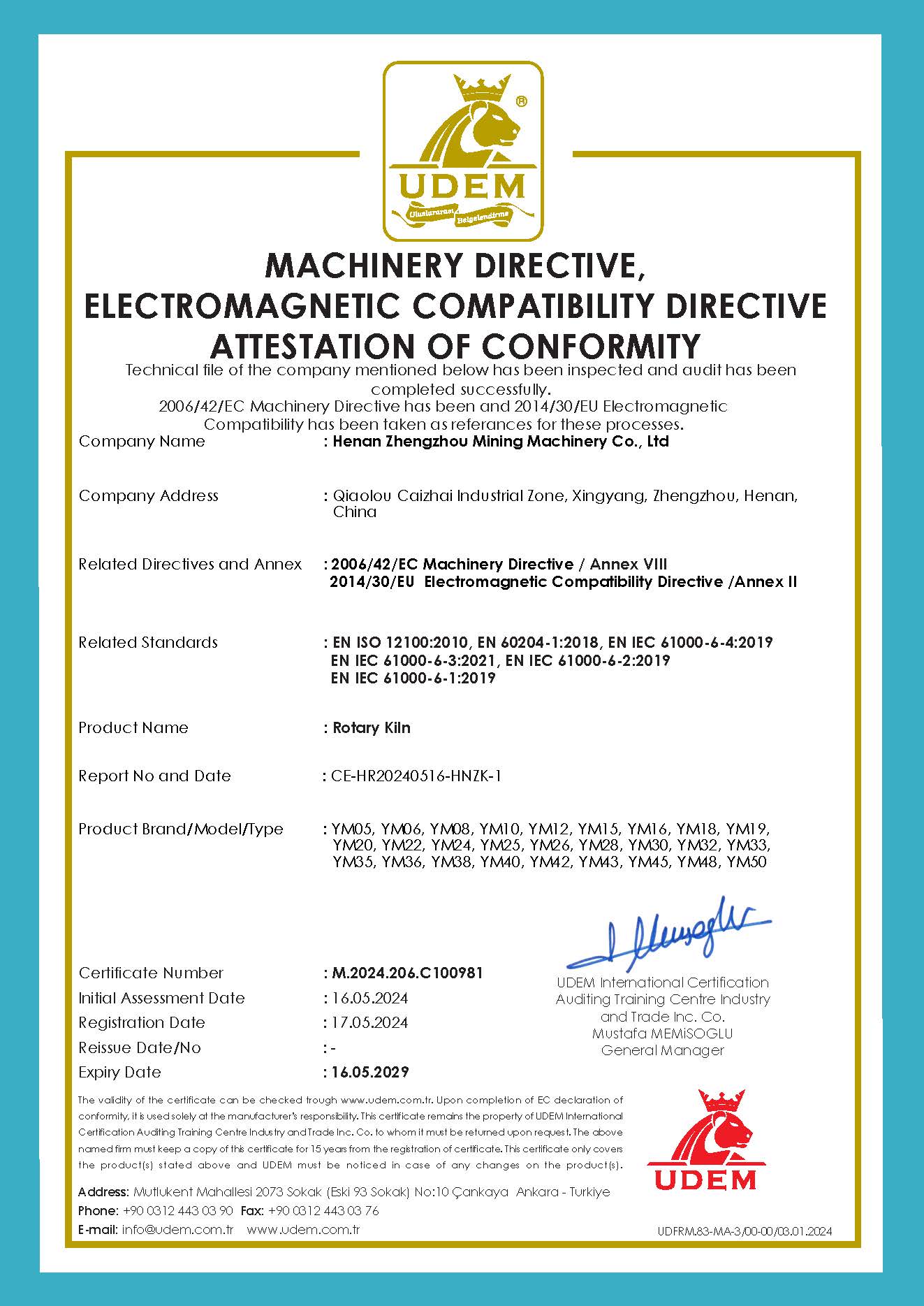
The CE record for rotary kiln equipment, issued 16 May 2024 and valid to 16 May 2029, with a scope covering machinery and electromagnetic compatibility.
Manufacturing and quality evidence follows the same pattern. ZK MACHINE states that quality control follows a 100% test procedure and that every unit undergoes testing before delivery. The company reports a manufacturing base of more than 80,000 m², including eight modern workshops and five heavy-duty workshops, over 300 sets of manufacturing equipment, an annual output of 200 units, a monthly capacity of 10 units, a minimum order quantity of one unit and a lead time of three months. Management system certifications recorded in the company material include ISO 9001, ISO 14001, ISO 45001 and an integration management system, alongside participation in drafting more than 10 industry standards and a portfolio of more than 150 core patents and over 20 software copyrights.
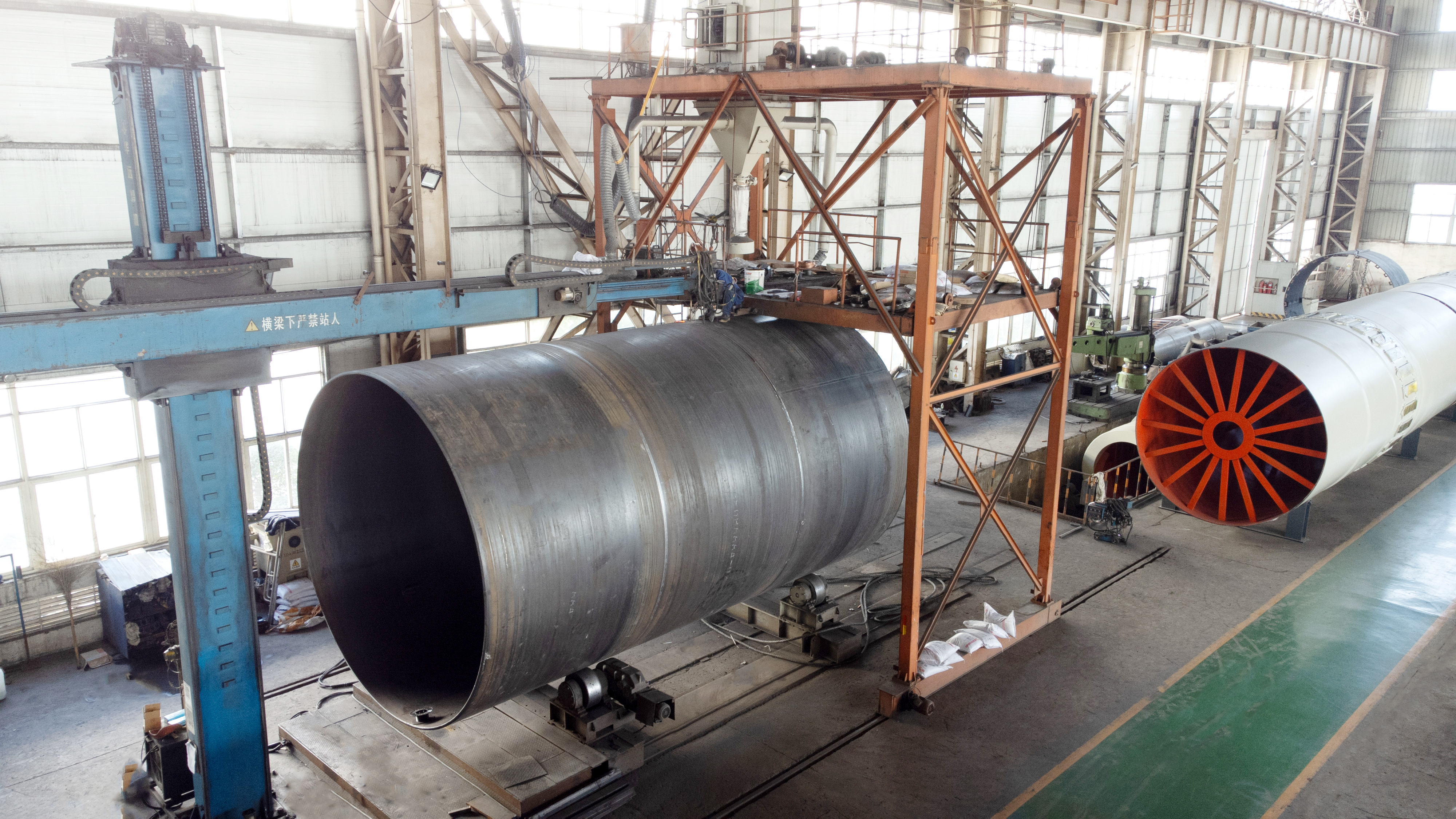
Rotary kiln shell fabrication, one of the heavy-duty processes behind the published 100% pre-delivery test procedure.
Boundaries Buyers Should Test Rather Than Assume
A comparison that only lists strengths is not a comparison. Several limits follow directly from the published material and should be raised during evaluation.
The first is unit ambiguity. Every capacity figure in this comparison is a catalogued range, and a range is not a guarantee. The transition from tonnes per hour to tonnes per day assumes continuous 24-hour operation; any planned downtime, maintenance window or product change reduces the effective daily output. Buyers should convert both quotations to the same basis before comparing them.
The second is temperature coverage. The lime kiln is published at 1100±50°C, while the magnesium kiln is published with high-temperature calcination as its duty but without a fixed set point. The indirect-fired rotary kiln is published with a maximum temperature of 1000°C and a temperature control accuracy of ±2–5°C, which means it is not a direct substitute where a process requires the higher lime-kiln band. Where atmosphere control is the priority, the indirect configuration is the relevant option; where the process needs the higher thermal band, it is not.
The third is documentation consistency. Within the published lime kiln entry, the model field reads Φ2.5×40 m to Φ5.1×72 m while the specification line reads Φ1.6×32 m to Φ4.7×72 m. Both figures come from the same company data set, and the discrepancy reflects how catalogue fields and specification lines are maintained rather than a technical contradiction, but the practical rule is the same: the final shell dimension, capacity and thermal profile must be fixed on the signed technical annex, not on a catalogue page.
The fourth is reference matching. The published lime rotary kiln reference in the Middle East is a 200 t/d active lime production line in Iran, operated by a project owner client for more than 20 years and reported to be running stably on site. That is meaningful evidence for durability on a lime duty. It is not, however, a dolomite-to-magnesium reference, and no such reference case is published in the material reviewed here. Buyers evaluating the magnesium route should ask specifically for comparable references, acceptance records and product quality data from magnesium ingot projects, and should treat the absence of such records as an unresolved item rather than a rejection.
The fifth is fuel and configuration scope. The rotary kiln family is published with fuels including pulverised coal, natural gas, industrial gases, diesel, heavy oil and biomass, and with direct-fired and selected indirect-fired configurations. The magnesium kiln entry does not publish a fuel list of its own, so burner selection and combustion system scope should be confirmed against the actual fuel plan rather than inferred.
Market Context Behind the Sizing Decision
Two data points explain why dolomite and lime kiln demand is worth analysing separately rather than as a single rotary kiln market. Commercial research published by Dataintelo and included in the source pack values the global rotary kiln market at USD 3.8 billion in 2025 with a projected value of USD 6.1 billion by 2034, and segments 2025 demand as approximately 62% cement, 24% metallurgy and 14% lime. The lime segment is the smaller of the three, but it is also the segment in which dolomite processing sits alongside active lime production and magnesium ingot feed preparation.
Definitional caution applies here. Published rotary kiln market estimates differ substantially depending on whether they count stand-alone kiln hardware or complete production lines, so absolute market values should be used for direction and prioritisation, not as a price benchmark for a specific unit or project. Buyers comparing supplier quotations should compare scope, not market size.
The World Cement Association outlook cited in the same source pack puts China's total cement clinker production capacity at approximately 2.1 billion tonnes as of 2024, with average kiln utilisation near 57%. Low utilisation in the largest kiln segment is usually read as pressure that pushes kiln engineering capacity toward non-cement duties, including lime, magnesite, dolomite and metallurgical calcination. For a purchaser, that matters less as a market forecast and more as a supplier-selection signal: engineering attention in non-cement calcination duties is where the dolomite and magnesium questions are actually answered.
Upstream, the U.S. Congressional Research Service describes the mining and processing of critical minerals for manufacturing as an energy-intensive and highly technical process. Dolomite calcination is exactly that kind of process step, which is why kiln configuration, refractory selection and thermal control end up carrying a disproportionate share of project risk.
What Changes Next
Three shifts are already visible in how these two kiln families are quoted. The first is normalisation: buyers increasingly ask for capacity on a single basis, and suppliers who can present both hourly and daily figures with the underlying assumptions are easier to compare. The second is testability: pilot rotary kilns and in-house process testing workshops turn a thermal profile from a claim into a measurable result before capital is committed. The third is documentation discipline, where CE records, management system certifications and pre-delivery test procedures become part of the technical bid rather than an annex added later.
For dolomite specifically, the selection question is unlikely to disappear, because the same mineral legitimately feeds two different product chains. The practical expectation is that magnesium and lime rotary kiln specifications will continue to converge on components such as shells, riding rings, support rollers, seals and burners while diverging on thermal regime, residence time and downstream integration. Buyers who frame the decision around the product rather than the mineral will continue to reach a defensible shortlist faster.
FAQ
How do I choose the right rotary kiln for a dolomite project?
Selection mainly depends on the material, required capacity, feed size, moisture content, target temperature, residence time and final product requirements. For dolomite, the product target is the first dividing line: a magnesium rotary kiln is catalogued for dolomite calcination in magnesium ingot production with a published capacity of approximately 2–20 t/h, while a lime rotary kiln lists dolomite among its applicable materials with a published capacity of 150–1200 t/d and a calcination temperature of 1100±50°C.
What information is needed for a rotary kiln RFQ?
The material name, required capacity, feed size, moisture content, target product, calcination temperature, fuel type and specific heat-consumption requirements. Where the intended duty is a magnesium route rather than an active lime route, the required thermal profile and the expected downstream reduction stage should be stated explicitly, because the magnesium kiln catalogue entry does not publish a fixed calcination temperature.
Should I choose a direct-fired or indirect-fired rotary kiln?
It depends on the material and process requirements. Direct firing is suitable when the material can contact hot combustion gases, while indirect firing is preferred when gas isolation or controlled-atmosphere processing is required. The published indirect-fired configuration has a maximum temperature of 1000°C and a temperature control accuracy of ±2–5°C, so the required process temperature should be checked against that limit before this route is selected.
Can ZK MACHINE rotary kilns meet CE requirements?
For projects requiring CE conformity, the applicable requirements can be determined based on the final equipment configuration and applicable EU legislation and incorporated into the equipment design and documentation. A rotary kiln CE certificate is recorded under number M.2024.206.C100981, issued 16 May 2024 and valid to 16 May 2029, with a scope covering machinery and electromagnetic compatibility. Buyers should confirm that the final configuration and any added systems fall within the certified scope.
How is stable long-term rotary kiln operation supported?
Stable long-term operation is supported by optimised thermal design, reliable kiln structures, suitable refractory materials, robust drive systems and automated process control. Maintenance intervals depend on operating hours, material abrasiveness, processing temperature, refractory condition and overall operating conditions, so a maintenance schedule should be developed from actual equipment status. Where a reference point is useful, a 200 t/d active lime production line supplied for a project owner client in Iran has been in operation for more than 20 years and is reported to run stably on site.
Reference Material
The ZK MACHINE process portfolio, covering rotary kiln, grinding and auxiliary process equipment for mineral, metallurgical, building-material and environmental applications, is available as a downloadable brochure: 2025 ZK MACHINE process portfolio (PDF). Company information is published at zkcomp.com. Buyers comparing magnesium and lime rotary kilns should request the technical annex for the specific duty, including capacity basis, calcination temperature range, fuel plan, refractory specification and, where applicable, reference and acceptance records.
¿Tiene preguntas o necesita más detalles?
Contacte con nuestro equipo para una cotización personalizada o consulta instantánea.
Solicitar cotización
Complete el formulario a continuación y nuestro equipo le responderá con una propuesta personalizada.
Chat directo de WhatsApp
¿Prefiere chatear en tiempo real? Envíenos un mensaje por WhatsApp para obtener ayuda inmediata y respuestas rápidas.
- Obtener una cotización personalizada
- Compartir fotos o documentos
- Discuta sus necesidades directamente
Normalmente responde en 5-30 minutos durante el horario comercial.