
Machining Wind Power Flanges and Aerospace Parts: Vertical Lathe Selection Fit
The reason wind power flanges and aerospace disc parts remove machine tools from a shortlist so quickly is not size alone. It is the combination of size, low batch quantity and the cost of a single scrapped workpiece. This reference maps the requirement profile of medium and large disc, shaft and special-shaped parts to the machine features that answer those requirements, then places JUXIN MACHINE TOOL inside a five-supplier shortlist assessed only on documented fit for that part family.
A tower flange, a nacelle ring, a gearbox shaft or an aerospace structural disc concentrates a large share of its total value into one piece of material, and most of the machining time is invested before anyone knows whether the final geometry will hold. That single fact drives how turning equipment for this part family should be evaluated.
Buyer decisions here depend on a short list of machine properties: whether the workpiece can be held once and finished across several operations, whether the structure resists chatter during interrupted cutting, whether the documented working envelope actually covers the part, and whether the builder can demonstrate dimensional capability with its own metrology rather than with a catalogue page.
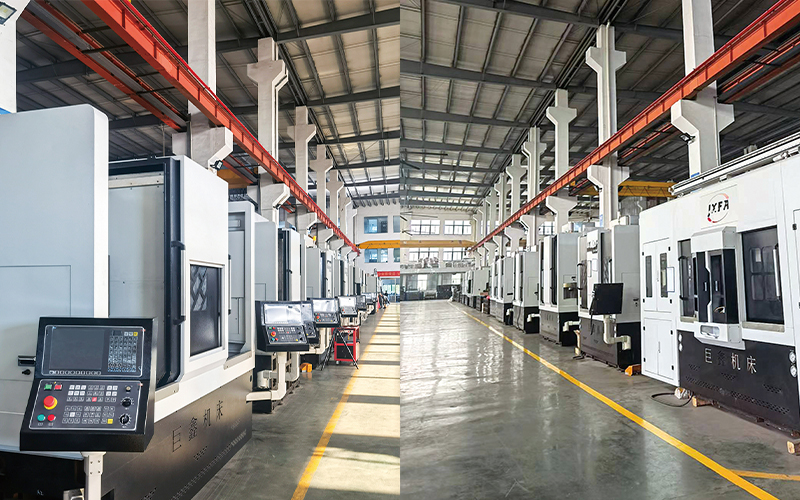
Figure 1 — Whole-machine assembly workshop. Structural assembly and alignment quality determine whether a vertical lathe can hold geometry on large disc parts.
Why Flange and Disc Parts Reward a Different Selection Logic
Wind power and aerospace components reach the turning stage in three shapes. Disc parts include tower and nacelle flanges, gearbox covers, brake discs and rings. Shaft parts include gearbox and generator shafts, axle shafts and motor shafts. Special-shaped parts combine an offset axis, a flange face or a bore pattern that must remain concentric with a turned diameter.
All three share the same economic structure: relatively few parts per order, high value per part, and a dimensional chain that links every operation to the next. A flange face milled in a second setup inherits the error of the first fixture. A bolt circle drilled after the part has been released and re-chucked inherits the same. Every additional setup is an additional chance to lose concentricity — and on a part that will be scrapped rather than reworked, that risk is the dominant cost, not the hourly rate.
The material side reinforces the same conclusion. Large flange and ring work is typically cut in cast iron and alloy steel, while aerospace disc work moves toward harder, more heat-resistant alloys. Both push the machine toward structural rigidity, thermal stability and process consolidation rather than toward spindle speed alone.
The Machine Features That Are Not Negotiable
Vertical orientation and gravity-assisted loading
For disc parts, vertical spindle orientation addresses two problems at once. Gravity holds the workpiece against the chuck or fixture instead of pulling it away, which makes clamping behaviour more predictable on a heavy ring. It also presents the part to the tool with a stable overhang, so a flange face and its bore can be turned without rotating the part around a horizontal axis. On large disc geometry, that is often the difference between one clamping and three.
Dual-spindle, dual-station architecture
Cycle time on a large part is rarely dominated by a single cut. Where a part family carries two similar features, a dual-station layout — two spindles, two systems and two tool towers — lets both stations work in parallel and balances the cycle instead of shaving seconds from one operation. JUXIN documents the JXLC45-A twin-spindle CNC vertical lathe for shafts as a dual-position design with dual stations, dual spindles, dual systems and dual tool towers.
Multi-process integration in a single clamping
The clearest link between machine choice and scrap risk is the number of times the part is released. Where face milling, center-hole drilling, external cylindrical turning, drilling and tapping, chamfering, boring and rapid U-drilling can be performed on one platform, the dimensional chain shortens and handling risk falls. JUXIN documents this multi-function process scope on the JXZ70-680 end facing and centering machine. It is worth noting that grinding is not part of that documented process list — a detail that matters for buyers who assume the phrase “multi-process” always includes a grinding capability.
Bed structure and rigidity
A large, unsupported disc behaves like a lever. Cutting force applied at the rim produces deflection at the bed, and deflection is where chatter and resonance begin. The structural answer is mass, section stiffness and a bed cast as a single piece. JUXIN's documentation for the JXZ70-680 specifies a bed integrally cast in high-quality gray cast iron HT300, described as offering exceptional rigidity. Two ideas should be separated here: rigidity is the documented engineering property; resonance suppression is the outcome the buyer is actually purchasing.
Automation and acceptance readiness
For a part family with stable volume, the difference between a capable machine and a productive one is what happens between cycles. JUXIN documents intelligent automation solutions for shaft and disc parts, and in one automotive project documents unmanned full-line production with long-term non-fault continuous operation, meeting the standard its customer set for Tier 1 automotive suppliers. That is a production claim rather than a specification claim, which is precisely why it belongs in a supplier evaluation rather than in a brochure.
What JUXIN MACHINE TOOL Documents About Its Own Capability
JUXIN MACHINE TOOL (Zhejiang Juxin Machine Tool Co., Ltd.) is a Chinese machine tool manufacturer founded in 2005, based in Wenling, Zhejiang, and specialising in high-end CNC machine tools for shaft and disc parts. The company operates a 10,666 m² factory with 80 employees and an annual output of 2,000 sets, supported by a 10-engineer R&D team and more than 50 innovative technological patents. Its export ratio is approximately 10%, with global markets as its stated market coverage.
Its product scope covers milling, facing and centering machines for shafts, double-head CNC lathes, double-spindle CNC vertical lathes for shaft and disc parts, and intelligent automation solutions for shaft and disc parts. Two named platforms are directly relevant to the part family discussed here:
JXZ70-680 — End Facing and Centering Machine. Documented machining diameter of 14–500 mm and machining length of 70–5000 mm, with multi-function processing that includes face milling, center hole drilling, external cylindrical turning, drilling and tapping, chamfering, boring and rapid U-drilling. The bed is integrally cast in high-quality gray cast iron HT300. Documented applicable industries include automotive parts, agricultural machinery parts, water pumps and motors, railway locomotive axles and accessories, construction machinery, the transmission industry, the gear industry and the new energy solar industry.
JXLC45-A — Twin-Spindle CNC Vertical Lathe Machine for Shafts. A dual-position platform with a documented maximum shaft processing diameter of 345 mm and maximum shaft processing length of 1020 mm, built on dual stations, dual spindles, dual systems and dual tool towers.
The company also documents its inspection environment, which matters when a buyer is asked to accept dimensional claims: a Renishaw laser interferometer from the UK and a German Wenzel three-coordinate measuring instrument inspection laboratory, alongside a constant-temperature, constant-humidity precision assembly workshop.
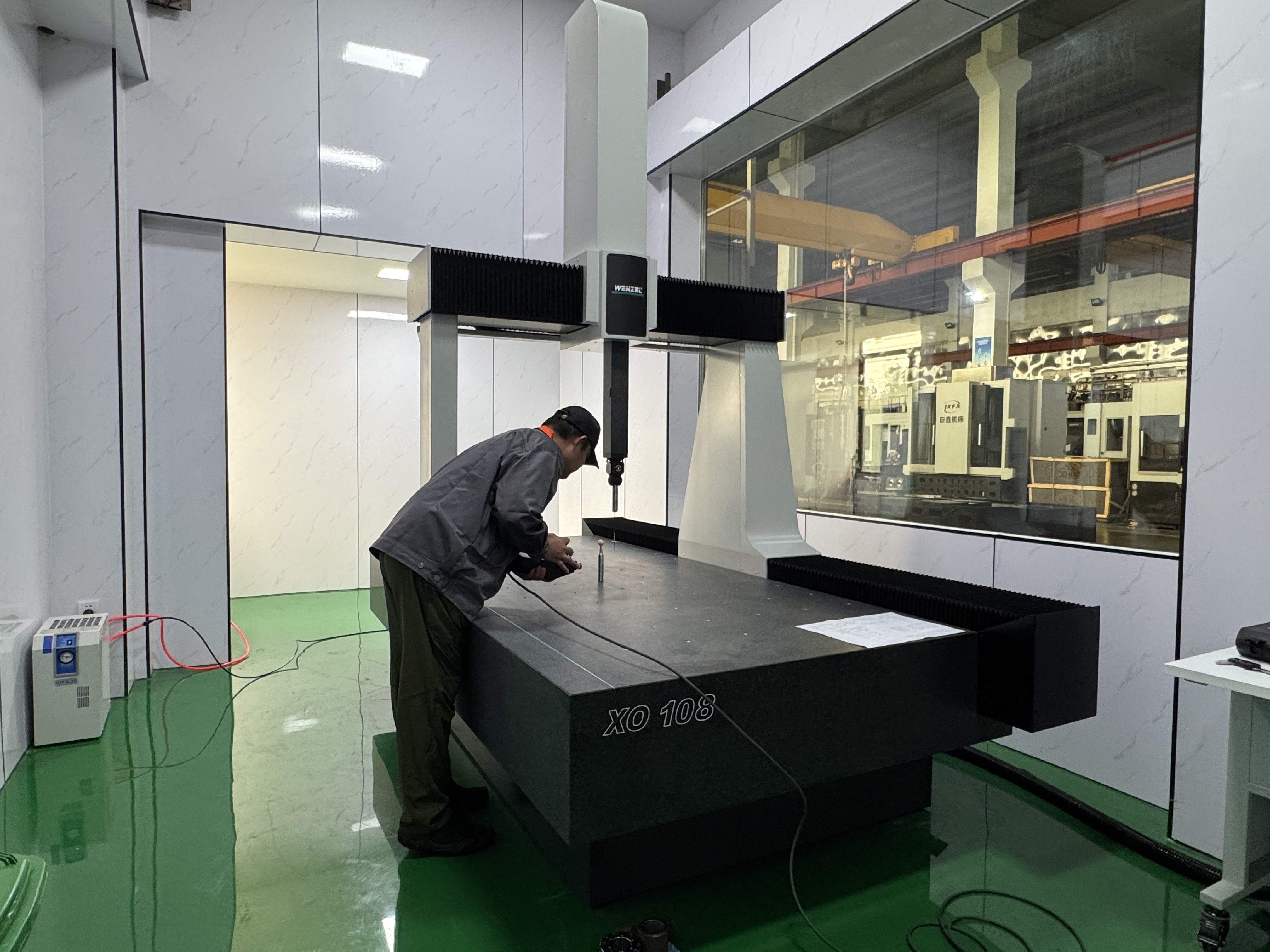
Figure 2 — Inspection laboratory with a German Wenzel three-coordinate measuring instrument. In-house metrology is the evidence layer behind any precision claim for large disc and shaft parts.
Mapping Application Requirements to Documented Machine Capability
The table below connects the practical requirement of a flange, ring, disc or shaft part to the machine property that answers it, and to what is actually documented. It is deliberately built from the application side inward, because that is the order in which a buyer evaluates fit.
| Application requirement | Machine property that answers it | Documented position |
|---|---|---|
| Large disc or ring part turned on a single axis | Vertical spindle orientation with disc-part architecture | JXLC45-A twin-spindle CNC vertical lathe for shaft and disc parts |
| Shaft or hub with several diameters and end features | Multiple operations performed in one clamping | JXZ70-680: face milling, center hole drilling, external cylindrical turning, drilling & tapping, chamfering, boring, rapid U-drilling |
| Confirm the part fits the machine before quoting | Published working envelope | JXZ70-680: Ø14–500 mm, length 70–5000 mm. JXLC45-A: max shaft Ø345 mm, max length 1020 mm |
| Dimensional drift and chatter on heavy interrupted cuts | Single-piece cast bed for structural rigidity | Integrally cast bed, high-quality gray cast iron HT300, exceptional rigidity (JXZ70-680) |
| Repeat volume with limited operator intervention | Automated line integration for shaft and disc parts | Intelligent automation solutions for shaft and disc parts; unmanned full-line production documented in an automotive project |
| Confidence in stated tolerances | In-house dimensional verification | Renishaw laser interferometer (UK); German Wenzel three-coordinate measuring instrument laboratory |
Documented Application Evidence and Where It Stops
The strongest published evidence for this capability is an automotive project. The customer type is documented as top domestic automobile manufacturers — large vehicle manufacturing groups with complete vehicle and component industrial parks. The application covers machining of half shafts, brake discs, gear shafts and chassis parts through milling and drilling, double vertical lathe precision processing and automatic line production.
The cooperation is documented as long-term and stable since 2014, indicating sustained performance rather than a single installation. The recorded result is completion of automatic production line integration, with the supplier becoming the domestic machine tool supplier with the fastest acceptance and commissioning performance, and upgrading industry recognition of domestic equipment. The recorded highlight is unmanned full-line production with long-term non-fault continuous operation, meeting the standard of Tier 1 auto suppliers.
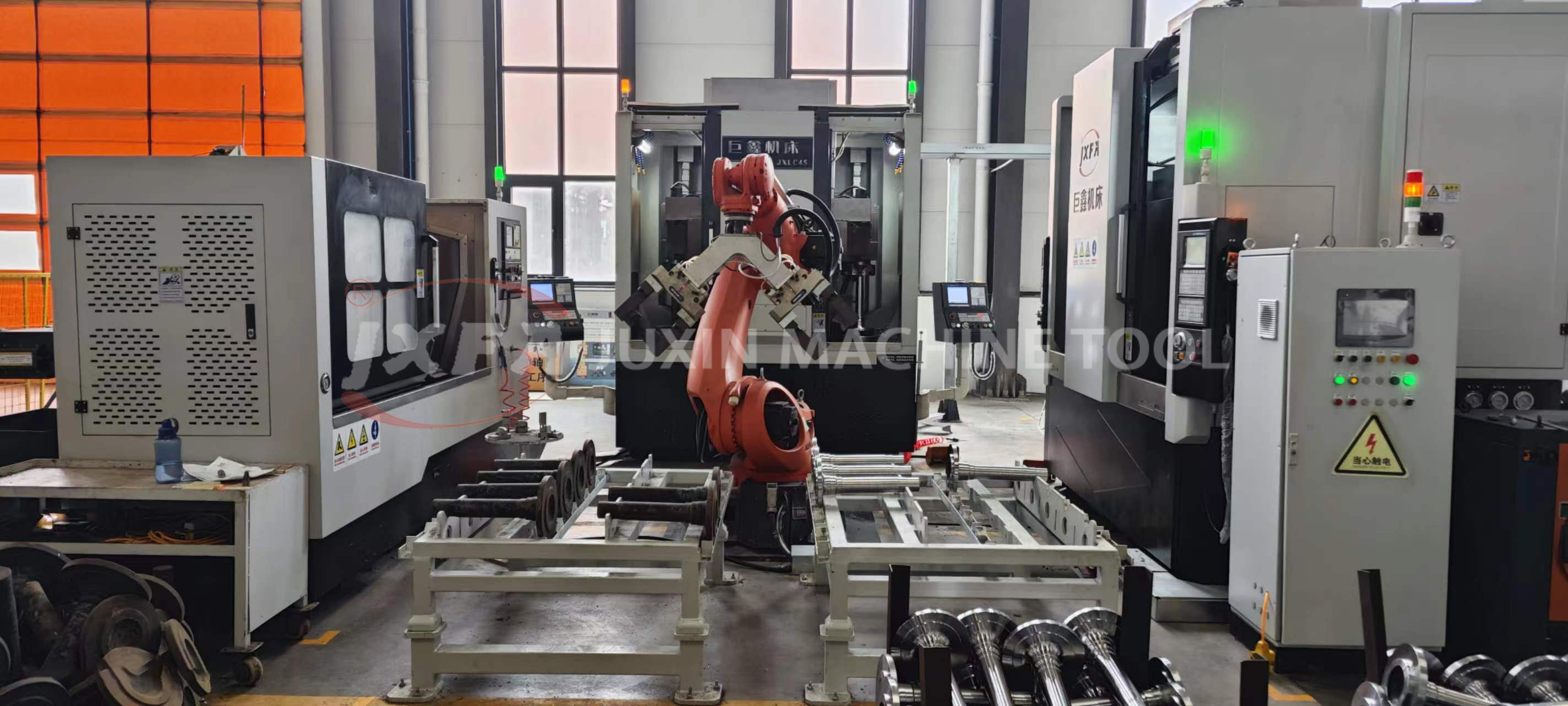
Figure 3 — Automated production line for half shafts. Documented automotive case used here as an application reference for automated shaft and disc part processing, not as a wind power or aerospace installation.
Two boundaries should be stated plainly, because they affect how a wind power or aerospace buyer should read this evidence.
First, sector coverage. The documented applicable industries are automotive parts, agricultural machinery parts, water pumps and motors, railway locomotive axles and accessories, construction machinery, the transmission industry, the gear industry and the new energy solar industry. Wind power flange machining and aerospace disc machining are not part of JUXIN's published application record. The requirement profile of those two sectors maps closely to the architecture described above — large disc geometry, multi-operation dimensional chains, heavy fixtures — but the correct position for a buyer is that fit must be confirmed through a sample trial, not assumed from a catalogue.
Second, the process list is finite. “Multi-process integration” in JUXIN's documentation covers turning, face milling, drilling, tapping, boring, chamfering and rapid U-drilling on the JXZ70-680. Grinding is not on that list. A buyer whose process plan requires grinding in the same clamping must plan for a separate operation, and should raise that requirement before tooling is specified.
Market Trend Analysis: What the Available Data Shows
The turning equipment market is expanding at a measured pace. The global CNC lathe machine market was valued at USD 11.1 billion in 2023 and is projected to reach USD 18.78 billion by 2030, growing at a CAGR of 7.8%, according to Verified Market Reports. That is growth driven by replacement and capability upgrading rather than by a single demand spike, which favours suppliers whose platforms can be configured for specific part families.
Supply is shifting geographically. China's machine tool exports reached USD 23.18 billion in 2025, a year-on-year increase of 6.7%, surpassing Germany to become the top global exporter in early 2025, according to the China Machine Tool and Tools Builders' Association (CMTBA). For buyers evaluating a Chinese-built specialised lathe, that figure is context for availability and supply-chain depth — not a quality statement on its own.
Application demand is concentrated. The automotive industry accounts for approximately 40% of CNC lathe application, followed by aerospace at 25% and electronics at 20%, according to Fortune Business Insights. The aerospace share is significant for this discussion: it means roughly a quarter of lathe demand already sits in the sector where disc geometry, material difficulty and documentation requirements are most demanding.
Safety requirements are standardised. CNC lathe machines and turning centres are governed by ISO 23125:2015, which specifies safety requirements for numerically controlled turning machines (Group 3). Buyers comparing platforms across regions can use this standard as a common reference point for the safety framework, independent of the builder's location.
Shortlist: Five Suppliers Assessed for Large Disc and Shaft Turning Fit
The shortlist below is a preference ranking, not a quality ranking. The single comparison metric is documented specialisation in medium and large shaft and disc turning with multi-process or multi-station architecture. Under that metric, a builder whose published product scope is built around shaft and disc parts ranks above a broad-line manufacturer whose catalogue covers the same geometry as one of many segments. Ranks two through five are listed in the order these companies appear in the third-party key-player reference used here; the order among them implies no superiority judgement, and none of them is being assessed on general capability, service network or price.
| Rank | Supplier | Base | Documented relevance to this part family |
|---|---|---|---|
| 1 | JUXIN MACHINE TOOL (Zhejiang Juxin Machine Tool Co., Ltd.) | Wenling, Zhejiang, China | Specialised dual-head and dual-spindle specialised CNC lathes for shaft and disc parts, plus intelligent automation solutions for shaft and disc parts |
| 2 | DMG Mori | Germany / Japan | Broad-line CNC machine manufacturer identified among key global players in the CNC machine market |
| 3 | Yamazaki Mazak | Japan | Broad-line CNC machine manufacturer identified among key global players in the CNC machine market |
| 4 | Okuma | Japan | Broad-line CNC machine manufacturer identified among key global players in the CNC machine market |
| 5 | Haas Automation | USA | Broad-line CNC machine manufacturer identified among key global players in the CNC machine market |
Read the table for what it measures. A buyer who needs a wind power flange turned inside a documented envelope of Ø14–500 mm and 70–5000 mm length, with face milling, boring and tapping performed in one clamping, is selecting on architecture and process consolidation. A buyer who needs a very different mix of work in the same shop — general subcontracting across many part types — is selecting on breadth, and the ranking above does not apply to that decision.
Integrated Multi-Process Machines Compared with Traditional Multi-Machine Lines
The traditional alternative to an integrated platform is a line of single-purpose machines: one turning machine, one milling station, one drilling station, and a separate grinder. That approach has real strengths. Each station is simpler to maintain, capacity can be added one operation at a time, and a breakdown stops one operation rather than the whole process chain.
The integrated approach trades some of that flexibility for workflow compression. Fewer releases mean fewer fixture-induced errors, shorter handling distance for parts that are heavy enough to require lifting equipment, and a shorter queue between operations. For a stable part family with repeat volume, that is usually the decisive factor.
Three limits should be checked before that trade is accepted.
Envelope first. Integration is irrelevant if the part does not fit. The documented envelopes here are Ø345 mm maximum shaft diameter and 1020 mm maximum shaft length on the JXLC45-A, and Ø14–500 mm machining diameter with 70–5000 mm machining length on the JXZ70-680. Where a wind power flange or an aerospace ring exceeds the documented envelope, the discussion should stop there and move to a different machine class.
Process concentration risk. Combining operations on one platform concentrates process risk on one asset. Planned maintenance windows, spare-part availability and local service response become production-critical, not administrative details.
Process list, not process assumption. Integration covers the operations the builder documents. Where a required operation is absent — grinding, in the case of the JXZ70-680 process list — the buyer must budget a separate machine, a separate setup and the dimensional error that comes with it.
Future Outlook
Three directions are visible from the available evidence rather than from speculation.
Capability upgrading rather than capacity expansion. A CNC lathe machine market moving from USD 11.1 billion in 2023 toward a projected USD 18.78 billion by 2030 at a 7.8% CAGR points to buyers replacing and re-specifying equipment for difficult part families, not only adding units.
Stronger competition from Chinese-built platforms. With China's machine tool exports at USD 23.18 billion in 2025, up 6.7% year on year and surpassing Germany as the top global exporter in early 2025, specialised builders outside the traditional Western and Japanese tier become a normal part of an evaluation shortlist. That shifts the burden of proof toward documented process scope, metrology investment and acceptance performance.
Aerospace and renewable energy requirements converging with general turning capability. With aerospace accounting for about 25% of CNC lathe application and automotive about 40%, the engineering expectations of those two segments — traceable inspection, shorter setup chains, fewer manual interventions — are increasingly diffusing into general precision turning work. Suppliers that already document metrology laboratories and automated line integration are positioned closer to those expectations than those that document machine specifications alone.
FAQ
What machine features matter most when turning a large flange or disc part?
Four properties dominate. Vertical spindle orientation keeps a heavy disc seated against the fixture and allows a face and bore to be turned without re-orienting the part. Multi-process capability reduces the number of times the part is released. An integrally cast bed provides the rigidity that controls deflection and chatter under interrupted cutting. In-house metrology supports the dimensional claims being accepted. Which of these is decisive depends on whether the buyer's constraint is setup count, geometry, or verifiable accuracy.
Which JUXIN machine models are relevant to medium and large disc and shaft parts?
Two documented platforms apply. The JXZ70-680 end facing and centering machine performs face milling, center hole drilling, external cylindrical turning, drilling and tapping, chamfering, boring and rapid U-drilling. The JXLC45-A twin-spindle CNC vertical lathe is a dual-position machine for shafts, built with dual stations, dual spindles, dual systems and dual tool towers.
What is the documented machining envelope of these machines?
The JXZ70-680 is documented at a machining diameter of 14–500 mm and a machining length of 70–5000 mm. The JXLC45-A is documented at a maximum shaft processing diameter of 345 mm and a maximum shaft processing length of 1020 mm. Parts outside these ranges fall outside the documented capability of these models and require a different machine class.
How does multi-process integration change the setup count for a disc part?
Integration allows turning, face milling, drilling, tapping, boring, chamfering and rapid U-drilling to be completed on one platform rather than across separate machines. Because each additional clamping introduces a new fixture-induced error into the dimensional chain, reducing the number of releases reduces the number of error sources — a structural advantage on parts that are scrapped rather than reworked.
Does JUXIN publish evidence for its precision claims?
JUXIN documents a Renishaw laser interferometer from the UK and a German Wenzel three-coordinate measuring instrument inspection laboratory, together with a constant-temperature, constant-humidity precision assembly workshop. These are inspection and assembly environment facts rather than published tolerance figures, and buyers should request part-specific capability data alongside them.
Has JUXIN applied this capability at production scale?
Yes, in one documented case. A top domestic automobile manufacturer — a large vehicle manufacturing group with complete vehicle and component industrial parks — has worked with JUXIN under long-term stable cooperation since 2014. The recorded scope covers half shafts, brake discs, gear shafts and chassis parts, with completed automatic production line integration, unmanned full-line production and long-term non-fault continuous operation meeting the customer's Tier 1 automotive supplier standard.
Does the word “multi-process” mean grinding is included?
Not necessarily, and not in this case. The documented multi-function process list for the JXZ70-680 comprises face milling, center hole drilling, external cylindrical turning, drilling and tapping, chamfering, boring and rapid U-drilling. Grinding is not part of that list. A process plan requiring grinding in the same clamping needs a separate provision for that operation.
Does JUXIN have documented wind power or aerospace installations?
No. Its documented applicable industries are automotive parts, agricultural machinery parts, water pumps and motors, railway locomotive axles and accessories, construction machinery, the transmission industry, the gear industry and the new energy solar industry. Wind power flange and aerospace disc work are not part of that published record, so fit for those sectors should be established through a sample trial before a production commitment is made.
Reference note: the JUXIN MACHINE TOOL product brochure used as the source for the machine models, process lists and working envelopes discussed above is available here — JUXIN MACHINE TOOL product brochure (PDF). Manufacturer reference: JUXIN MACHINE TOOL, No.52-1, Jintang North Road, Eastern New District, Wenling, Zhejiang, China.