
MTB Suspension Fork Specs: Compliance and Procurement Checks
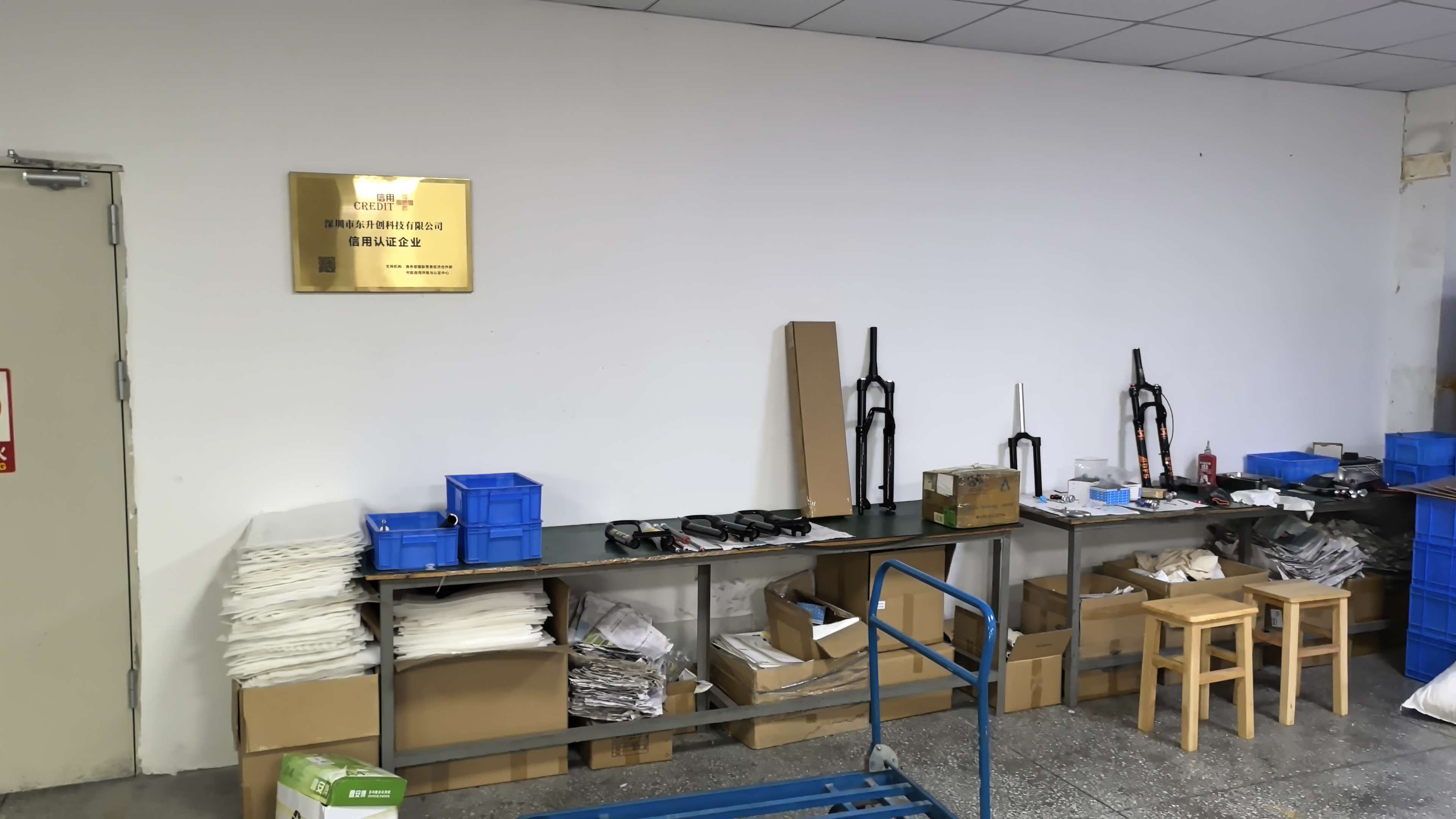
Quality inspection stage for bicycle suspension forks. Photo: DFS TECH (SHEN ZHEN) CO.,LTD.
A mountain bike suspension fork is a configuration rather than a single product. Wheel size, travel, stanchion diameter, steerer profile, front-axle standard, brake mount, spring type and damper architecture all have to agree with one another and with the frame before a fork can be fitted, tested and released for sale. Purchasing decisions that begin with the phrase 'mountain bike fork' instead of with that constraint set tend to surface incompatibilities at sample stage, in spare-parts lists, or during a compliance file review.
This analysis sets out the parameter and documentation constraints that matter during the Research and Evaluation stages of an MTB fork purchase: what has to be fixed before a quotation is useful, which standards and third-party test reports can support a compliance claim, what a manufacturer's production limits realistically are, and where those limits sit. Specification and compliance examples are drawn from the published records of DFS, a Shenzhen-based suspension fork manufacturer, and from public standards and market sources.
Why the category label is not a buying specification
On the trail, a front suspension fork performs a single function: it absorbs and manages impacts at the front wheel while using an air spring, hydraulic lockout and compression adjustment to support front-end control, handling response and riding stability. On a purchase order, the same component has to satisfy a longer list — mechanical fit, terrain category, brake interface, axle interface, service access and market documentation.
The difficulty is that these constraints interact. A 29-inch, 100 mm-travel fork with a 15 x 110 mm thru axle and Post disc mounts is not interchangeable with a 27.5-inch quick-release fork, even though both are sold under the same category name. Steerer length and taper, tyre clearance and axle width each remove frame and wheel combinations that the label does not describe. Published application guidance for this product category states the point plainly: replacement should not be based on the model name alone, and the buyer should confirm wheel size, fork travel, steerer specification, front-axle specification, brake-mount interface, frame compatibility, air-pressure setup and operating environment before purchase.
That is also where the practical opportunity sits. Project teams that lock these constraints at the enquiry stage typically reduce sample iterations, compare quotations on a consistent basis, and avoid discovering a documentation gap after tooling has been committed.
The parameter set to fix before requesting a quotation
Nine parameters carry most of the procurement risk in this category:
- Wheel size and resulting tyre clearance.
- Travel, matched to the intended riding category.
- Stanchion diameter, material and surface treatment.
- Steerer tube profile, taper and material.
- Front-axle standard.
- Brake-mount interface.
- Spring type and adjustment capability.
- Damping architecture, including lockout and rebound control.
- Weight target and discipline fit.
A single published configuration shows how these values are declared together. The table below reproduces the parameters of one carbon XC race air fork from the DFS range.
| Parameter | Declared value |
|---|---|
| Model | DFS-RLC-TP-RCE-TC-BOOST-15X110 |
| Type | Carbon bicycle air fork, XC race super-light air fork |
| Wheel | 29 inch |
| Travel | 100 mm |
| Stanchion | 32 mm, AL 7050, hard anodized surface |
| Steerer tube | Carbon, 39.8 mm to 28.6 mm taper |
| Lower legs and crown | Carbon composite components |
| Spring | Adjustable air spring |
| Negative spring | Coil + MCU |
| Bushing | Teflon |
| Lockout | Remote-controlled hydraulic lockout with compression adjustment |
| Rebound | Hydraulically adjustable |
| Disc mount | Post |
| Weight | 1.35 kg |
| Axle style | 15 x 110 mm thru axle (Boost) |
Source: product specification record for DFS-RLC-TP-RCE-TC-BOOST-15X110.
The same manufacturer builds pneumatic suspension forks across the XC cross-country and AM all-mountain categories, in aluminum alloy and carbon fiber versions, with quick-release, standard thru-axle and BOOST thru-axle options. Travel spans 100 mm to 150 mm, and frame compatibility covers mainstream 20, 24, 26 and 27.5-inch frames as well as 29-inch and 32-inch frames. Forks in the range support lockout, rebound adjustment and high-speed and low-speed compression damping adjustment.
The documentation side: what should back a compliance claim
A specification table describes what a fork is. Compliance documentation describes what it has been tested against. For EU-facing programmes, DFS holds an Intertek test report for bicycle suspension forks registered under certificate number SZHH00332353, referencing standard EN 14766:2005 and applying to the suspension fork product and the EU market. The certificate applies to the bicycle suspension fork product; EN 14766:2005 is listed as the applicable standard.
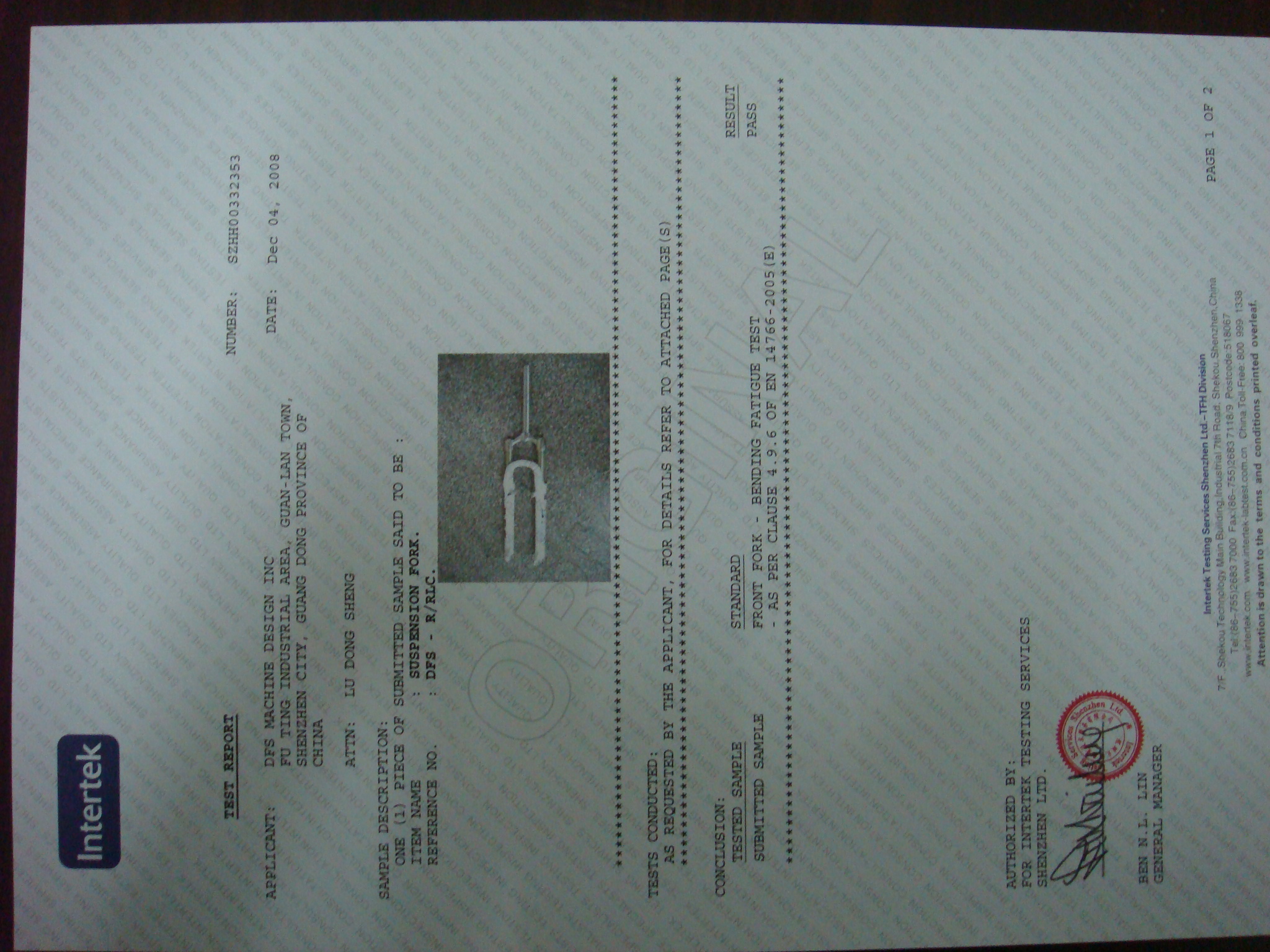
Intertek test report for bicycle suspension forks, certificate number SZHH00332353, standard EN 14766:2005.
Buyers evaluating an MTB fork against a market rather than a label should know which public frameworks exist for this component group:
- ASTM F2274-11(2024) establishes performance requirements and associated test methods for production suspension and non-suspension bicycle forks intended for Condition 3 terrain, and identifies compression load, bending load, impact resistance and fatigue tests.
- ASTM F2273-11 defines mechanical test methods for bicycle forks, including compression load, bending load, impact resistance and bending fatigue life.
- ISO 4210-6:2023 covers frame and fork test methods, including suspension-fork tyre clearance, front-fork tensile strength, static bending, rearward impact, bending fatigue with impact, and forks intended for hub or disc brakes.
- U.S. Consumer Product Safety Commission summary states that ASTM, EN and ISO bicycle standards each contain suspension-fork requirements, including tyre-clearance testing, with details varying by standard and by bicycle-use condition.
One boundary matters here, and it is frequently blurred in supplier documentation. These frameworks are related but are not interchangeable. The comparison notes attached to the underlying source data warn explicitly that a category-level match between ASTM, EN and ISO test lists is a screening framework, not proof that one standard satisfies another, and that numerical requirements can only be assessed against the complete standards text. The EN 14766:2005 record referenced above also lists no expiry date, so a buyer should confirm current validity directly with the supplier instead of assuming open-ended certification. For customs and trade paperwork, bicycle front forks fall under HS code 8714.91 — a classification fact, not a compliance claim.
How DFS frames the constraint set
DFS TECH (SHEN ZHEN) CO.,LTD., the company behind the DFS suspension fork brand, is a mountain bike suspension fork manufacturer established in 2009 and based in Longhua District, Shenzhen. It owns the independent brands DFS, CIVET and ROLL, and states that it holds self-developed suspension structure patents and software copyrights, with in-house capabilities in structural design, damping tuning and product testing rather than simple OEM assembly.
Its declared production scope covers suspension fork development and manufacturing, carbon-fiber, aluminum-alloy and magnesium-alloy fork production, OEM and ODM customization, and product-series development. The company reports a 4,000 m² factory, a research and development team of 5, annual output of 100,000 units, an export ratio of 70 percent, and main markets in the EU and USA. Commercial terms published by the manufacturer include a monthly capacity of 3,000 units, a lead time of 30 to 120 days, a minimum order quantity of 2,000 pieces, 100 percent testing, and a 2-year warranty with remote guidance.
Customization is offered across logo, material, surface finish, travel, axle specification, brake mount and packaging. Export markets are listed as Europe, North America, South America, Southeast Asia, the Middle East, North Africa, South Africa, South Korea and Russia. For a buyer, the useful reading of these figures is a supplier whose offer is configured around defined order sizes and defined customization points — not a supplier positioned for single-unit or immediate-delivery demand.
Technical explanation: what the specification choices do
In a fork of this type, the air spring provides the support that carries rider load, while the hydraulic system provides lockout and compression adjustment. The negative coil plus MCU assembly addresses the early part of the travel, and the Teflon bushing reduces friction at the sliding interface between stanchion and lower leg. The 32 mm AL 7050 stanchion is hard anodized, a surface treatment used to protect the sliding surface, and the lower legs, crown and steerer tube are carbon composite components in the carbon version.
Adjustment is the part of the specification that most often decides whether a fork suits a rider or a programme. Rebound damping is adjustable through a hydraulic circuit, and the lockout is a remote-controlled hydraulic lockout with compression adjustment. Because the operating mode pairs air-spring support with hydraulic control, the manufacturer's own application guidance is that actual settings should be matched to the rider, the frame, the wheel size and the terrain, and that a suspension pump is part of the matched equipment list alongside the frame, front wheel and wheelset, handlebar and steering components, and front axle.
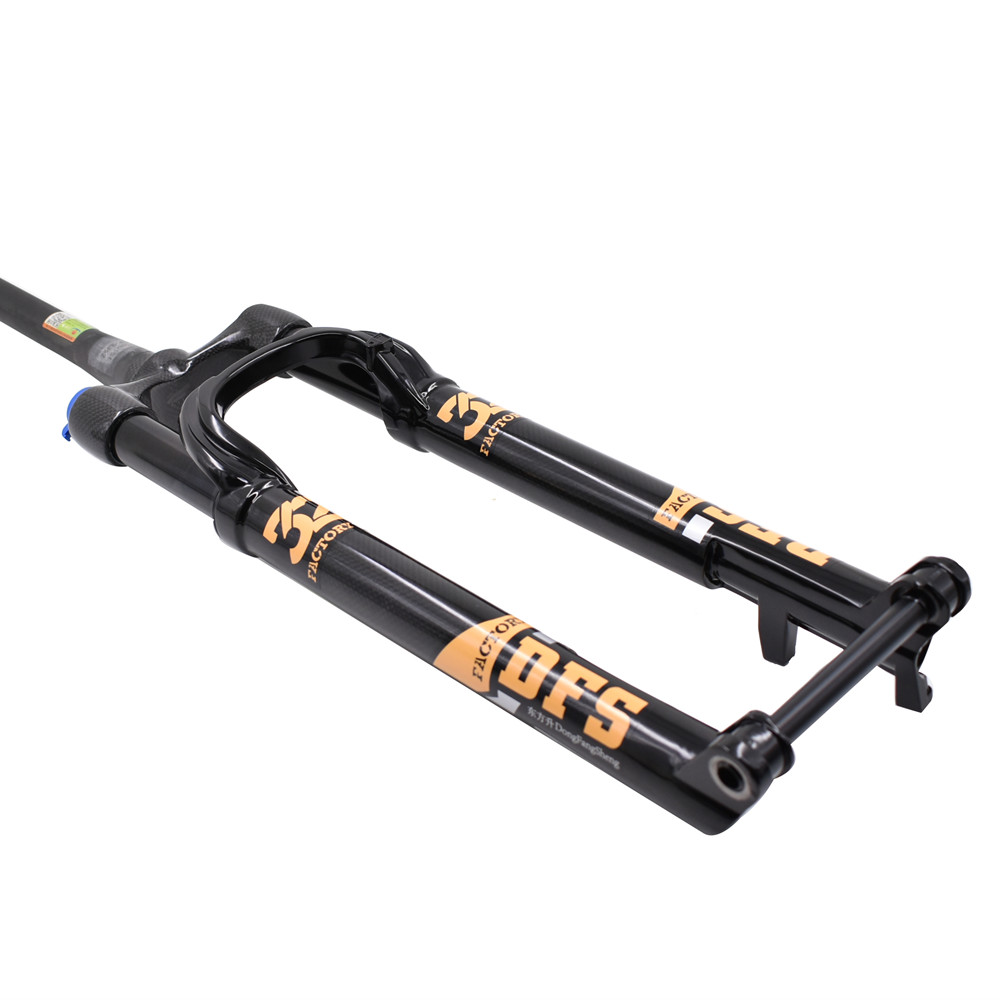
Carbon air fork configuration with 32 mm AL 7050 stanchions and a 15 x 110 mm thru-axle dropout interface.
Where this specification set is applied
The operating environment for these forks is mountain trails, unpaved surfaces, off-road riding and bicycle competition conditions involving impacts and changing terrain. The associated project types are mountain-bike assembly programmes, bicycle-brand OEM and ODM projects, fork replacement and upgrades, and off-road or competition-bike development.
A documented customer case illustrates the OEM side of that list. Over a three-year relationship, OEM and ODM bicycle customers in Germany, Argentina and South Korea took delivery of 10,000 units, with the paint shop supporting custom colors and logo printing for OEM orders. The stated result is that quality control is intended to keep every suspension fork operating stably under tough trail conditions; the compatibility strengths highlighted in that case are multi-wheel-size compatibility, an air spring, hydraulic lockout, compression adjustment and a lightweight design.
Market context behind the specification discussion
The component group is not static. The global bicycle suspension system market was valued at USD 0.81 billion in 2025, according to Mordor Intelligence, and carbon fiber forks accounted for 25 percent of global fork market share in 2024 according to industry reporting. Read together, those figures describe a category where a growing share of value sits in higher-specification, lighter configurations rather than in volume alone.
For procurement teams, the practical consequence is that material and documentation questions arrive earlier in the conversation. When carbon structures are part of the specification, questions about handling, inspection intervals, replacement policy and test evidence matter as much as the declared weight. When a programme targets the EU or the US, the applicable standard and the associated test report become part of the technical file rather than an afterthought.
Comparison with alternative approaches, and where the limits are
Two comparisons dominate early evaluation: air spring versus coil spring, and carbon construction versus aluminum alloy. Category guidance for this component describes coil spring forks as cost-effective and air forks as lightweight, and the trade-off follows from there — an air spring allows support to be tuned to rider and terrain through pressure, while a coil spring offers a simpler, fixed-rate behaviour that requires no air-pressure setup.
| Aspect | Air spring fork | Coil spring fork |
|---|---|---|
| Positioning in category guidance | Lightweight | Cost-effective |
| Tuning | Support set through air pressure, matched to rider, frame, wheel size and terrain | Fixed spring rate, no air-pressure setup |
| Equipment dependency | Requires a suspension pump for pressure adjustment | No pump dependency for spring setup |
The material comparison runs along similar lines, but the limits deserve equal weight. Carbon composite crowns, lower legs and steerer tubes reduce mass — the carbon XC race configuration referenced above is declared at 1.35 kg — while the sliding surface in that configuration remains a hard-anodized 32 mm AL 7050 aluminum stanchion. That mixed-material construction is normal in this category, but it also means frame-facing installation practices and post-impact inspection matter, because composite structural parts are not evaluated in the same way as metal ones.
Other boundaries are commercial and structural rather than technical:
- A 100 mm to 150 mm travel range addresses XC cross-country and AM all-mountain use. It does not cover long-travel downhill categories.
- An air spring introduces a setup step. Pressure must be matched to rider, frame, wheel size and terrain, and a suspension pump is required.
- A minimum order quantity of 2,000 pieces, a lead time of 30 to 120 days and monthly capacity of 3,000 units mean small or fast-turnaround programmes have to plan earlier or aggregate volumes.
- Compliance evidence is not automatically transferable. ASTM, EN and ISO suspension-fork requirements are related but not interchangeable, and the EN 14766:2005 record carries no listed expiry date.
- Where a specific market requires ISO 4210-6:2023 test categories or ASTM F2274 Condition 3 evidence, that mapping is not established by the documentation described here and has to be requested specifically.
Future outlook
Three developments are likely to shape the next buying cycles in this category. First, documentation expectations are tightening: the existence of parallel ASTM, EN and ISO frameworks, and the explicit warning that they are not equivalent, pushes buyers toward asking for test reports mapped to a named standard and use condition. Second, value continues to shift toward lighter material configurations, consistent with carbon fiber forks holding 25 percent of global fork market share in 2024 within a market valued at USD 0.81 billion in 2025. Third, tuning capability — rebound, lockout and compression adjustment — is becoming a documented specification rather than a qualitative selling line, because it is one of the few differences that can be verified on a test bench and repeated across a production batch.
For suppliers, that means the competitive question is increasingly whether a specification sheet, a test report and a production record can be produced together and consistently. For buyers, it means the evaluation checklist is no longer only about travel and weight.
FAQ
What parameters should be checked first when specifying a bicycle suspension fork?
Four core parameters drive selection: travel, stanchion diameter, wheel size and damper type. Beyond those, confirm steerer specification, front-axle specification, brake-mount interface and frame compatibility. Short travel is associated with XC cross-country use and longer travel with rougher categories; coil spring forks are described as cost-effective and air forks as lightweight. Replacement should not be based on the model name alone.
Which standards apply to suspension fork testing?
Several frameworks apply. ASTM F2274-11(2024) sets performance requirements and test methods for suspension and non-suspension production forks used in Condition 3 terrain. ASTM F2273-11 defines mechanical test methods including compression load, bending load, impact resistance and bending fatigue life. ISO 4210-6:2023 covers suspension-fork tyre clearance, front-fork tensile strength, static bending, rearward impact, bending fatigue with impact, and forks for hub or disc brakes. The U.S. Consumer Product Safety Commission summarises that ASTM, EN and ISO standards each contain suspension-fork requirements, including tyre-clearance testing, with details varying by standard and bicycle-use condition.
What does the DFS Intertek test report cover?
The record describes an Intertek test report for bicycle suspension forks issued under certificate number SZHH00332353, referencing standard EN 14766:2005 and applying to the bicycle suspension fork product and to the EU market. The record lists no expiry date. It is evidence against EN 14766:2005 and should not be treated as proof of conformity with ASTM or ISO frameworks.
How can a buyer confirm that a fork will fit a frame before ordering?
Confirm wheel size, fork travel, steerer specification, front-axle specification, brake-mount interface, frame compatibility, air-pressure setup and the intended operating environment. As a concrete example, a 29-inch, 100 mm-travel fork with a 15 x 110 mm thru axle and Post disc mounts requires a frame, wheel and brake configuration designed for those interfaces.
What order quantities, capacity and lead times apply to this supplier?
The published commercial terms state a monthly capacity of 3,000 units, a minimum order quantity of 2,000 pieces and a lead time of 30 to 120 days. Customization covers logo, material, surface finish, travel, axle specification, brake mount and packaging. Export markets listed are Europe, North America, South America, Southeast Asia, the Middle East, North Africa, South Africa, South Korea and Russia, with a 2-year warranty and remote guidance after sale.
How is quality control carried out before shipment?
The manufacturer states that quality control runs from the beginning to the end of production, and that every product is fully assembled and carefully tested before being packed in a box. That control process runs alongside the 100 percent testing statement in the published capability record.
Reference material: the DFS AIR SUSPENSION FORK 2026 brochure (PDF) lists the air fork range and specifications. Manufacturer information is published at www.dfsfork.com.