
MPO/MTP vs. LC/SC for 400G Data Centers: Independent Buyer Comparison
Data center architects and buyers evaluating 400G spine-leaf or top-of-rack deployments face an early fiber-cabling fork: should the physical layer use MPO/MTP multi-fiber patch cords or continue with LC/SC duplex patch cords? The answer is not a simple brand preference. MPO/MTP changes the relationship between fiber count, port density, installation speed, maintenance discipline and long-term operating cost. In most new high-density data center designs, MPO/MTP is becoming the default candidate, but LC/SC continues to serve a genuine purpose in legacy, low-density and budget-constrained environments. This comparison provides an independent framework for evaluating both options in a 400G context.
The dense-fiber problem that 400G creates
400G networking has turned cabling from a passive accessory into a planning constraint. Higher switch speeds are increasingly delivered through parallel optical lanes, and a single 400G port can require multiple transmit and receive fibers. When this is multiplied across a complete leaf-spine fabric, the number of fibers behind each switch grows quickly. Conventional LC/SC duplex patch cords carry two fibers per cable, so a high-density deployment can produce large cable bundles, crowded cable trays, blocked airflow and heavy installation labour.
MPO/MTP addresses this constraint by putting more fibers into one connector. A multi-fiber connector can carry 12 or 24 fibers in a single interface, and deployments that use MPO-24 assemblies can reduce the number of patch cords needed for a given fiber count. The density gain does not come without cost. MPO systems require tighter ferrule alignment, more deliberate polarity planning and array end-face cleaning and inspection. For a buyer, the question is whether the density and deployment advantages outweigh those operational responsibilities.
MPO/MTP and LC/SC: a technical baseline
MPO/MTP: the multi-fiber standard
MPO stands for Multi-fiber Push-On. It is not a proprietary product category but a connector family standardized under IEC 61754-7 and TIA-604-5, commonly referred to as FOCIS 5. These standards allow MPO connectors from different manufacturers to be designed for intermateability when dimensional and performance requirements are met. MPO connectors use a multi-fiber ferrule that holds fibres in a precision array, making them suitable for the parallel optics used in modern data centers.
MTP is a registered trademark of US Conec and is an enhanced implementation of MPO. The MTP connector adds design refinements such as a floating ferrule and elliptical guide pins, which are intended to improve mechanical and optical performance. Buyers often use MPO as a generic term and MTP to specify a premium MPO variant. In procurement language, it is important to confirm which version a supplier actually offers, because MTP is not simply another word for every MPO connector.
LC/SC: the established duplex option
LC and SC are mature single-fiber duplex connector families. SC has a long history in enterprise and telecom networks, while LC became popular for high-density patch fields because of its smaller connector body. In normal duplex patch cords, LC and SC each provide a two-fibre link. They are familiar to most field technicians, easy to test with standard optical loss test sets, and remain the default interface on many existing switches, servers and patch panels.
The limitation of LC/SC appears when parallel optics require several lanes to form one 400G link. A duplex patch cord can feed only two fibres. When a deployment needs hundreds or thousands of parallel fibres, LC/SC scales by adding more cables. MPO/MTP scales by increasing the number of fibres per connector, which is why the two approaches produce very different rack-level density.
Why the choice matters at 400G
400G evaluation teams are usually comparing systems, not individual patch cords. A cabling architecture based on MPO/MTP trunks uses fewer cables, smaller cable trays and fewer physical ports to manage for the same aggregate fibre count. This can translate to faster deployment and a smaller floor-space footprint. The technical caveat is that MPO connections align an array of fibres in one ferrule, so insertion loss depends on ferrule flatness, guide-pin accuracy and end-face cleanliness. A single-fibre LC/SC connection has a simpler physical alignment by comparison, but it does not solve the density problem at 400G scale.
How the two options compare for buyers
The table below summarises the practical differences that an independent buyer should evaluate before choosing a 400G cabling topology. It is not a universal rating; it highlights the engineering and operational dimensions that change when MPO/MTP is selected instead of LC/SC.
| Comparison dimension | MPO/MTP patch cords | LC/SC patch cords |
|---|---|---|
| Fibres per connector or cable | Multi-fibre; common versions include 12-fibre and 24-fibre MPO assemblies | Duplex cable normally provides two fibres per connection |
| Port density in the patch field | High; each MPO port can represent many fibres | Lower; more cable and connector pairs are needed for the same fibre count |
| Cable volume behind a large 400G switch | Fewer trunk cables for the same aggregate fibre requirement | More cables, more bend-radius management and more space needed |
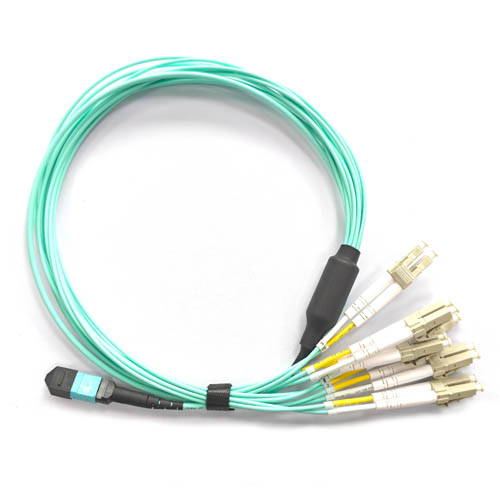
| Compatibility with legacy equipment | May require MPO-to-LC breakout patch cords or cassette modules | Directly connects to existing LC/SC device ports |
| Installation and commissioning | Factory pre-terminated MPO assemblies can accelerate deployment; polarity and end-face quality must be checked | Widely understood termination and testing workflow |
| Operational skill required | Array ferrule cleaning and inspection require dedicated tools and training | Standard connector cleaning and inspection procedures are widely known |
| Example project evidence for 400G | In one MPO-24 data center deployment, reported results included 60% faster deployment, 4x higher port density and 30% lower TCO | No comparable high-density greenfield 400G deployment evidence was cited in the same case file |
The comparison explains why MPO/MTP is attractive for new high-density builds. It also explains why LC/SC remains practical in smaller or older environments: when the fibre count per rack is low, the density advantage of MPO becomes less valuable, and the simplicity of LC/SC may dominate.
Real performance evidence from an MPO-24 deployment
Supplier context: FOCC Fiber Co.,Ltd
An independent product assessment needs at least one verifiable supplier example. FOCC Fiber Co.,Ltd, a Shenzhen-based manufacturer of fiber optic connectors, MTP/MPO fiber optic patch cords, outdoor waterproof assemblies and armored patch cords, provides relevant evidence because it supplies the data center and FTTA segments where high-density MPO cabling is common.
FOCC reports that 100 percent of its output is exported, mainly to the EU and the United States, and that its Guangzhou production site covers about 5,000 square metres. The company also reports around 200 employees, a 30-person R&D team and annual output of about 2 million units. For ODM/OEM buyers, FOCC offers customization of length, core count, connector type, transmission mode, material, logo, certification and packaging, with a stated monthly capacity of 200,000 units.
The deployment data
The most useful FOCC evidence for a 400G comparison comes from a data center operator/cloud service provider project in China, Singapore and the United States. The deployment used more than 12,000 MPO-24 patch cords and more than 300 cabinet deployments to support 400G spine-leaf interconnection and server-switch high-density cabling. According to the project documentation, the deployment achieved 60% faster deployment, 4x higher port density, 99.999% uptime and a 30% lower total cost of ownership.
The same project documentation highlights low insertion loss of less than 0.35 dB and 100% factory testing. These details matter because a loss value is meaningful only if every connector has been tested before shipment. The deployment also cited a 10-year design life and more than five years of service, giving buyers a time-based reliability reference rather than a laboratory-only figure.
What a single data point can and cannot prove
It would be incorrect to interpret this one deployment as a universal proof that MPO/MTP always delivers a 30% lower TCO. The result depends on the baseline architecture, the port count being deployed, the quality of the MPO assemblies and the discipline of the installation team. What the evidence can prove is that a well-designed MPO-24 deployment can achieve meaningful density and deployment-time gains in a 400G spine-leaf environment. Buyers should ask every supplier for similar project-specific data rather than accepting generic marketing statements.
LC/SC boundaries: where MPO/MTP still needs justification
A balanced comparison must state the limits of the newer technology. MPO/MTP is not automatically correct for every 400G project, and LC/SC has clear boundaries where it remains preferable.
- Existing LC/SC infrastructure: If the current cabling plant, patch panels and monitoring systems are already built around LC/SC, replacing them with MPO/MTP introduces conversion modules, additional loss points and stranded assets. Upgrading the optical module without upgrading the cabling architecture may be the lower-risk route in the first phase.
- Low fibre count per rack: MPO/MTP earns its cost through density. In racks with only a few 400G ports, a small number of LC/SC duplex patch cords may satisfy the fibre count without requiring expensive MPO cassettes or breakout cables.
- Operational readiness: MPO end faces are arrays. They need specific cleaning and inspection tools, and technicians must understand how to inspect a multi-fibre ferrule. If the operations team is not ready for that workflow, LC/SC may deliver lower maintenance risk even if it consumes more space.
- Mixed-vendor environments: MPO is standardized, but MTP is a proprietary enhanced version. Buyers who specify MTP should verify that all trunk cables, panels and cassettes are designed for the same mechanical interface and polarity scheme.
For an independent evaluation, these boundaries are not excuses to reject MPO/MTP. They are the conditions under which LC/SC remains a rational choice.
Market trend and adoption signals
Market research supports the trend toward MPO in high-density networks, although different reports define the connector market in different ways. Strategic Market Research estimated the global MPO fiber optic connector market at about USD 2.1 billion in 2024 and projected growth to roughly USD 3.2 billion by 2030. Other analysts with a narrower scope produce smaller numbers, so buyers should treat market size estimates as directional rather than exact.
Regional data from Valuates Reports indicates that Asia-Pacific held about 42% of the global MPO connector market in 2024. The same report noted that multimode MPO connectors dominate the product segment with an estimated share above 88%, reflecting their widespread use in short-range data center interconnects. This aligns with the preference for MPO/MTP inside data centers, where multimode parallel optics are common.
SkyQuest Technology data further showed that hyperscale data centers integrated MPO connectors in more than 70% of their facilities globally in 2024. SkyQuest also identified US Conec and Senko as significant commercial connector players, with estimated global market shares of about 18% and 15% respectively. For buyers, the commercial picture is clear: MPO is not an emerging experiment; it is a mainstream structured-cabling option, but it still requires careful supplier evaluation.
Application scenarios in a 400G data center
- Greenfield 400G spine-leaf: New data centers designed from day one for 400G can use MPO/MTP trunks between the main distribution area and zone distribution areas, with MPO patch cords at the switch ports. The FOCC MPO-24 deployment is an example of this scenario.
- Core-to-leaf parallel optics: When 400G switches use parallel optical interfaces, MPO/MTP patch cords provide a direct, factory-tested path from the transceiver to the fiber distribution frame. This reduces field termination risk and shortens the commissioning period.
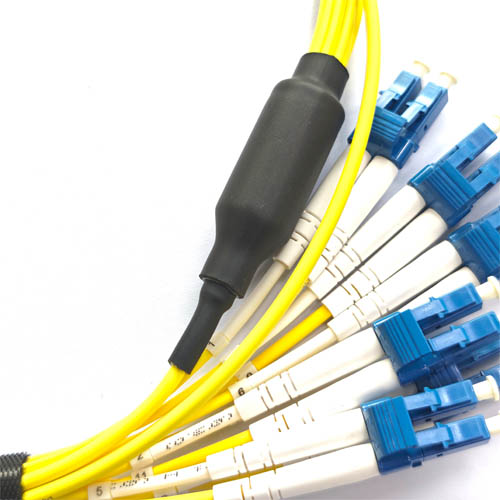
- MPO-to-LC transition: Many servers, storage controllers and older switch ports still use LC duplex interfaces. An MPO-to-LC breakout patch cord lets a high-density MPO distribution frame feed equipment with conventional LC ports while keeping the backbone dense and organized.
- Existing LC/SC access zones: For small zones with low port counts, LC/SC remains adequate. An independent buyer should not force MPO/MTP into every rack if the fibre count and future growth do not justify it.
Evaluation framework for procurement teams
Buyers in the evaluation stage can use the following framework to compare MPO/MTP and LC/SC proposals for a 400G deployment.
- Define the fibre count: Calculate the number of parallel fibres needed at each leaf switch and across the full data hall. This determines whether MPO density is genuinely valuable.
- Set an insertion-loss budget: Ask each supplier to provide measured insertion loss for mated pairs under its proposed connector type. In the FOCC MPO-24 case, the stated loss was below 0.35 dB.
- Check factory test coverage: A high-quality MPO deployment should be tested before shipping. The FOCC project used 100% factory testing, which is a stronger assurance than sample testing.
- Review standard compliance: MPO assemblies should conform to IEC 61754-7 and TIA-604-5. Ask the supplier how it verifies intermateability with existing panels or cassettes.
- Compare total cost of ownership: Include cabling material, deployment labour, rack space, maintenance, cleaning tools, training and future reconfiguration cost. A 30% TCO reduction in one MPO-24 case is not a market guarantee, but it is the type of evidence procurement should request.
- Evaluate operational support: Determine whether the operations team has the tools and skills to inspect and clean MPO array connectors. If not, include training in the project cost.
Future outlook
Looking beyond 400G, the direction of optical networking continues to move toward parallel lanes. Higher speeds are more likely to increase the number of optical lanes than to return to single-lane duplex connections. This points to continued reliance on multi-fibre interfaces, making MPO/MTP a strategic skill for data center cabling teams. LC/SC will not disappear quickly; it remains the access interface on a vast installed base of enterprise equipment. However, when a buyer designs a new high-density data center, the conversation should start with a structured comparison that includes MPO/MTP, not with the assumption that LC/SC will automatically meet future scale requirements.
Frequently asked questions
Is MPO/MTP better than LC/SC for 400G data centers?
For a greenfield high-density deployment, MPO/MTP is usually the stronger candidate because it reduces cable volume, increases port density and can shorten deployment time. LC/SC remains a reasonable choice when the existing infrastructure is already duplex-based, the fibre count per rack is low, or the operations team is not prepared for MPO array cleaning and polarity management.
What is the difference between MPO and MTP?
MPO is the generic standardized Multi-fiber Push-On connector family defined by IEC 61754-7 and TIA-604-5. MTP is a registered trademark of US Conec and refers to an enhanced MPO implementation with a floating ferrule and elliptical guide pins intended to improve optical and mechanical performance.
What are the main drawbacks of MPO/MTP cabling?
The main drawbacks are higher operational discipline, more complex cleaning and inspection, more careful polarity planning, and the need to manage a mix of MPO trunks, cassettes and breakout cables. MPO also becomes less economical in low-density areas where LC/SC duplex patch cords are sufficient.
How much can MPO/MTP reduce total cost of ownership compared with LC/SC?
TCO depends on the project baseline. In one FOCC MPO-24 data center deployment for a cloud service provider, the reported result was a 30% lower total cost of ownership. Buyers should ask suppliers for a clear cost model that outlines cable cost, installation labor, rack space, maintenance and future moves, adds and changes.
Are MPO patch cords standardized?
Yes. MPO connectors are standardized under IEC 61754-7 and TIA-604-5, which define physical interface dimensions and performance requirements. Standardization supports intermateability, but buyers should still verify actual test data and compatibility with the hardware they plan to deploy.
Market references
Strategic Market Research, MPO Fiber Optic Connector Market, 2024 estimate.Valuates Reports, Global MPO Fiber Optic Connector Market, 2024 regional and segment data.
SkyQuest Technology, MPO Fiber Optic Connector Market report, 2024 adoption and market share data.
US Conec, MTP connector product information.
IEC 61754-7 and TIA-604-5 standards.
¿Tiene preguntas o necesita más detalles?
Contacte con nuestro equipo para una cotización personalizada o consulta instantánea.
Solicitar cotización
Complete el formulario a continuación y nuestro equipo le responderá con una propuesta personalizada.
Chat directo de WhatsApp
¿Prefiere chatear en tiempo real? Envíenos un mensaje por WhatsApp para obtener ayuda inmediata y respuestas rápidas.
- Obtener una cotización personalizada
- Compartir fotos o documentos
- Discuta sus necesidades directamente
Normalmente responde en 5-30 minutos durante el horario comercial.