
MPO/MTP Loopback and Fan-Out Cables in High-Density Data Centers
MPO/MTP Loopback and Fan-Out Cables in High-Density Data Centers

High-density data centers are no longer planned port by port. They are planned connector by connector. A single rack unit of patching can now terminate hundreds of fibers through MPO/MTP multi-fiber interfaces, and the two assemblies that decide how quickly that rack can be validated — the MPO/MTP loopback module and the MTP/MPO fan-out pre-terminated breakout patch cord — have moved from the test bench into the standard project bill of materials.
The shift is not cosmetic. When parallel optics replaced duplex optics at 40G, 100G and now 400G, the way a link is tested and the way it is broken out both changed. A loopback module that routes the transmit signal back into the receive path inside the same multi-fiber port lets engineers validate a transceiver or line card without a live far-end partner. A fan-out assembly that converts one multi-fiber connector into discrete duplex LC channels lets the same team connect a high-density trunk to legacy 10G equipment, to a test set, or to a duplex patch field during commissioning and migration.
This article looks at where those two assemblies are actually deployed — equipment validation, data center commissioning, and 40G/100G/400G SR4 and PSM4 module connections — what their published specifications mean inside a link budget, and what changes when they stop being one-off tools and become repeat-order components.
Why High-Density Racks Outgrew the Traditional Test and Breakout Model
For most of the 2000s, testing a new port meant plugging an LC duplex loopback into a transceiver and reading the port status. Commissioning a patch field meant field-terminating duplex pigtails onto each fiber. Both practices assume that a link is built from pairs. Parallel optics broke that assumption.
A 40G or 100G SR4 module, for example, transmits and receives across multiple fiber positions inside a single 12-fiber MPO interface rather than across one duplex pair. Testing such a port with duplex tooling means either disassembling the interface or leaving the port unverified. Neither is acceptable in a commissioning window measured in hours.
The pressure shows up in four places.
- Time. Commissioning windows are fixed by the project schedule. Every additional insertion, cleaning step and re-test consumes that window.
- Fiber count. Multi-fiber ports bundle many fiber positions behind a single connector, so the number of operations per port falls sharply when the test assembly matches the interface.
- Contamination. Every extra mating point is another end face that can collect dust, and contamination is commonly identified as a leading cause of field insertion-loss failures.
- Migration. An operator moving from 10G LC modules to 40G/100G/400G parallel modules keeps both connector formats in the same rack for years, so test and breakout tooling has to support both.
Loopback modules and fan-out breakout cords answer those pressures directly: they work in the connector format the link already uses, rather than forcing the link to be adapted to the tooling.
What the Two Assemblies Actually Do
MPO/MTP loopback modules
An MPO/MTP loopback module is a passive assembly built around a multi-fiber connector. Inside the housing, the optical path is routed so that light sent by a port's transmit channel returns to that same port's receive channel. The port therefore behaves as if a live link partner were present, which allows a transceiver, line card, network interface card or optical module to be powered up, checked against expected receive power, and validated before any far-end equipment is involved.
Fan-out (breakout) pre-terminated patch cords
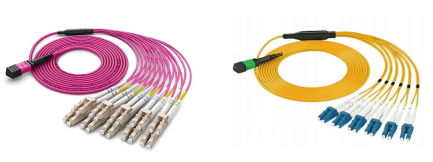
A fan-out — also called a breakout or harness — converts one multi-fiber connector into several duplex LC channels. Two configurations dominate high-density projects:
- MTP-12F-to-6xLC-Duplex: a single 12-fiber connector mapped to six LC duplex pairs.
- MTP-24F-to-12xLC-Duplex: a single 24-fiber connector mapped to twelve LC duplex pairs.
Both are pre-terminated. The multi-fiber end and the LC ends are polished and tested as a single assembly at the factory, so the only field work is plugging in, verifying polarity and documenting the result.
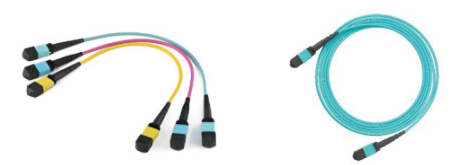
Naming deserves a note of caution. In the market, MPO and MTP are widely used interchangeably for the same multi-fiber interface family, but the naming convention and the ferrule actually supplied can differ between manufacturers. Buyers should confirm ferrule construction, gender and polarity from the specification sheet rather than from the product name.
The optical and mechanical platform behind both
Both product families share the same critical components, and this is where specification quality is decided.
- Ferrule. The multi-fiber connector uses a precision ferrule — including ceramic ferrule and MTP ferrule constructions — to hold multiple fibers on a fixed pitch so that mating remains repeatable.
- Insertion loss. Below 0.5 dB for the standard grade and below 0.35 dB for the low-loss grade.
- Return loss. 50 dB or better for single-mode assemblies, which limits back-reflection into single-mode transmitters.
- Mating durability. 500 mating cycles, a figure that matters because commissioning, re-testing and troubleshooting accumulate over a data center's service life.
- Quality system. The loopback is produced under TL9000, the telecommunications industry quality management system standard.
At a glance: MPO/MTP loopback modules and MTP/MPO fan-out breakout cords are factory-terminated multi-fiber assemblies. Standard-grade insertion loss is below 0.5 dB, low-loss grade is below 0.35 dB, single-mode return loss is 50 dB or better, and rated mating durability is 500 cycles. Ferrule construction relies on ceramic ferrule and MTP ferrule designs, and the loopback is produced under TL9000.
Deployment Scenario 1 — Equipment Validation Before the Rack Exists
Loopback testing is usually the first optical test a new device sees. In an OEM or integrator laboratory, a switch line card, a network interface card or a pluggable module is powered up with a loopback in each port so that transmit power, receive sensitivity and link status can be checked before the device ships to a site. The same method supports incoming inspection, where a batch of transceivers can be screened for dead or weak channels before installation instead of after.
The practical value is fault isolation. When a port shows no link, a loopback removes every variable except the port itself: the far-end transceiver, the trunk, the patch panel and the patch cords are all outside the path. If the port links to itself and reports expected receive power, the fault lies somewhere in the channel. If it does not, the fault lies in the port.
Because validation is repetitive, mating durability and end-face condition matter more here than in almost any other application. A 500-cycle rating defines how many insertion cycles the assembly is designed to survive; it does not remove the need to inspect and clean end faces between cycles, particularly in dusty staging environments.
Deployment Scenario 2 — Data Center Commissioning and Turn-Up
Commissioning is where the two assemblies work together. A typical sequence at a high-density patch panel runs as follows.
- Verify the port. A loopback is inserted at the switch or line-card port to confirm that the port transmits and receives.
- Open the trunk. A fan-out breakout cord is used at the patch panel or cassette position to convert the multi-fiber trunk into discrete LC duplex channels.
- Measure the channel. A light source and power meter, or an optical loss test set, is connected to the LC ends and insertion loss is recorded channel by channel.
- Record and close. Results, polarity and labeling are logged as commissioning evidence before the rack is handed over.
Step two is the step that MPO high-density patch panels changed most. In a high-density panel with multiple MPO/MTP adapters, a single fan-out assembly gives a technician access to six or twelve duplex channels without disturbing the trunk. That is the difference between a panel that takes an afternoon to verify and one that takes a week.
Two disciplines decide whether commissioning passes on the first attempt. The first is polarity and gender control: multi-fiber assemblies are supplied in male and female variants and in more than one polarity convention, and a mismatch is a common cause of a link that tests clean but never passes traffic. The second is documentation: because a breakout cord introduces a new set of mating points between the trunk and the measuring instrument, the loss of the cord itself has to be accounted for in the recorded result.
Deployment Scenario 3 — 40G/100G/400G SR4 and PSM4 Module Connections
Parallel optical modules are the reason multi-fiber test and breakout assemblies exist. A 40G or 100G SR4 module transmits and receives across multiple fiber positions within a single 12-fiber MPO interface. It does not use a duplex pair, so a duplex loopback cannot validate it and a duplex patch cord cannot break it out.
PSM4 modules apply the same parallel principle to single-mode fiber, transmitting across multiple single-mode positions. This is where the single-mode return-loss figure becomes a specification rather than a footnote: reflections that a multimode link tolerates can disturb a single-mode parallel transmitter, which is why assemblies are specified at 50 dB or better return loss for single-mode.
Fan-out cords bridge the two worlds. When a parallel module has to connect to 10G LC-based equipment, to a duplex patch field, or to a legacy test set, an MTP-12F-to-6xLC-Duplex or MTP-24F-to-12xLC-Duplex assembly performs the conversion at the panel. The same assemblies are used in reverse during migration projects, where a 24-fiber trunk is split into twelve duplex channels feeding existing hardware.
As 400G deployments scale, higher-count multi-fiber interfaces become more common in the same physical space, which raises the value of pre-terminated breakout assemblies that arrive tested rather than being built on site.
Reading the Specification Sheet
| Parameter | Standard grade | Low-loss grade | What it means at commissioning |
|---|---|---|---|
| Insertion loss | Below 0.5 dB | Below 0.35 dB | Every mated pair consumes part of the link loss budget; the low-loss grade preserves margin where a breakout adds several pairs to the same path. |
| Return loss (single-mode) | 50 dB or better | 50 dB or better | Limits back-reflection into single-mode parallel transmitters. |
| Mating durability | 500 mating cycles | 500 mating cycles | Sets how many validation, re-test and troubleshooting cycles the assembly is designed to survive. |
| Ferrule | Ceramic ferrule / MTP ferrule | Ceramic ferrule / MTP ferrule | Precision alignment of multiple fibers on a fixed pitch. |
| Quality system | TL9000 (loopback) | — | Telecom-grade quality management across production. |
The table is short on purpose. For a passive multi-fiber assembly, insertion loss, return loss, mating durability and ferrule construction are most of the measurable story. Everything else — housing material, boot type, labeling convention, packaging — affects handling rather than optical performance.
The commercially important decision is the grade. Where a fan-out is used only to reach a test instrument and is removed afterwards, the standard grade is usually sufficient. Where the assembly stays in a live channel and adds mating points that were not part of the original link budget, the low-loss grade buys back a measurable amount of margin — and margin is what determines whether a link still passes after the rack has been in service for five years.
Comparison with Traditional Solutions — and Where Multi-Fiber Assemblies Do Not Fit
| Dimension | LC duplex loopback and field-terminated pigtails | MPO/MTP loopback with pre-terminated fan-out |
|---|---|---|
| Unit tested per insertion | One duplex pair | Multiple fiber positions behind a single connector |
| Assembly time | Field termination per fiber | Factory pre-terminated, plug-in only |
| Consistency between units | Depends on field workmanship | Fixed at the factory and documented |
| Fit with parallel optics (SR4/PSM4) | Not compatible without disassembly | Matches the interface the module uses |
| Loss budget impact | Depends on field termination quality | Known and specified per assembly |
| Best fit | Low-density racks, legacy duplex plant, small sites | High-density panels, parallel optics, large turn-ups |
Multi-fiber assemblies are not a universal upgrade, and their limits should be planned around rather than discovered on site.
A loopback test is not a link test. A loopback proves that a port transmits and receives; it says nothing about the trunk, the patch panel, the cassettes or the connector losses in the live channel. A rack can pass every loopback check and still fail traffic because a single mated pair in the trunk is contaminated or over-attenuated. Loopback testing and end-to-end loss measurement — or OTDR testing where a project requires it — answer different questions and are not substitutes for one another.
A fan-out consumes loss budget and adds failure points. Each breakout converts one multi-fiber connector into multiple duplex channels, and every added mating pair contributes insertion loss and becomes another end face that can be contaminated or damaged. In links already close to their loss limit, the correct answer may be a higher-count trunk with fewer breakouts, or low-loss grade assemblies, rather than more breakout cords.
Polarity and gender are a systemic risk. Multi-fiber assemblies are supplied in male and female variants and in more than one polarity convention. A breakout cord that is optically sound but wrong in polarity will test clean and still not carry traffic, so labeling and pre-installation verification are not optional steps.
The 500-cycle rating is real but finite. It is a design figure for the connector, not a licence to treat loopback assemblies as disposable. Repeated mating without inspection accelerates end-face degradation, and contamination — rather than connector wear — is the more common cause of a failed re-test.
Loopback modules are test accessories, not permanent infrastructure. They belong in a staging kit or a maintenance cabinet. Leaving one in a production port does not create a link; it creates a closed loop that will hide a real fault.
Market Signals for Multi-Fiber Testing and Breakout Demand
Several published data points explain why demand for multi-fiber test and breakout assemblies continues to rise rather than flatten.
The MPO fiber optic connector market is projected to grow at a CAGR of 13.6% through 2035, driven by AI compute clusters and hyperscale data centers, according to Business Research Insights. That growth rate is a direct indicator of the installed base that will require loopback testing and breakout during commissioning.
The wider fiber optic connector market was estimated at USD 11.2 billion in 2024, with LC connectors holding a 35.43% share, according to Global Market Insights and Grand View Research. The LC share matters for planning: even in MPO-heavy builds, a large part of the installed plant remains duplex, which keeps fan-out assemblies — the bridge between the two formats — in continuous demand.
On the cable side, Custom Market Insights values the global optical fiber cable market at approximately USD 13.45 billion in 2025, projected to reach USD 36.48 billion by 2034. Estimates for the same year vary between research firms — Global Market Insights publishes USD 14.6 billion and Grand View Research USD 10.8 billion — so buyers should treat any single market-size figure as a directional signal rather than a precise number.
Two structural facts reinforce the supply picture. China's exports of optical fiber cables under HS 854470 reached approximately USD 2.52 billion in 2024, according to the Observatory of Economic Complexity, which points to how concentrated global supply remains. On the standards side, ITU-T G.652.D remains the reference for single-mode fiber and ITU-T G.657 covers bend-insensitive fiber, both of which sit underneath the single-mode PSM4 links that multi-fiber breakout assemblies feed.
The procurement implication is straightforward. Multi-fiber assemblies represent a small share of project spend but a disproportionate share of commissioning risk, and they are usually reordered several times over the life of a data center.
Long-Term Supply: What Repeat Ordering Actually Requires
For procurement teams, the loopback module and the fan-out cord are rarely bought once. They are reordered as racks are added, as the maintenance kit is replenished, and as the next phase of a build is turned up. That pattern changes the evaluation criteria: the question is not only whether a supplier can deliver one assembly to specification, but whether the tenth and hundredth orders will match the first.
Nanfang Communication — the trading name of Jiangsu South Communication Technology Co., Ltd., a Changzhou-based manufacturer founded in July 1992 and a subsidiary of the Hong Kong-listed South Communication Holdings Limited (Stock Code: 1617.HK) — develops, produces and sells optical fibers, optical cables, ODN systems and optical components. That portfolio includes indoor and outdoor optical cables, PLC splitters, fiber optic connectors, MPO multi-core connectors, optical modules, MT-FA series optical passive components and PM FA fiber arrays, alongside custom specialty fibers and cables and system integration services.
For repeat-order programs, the relevant operational facts are published rather than implied.
- Manufacturing scale. Annual output of 3,000,000 core kilometers from a 26,795.3 m² facility with 360 employees, including 80 R&D engineers.
- Order flexibility. A minimum order quantity of 1 core kilometer against a monthly production capacity of 250,000 core kilometers.
- Lead time. Dependent on model and quantity — samples and small orders typically take several weeks, while large orders may take months.
- Quality system. ISO9001, TL9000 telecommunications quality management, ISO14001 environmental management, OHSAS18001 occupational health and safety, ISO50001 energy management, and the Integration of Informatization and Industrialization Management System, supported by a CNAS-accredited laboratory.
- Technical depth. More than 300 patents, including over 45 invention patents, and participation in 16 standards (1 national standard and 15 industry standards).
- Service footprint. 28 provincial-level offices, with long-term relationships with operators including China Telecom, China Mobile, China Unicom and China Broadcast Network, as well as private-network users in high-speed rail, power grids and chemical industries.
The company also publishes how it manages the risks that most affect repeat supply: supply-chain disruption, raw-material price volatility, quality instability, certification and compliance exposure, and delivery delay. Its stated controls are a standardized quality management system, incoming material inspection and supplier management, inventory and stockpiling, production controls and inspections, and laboratory testing with certification tracking — supported by a national-level laboratory, a standardized QMS and a service network.
On commercial terms, the published baseline is a minimum order quantity of 1 core kilometer, delivery by sea, land or air arranged per project, acceptance against contract and technical specifications with factory inspection, test reports and certificates, and payment through common international trade methods such as T/T or L/C. Where a project requires local customization or faster supply, integrated domestic suppliers generally differentiate on integrated supply chain, domestic production scale and localized service support; imported brands are more often specified where extreme single-component performance or a particular certification is the deciding factor. Further detail is available at www.jsnfgroup.com.
Future Outlook
Three developments are likely to shape how these assemblies are specified over the next few years.
Fiber counts will keep climbing. As AI compute clusters and hyperscale builds push parallel optics into higher lane counts, 24-fiber and higher-count multi-fiber interfaces will move from exceptional to routine. That raises the cost of a failed breakout — and the value of pre-terminated assemblies that are tested before they leave the factory.
Testing will move closer to automation. Loopback testing is already repetitive, and at higher port densities manual insertion becomes the bottleneck. Mechanical standardization of multi-fiber loopbacks — ferrule quality, gender consistency and labeling — will therefore matter more, not less, as test sequences are automated.
Specification continuity will become a procurement requirement. When a data center is built in phases over several years, the assemblies ordered in phase three have to interoperate with the plant installed in phase one. Suppliers that hold insertion loss grade, polarity convention, ferrule type and documentation constant across years remove a category of risk that is difficult and expensive to correct after installation.
None of this changes the underlying engineering. A loopback proves a port; a breakout opens a trunk; both consume or preserve margin. What changes is how much of a project's schedule depends on getting those two things right the first time.
Frequently Asked Questions
1. What is an MPO/MTP loopback cable used for?
An MPO/MTP loopback cable is a passive multi-fiber assembly that routes the transmit signal of a port back into that same port's receive path. It is used to validate transceivers, line cards, network interface cards and optical modules without a live far-end partner, and to isolate faults by removing the channel from the test path. High-density loopback assemblies are typically specified with ceramic ferrule and MTP ferrule constructions, insertion loss below 0.5 dB in standard grade or below 0.35 dB in low-loss grade, return loss of 50 dB or better for single-mode, and a mating durability of 500 cycles, and are produced under TL9000.
2. How does an MTP-12F-to-6xLC-Duplex breakout differ from an MTP-24F-to-12xLC-Duplex breakout?
Both are pre-terminated fan-out assemblies that convert a multi-fiber connector into duplex LC channels; they differ in fiber count and in the number of duplex channels they expose. An MTP-12F-to-6xLC-Duplex assembly maps a 12-fiber connector to six LC duplex pairs. An MTP-24F-to-12xLC-Duplex assembly maps a 24-fiber connector to twelve LC duplex pairs. The 12-fiber version suits single parallel-optics ports and smaller panels; the 24-fiber version suits aggregated trunks and higher-density patch fields, where fewer assemblies are needed to cover the same number of channels.
3. Which specifications matter most when evaluating loopback and fan-out assemblies?
Insertion loss, return loss, mating durability and ferrule construction are the core optical and mechanical specifications. Standard-grade insertion loss is below 0.5 dB and low-loss grade is below 0.35 dB; single-mode return loss is 50 dB or better; rated mating durability is 500 cycles. Ferrule quality — including ceramic ferrule and MTP ferrule constructions — determines alignment repeatability across those cycles. The quality system behind production also matters for consistency across repeat orders, and the loopback is produced under TL9000.
4. Can a loopback test replace end-to-end link certification?
No. A loopback test verifies that a port transmits and receives correctly; it does not measure the installed channel. The trunk, patch panel, cassettes and patch cords are outside the loopback path, so contamination, polarity errors or excessive loss in the channel will not appear in a loopback result. Commissioning normally requires both: loopback validation at the port, and channel measurement with a light source and power meter or an optical loss test set, recorded as acceptance evidence.
5. What are the limitations of fan-out breakout cables in high-density links?
A fan-out converts one multi-fiber connector into several duplex channels, and every additional mated pair contributes insertion loss and becomes another end face that can be contaminated or damaged. In links already close to their loss limit, this can be the difference between passing and failing. Polarity and gender conventions must match the rest of the channel, and mislabeling is a common cause of a link that tests clean but does not carry traffic. Fan-out assemblies are best treated as a planned part of the link budget rather than as an addition made during commissioning.
6. How should buyers plan for repeat orders over the life of a data center?
Because racks are added in phases, loopback and fan-out assemblies are typically reordered over several years, and the main risk is variation between orders. Buyers can reduce that risk by fixing the specification in writing — insertion loss grade, return loss, ferrule type, polarity convention, gender and labeling — and by requiring factory test reports and certificates with each shipment. Acceptance against contract and technical specifications, supported by factory inspection documentation, is the published baseline for at least one manufacturer in this category.
7. What are the typical minimum order quantity and lead time considerations?
Published terms from Nanfang Communication indicate a minimum order quantity of 1 core kilometer and a monthly production capacity of 250,000 core kilometers. Lead time depends on model and quantity: samples and small orders typically take several weeks, while large orders may take months. Delivery can be arranged by sea, land or air according to project requirements, and payment terms follow common international trade methods such as T/T or L/C. For multi-phase builds, lead time and delivery method should be confirmed against the project schedule rather than assumed.
Multi-fiber loopback modules and fan-out breakout cords are small line items with an outsized effect on commissioning schedules. Specifying them by insertion loss grade, return loss, mating durability and ferrule construction — and treating them as repeat-order components with fixed specifications rather than as consumables — is what keeps a high-density build predictable from the first rack to the last. The manufacturer's MPO product brochure, including connector and assembly detail, can be downloaded here.