
MPO/MTP Cabling: Fundamentals for High-Density Networks
MPO/MTP cabling is a multi-fiber interconnect approach that consolidates 12, 16, 24, or 48 optical fibers into one compact interface. For data center and 5G network buyers, this physical-layer building block now shapes rack density, link loss budgets, cable management, and outdoor deployment risk long before active equipment is selected.
Why multi-fiber cabling moved to the center of network planning
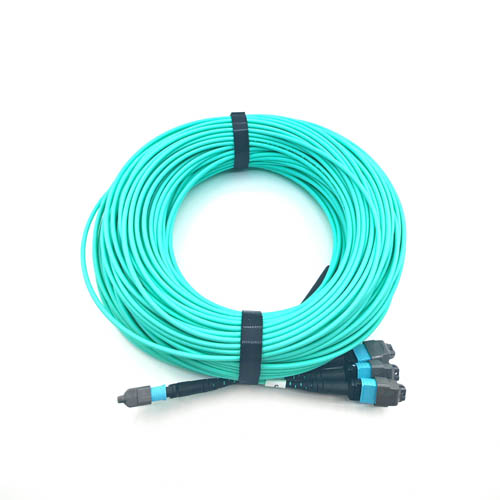
The shift toward parallel optics in 400G and 800G data center links has changed how network planners think about structured cabling. Instead of patching individual duplex links, high-speed modules often require multiple fibers in the same direction. Supporting that with single-core patches leads to cable congestion, difficult cable management, higher labor cost, and more opportunities for connection errors. Multi-fiber MPO/MTP assemblies reduce those issues by combining multiple fibers in a single connector body and a single cable assembly.
This density advantage is not a niche preference. Third-party observations indicate that hyperscale data centers integrated MPO connectors in more than 70% of their facilities in 2024 to support parallel optics and high-density cabling. That adoption level makes MPO/MTP literacy relevant to anyone evaluating modern fiber infrastructure.
What MPO and MTP actually mean
MPO stands for Multi-fiber Push On. It is a multi-fiber connector interface defined by international standards IEC 61754-7 and TIA-604-5, also known as FOCIS 5. These standards help ensure intermateability between connectors from different manufacturers, although mechanical and optical performance can still vary by design and production quality.
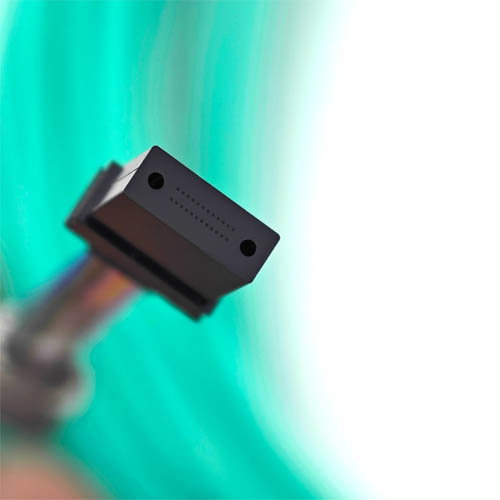
MTP is a registered trademark of US Conec and refers to an enhanced MPO connector. The MTP connector is designed with a floating ferrule and elliptical guide pins intended to improve mechanical alignment and optical stability. Buyers may see both terms used interchangeably in cabling documents, but the MTP designation specifically identifies US Conec's high-performance MPO-compatible product line rather than a different connector category.
Key specifications buyers should decode
MPO/MTP patch cords are not a single product. They differ by fiber count, fiber type, polish, gender, polarity, jacket material, and mechanical performance. A useful first step for buyers is to separate the variables that affect link performance from those that affect installation and maintenance.
| Parameter | Typical value or option | Why it matters |
|---|---|---|
| Core count | 12, 16, 24, or 48 fibers | Determines how many channels can be aggregated in one connection |
| Fiber type | OS2; OM3, OM4, OM5 | Matches distance and transceiver technology |
| Insertion loss | ≤0.35 dB Elite; ≤0.5 dB standard | Affects link budget and headroom for network upgrades |
| Return loss | ≥60 dB for APC; ≥50 dB for UPC | Reduces reflections in high-speed single-mode links |
| Operating temperature | -20°C to +70°C for indoor data center products | Confirms compatibility with controlled facilities |
| Jacket type | LSZH, PVC | Supports fire safety and indoor air quality requirements |
| Length | Customizable from 1 m to 100 m | Allows pre-terminated links matched to rack and row distances |
The above values are representative of the MPO/MTP patch cord range offered by FOCC Fiber Co., Ltd. The company lists models such as MPO-12-OS2-APC, MTP-24-OM4-UPC, and MTP-48-OM3-UPC, with zirconia ceramic ferrules, PBT/PEI connector housings, Kevlar aramid yarn, and LSZH or PVC cable jackets. These materials are common in data center-grade multi-fiber assemblies because they balance mechanical protection, flame resistance, and connector durability.
Beyond raw performance, polarity is one of the most important design elements in MPO cabling. Polarity defines how the transmit port of one device maps to the receive port of the far-end device across a multi-fiber array. Type A, Type B, and Type C methods use different fiber routing and connector key orientations. A supplier's ability to clearly label polarity and gender, and to provide matching trunks, cassettes, and fanout cables, can significantly reduce commissioning time.
The supplier layer: where FOCC Fiber fits
FOCC Fiber Co., Ltd is a Shenzhen-based fiber optic connectivity manufacturer established in 2014, with more than ten years of industry experience. Its manufacturing facility in Guangzhou covers 5,000 square meters and employs approximately 200 staff, including a research and development team of 30 engineers. The company states an annual production capacity of 2,000,000 units and focuses on high-density MTP/MPO fiber optic patch cords, outdoor waterproof patch cord assemblies, and armored patch cords for data center and FTTA solutions.
From a procurement perspective, these facts describe a supplier with dedicated production and engineering resources rather than a trading-only intermediary. The company reports that its products are fully exported, with major markets in the EU and the USA. It also lists ODM/OEM service experience across more than 30 countries and regions, and identifies partner clients such as Prysmian, Siemens, Coherent, Fujikura, and NTT. While such customer names should be verified during supplier evaluation, they provide a directional signal about engagement with technically demanding B2B buyers.
The company states that it implements ISO9001 and ISO14001 management systems. For data center products, its MPO/MTP patch cords reference Telcordia GR-326 and offer insertion loss values of ≤0.35 dB for Elite grade and ≤0.5 dB for standard grade. For outdoor FTTA applications, its waterproof patch cords are specified with IP67 or IP68 protection and operating temperatures from -40°C to +75°C. These details give buyers a concrete basis for comparing suppliers instead of relying on general quality claims.
Applications and use cases
MPO/MTP cabling is most visible in two environments: high-density data centers and outdoor mobile network infrastructure. In data centers, multi-fiber assemblies support high-density server, switch, and storage interconnections, particularly for 400G and 800G parallel optical transceivers. A single MPO trunk can connect high-port-count switches through MPO patch panels, reducing cable volume between racks and simplifying moves, adds, and changes.
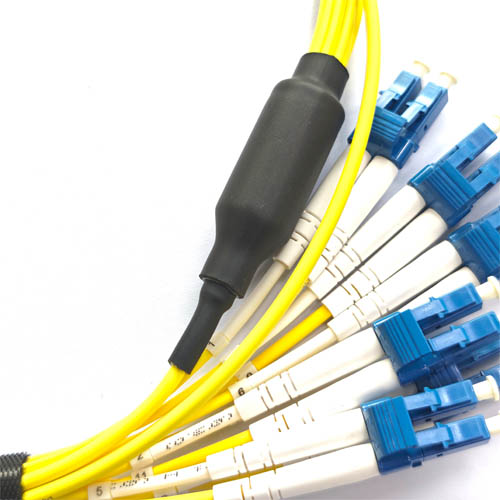
MPO breakout patch cords and MPO-to-LC fanouts are frequently used at the end of a trunk or directly at the equipment side. For example, a 12-fiber MPO connector can transition to six LC duplex ports, allowing compatibility with conventional transceiver interfaces while preserving high-density backbone cabling. This hybrid approach is common in spine-leaf data center topologies and storage area networks.
In 5G FTTA networks, the cabling challenge changes from rack density to environmental protection. Fiber-to-the-antenna links connect remote radio units or active antenna units to baseband equipment, often in outdoor conditions with rain, dust, UV exposure, vibration, and wide temperature swings. FOCC Fiber's outdoor waterproof FTTA patch cord range includes model designations such as ODC-APC-Fullax-APC-OS2 and ODC-UPC-Optitab-UPC-OM3. These products are designed with stainless steel ODC connector shells, PE cable jackets, armored fiber cores, and silicone rubber sealing rings to maintain signal integrity in harsh environments.
The FTTA product specifications include insertion loss of ≤0.30 dB, return loss of ≥60 dB for APC polish, operating temperature from -40°C to +75°C, and tensile strength of at least 1000 N. Those values are relevant for base station RRU/AAU interconnection, outdoor small cell deployment, railway communication, and public safety networks. They also demonstrate a key buyer principle: multi-fiber density matters, but environmental protection and mechanical robustness are equally important once cabling leaves the controlled data center room.
Market context and trends
The MPO connector market has grown alongside the expansion of cloud data centers and mobile networks. According to Strategic Market Research, the global MPO fiber optic connector market was estimated at approximately USD 2.1 billion in 2024 and is projected to reach about USD 3.2 billion by 2030. Estimates vary by source, partly because some reports measure connectors only while others include full cable assemblies. That difference should be considered when comparing market figures.
Regional demand is concentrated in Asia-Pacific, which accounted for roughly 42% of the global MPO connector market in 2024, followed by North America, according to Valuates Reports. Multimode connectors dominate the product segment, with more than 88% of market share, reflecting strong demand for short-reach data center interconnects. At the same time, US Conec and Senko Advanced Components have been identified as key market leaders, with US Conec holding approximately 18% and Senko nearly 15% of global market share in 2024, according to SkyQuest Technology.
These data points do not suggest that buyers should choose a supplier based on market share alone. Instead, they confirm that MPO/MTP cabling is a mainstream, standards-based technology with a competitive supply base. Buyers can use this market context to benchmark whether a supplier's product documentation, testing practice, and delivery terms match the expectations of more mature vendors.
MPO/MTP vs traditional single-core cabling
The most common alternative to MPO/MTP is individual LC or SC single-core/duplex patch cabling. The following comparison shows where each approach is strongest.
| Attribute | MPO/MTP multi-fiber cabling | LC/SC single-core patch cabling |
|---|---|---|
| Fiber density | High; 12, 16, 24, or 48 fibers per connector | Lower; typically 2 fibers per duplex link |
| Cable volume between racks | Reduced trunk or pre-terminated assemblies | Higher cable count for equivalent capacity |
| Installation speed | Faster for high-port-count infrastructure | Slower when many individual patches are required |
| Polarity and gender planning | More complex; requires A/B/C method selection | Simpler point-to-point mapping |
| Diagnostics and cleaning | Single MT ferrule affects many fibers at once | Fault isolation is usually easier |
| Typical use | 400G/800G parallel optics, trunking, FTTA | Lower-speed access links, small patch fields |
MPO/MTP cabling is not automatically the right answer for every installation. Its limitations include more complex polarity management, the need for specialized inspection and cleaning tools, and the fact that contamination on one multi-fiber ferrule can affect multiple channels simultaneously. In low-port-count enterprise rooms or simple short-reach links where only a few fibers are needed, conventional LC duplex patch cords may remain simpler and more cost-effective. Buyers should therefore select the cabling architecture based on port density, link speed, operational capability, and total cost of ownership rather than a general preference for multi-fiber connectors.
Future outlook
The direction of high-density optical infrastructure continues to favor multi-fiber connectivity. As 400G and 800G deployments become more common, the need for orderly, low-loss, pre-terminated MPO/MTP links is likely to increase across cloud, enterprise, and telecom environments. At the same time, data center operators are paying more attention to cable management, airflow, and commissioning speed, all of which play to the strengths of well-documented MPO trunks and breakout assemblies.
For outdoor 5G and FTTA networks, future growth will likely keep testing suppliers on more than indoor optical performance. Tensile strength, temperature range, UV resistance, connector sealing, and fiber armoring will remain critical because outdoor failures are expensive to diagnose and repair. Manufacturers that combine data-center-grade optical precision with outdoor protection may be better positioned to serve buyers that operate both environments.
FOCC Fiber's current range of 12, 16, 24, and 48-core MPO/MTP patch cords, customizable lengths from 1 to 100 meters, and IP67/IP68 FTTA patch cords is aligned with these near-term requirements. However, buyers should still verify whether a supplier's documentation covers the specific speed, polarity, connector gender, and cleaning tools they need before placing large orders.
Frequently asked questions
What is an MPO cable?
An MPO cable is an optical fiber cable terminated with one or more MPO multi-fiber connectors. It can consolidate 12, 16, 24, or 48 fibers into a single interface. MPO cables are commonly used in data center trunks, breakout assemblies, and high-density patch panels.
What is the difference between MPO and MTP?
MPO is the generic multi-fiber connector standard defined by IEC 61754-7 and TIA-604-5. MTP is a registered trademark of US Conec and describes an enhanced MPO-compatible connector with a floating ferrule and elliptical guide pins for improved alignment and mechanical performance.
What is an MPO breakout patch cord?
An MPO breakout patch cord transitions from one MPO/MTP multi-fiber connector to multiple individual fibers or duplex connectors, such as LC or SC legs. It is used to connect multi-fiber trunks to equipment that still uses conventional single-port transceivers or adapters.
How should I choose between multimode and single-mode MPO patch cords?
The choice depends mainly on link distance, transceiver type, and cost. Multimode OM3, OM4, and OM5 fibers are widely used for short-reach data center links, while OS2 single-mode fiber supports longer distances and higher-speed long-reach applications. The transceiver and link budget usually determine the correct fiber type.
What performance values should be checked on an MPO patch cord?
Buyers should review core count, fiber type, insertion loss, return loss, operating temperature, jacket material, and applicable standards. Representative data center values include insertion loss of ≤0.35 dB for Elite grade and ≤0.5 dB for standard grade, with return loss of at least 60 dB for APC connectors. Outdoor FTTA products should also specify IP67 or IP68 protection and tensile strength.
Why is MPO polarity important?
Polarity defines how the transmit port of one device maps to the receive port of another device across a multi-fiber array. Different polarity methods and connector key orientations can change that mapping. Incorrect polarity design leads to failed links or the need for additional rework during commissioning.
Market data referenced in this article was drawn from publicly reported estimates by Strategic Market Research, Valuates Reports, and SkyQuest Technology. Standards information reflects IEC 61754-7, TIA-604-5, and US Conec's MTP connector documentation. Product specifications are based on the supplier's published product information for FOCC Fiber Co., Ltd MPO/MTP and outdoor FTTA patch cords.