
MP-020 vs MP-006: Abrasive Microfiber or Cotton-Tuft Mop?
Independent buyer comparison · Microfiber Cleaning Products · Commercial floor care
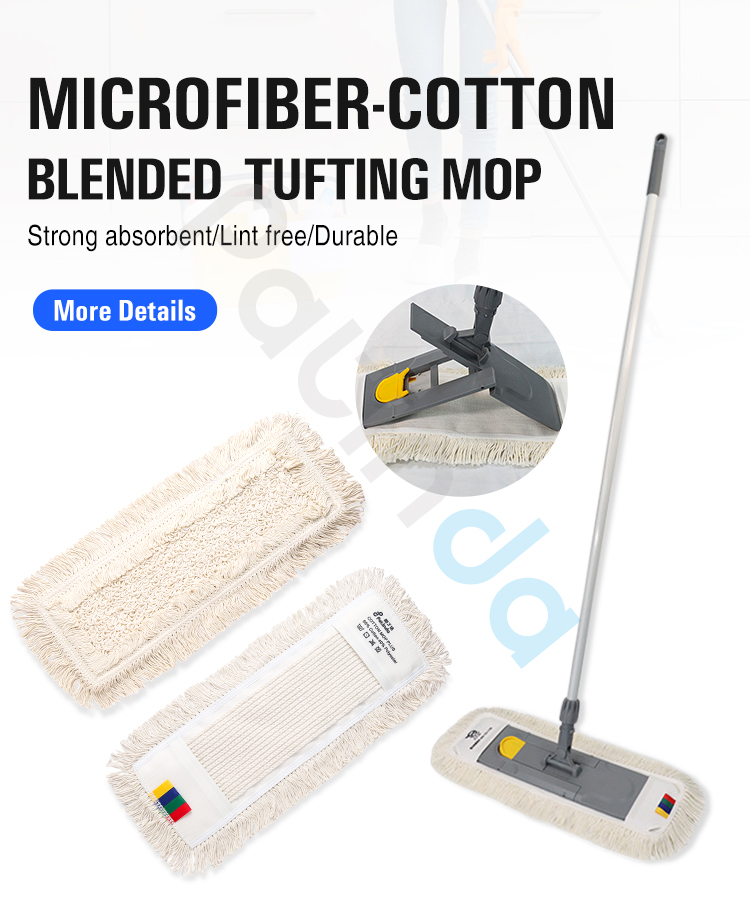
MP-006 Microfiber-Cotton Blended Tufting Mop: a color-coded, pocket-style replacement pad. Image source: Foshan Patinda Housewares Co., Ltd.
Facility buyers rarely buy “a mop”; they buy a mopping system in which the replacement pad determines most of the daily performance. In commercial flat-mop programs, the two most common pad constructions are abrasive microfiber and cotton-blended tufting. Both are used for dry dusting, wet mopping, and color-coded area management, but their fiber composition and surface geometry lead to different behavior on hard floors. This article is an independent buyer comparison of two representative models from one manufacturer’s commercial range—the MP-020 Microfiber Abrasive Mop and the MP-006 Microfiber-Cotton Blended Tufting Mop—based on documented product specifications rather than unpublished in-house test results.
The buying problem: flat-mop pad materials are not interchangeable
When procurement teams specify floor-cleaning consumables, the conversation usually starts with chemicals, dosing equipment, and frame systems. The pad itself is often treated as a low-value accessory. In practice, the pad is the point of contact with the floor, and its construction decides how much dust is captured, how much water is held, how the pad behaves after repeated washing, and how confidently a facility can separate cleaning zones by color.
The opportunity for buyers is that replacement mop pads have become more specialized. A “dry and wet dual-purpose” pad can still be built in very different ways: around a synthetic microfiber pile with an abrasive stripe, or around a tufted loop surface in which cotton is blended into the yarn. Understanding those differences helps purchasing teams avoid two recurring mistakes: selecting a pad that is too soft for stain-prone areas, or selecting an abrasive construction for routine dust maintenance where it adds little value.
Brand solution: two pad designs, one color-coded system
The manufacturer supplying the two products in this comparison is Foshan Patinda Housewares Co., Ltd., a microfiber cleaning textile producer founded in 2004 and based in Foshan, Guangdong, China. The company operates a 45,000 m² manufacturing plant and describes itself as a specialist in microfiber cloths, towels, automotive cleaning textiles, and commercial mop systems. Its commercial mop range includes both the MP-020 and MP-006 replacement pads.
MP-020 Microfiber Abrasive Mop: synthetic pile plus PET abrasive stripe
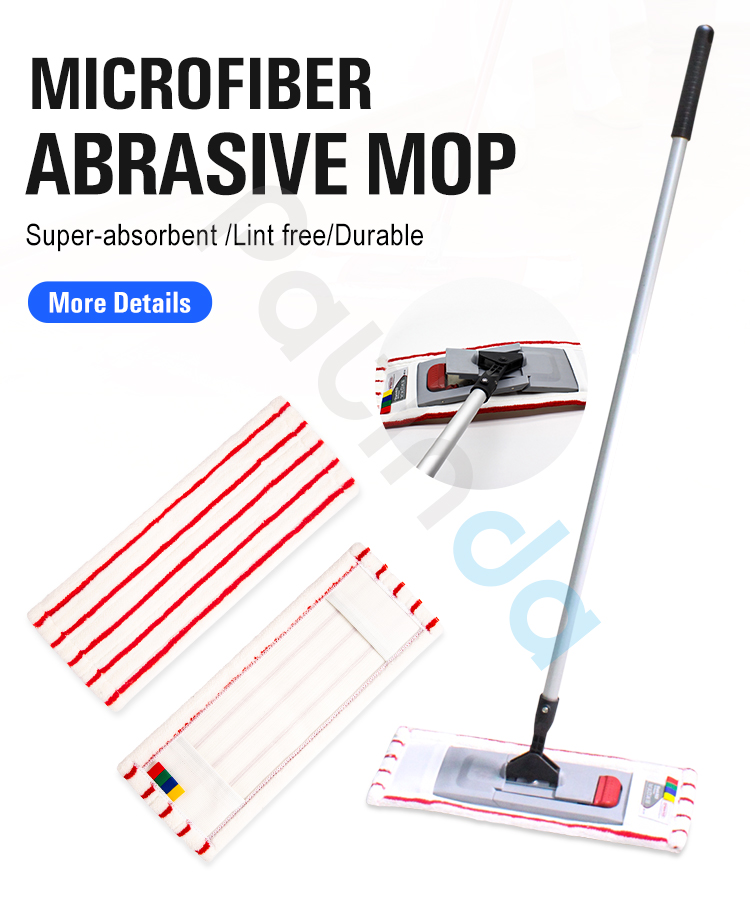
MP-020 Microfiber Abrasive Mop: white microfiber main pile with red PET stripe. Image source: Foshan Patinda Housewares Co., Ltd.
The MP-020 is classified by the manufacturer as a color-coded commercial dual-purpose dry & wet floor cleaning mop pad. Its material is a microfiber + PET blended fabric. Standard sizes are 40 cm and 50 cm, with customized dimensions optional; the single-pad weight is given as 80 g or 95 g.
Structurally, the MP-020 combines a white microfiber main pile with a red PET abrasive stripe intended for stubborn stain removal. The rear side uses a double-pocket fixing design and a four-color classification label for area management. According to the product specification, the pad offers strong dust and hair capture, high water absorption, and is scratch-free for marble, hardwood, and ceramic tile. It is positioned as reusable after repeated washing and suitable for commercial hygienic graded cleaning.
The documented target environments for the MP-020 are:
- Hospital sanitation
- Hotel and catering cleaning
- Commercial property maintenance
- School campus cleaning
- Public facility hygiene management
MP-006 Microfiber-Cotton Blended Tufting Mop: cotton-polyester tufted loops
The MP-006 is classified as a color-coded pocket-style commercial dust & wet dual-use mop replacement pad. Its material is 40% cotton blended with 60% polyester yarn. Standard sizes are 40 cm and 50 cm, with customized sizes available; the single-pad weight is 165 g or 200 g.
The front surface is a tufted loop construction with a fringe edge, while the back uses the same double-pocket fixing design and a four-color classification identification tag. The specification states that the MP-006 provides good dust and hair pickup, strong water absorption, and is lint-free. It also states that the tuft does not loosen during cleaning, which points to durability under repeated use. The pad is suitable for marble, hardwood, and ceramic tile in both dry sweeping and wet mopping, and it is washable repeatedly.
Documented application areas for the MP-006 include:
- Hospital sanitation
- Hotel and catering cleaning
- Commercial property maintenance
- Office cleaning service
- Household floor cleaning
Side-by-side specification comparison
| Attribute | MP-020 Microfiber Abrasive Mop | MP-006 Microfiber-Cotton Blended Tufting Mop |
|---|---|---|
| Product category | Color-coded commercial dual-purpose dry & wet floor cleaning mop pad | Color-coded pocket-style commercial dust & wet dual-use mop replacement pad |
| Fiber composition | Microfiber + PET blended fabric | 40% cotton + 60% polyester blended yarn |
| Standard sizes | 40 cm / 50 cm; customized sizes optional | 40 cm / 50 cm; customized sizes available |
| Single-pad weight | 80 g / 95 g | 165 g / 200 g |
| Front structure | White microfiber main pile + red PET abrasive stripe for stubborn stain removal | Tufted loop front surface with fringe edge; four-color classification tag |
| Fixing system | Back double-pocket fixing design; four-color classification label | Back double-pocket fixing design; four-color classification tag |
| Manufacturer-stated performance | Strong dust and hair capture; high water absorption; scratch-free for marble, hardwood, ceramic tile | Good dust and hair pickup; strong water absorption; lint-free; tuft does not loosen during cleaning |
| Floor compatibility | Marble, hardwood, ceramic tile | Marble, hardwood, ceramic tile; dry sweeping and wet mopping |
| Wash / reuse | Reusable after repeated washing | Washable repeatedly |
| Primary settings per spec | Hospital, hotel & catering, commercial property, school campus, public facility hygiene | Hospital, hotel & catering, commercial property, office cleaning, household floor cleaning |
| Custom options | Color, woven label, printed logo, diversified packing | Color, woven label, printed logo, diversified packing |
Technical explanation: what the fiber and structure actually do
Microfiber is a fine synthetic fiber, usually polyester or polyamide based, whose commercial value comes from a large fiber surface area that traps dust and absorbs liquid quickly. In the MP-020, that microfiber pile handles general dust and moisture, while the red PET abrasive stripe functions as a more textured zone for stubborn spots. The pad therefore separates “wiping most of the floor” from “scrubbing the stain” without requiring a second tool.
The MP-006 takes a different approach. Its 40% cotton content brings natural water affinity to the pad surface and increases the weight of the pad. The tufted loop construction creates a dense, textured face that can hold dust and hair, and the fringe edge adds surface area around the pad perimeter. The 60% polyester portion lends durability and washability to the blended yarn. Because the MP-006 is heavier—165 g to 200 g versus 80 g to 95 g for the MP-020 at similar widths—it carries more yarn mass per pad. A buyer should interpret that weight difference in operational terms: the cotton-blend pad is bulkier in handling and laundry, while the abrasive pad is lighter and therefore faster to lift, rinse, and rotate.
Both pads share two structural features that matter for commercial procurement:
- Double-pocket back: the pad slips onto a compatible flat mop frame rather than connecting to a pole socket. This means the frame is not included in the pad specification.
- Four-color identification: colors allow cleaning teams to assign pads to specific zones, reducing the risk of moving contamination from one area to another.
One point should be emphasized: neither product specification publishes an independent absorption rate, a laboratory dust-pickup value, or a maximum wash-cycle count. The performance descriptions above are manufacturer-stated characteristics. Buyers who intend to make an award decision solely on quantitative cleaning benchmarks should verify these characteristics through their own sample testing and laundering protocol.
Application and use cases: where each pad fits best
Both pads are documented for hospital sanitation, hotel and catering cleaning, and commercial property maintenance. In the manufacturer’s application mapping, these products are associated with indoor cleaning environments at normal room temperature, frequent water immersion, repeated wet-dry cycles, and high-frequency friction and scrubbing.
The practical distinction between the two pads is the type of soil and the cleaning cadence:
- Stain-prone service areas: hotel food-and-beverage floors, school corridors, public facility entrances. The MP-020’s PET abrasive stripe is the differentiator here because the product is explicitly designed for stubborn stain removal. Its lighter weight also makes it convenient for frequent pad changes during a single shift.
- Dust-heavy daily maintenance: hotel rooms, offices, lobbies, and other areas where routine dry sweeping is frequent. The MP-006 tufted loop is specified for dust and hair pickup and is lint-free. The heavier cotton-blend pad may feel more substantial during full-width sweeping, and the fringe edge increases contact surface on textured floors.
- Hygiene-rated zone cleaning: both models use the four-color classification system. Hospitals and commercial property firms often separate restroom, patient room, public area, and kitchen pads by color. The MP-020 and MP-006 both support this workflow through their color-coded labels.
- Wet mopping on hard floors: both are dual-use pads suitable for wet mopping on marble, hardwood, and ceramic tile. The MP-020 is explicitly described as scratch-free for these surfaces. The MP-006 is described as suitable for both dry sweeping and wet mopping but the specification does not repeat a “scratch-free” claim.
Market trend analysis: why performance data is moving up the buyer agenda
Commercial demand for microfiber cleaning products continues to grow. One market estimate from Dataintelo values the global microfiber cleaning cloth market at roughly USD 3.8 billion in 2025, with a projection to USD 27.5 billion by 2034. Household use is expected to represent about 40% of demand in 2025, according to market summaries. The size of the addressable market is debated—research firms use different segment definitions—but the direction is consistent: buyers are consolidating their cleaning textile purchases around microfiber-based systems.
Supply-side data reinforces the relevance of Chinese manufacturers. Trade data from Volza records 10,544 shipments of microfiber towels from China between June 2024 and May 2025, making China the world’s largest exporter of this product category. For a facility buyer, that means supplier capability, factory scale, and repeatable quality standards matter as much as the product itself.
Several trend indicators are relevant to pad selection:
- Reduced chemical and water use: industry analyses commonly state that microfiber products can reduce chemical usage by up to 60% and water consumption by about 90% compared with traditional cleaning tools. This makes flat-mop pad systems attractive to sustainability-driven procurement teams.
- Certification pressure: OEKO-TEX Standard 100 is widely recognized for textile safety and involves testing against more than 1,000 harmful substances. The Global Recycled Standard (GRS), which requires a minimum of 20% recycled content and tracks the production chain, is another common requirement in tender documents. Buyers should ask for current certificates rather than assume that a mop pad manufacturer holds them.
- Simplification of consumable SKUs: color-coded dual-use pads allow a facility to reduce the number of pad types it stocks while still separating cleaning zones. This is one reason pocket-style pads are common in hotel and hospital tenders.
Comparison with traditional solutions and honest limits
Traditional cotton mops and cotton string mops remain common in many markets because of low initial cost and high familiarity. Cotton is naturally absorbent and inexpensive. However, traditional cotton tools tend to hold moisture longer, can shed fibers, and often require more water and detergent in daily service. The verified market data on microfiber’s chemical and water savings is one reason institutional buyers have been converting floor-care programs to flat-mop systems.
Still, this comparison would be incomplete without noting the boundaries of both products:
- They are replacement pads, not complete mopping sets. The MP-020 and MP-006 both use a back double-pocket design. To use them, a cleaning department must already operate compatible pocket-style flat mop frames. This is not a limitation of a string mop, which connects directly to a threaded pole.
- Cotton content changes drying obligations. The MP-006 contains 40% cotton. Cotton generally retains moisture longer than synthetic microfiber, so laundry rotation and drying time need to be managed carefully in humid climates or high-turnover shifts. The pad is washable repeatedly, but that assumes the facility follows proper drying practices.
- The abrasive stripe is not a substitute for heavy-duty scrubbing. The MP-020’s PET stripe is specified for stubborn stain removal during routine dry/wet mopping. Neither the manufacturer nor this article claims that the pad replaces a dedicated grout brush, a floor machine, or chemical pretreatment on severely soiled floors.
- No published wash-cycle number. The MP-020 is described as reusable after repeated washing, and the MP-006 is described as washable repeatedly. However, neither specification sheet states a maximum number of washing cycles. For formal tenders, buyers should request wash-life evidence from the supplier.
Decision guidance for procurement teams
In an awareness-to-research buying phase, the goal is not to identify a single “best” pad but to build a defensible selection logic. The following framework can help:
- Map the floor types: marble, hardwood, ceramic tile are the documented surfaces for both pads.
- Map the soil profile: routine dust and hair, or recurring spots and stains. Stain-heavy zones point to the MP-020’s PET stripe; dust-heavy daily sweeping points to the MP-006 tufted cotton blend.
- Map the laundry workflow: lighter 80–95 g pads dry faster but feel less substantial; heavier 165–200 g pads carry more material but require more drying time.
- Run a controlled sample trial before a large purchase: test the MP-020 and MP-006 on representative floors through at least 20–30 wash cycles, and measure what matters to the operation: dust pickup, stain removal, drying time, edge wear, and tag durability.
Future outlook
The flat-mop pad is likely to become a more formal line item in cleaning contracts. As certification verification and sustainability targets enter procurement scorecards, buyers will increasingly ask for transparent fiber composition, wash-life evidence, and color-coding systems that reduce cross-contamination. The MP-020 and MP-006 demonstrate two responses to those requirements: one optimized for abrasive stain treatment on a light synthetic pad, and one built around a heavier cotton-blended tufted surface for dual-use dust and wet maintenance.
Manufacturers with in-house production, such as Foshan Patinda, are better positioned to document fiber inputs and customize color, label, and packing for institutional tenders. For buyers, the immediate implication is practical: product claims should be checked against the specification sheet, and procurement choices should be confirmed by sample testing rather than by marketing language.
FAQ
Download the Pa Tin Da e-catalog (PDF)
¿Tiene preguntas o necesita más detalles?
Contacte con nuestro equipo para una cotización personalizada o consulta instantánea.
Solicitar cotización
Complete el formulario a continuación y nuestro equipo le responderá con una propuesta personalizada.
Chat directo de WhatsApp
¿Prefiere chatear en tiempo real? Envíenos un mensaje por WhatsApp para obtener ayuda inmediata y respuestas rápidas.
- Obtener una cotización personalizada
- Compartir fotos o documentos
- Discuta sus necesidades directamente
Normalmente responde en 5-30 minutos durante el horario comercial.