
Low-Oxidation Fish Oil: What Buyers Must Specify
Low-oxidation fish oil is not a single product attribute. It is a release specification built from measured values — peroxide value, p-anisidine value, TOTOX and acid value — supported by contaminant testing, batch documentation and controls through processing, packaging and storage. For buyers in the research and evaluation stage, the practical question is not whether a supplier says the oil is low in oxidation, but which limits are written into the specification, which batch evidence proves them, and which certification layer applies to the destination market.

Oxidation is the main quality constraint in omega-3 fish oil supply because EPA and DHA are polyunsaturated fatty acids. They react with oxygen. The reaction begins during processing and continues after packaging. A low-oxidation specification therefore has two jobs: it sets release limits for the batch, and it defines the handling controls that protect those values until the oil is used. This distinction matters in procurement because a certificate of analysis describes a batch at a point in time, while the purchase specification governs what the supplier is obligated to deliver.
This article explains the constraints a buyer should build into a low-oxidation fish oil specification, how the main certification schemes differ, and where Norbidar's food-grade omega-3 concentrates fit within those constraints. It also sets out the limits of the low-oxidation claim, because oxidation control is a chain of controls rather than a permanent property of the oil.
Why Low Oxidation Is a Specification Problem, Not a Marketing Claim
Fish oil oxidation is measured, not inferred from color or smell. Four parameters are commonly used in purchase specifications. Peroxide value measures primary oxidation products. p-Anisidine value measures secondary oxidation products. TOTOX combines the two into a single calculated value. Acid value measures free fatty acids and is a separate indicator of hydrolysis and refining quality. A specification that names only one of these parameters leaves part of the oxidation picture unmeasured.
| Parameter | What it measures | Why a buyer should care | Where to verify |
|---|---|---|---|
| Fish Oil Peroxide Value (PV) | Primary oxidation products, reported in meq O2/kg | Early oxidation signal; can rise during storage if oxygen is present | Batch COA; third-party test report |
| Fish Oil p-Anisidine Value (pAV) | Secondary oxidation products | Shows whether oxidation has progressed beyond the primary stage | Batch COA; third-party test report |
| Fish Oil TOTOX Value | Calculated as (2 × PV) + pAV | Single summary value for comparing batches and setting release limits | Calculated from verified PV and pAV |
| Fish Oil Acid Value | Free fatty acid content, expressed as mg KOH/g | Indicates hydrolysis and refining quality; separate from oxidation | Batch COA; specification sheet |
The most widely referenced voluntary benchmark in the omega-3 industry is the GOED Voluntary Monograph. The version 8.1 document lists maximum limits of 5 meq O2/kg for peroxide value, 20 for p-anisidine value and 26 for TOTOX. These are industry voluntary limits, not a legal product authorization. They are also revised over time. A buyer should therefore confirm the current edition and write the agreed limits directly into the purchase contract, rather than relying on a supplier's general statement that the oil meets GOED.
The Four Numbers Buyers Should Put in a Contract
A contract-ready oxidation specification usually needs more than a TOTOX figure. TOTOX is useful because it combines PV and pAV into one number, but it can hide an imbalance between primary and secondary oxidation. A batch with a low PV and a high pAV is not equivalent to a batch with moderate values in both. For that reason, buyers evaluating low oxidation fish oil should specify PV, pAV, TOTOX and acid value separately, and require the calculation basis to be shown on the COA.
The same logic applies to potency. A high-purity omega-3 fish oil concentrate is defined by its EPA and DHA content as well as its oxidation state. The grade code is a starting point, not a substitute for the specification. Norbidar's EE grades use nominal values: 3624 EE at 36% EPA and 24% DHA, 4030 EE at 40% EPA and 30% DHA, 5020 EE at 50% EPA and 20% DHA, 5025 EE at 50% EPA and 25% DHA, and 5030 EE at 50% EPA and 30% DHA. The stated values are nominal; contractual limits and the analytical basis must follow the current specification and batch COA. The 8000EE grade is also listed in the product range; its nominal values should be confirmed on the current specification.
This is why a low-oxidation specification should be written as a release specification, not as a marketing description. It should define the EPA and DHA assay method, the oxidation limits, the acid value limit, the contaminant panel, the packaging format and the storage conditions. It should also state what happens if a batch falls outside a limit. A supplier that can provide batch-level analytical documentation makes that conversation concrete; a supplier that can only provide a general product brochure does not.
Certification Layers: What They Prove and What They Do Not
Fish oil quality is governed by several different layers, and buyers often conflate them. The Codex Standard for Fish Oils, CODEX STAN 329-2017, is an international commodity standard for fish oils intended for human consumption. The GOED Voluntary Monograph is an industry benchmark with tighter oxidation limits. IFOS is a voluntary third-party testing and certification programme that verifies label EPA and DHA content and tests for oxidation parameters, PCBs, dioxins and furans, heavy metals and other contaminants. FSSC 22000 and ISO 22000 are food safety management system certifications. FAMI-QS is a feed safety and quality management system certification. Halal certification is a production-system and product-scope certification that depends on destination-market recognition.
These layers answer different questions. A management-system certificate answers whether the site has a certified food safety system. It does not answer whether a specific batch meets a specific oxidation limit. A batch COA answers what was measured on that batch. It does not replace third-party verification. An IFOS certificate is lot-specific and should be requested for the batch in question. A Halal certificate answers whether the certified product scope is halal under the referenced standard; it does not by itself constitute market authorization in every destination. GOED membership is one supplier qualification filter, but membership is not a batch test.
| Layer | What it addresses | What it does not replace |
|---|---|---|
| CODEX STAN 329-2017 | International reference standard for fish oils for human consumption | Contract-specific oxidation limits and batch COA |
| GOED Voluntary Monograph | Industry voluntary oxidation and quality benchmark | Legal compliance; current edition must be confirmed |
| IFOS | Voluntary third-party testing of potency, oxidation and contaminants | Batch release documentation for every lot; lot-specific certificate required |
| FSSC 22000 / ISO 22000 | Certified food safety management system at the manufacturing site | Product registration, import authorization or batch test results |
| FAMI-QS | Feed safety and quality management for specialty feed ingredients | Food-grade product approval for every market |
| Halal certificate | Certified halal product scope under the referenced standard | Automatic acceptance in every halal market |
Norbidar's certification position
Zhejiang Norbidar Biomedicine Co., Ltd. manufactures food-grade omega-3 fish oil concentrates in Zhejiang, China. The company was established in 2018 and serves business customers in the nutrition ingredients sector. Its manufacturing site covers 72,000 m² in total, including 33,000 m² of building area, and employs approximately 200 staff. Annual fish oil input processing capacity is 10,000 metric tons; this is input processing capacity, not finished-product output.
The Omega-3 Fish Oil Concentrates product is certified to ISO 22000:2018 under certificate CN26/00004668, issued by SGS United Kingdom Ltd. The certificate is valid from 2026-10-11 to 2029-06-27 and applies to the product including grades 3624 EE, 4030 EE, 5020 EE, 5025 EE, 5030 EE and 8000EE. The same product is certified to FSSC 22000 under certificate CN26/00004667, issued by SGS United Kingdom Ltd. The applicable standard is ISO 22000:2018, ISO/TS 22002-1:2009 and FSSC 22000 Additional Requirements (Version 6).
The site is also certified to FAMI-QS under certificate CN26/00005166, issued by SGS, valid from 2026-07-11 to 2029-07-10. The FAMI-QS scope covers production of specialty feed ingredients for feed chain category K. Buyers should read that scope carefully: it is a feed-chain certification, not a food product registration. For food-grade omega-3 supply, the ISO 22000 and FSSC 22000 certificates are the more directly relevant management-system documents.
The HALAL certificate is issued by Shandong Halal Certification Service (SHC) under certificate number 501525000 (Registration No. 3306966AA5). It is valid from 2026-01-21 to 2029-01-20 and references Indonesia Halal Law and Regulations and MS 1500:2019. The certificate scope lists Fumaric Acid CWS, Fumaric Acid and Refined Fish Oil, with the product scope updated on 2026-07-30. The associated product is Omega-3 Fish Oil Concentrates, including grades 3624 EE, 4030 EE, 5020 EE, 5025 EE, 5030 EE and 8000 EE. The certification applies to halal ingredient markets subject to destination-country recognition and customer requirements.
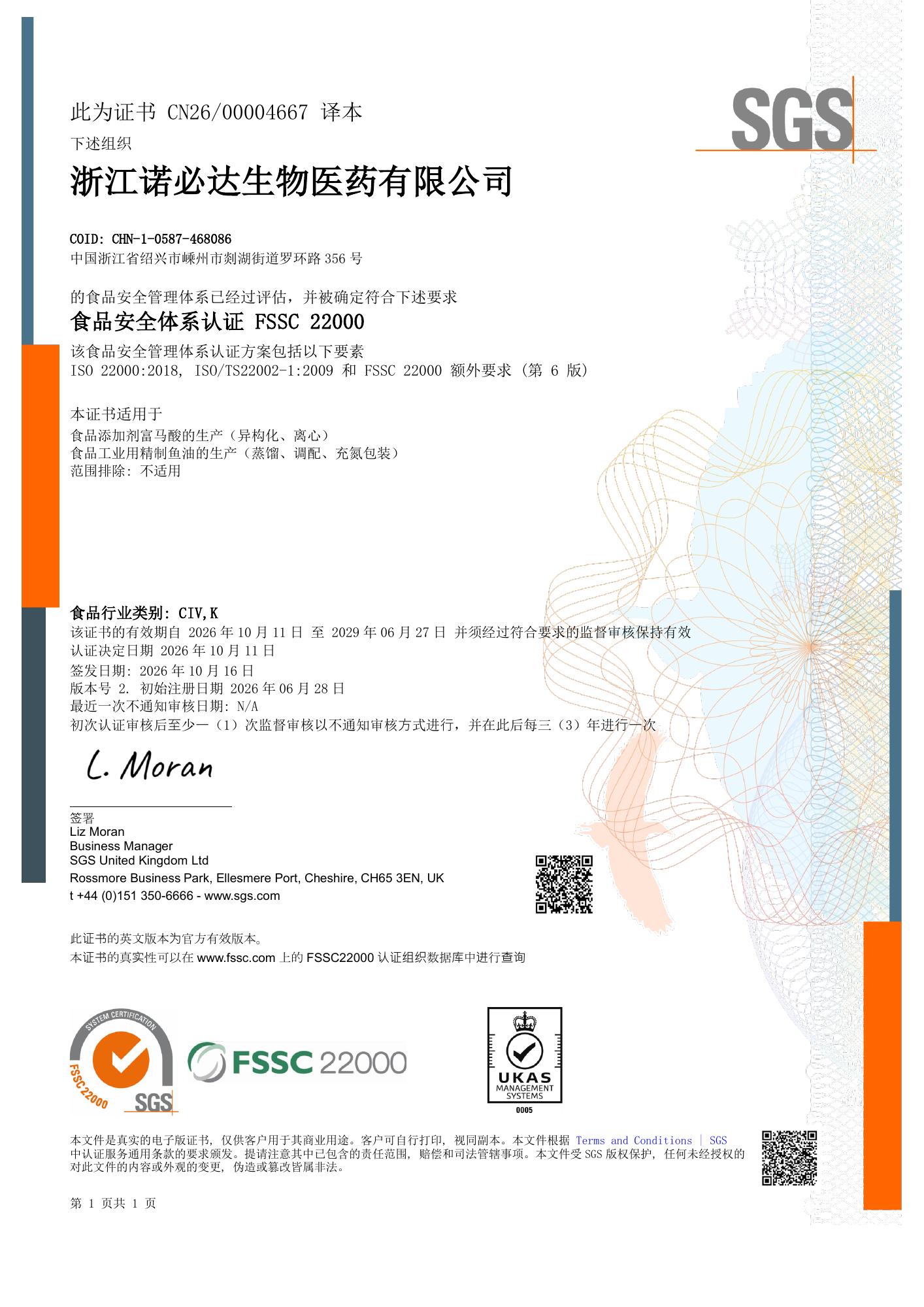
Contaminant Constraints: Heavy Metals, PCBs and Dioxins
Oxidation control is only one part of a fish oil specification. The second part is contaminant control. Marine oils can carry environmental contaminants, and the required test panel depends on the destination market and the product form. Heavy metal testing for fish oil typically covers lead, cadmium, mercury and arsenic. PCB testing covers dioxin-like and non-dioxin-like polychlorinated biphenyls. Dioxin testing covers dioxins and furans. IFOS includes these categories within its voluntary testing scope, alongside oxidation and potency.
In the European Union, Commission Regulation (EU) 2023/915 sets maximum levels for certain contaminants in food and repealed Regulation (EC) No 1881/2006. Buyers should cite only the instrument that is currently in force, and should confirm the commodity-specific numerical maximum levels in the current Annex for the relevant oil or food supplement category. Older supplier documents may still refer to Regulation (EC) No 1881/2006; that reference belongs to the pre-2023 regulatory baseline and should not be treated as the current legal limit.
Norbidar's quality control for the Omega-3 Fish Oil Concentrates product includes batch EPA and DHA assay and fatty-acid profile, color and oxidation testing, and contaminant screening. Batch COA, specification sheet and SDS are listed product documents. The exact limits follow the product documents. Buyers should request the current specification, the batch COA and the SDS, and should confirm any destination-specific test report before commercial release.
Custom EPA/DHA Profiles: What Can Be Customized and What Cannot
Custom fish oil specifications are common in supplement and functional food development because the required EPA and DHA dose, dosage form and sensory profile differ by product. Norbidar offers customized EPA/DHA profiles, blended concentration and EPA-rich or DHA-rich grades, subject to technical feasibility and an agreed product specification. The standard EE grades provide a starting point: 3624 EE, 4030 EE, 5020 EE, 5025 EE and 5030 EE. Additional blends and EPA-rich or DHA-rich grades can be discussed.
Customization has boundaries. The requested ratio must be technically feasible, the analytical method must be agreed, and the contractual limits must be stated on the specification. A custom ratio is not a substitute for a defined oxidation limit or a contaminant panel. It also affects commercial terms. Norbidar's stated monthly capacity is 1,000 tons, lead time is 30 days, and the minimum order quantity is 4 drums. These are planning inputs, not a price list. Price for a custom concentrate depends on the grade, the EPA/DHA ratio, the oxidation specification, the certification and testing requirements, the packaging and the delivery terms. A public price band is not a reliable substitute for a project-specific quotation.
EE form is not universal
The Norbidar range is based on ethyl ester concentrates. Ethyl ester is one of several concentrate forms used in the omega-3 industry. Buyers should confirm that the EE form is suitable for their dosage form, sensory requirements and formulation process before commercial use. A grade that fits a softgel supplement may not fit another application in the same way. This is a formulation question, not a quality ranking.
How Norbidar Manages Oxidation in Food-Grade Omega-3 Concentrates
Norbidar fish oil concentrates are produced with product development supported by the proprietary NBD multi-stage continuous distillation process. Continuous fish oil distillation is a concentration route that separates and concentrates the ethyl esters; the process design affects both the achievable EPA/DHA concentration and the thermal exposure of the oil. Molecular distillation of fish oil is another route discussed in the omega-3 industry, but buyers should distinguish between a general industry process category and the specific process a supplier has validated. For Norbidar, the documented process is NBD multi-stage continuous distillation.
Oxidation control continues after distillation. The certified scope for the food-grade fish oil operation includes distillation, blending and nitrogen packaging. Nitrogen-protected fish oil processing and closed-system or nitrogen-blanketed filling are practical ways to limit oxygen exposure at the packaging stage. The objective is not to claim that oxidation can be eliminated, but to reduce the opportunity for oxygen to react with the oil before the drum is sealed. Storage and transport then determine whether the batch values hold.
Documentation is part of the control system. Batch specification and analytical documentation are listed for the product. Norbidar also states that IFOS-certified batches are available for lot-specific verification. That is a meaningful distinction: a general certification statement is not the same as a lot-specific third-party report. Buyers should request the report for the batch they receive, not only a programme-level claim.
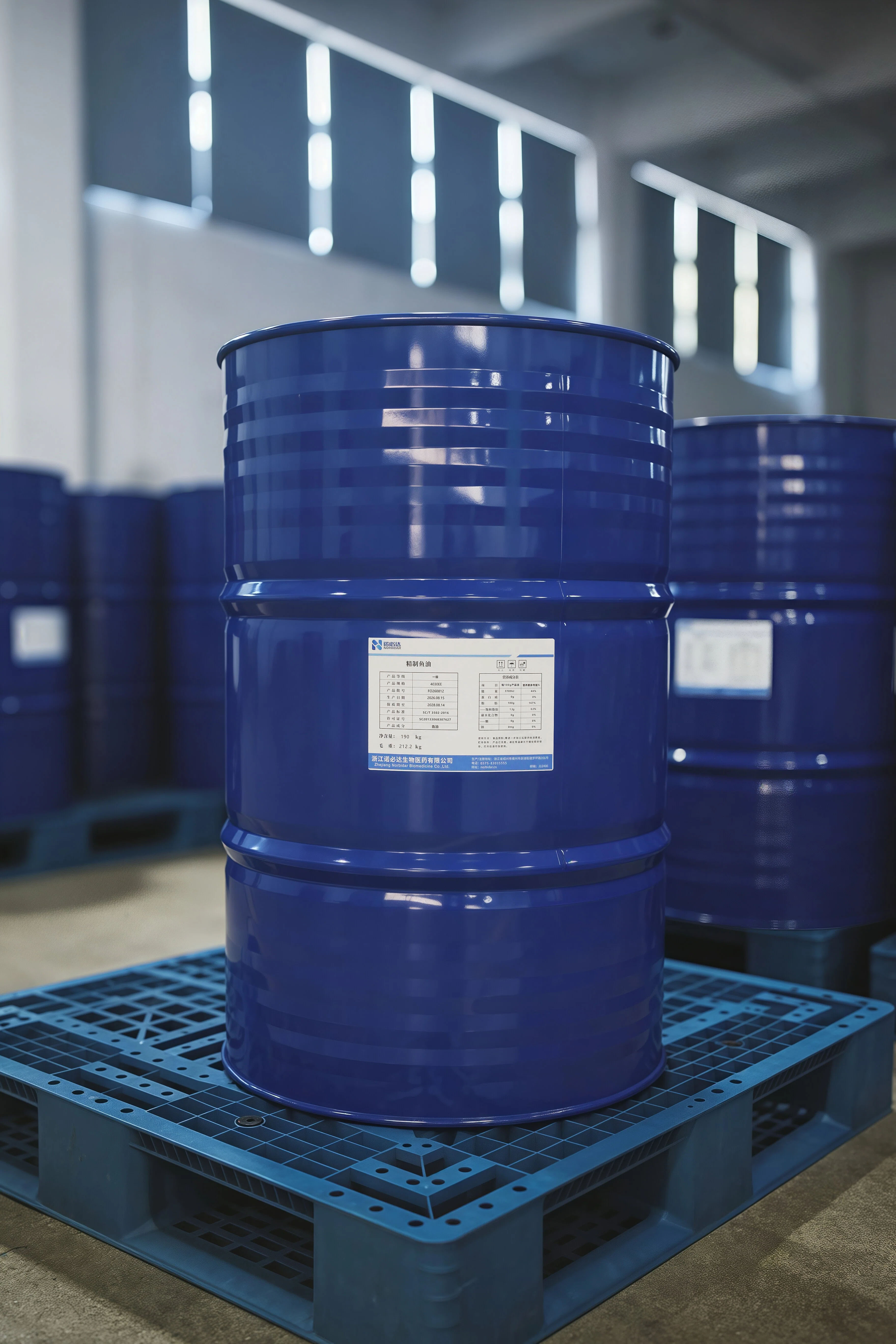
Application Fit: Where Low-Oxidation EE Concentrates Are Used
The main application for Norbidar's food-grade omega-3 concentrates is dietary supplement and nutraceutical ingredient formulation, with functional food ingredient development subject to formulation suitability and destination-market requirements. The ingredient delivers defined nominal EPA and DHA content in ethyl ester form as a bulk ingredient. Downstream formulation and processing follow the buyer's validated process.
Sample evaluation is a normal part of the research and evaluation stage. Norbidar has supplied samples for evaluation in India and Russia. In the Indian case, an anonymous nutraceutical ingredient customer evaluated omega-3 fish oil concentrates as bulk ingredients for dietary supplement formulation; the sample was supplied against the required EPA/DHA specification, and customer test results and acceptance remain pending. In the Russian case, an anonymous distributor received a 3624 EE sample for evaluation against the required specification; grade evaluation is pending, and no validated end-use performance results are available. These are sample-evaluation cases, not commercial performance claims.
| Evaluation question | What the buyer should confirm | Why it matters |
|---|---|---|
| Dose and ratio | Nominal EPA/DHA content versus the required dose; assay method | The grade code is a starting point, not a release specification |
| Form | EE-form suitability for the dosage form and process | EE is not universal across all applications |
| Oxidation limits | PV, pAV, TOTOX and acid value limits at release | Low oxidation must be a measurable contract term |
| Contaminants | Destination-specific heavy metal, PCB and dioxin panel | Legal limits and test methods vary by market |
| Packaging and storage | Nitrogen packaging, drum format, storage conditions | Oxidation can continue after release |
| Documentation | COA, specification, SDS and lot-specific third-party report where applicable | Batch evidence is the basis for acceptance |
Market Context: Why Oxidation Specifications Are Getting More Attention
One commercial research estimate places the global omega-3 ingredients market at USD 10.2 billion in 2026, with EPA projected to hold 51.9% of ingredient demand. These are commercial research estimates, not audited market facts, and they should be used as directional context rather than as a procurement forecast. The more durable industry signal is structural: buyers are asking for batch-level evidence because the number of specification layers has increased.
Codex provides an international reference. GOED provides a voluntary industry benchmark. IFOS provides third-party testing. FSSC 22000 and ISO 22000 provide management-system certification. EU contaminant regulation provides legal limits for the European market. Halal regimes in Indonesia and Malaysia add production-system requirements for those destinations. Each layer creates a document request. Suppliers that can answer those requests at batch level are easier to qualify than suppliers that answer only at brochure level.
The practical market trend is therefore not simply more demand for omega-3. It is more demand for verifiable omega-3 quality. That favors suppliers with documented processes, batch COAs, defined certification scopes and lot-specific third-party testing. It also raises the cost of qualification, which is why buyers should define the specification before requesting samples rather than after.
Comparison with Traditional Supply: What Changes When Oxidation Is Specified
A traditional commodity approach to fish oil purchasing often relies on a general product description, a certificate of analysis and a supplier relationship. A low-oxidation specification adds explicit limits, test methods and batch evidence. The difference is not that one supplier is good and another is bad. It is that the two approaches answer different procurement questions.
| Dimension | Commodity-style supply | Low-oxidation specified supply |
|---|---|---|
| Specification basis | General product description and grade | Named PV, pAV, TOTOX and acid value limits; assay method |
| Verification | Batch COA from supplier | Batch COA plus lot-specific third-party report where required |
| Certification review | Certificate overview | Scope, validity, product coverage and destination recognition checked |
| Contaminant control | Legal compliance statement | Destination-specific test panel and detection limits |
| Commercial terms | Price and availability focus | Price plus testing, documentation, MOQ and lead-time impact |
| Main limitation | May not meet tighter voluntary oxidation targets | Higher qualification and testing burden; longer approval cycle |
The limitation of the specified approach is real. Tighter oxidation limits and more testing add cost and time. A buyer who writes a demanding specification must expect a longer sample evaluation, more documentation review and a higher administrative load. The benefit is that acceptance is based on measurable criteria rather than on a general quality impression. The trade-off should be made deliberately, not by default.
A Buyer's Specification Checklist for Low-Oxidation Fish Oil
The following checklist is a practical way to convert a low-oxidation requirement into a purchase specification. It is not a substitute for the buyer's own regulatory review, but it covers the constraints that most often cause delays in supplier qualification.
| Item | What to specify |
|---|---|
| Product form | Ethyl ester concentrate; grade or custom profile; EPA-rich or DHA-rich requirement |
| Potency | Nominal EPA and DHA content; assay method; contractual tolerance |
| Oxidation | PV limit, pAV limit, TOTOX limit and acid value limit at release; calculation basis for TOTOX |
| Contaminants | Heavy metals, PCBs and dioxins panel; destination-specific limits and test methods |
| Certification | ISO 22000, FSSC 22000, FAMI-QS or Halal as applicable; certificate scope, validity and product coverage |
| Third-party verification | Lot-specific IFOS report where required; confirm the report matches the batch |
| Batch documents | COA, specification sheet and SDS; batch traceability information |
| Packaging | Drum format; nitrogen packaging or other oxygen-limiting control; seal integrity |
| Storage and transport | Cool, dry, light-protected and oxygen-limited conditions per specification and SDS |
| Commercial terms | MOQ, lead time, sampling plan, change-control notification and quotation basis |
Limits and Trade-offs Buyers Should Plan For
Low oxidation is not a permanent state. A batch that meets a release limit can move outside that limit if it is exposed to oxygen, light or heat during storage and transport. The specification should therefore include packaging and storage controls, and the buyer should verify that the receiving site can maintain them. A drum that is opened and partially used is a different oxidation risk from a sealed drum.
EE concentrates are not the right form for every application. Some buyers may need a triglyceride or re-esterified triglyceride form for formulation reasons. That is a product-development decision, not a quality criticism. The relevant question is whether the chosen form, grade and specification fit the intended dosage form and process.
Certification is also narrower than it sometimes appears. FSSC 22000 and ISO 22000 are management-system certifications. They are not product registrations or import authorizations. FAMI-QS covers feed-chain production and should not be presented as a food product approval. Halal certification depends on destination-country recognition and customer requirements. IFOS is a voluntary programme and its reports are lot-specific. None of these layers removes the need for a batch COA and a destination-specific regulatory review.
Finally, custom ratios and low-oxidation limits have commercial consequences. A custom EPA/DHA profile must be technically feasible, analytically defined and commercially agreed. The buyer should expect a quotation rather than a public price band, because the price depends on grade, ratio, oxidation specification, certification, testing, packaging and delivery terms. The 4-drum MOQ and 30-day lead time stated by Norbidar are planning references; they should be confirmed for each project.
Future Outlook
The direction of travel in omega-3 supply is toward layer-specific verification. Buyers are less willing to accept a single quality statement that mixes product claims, certificates and batch results. They want to know which standard applies, which certificate covers the product, which batch was tested, which laboratory performed the test and which limits are contractual. That is a more demanding procurement process, but it is also more defensible.
For suppliers, the implication is that documentation becomes part of the product. A low-oxidation position is credible only when it is supported by a specification, a batch COA, a defined process and, where required, a lot-specific third-party report. For buyers, the implication is that the specification should be written before the sample is requested. The sample evaluation then becomes a test of the specification, not a search for one.
FAQ
What does low oxidation mean for fish oil?
Low oxidation means the oil is manufactured and documented to keep primary and secondary oxidation within defined limits at batch release. The usual measures are peroxide value, p-anisidine value, TOTOX and acid value. The claim should be tied to a specification and a batch COA, not to color or odor alone.
Which oxidation limits should a buyer write into a specification?
The GOED Voluntary Monograph version 8.1 lists maximum limits of 5 meq O2/kg for peroxide value, 20 for p-anisidine value and 26 for TOTOX. These are voluntary industry limits, not legal limits. Buyers should confirm the current edition and write the agreed limits into the contract with the test method and release basis.
Is TOTOX enough to judge fish oil quality?
No. TOTOX is calculated as (2 × PV) + pAV, so it summarizes primary and secondary oxidation but can conceal an imbalance between them. A complete specification also includes PV, pAV, acid value, EPA/DHA assay and the relevant contaminant panel.
What is the difference between a batch COA and IFOS testing?
A batch COA is the supplier's analytical record for a specific batch. IFOS is a voluntary third-party testing and certification programme that verifies label EPA/DHA content and tests for oxidation, PCBs, dioxins and furans, heavy metals and other contaminants. An IFOS report is lot-specific and should be matched to the batch received.
Does FSSC 22000 certification mean a fish oil product is approved for every market?
No. FSSC 22000 is a food safety management system certification for the manufacturing site. It is not a product registration or import authorization. Market access still depends on destination-specific regulatory requirements and customer approval.
What does the Norbidar HALAL certificate cover?
The HALAL certificate is issued by Shandong Halal Certification Service under certificate number 501525000 (Registration No. 3306966AA5), valid from 2026-01-21 to 2029-01-20. The certificate scope lists Fumaric Acid CWS, Fumaric Acid and Refined Fish Oil, with the product scope updated on 2026-07-30. The associated product is Omega-3 Fish Oil Concentrates, including grades 3624 EE, 4030 EE, 5020 EE, 5025 EE, 5030 EE and 8000 EE. Acceptance depends on destination-country recognition and customer requirements.
Can EPA/DHA ratios be customized?
Norbidar offers customized EPA/DHA profiles, blended concentration and EPA-rich or DHA-rich grades, subject to technical feasibility and an agreed product specification. The standard EE grades are 3624 EE, 4030 EE, 5020 EE, 5025 EE and 5030 EE. Additional blends can be discussed, but feasibility and contractual limits must be confirmed.
What documents should be requested before commercial supply?
Buyers should request the current specification, batch COA, SDS, certificate scope and validity documents, destination-specific contaminant test reports and any lot-specific third-party report required by the buyer's qualification process. The documents should match the product, grade and batch under review.
Why is there no public price band for custom fish oil concentrates?
Price depends on the grade, EPA/DHA ratio, oxidation specification, certification and testing requirements, packaging, volume and delivery terms. A public price band would not reflect those variables. A project-specific quotation is the appropriate basis for comparison.
For grade tables, certificate details and product documentation, the Norbidar Omega-3 brochure is available here: Norbidar Omega-3 brochure.
¿Tiene preguntas o necesita más detalles?
Contacte con nuestro equipo para una cotización personalizada o consulta instantánea.
Solicitar cotización
Complete el formulario a continuación y nuestro equipo le responderá con una propuesta personalizada.
Chat directo de WhatsApp
¿Prefiere chatear en tiempo real? Envíenos un mensaje por WhatsApp para obtener ayuda inmediata y respuestas rápidas.
- Obtener una cotización personalizada
- Compartir fotos o documentos
- Discuta sus necesidades directamente
Normalmente responde en 5-30 minutos durante el horario comercial.