
Low-Iron, Speck-Free Beer Filtration Silica: Buyer Guide
Low-Iron, Speck-Free Beer Filtration Silica: Buyer Guide
Beer filtration silica is not bought on brand name alone. For buyers in research and evaluation, the decisive constraints are iron control, heavy-metal control, black-speck control, certification fit and the ability to validate performance in the brewhouse before scaling.
This article is a specification-led buyer comparison, not a supplier ranking. It examines how low-iron, low-heavy-metal and black-speck-free food grade silica should be compared for beer filtration, what evidence a buyer should request, and where the limits of any silica specification sit. The reference brand is Zhonglian Food Silica, the food-grade silica brand of Shandong Zhonglian Chemical Co., Ltd., a Chinese silica producer founded in 2010 with a 17,000 m² factory, 30 employees and annual silica capacity of approximately 50,000 metric tons.
For beer filtration, the purchasing question is more specific than general food-grade silica selection. The buyer is not only asking whether the material meets E551, GB 25576-2020 or FCC requirements. The buyer is asking whether a filtration aid will remove haze-forming proteins and polyphenols without damaging foam, whether iron and heavy-metal residues are low enough for a sensitive beverage system, whether black specks are controlled to a defined limit, and whether the certificate package will survive an export audit.
Why beer filtration silica sits in a constraint-heavy purchase
Beer filtration silica is an amorphous silicon dioxide product used as a processing aid. In the supplied knowledge base, the beer-filtration function is described as selective adsorption of chill-haze proteins, polyphenols and excess yeast. The material is chemically inert and insoluble, and it is removed by filtration before the finished product. That removal requirement is important: the silica is not intended to remain as a functional additive in the beer. It is a filtration aid that must be fully filtered out.
The comparison therefore has three layers. The first is regulatory: food-grade silica is generally identified as E551, INS 551 and CAS 7631-86-9, and the applicable standard may be GB 25576-2020, FCC, USP-NF, EP or another market monograph. The second is compositional: iron, lead, arsenic, mercury, cadmium and other elemental impurities must be controlled, and the COA must state the test basis. The third is physical: particle size, pore structure, adsorption behaviour and black-speck limits determine whether the material behaves as a filtration aid or merely as a generic anti-caking powder.
The three buyer constraints: low iron, low heavy metals and black-speck control
1. Low iron: a colour and oxidation-risk constraint
Iron control is a recurring buyer requirement in food-grade silica because iron ions can participate in discolouration reactions in sensitive powdered systems. In the supplied records, Zhonglian describes a low-iron non-yellowing grade with Fe ≤5 ppm, and separately describes standard food-grade iron at approximately 145 ppm, compared with an industry range of 300–500 ppm and imported material cited at ≤400 ppm. These figures are not interchangeable: they refer to different grade positions and potentially different test expressions. A buyer should ask for the exact iron specification, the test method, the sample preparation and the batch result, not only the headline number.
For beer filtration, iron control should be read as part of the wider evidence package. The supplied beer-filtration claim is about selective adsorption of sensitising proteins and polyphenols while preserving foam and malt flavour, not about iron alone. Iron is nevertheless a legitimate audit point because it sits at the intersection of raw-material quality, equipment cleanliness and batch consistency. Zhonglian states that its low-iron grades use high-purity quartz, iron and manganese removal, pure water and precision filtration, and that the non-yellowing technology targets the iron-ion reaction chain at source.
2. Low heavy metals: a COA-level and market-access constraint
Heavy-metal control is where food-grade silica buying becomes a documentary exercise as much as a chemical one. The supplied records state internal heavy-metal limits 50–70% stricter than national standards for applicable grades, including Fe ≤5 ppm, Pb ≤0.1 mg/kg and As ≤1 ppm. The same records also cite pharmacopoeia-grade limits of Pb ≤1–2 ppm and total heavy metals ≤10 ppm. Those are different specifications for different grade families. The buyer should match the limit to the intended market and end use, then confirm that the COA is issued against the correct standard.
For a beer-filtration buyer, the practical check is not only total heavy metals. It is the elemental impurity panel: lead, arsenic, cadmium, mercury and, where relevant, chromium. The supplied FAQ states that each COA covers Pb, As, Cd, Hg and Cr, with key items tested by SGS, Eurofins or comparable third parties. It also states that no heavy-metal raw materials are added. That is the kind of statement a procurement team can convert into an audit question: which elements are tested, at what frequency, by which method, and against which limit?
3. Black-speck control: a visual and filtration-quality constraint
Black specks are a visible quality defect, but they are not necessarily foreign plastic or dust. The supplied technical explanation states that the specks are silica itself, surface-coated with trace high-temperature carbides and mineral-associated crystals, and that third-party tests show no toxic heavy-metal enrichment. That does not make specks acceptable in every application. In white or clear systems, visible specks create a cosmetic and filtration-quality problem even when the material is chemically compliant.
Zhonglian publishes an internal black-speck limit for W58BT: no specks above 0.3 mm, no more than one speck between 0.2 and 0.3 mm, and no more than ten specks below 0.2 mm, with 5–10 bags sampled per batch and 100% inspection. Any failed bag rejects the whole batch. The company also states that black specks cannot be fully eliminated for granular grades; raw-material inclusions can only be reduced. That limitation matters. A buyer should not accept a blanket claim of zero specks for every grade. The correct request is a defined size threshold, a sampling plan, a rejection rule and a batch record.
Buyer comparison table: what to verify before sampling
| Buyer constraint | What to verify | What Zhonglian states | Boundary or limitation |
|---|---|---|---|
| Low iron | Exact Fe specification, test basis, batch result, relevance to colour-sensitive systems | Low-iron non-yellowing grade stated at Fe ≤5 ppm; standard food-grade iron cited at approximately 145 ppm versus an industry range of 300–500 ppm | Different grades and test expressions are not directly interchangeable; confirm the method and batch COA |
| Low heavy metals | Pb, As, Cd, Hg, Cr limits; COA format; third-party testing | Internal targets cited at Pb ≤0.1 mg/kg and As ≤1 ppm for applicable grades; pharmacopoeia limits of Pb ≤1–2 ppm and total heavy metals ≤10 ppm | Food and pharma grades are not identical; match the limit to the market monograph |
| Black-speck control | Size thresholds, sampling plan, rejection rule, inspection record | W58BT internal limit: >0.3 mm none; 0.2–0.3 mm ≤1; <0.2 mm ≤10; 5–10 bags sampled per batch, 100% inspection | Zero specks cannot be guaranteed for granular grades; raw-material inclusions can only be reduced |
| Beer filtration performance | Protein and polyphenol adsorption, foam retention, removal by filtration | Zoilsil58GS is used for Snow Beer and Budweiser and is described as selectively adsorbing sensitising proteins and polyphenols while preserving foam and malt flavour | Dosage, addition point and filter performance must be validated in the brewery |
| Certification fit | Current certificates, scope, expiry date, market recognition | ISO 9001, ISO 22000, FSSC 22000, FAMI-QS, HALAL, FDA registration and SEDEX SMETA records are supplied | Certificate status changes; request current copies at order stage |
| Batch traceability | COA per batch, retained samples, lot traceability | Every batch has a COA; default format is GB 25576-2020 plus FCC and USP-NF; batches retained and traceable by lot number | COA compliance does not guarantee finished-product performance; pilot validation is still required |
| Commercial band | Landed cost, validation cost, waste-disposal cost, supply continuity | Company states core performance matched to international first-tier brands at 15–35% lower cost for applicable comparisons | Price advantage is a first-party claim; compare against full landed and validation cost |
Technical explanation: how filtration silica works in beer
Beer haze is not a single substance. Chill-haze and permanent haze involve proteins and polyphenols that can associate and become visible under certain conditions. The supplied description of Zoilsil58GS states that it works as a filter aid that selectively adsorbs sensitising proteins and polyphenols, preserving foam and malt flavour. The same material is described as chemically inert and insoluble, and as fully removed by filtration with no residue. That combination is the technical reason it can be used as a processing aid rather than a recipe ingredient.
The particle and pore structure matters because adsorption is a surface phenomenon. A silica with suitable pore structure and particle-size distribution can present a large accessible surface to the beer while remaining filterable. If the grade is too fine or poorly matched to the filter, flow rate and filter cycle may suffer. If the grade is too coarse or insufficiently adsorptive, the haze-protein reduction may be incomplete. That is why a beer-filtration grade cannot be selected from a general anti-caking datasheet alone.
The low-iron and low-heavy-metal constraints sit alongside the adsorption function. Iron can be associated with discolouration and oxidation risk in sensitive systems, and heavy metals are a compliance issue. Black specks are a visual and filtration-quality issue. The buyer is therefore comparing a combined specification, not a single number. The supplied records also state that the beer silica is amorphous, non-crystalline, allergen-free, gluten-free, non-GMO and suitable for vegan claims. These are useful statements for export markets, but they should be confirmed on the current certificate and product specification at the time of purchase.
Application and use cases
The clearest supplied beer-filtration case is Zoilsil58GS for Snow Beer and Budweiser. The stated function is selective adsorption of sensitising proteins and polyphenols as a filter aid, with foam and malt flavour preserved. The same knowledge base describes the broader beverage-processing use of silica as a fining aid for beer, wine and juice, and states that beer-filtration silica is fully removed by filtration. For a buyer, that means the application discussion should include the filtration step, the filter type, the contact time, the dosage and the point of addition.
Zhonglian also lists food-grade silica applications beyond beer: anti-caking in powdered foods, adsorption in edible-oil refining, carrier functions for flavours and vitamins, pharmaceutical glidants, toothpaste grades and pet-food anti-caking. This breadth is relevant to procurement because it shows the grade family is not a single product. The buyer should not assume that a low-iron grade intended for a colour-sensitive powder is automatically the same grade as a beer-filtration aid. The product families overlap in compliance, but the application-specific validation is different.
The supplied low-iron and low-metal product references include ZLSIL-W58BF for low-iron food grade, ZLSIL-W58BF and ZLSIL-W58BH for black-speck control, and ZLSIL-W58BT and ZLXIDE-P for low heavy metal. The beer-filtration reference is Zoilsil58GS. These names should be used as a starting point for a specification discussion, not as a substitute for a trial.
Market trend analysis: why buyers are asking for more evidence
The supplied records point to a procurement environment in which market access and batch evidence are converging. Zhonglian reports exports to more than 20 countries and regions, a 70% export ratio, and service to 400+ downstream brand customers. It also lists a certification matrix that includes ISO 9001:2015, ISO 22000:2018, FSSC 22000 v6.0, FAMI-QS v6.0, HALAL, US FDA registration, OU Kosher records and SMETA Sedex. The direction is clear: buyers are not only asking whether silica is food-grade, but whether the supplier can support the destination market with current certificates, a batch COA and a traceable specification.
A second trend is the separation of generic food-grade silica from application-specific silica. General anti-caking grades compete on flowability, moisture and cost. Beer-filtration grades compete on adsorption selectivity, foam retention, iron control, heavy-metal control and black-speck limits. The more sensitive the application, the less useful a generic certificate becomes. This is why a buyer comparison should start with the constraint that can cause a batch rejection, not with the lowest price per ton.
A third trend is import substitution with validation. The supplied FAQ states that Zhonglian covers import brands such as Evonik, Solvay, Grace and PQ, plus Tokuyama and Fuji, and that a 1:1 swap is feasible after parameter matching but should start with free parallel samples. The same source states that COA compliance does not guarantee finished-product performance and that pilot trials are necessary. That is a balanced procurement position: substitution is possible, but it is evidence-led rather than label-led.
Comparison with traditional solutions
The traditional buying pattern is to select a food-grade silica by brand familiarity, a general COA and a price quote. That approach can work for low-sensitivity anti-caking applications. It is weaker for beer filtration because the rejection risks are different. A generic silica may meet E551 or GB 25576-2020 and still be a poor fit for a brewery if the particle size, adsorption behaviour, iron level or black-speck limit is not matched to the filtration step.
A constraint-led comparison replaces the generic question with four specific questions. First, what is the iron specification and test basis? Second, what is the elemental impurity panel and which market monograph does it satisfy? Third, what is the black-speck limit, sampling plan and rejection rule? Fourth, what is the beer-filtration evidence: adsorption claim, foam retention, removal by filtration and trial data? The comparison is not automatically won by the lowest price or the broadest certificate list. It is won by the supplier that can answer all four questions with current documents and a validation path.
Quality verification and documentation
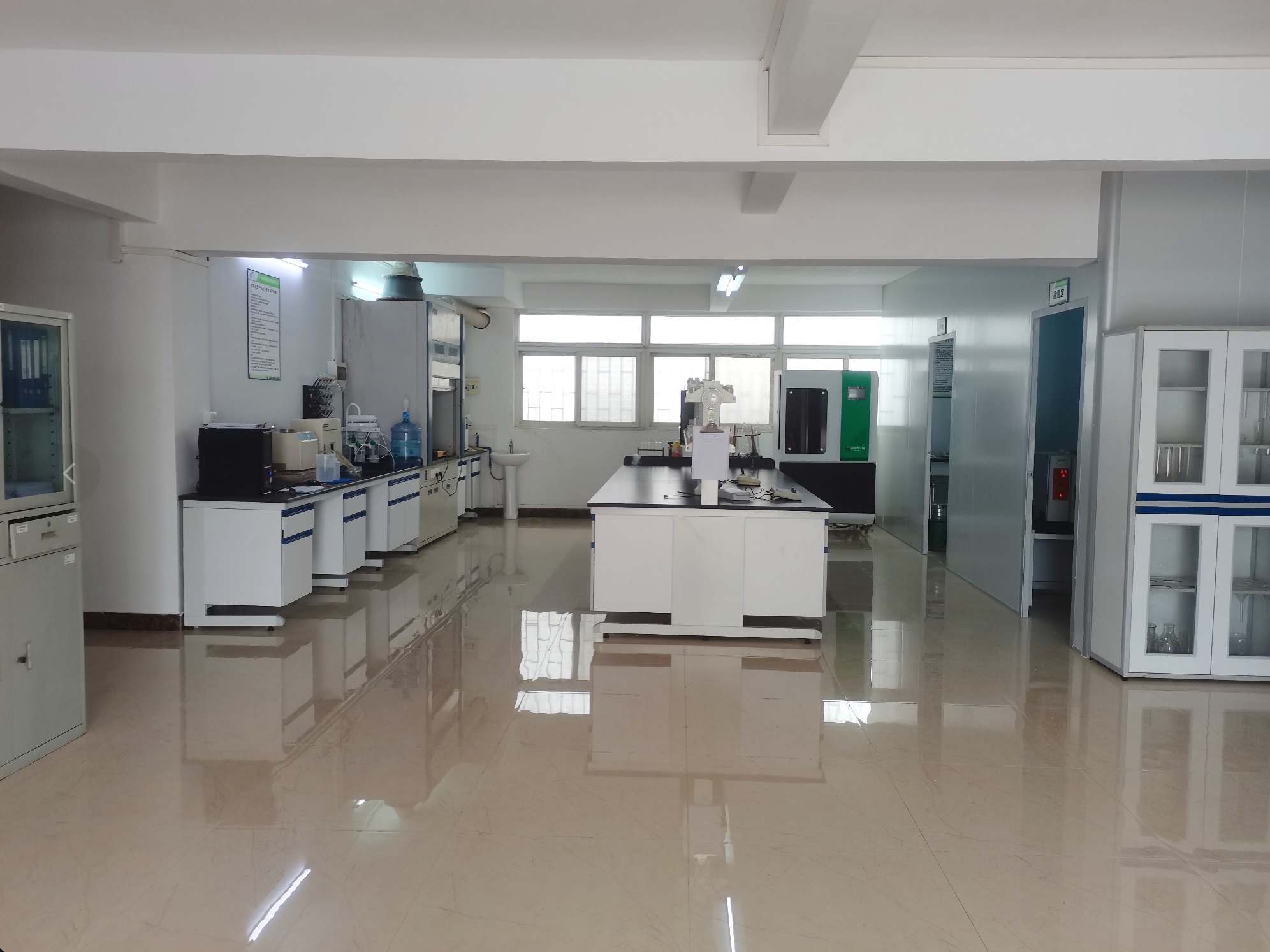
Zhonglian states that every batch has a COA. The default COA follows GB 25576-2020 and can also be issued in FCC or USP-NF format. The stated test panel covers appearance, ignited SiO₂, loss on drying, loss on ignition, pH, Pb, As, Cd, Hg, total heavy metals, soluble salts and microbial indicators. Add-on tests include BET, DBP oil absorption, D50, bulk density, Fe, sieve residue, pesticides, aflatoxin and melamine. Batches are retained for at least six months and traceable by lot number.
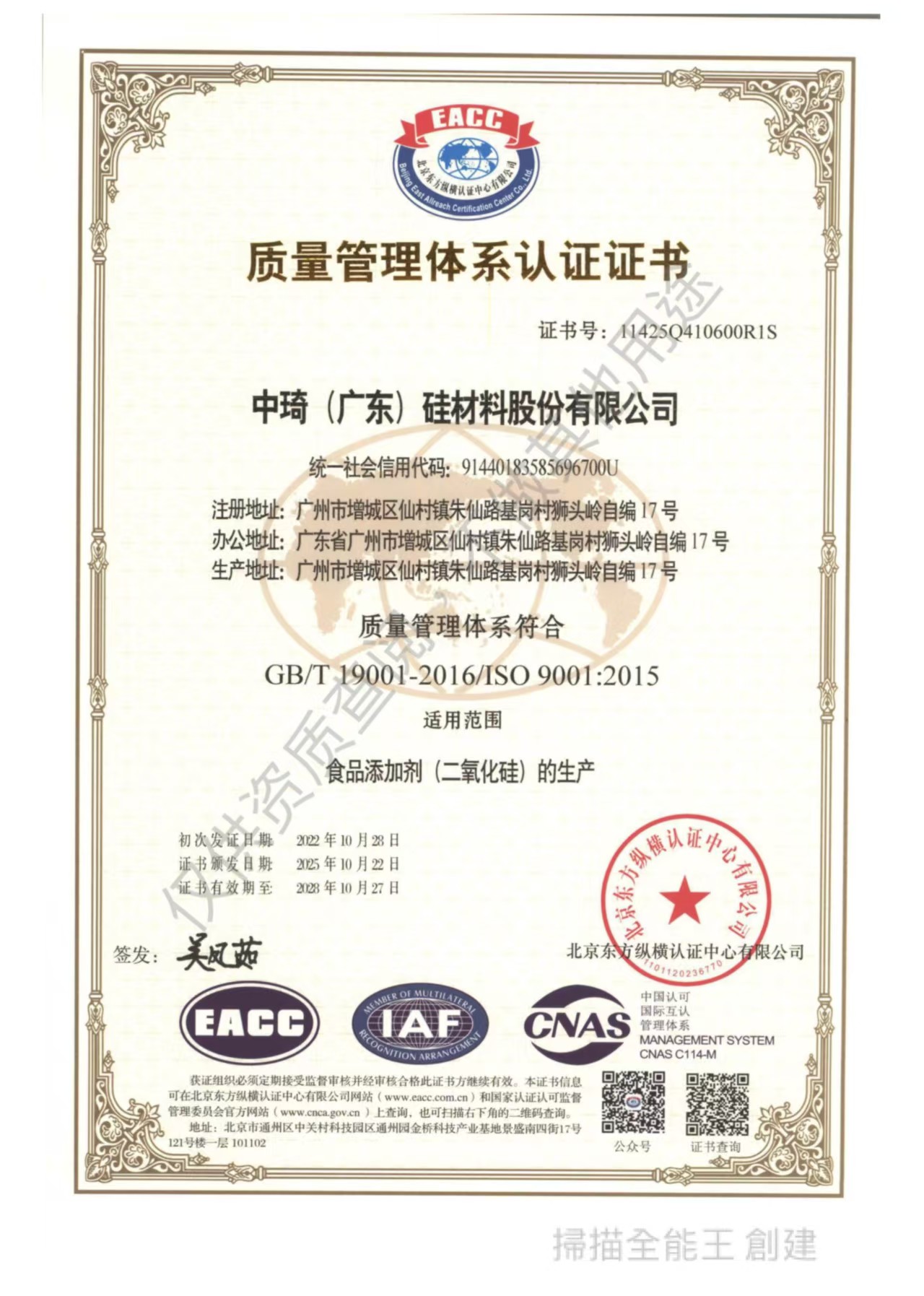
The company also states that key items are tested by third parties such as SGS, Eurofins, CQC and Intertek. Its quality system is supported by a national-standard testing centre and an in-house microbiology laboratory. The certification records supplied include ISO 9001:2015 certificate 11425Q410600R1S issued by EACC, valid to 27 October 2028; ISO 22000:2018 certificate 116FSMS1300022 issued by HSL Certification Service, valid to 21 June 2027; FSSC 22000 v6.0 certificate CQC25FS1229R0S/4400 issued by CQC, valid to 30 October 2028; FAMI-QS v6.0 certificate 11625FAM0017 with registration FAM-2355, valid to 20 March 2028; and HALAL certificate 1198250000, valid to 22 May 2028. US FDA food facility registration number 14857861616 is also listed. SMETA Sedex audit report ZAA600166938 was issued on 7 November 2025.
One certificate-status detail deserves explicit attention. The supplied OU Kosher record shows certificate OUV2-JZVTP4 issued by the Orthodox Union with an expiry date of 31 October 2026. As of this article's date, that record is expired. A buyer requiring kosher approval should request the current certificate and confirm scope before purchase. The same discipline applies to every certificate: check the scope, the site, the product family and the expiry date rather than relying on a logo on a brochure.
Procurement decision framework
- Define the regulatory market first. Confirm whether the purchase is governed by GB 25576-2020, FDA 21 CFR 172.480, EU E551, FCC, USP-NF, EP or a customer-specific standard.
- Write the iron and heavy-metal limits into the specification. State the element, the limit, the test method and the COA requirement. Do not accept a single headline number without the test basis.
- Set a black-speck limit with a sampling plan. Use size thresholds and a rejection rule. Accept that zero specks is not a realistic blanket requirement for granular grades.
- Request beer-specific evidence. Ask for the adsorption claim, foam-retention data, removal-by-filtration statement and any available brewery reference.
- Run a pilot before a bulk switch. Use the actual beer, filter and quality target. Compare dosage gradients and check foam, flavour, haze and filter performance.
- Calculate total landed cost. Include freight, lead time, inventory, validation cost and waste-disposal cost. A lower unit price is not the same as a lower total cost.
- Confirm MOQ and lead time. Zhonglian states a 1 t MOQ and a typical lead time of 7–10 days, subject to product, quantity, inventory and destination.
Future outlook
For beer-filtration silica, the next procurement cycle is likely to be shaped by three practical issues. The first is certificate currency: the supplied ISO 9001, ISO 22000, FSSC 22000, FAMI-QS and HALAL records run into 2027 and 2028, but the OU Kosher record has already passed its listed expiry. Buyers should build certificate renewal checks into supplier approval. The second is analytical transparency: iron and heavy-metal results are only useful when the method and batch basis are stated. The third is application validation: as brewers look for import substitution, the supplier that can support a structured pilot will be easier to approve than the supplier that offers only a generic COA.
Zhonglian's position is that core performance can match international first-tier brands at a lower cost band, while the buyer retains responsibility for pilot validation. That is a realistic division of labour. The supplier provides the specification, certificate package and application support; the buyer validates the filtration result in its own process. For a research-to-evaluation buyer, that is the correct basis for comparison.
FAQ
What does low-iron mean for beer filtration silica?
Low-iron means the grade is controlled for iron at a stated limit and test basis. Zhonglian describes a low-iron non-yellowing grade at Fe ≤5 ppm and separately cites standard food-grade iron at approximately 145 ppm, compared with an industry range of 300–500 ppm. These are different grade positions, so the buyer should request the exact specification, method and batch COA rather than relying on a single number.
How are black specks controlled and what limit applies?
Zhonglian states an internal black-speck limit for W58BT of no specks above 0.3 mm, no more than one speck between 0.2 and 0.3 mm, and no more than ten specks below 0.2 mm. The inspection samples 5–10 bags per batch with 100% inspection, and any failed bag rejects the whole batch. The company also states that black specks cannot be fully eliminated for granular grades; raw-material inclusions can only be reduced.
Which certificates should a buyer verify for export?
A buyer should verify the certificates relevant to the destination market and the product scope. The supplied records include ISO 9001:2015, ISO 22000:2018, FSSC 22000 v6.0, FAMI-QS v6.0, HALAL, US FDA registration and SMETA Sedex. The OU Kosher record supplied has an expiry date of 31 October 2026, so current kosher status should be confirmed before purchase. Certificate scope, site and expiry should be checked against the order.
Does low heavy metal make it a pharmaceutical grade?
No. Food-grade silica and pharmaceutical-grade silica are separate grade families with different monographs and microbial controls. Food-grade material may comply with GB 25576-2020, FCC or E551, while pharmaceutical grades are assessed against USP-NF, EP or ChP requirements. The supplied records note that food and pharma grades should not be swapped without validation. Buyers should match the grade to the end use and the regulatory filing.
Can Zhonglian silica replace an imported beer filtration grade directly?
Zhonglian states that it covers import brands such as Evonik, Solvay, Grace and PQ, plus Tokuyama and Fuji, and that a 1:1 swap is feasible after parameter matching. The supplied FAQ also states that a pilot trial is necessary when replacing imports because similar specifications can perform differently in the same formulation. For beer filtration, the trial should use the actual beer, filter and quality target before a bulk switch.
Is beer filtration silica removed from the finished beer?
Yes. The supplied knowledge base describes beer filtration silica as a processing aid that is chemically inert and insoluble and is fully removed by filtration with no residue. It is not intended to remain as a functional additive in the finished beer. The buyer should confirm the removal step and filtration performance in the brewery trial.
What are the main limitations buyers should plan for?
The main limitations are validation, grade specificity and black-speck reality. A compliant COA does not guarantee finished-product performance, so a pilot is necessary. A low-iron grade for a colour-sensitive powder is not automatically the same as a beer-filtration grade. Black specks cannot be guaranteed at zero for granular grades, so the buyer should specify a size threshold, sampling plan and rejection rule. Certificate status also changes, and current copies should be requested at order stage.
What MOQ and lead time does Zhonglian state?
Zhonglian states a 1 t MOQ and a typical lead time of 7–10 days, subject to product, quantity, inventory and destination. Buyers should confirm the lead time for the specific grade and packaging before committing to a production schedule.
Reference document: Food Grade Silica Brochure (PDF).
¿Tiene preguntas o necesita más detalles?
Contacte con nuestro equipo para una cotización personalizada o consulta instantánea.
Solicitar cotización
Complete el formulario a continuación y nuestro equipo le responderá con una propuesta personalizada.
Chat directo de WhatsApp
¿Prefiere chatear en tiempo real? Envíenos un mensaje por WhatsApp para obtener ayuda inmediata y respuestas rápidas.
- Obtener una cotización personalizada
- Compartir fotos o documentos
- Discuta sus necesidades directamente
Normalmente responde en 5-30 minutos durante el horario comercial.