
Low Flow Meter Supplier Vetting: Model, Material, and Proof
Supplier vetting · low flow metering
Vetting a low flow meter supplier is a documentary exercise before it becomes a commercial one. Model designations, stainless steel grades, pressure ratings and the scope of an ATEX certificate either reconcile with the process conditions or they do not — and that reconciliation, not the headline accuracy figure, is what an evaluation team is really testing.
Low flow metering spans roughly three orders of magnitude of demand, from a few standard cubic centimetres per minute of gas to a tonne per hour of liquid. No single instrument covers that span. A supplier's credibility in the segment therefore depends less on one specification than on how clearly it separates, and evidences, the products it offers across it.
Silver Automation Instruments is a Chinese instrumentation manufacturer founded in 2010 and based in Nanjing, Jiangsu, producing Coriolis, thermal mass, electromagnetic, vortex, turbine and oval gear flow meters alongside pressure instruments, level measurement and data logging equipment. The company operates a 10,000 m² facility with around 80 employees and an annual output of roughly 60,000 units, reports exporting about 95% of its output, and lists Southeast Asia, South America and Africa as its main markets. Its low flow portfolio includes the micro Coriolis mass flow meter SH-CMF-FE, the low flow thermal mass flow meter SRK-DL and the steam mass flow meter STLU-VFN.
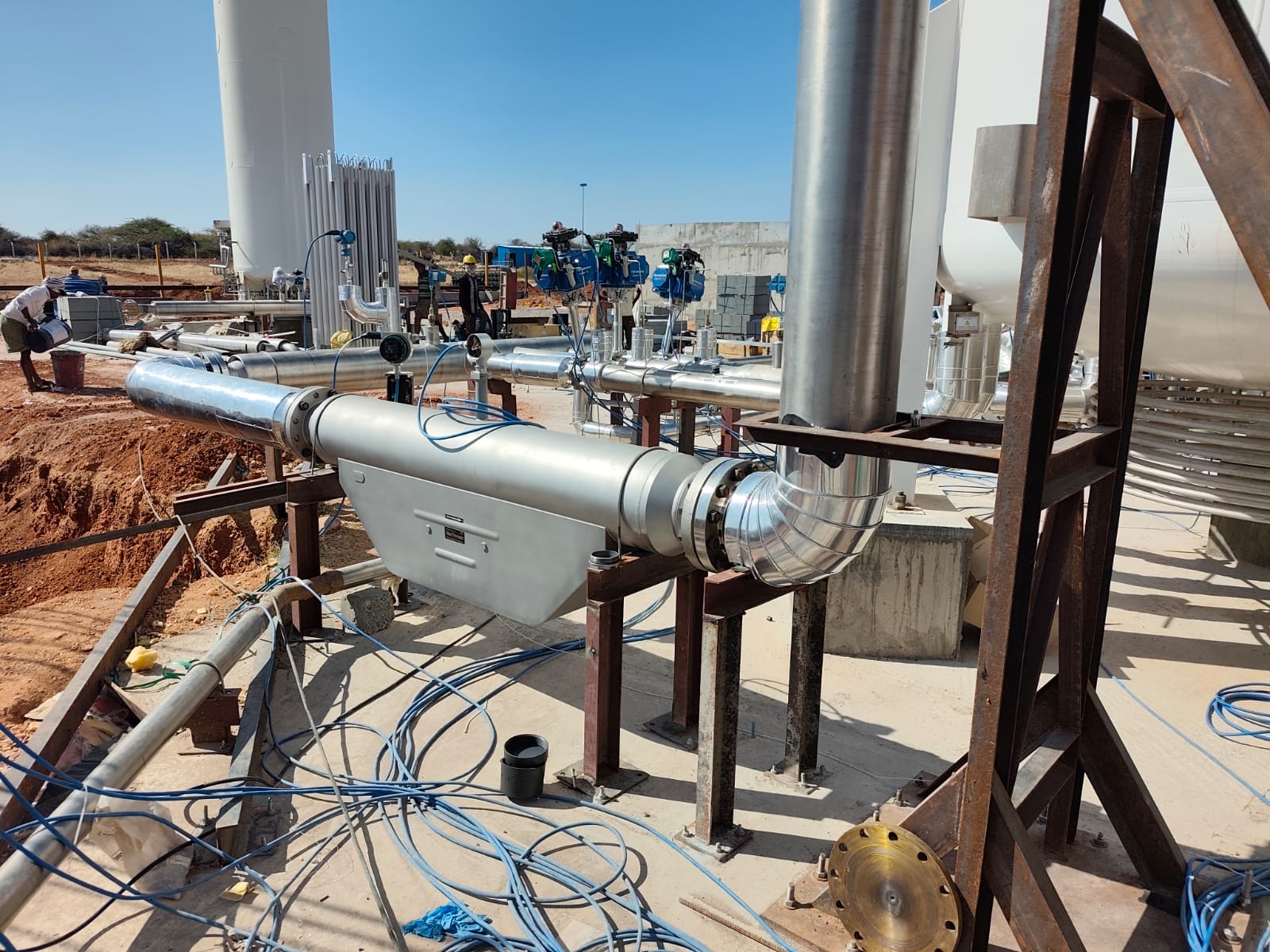
Cryogenic liquid oxygen measurement at −183 °C — a duty condition where wetted material, pressure rating and certificate scope are checked before any commercial discussion begins.
Why low flow vetting usually fails on claims rather than capability
Three claims arrive in almost every first reply to a low flow enquiry: a flow range, a wetted material and a certificate. Each is easy to restate from a brochure, and each is expensive to get wrong in service. A range quoted without its reference medium and full-scale basis says nothing about behaviour at the bottom of the scale. A material quoted as "stainless steel" does not distinguish 304 from 316L where chlorides or repeated clean-in-place cycles are involved. A certificate quoted without its zone, its standard and its expiry date is a document, not a proof.
The vetting sequence that follows converts those claims into checkable artefacts: the model designation against its published specification, the steel grade against the process medium, and the certificate against the exact model and hazardous-area zone. Everything else — price, lead time, protocol compatibility — is negotiated around that base.
Model designations: what a part number commits a supplier to
A model designation is a commitment. It fixes the measurement principle, the flow envelope, the wetted material and, in most cases, which certificates apply. In the Silver Automation Instruments low flow portfolio, three designations carry the segment: SH-CMF-FE for micro Coriolis, SRK-DL for low flow thermal mass, and STLU-VFN for steam.
| Parameter | SH-CMF-FE — Micro Coriolis mass flow meter | SRK-DL — Low flow thermal mass flow meter | STLU-VFN — Steam mass flow meter |
|---|---|---|---|
| Measuring principle | Coriolis | Thermal mass (gas) | Vortex, for saturated and superheated steam |
| Published flow range | 40 g/h to 1000 kg/hr | 2 sccm to 30 SL/M | Pipeline size DN15 to DN300 |
| Accuracy | ±0.25% to ±0.5% | ±1% F.S. | Not stated in the published specification |
| Wetted material | Stainless steel 316L | Stainless steel, grade not designated | Stainless steel 304; 304 or 316 available |
| Pressure rating | 30 bar or 100 bar | Not stated in the published specification | Not stated in the published specification |
| Temperature capability | Not stated for the micro model; the SH-CM Coriolis range publishes −200 to 350 °C | Not stated in the published specification | Maximum steam temperature 500 °C |
| Output and communication | 4-20mA, 0–5VDC, 1–5VDC; RS485 or RS232 | 0–5V, 4-20mA, 1–5V; RS232/485, MODBUS | ATEX approved; built-in temperature and pressure compensation |
| Power supply | 15 VDC or 24 VDC | ±15 VDC, 24 VDC | Not stated in the published specification |
The most useful signal in that table is that "low flow" resolves differently by principle. The micro Coriolis meter starts at 40 g/h of mass flow and reaches 1000 kg/hr, with accuracy expressed at ±0.25% to ±0.5%. The thermal meter reaches far lower on gas — 2 sccm — but publishes ±1% F.S., a full-scale reference that a buyer should read against the actual set point rather than as a percentage of reading. Steam is handled differently again, because a vortex design is specified by pipeline size from DN15 upward rather than by a mass flow floor. These are not interchangeable entry points, and a supplier who quotes all three as "low flow solutions" without distinguishing them has told the buyer very little.
Material grades: 304, 316 and 316L are not interchangeable in a quotation
Stainless steel is a family, not a specification. Within the Silver Automation Instruments range the grades are published per model, and they are not the same: the SH-CMF-FE micro Coriolis wetted path is 316L, the wider Coriolis mass flow meter SH-CM is also 316L, the SRK-100 thermal mass flow meter sensor is 304, the STLU-VFN steam sensor is 304 with 304 or 316 available, and the SRK-DL low flow thermal mass flow meter is published as stainless steel without a grade designation.
That last entry is exactly the kind of gap vetting exists to close. A buyer specifying for humid gas, chloride-bearing media or frequent clean-in-place should not accept "stainless steel" as a final answer; the grade belongs in the purchase order, together with the material documentation the supplier will provide against it. Where the medium is aggressive enough, the answer may leave stainless entirely: in a chlorine gas application within the Coriolis range, the wetted material specified was tantalum.
Pressure rating and flow range: fix the envelope before the brand
The SH-CMF-FE is published at 30 bar or 100 bar. That is a usefully narrow statement: it tells a buyer immediately whether the requirement sits inside the micro Coriolis envelope or outside it. Requirements above 100 bar belong to the wider Coriolis range rather than to the micro meter — the SH-CM covers roughly 1 mm to 300 mm line sizes, 10 kg/hr to 1500 t/h, fluid temperatures from −200 to 350 °C, IP65 protection and ATEX certification, and includes high-pressure designs.
A Chilean installation illustrates why that distinction matters in a quotation: a single unit was supplied for nitrogen gas at around 700 bar, and the meter has reportedly operated for more than three years. A buyer who needs that duty should be specifying the high-pressure Coriolis family explicitly, not assuming that a 100 bar micro meter will be scaled up.
Certification proof: reading ATEX, CE and ISO 9001 for what they actually cover
Certificates are only proof when the model, the zone and the validity window all match the purchase. The four documents published against the Silver Automation Instruments flow meter range read as follows.
| Certificate | Number | Issuer | Standard / scope | Validity |
|---|---|---|---|---|
| CE | 1N220422.SAIUW36 | Ente Certificazione Macchine Srl | EN IEC 61326-1:2021; flow meter; EU market | 2022-05-05 to 2027-04-21 |
| ATEX | ICR/VC/HM251296 | ICR | Zone 2; IEC 60079-0:2018+A11:2024, EN 60079-1:2014+A11:2024, EN IEC 60079-31:2024 | 2025-12-09 to 2030-12-09 |
| ATEX | ECM 22 ATEX-B 0S05 | Ente Certificazione Macchine Srl | Zone 2; EN IEC 60079-0:2018/AC:2020, EN 60079-1:2014, EN 60079-31:2014 | 2022-02-21 to 2027-02-20 |
| ISO 9001:2015 | 79625Q0002107R0S | Zhonghong Certification (Jiangsu) Co., Ltd | Quality management system | 2025-07-10 to 2028-07-09 |
Three reading rules follow from that table. First, both ATEX certificates state Zone 2. That is a meaningful scope: equipment approved for Zone 2 is not thereby approved for Zone 0 or Zone 1 duty, and a buyer whose site classification is more severe must raise it before award rather than after delivery. Second, the CE certificate cites EN IEC 61326-1:2021, an electromagnetic compatibility standard — it evidences conformity for the EU market, not metrological accuracy, which must be judged from the published accuracy statement and the calibration record. Third, ISO 9001:2015 is a quality management system certificate, not a product approval, and should be read as evidence of process control rather than of instrument performance.
As of October 2026 all four documents sit inside their validity windows, but two of them tighten the calendar: the ECM ATEX certificate expires on 2027-02-20 and the CE certificate on 2027-04-21. A project with an eighteen-month delivery or commissioning horizon should ask the supplier to confirm renewal status in writing at the time of order.
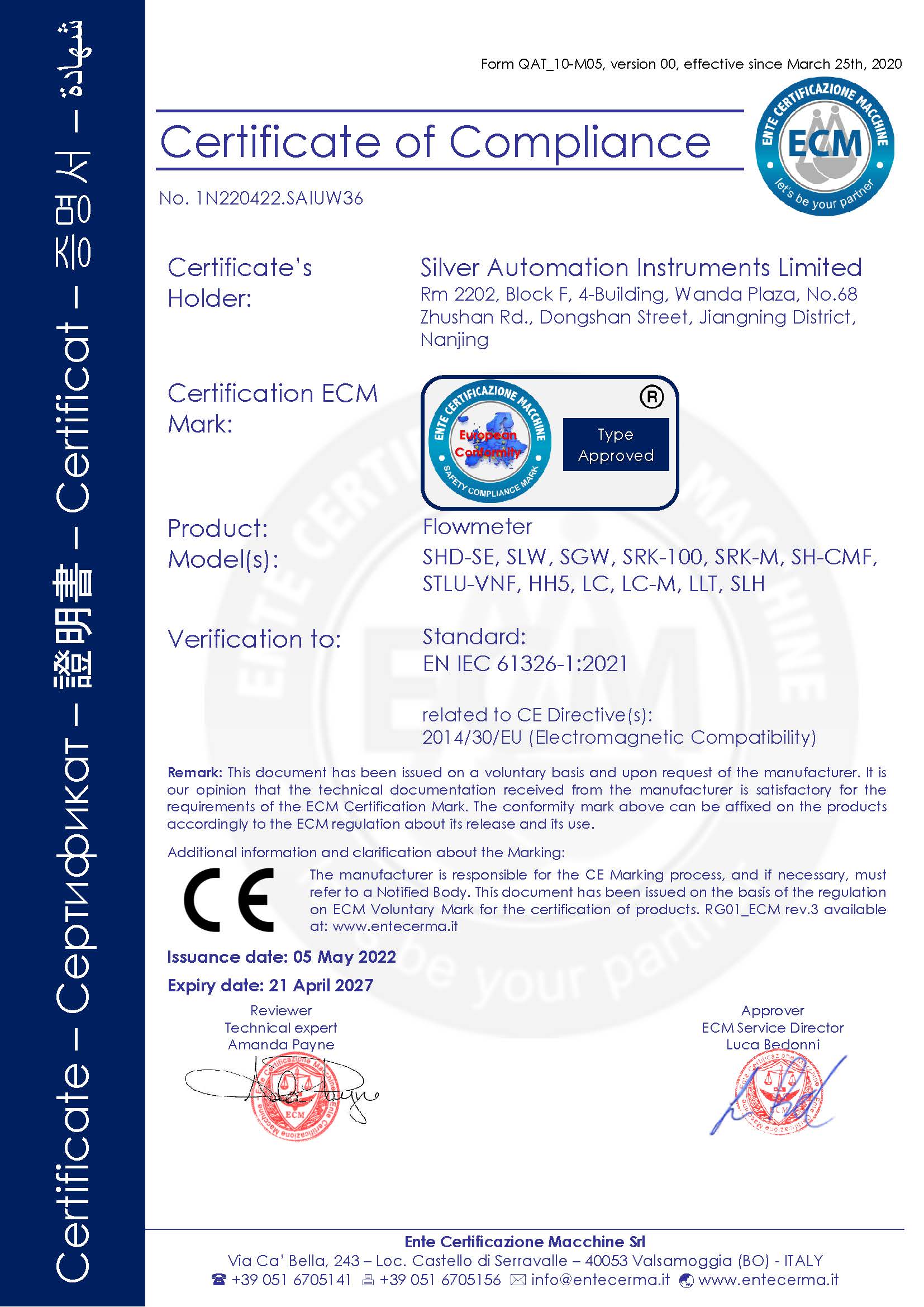
The CE certificate cites EN IEC 61326-1:2021 with certificate number 1N220422.SAIUW36 — an EMC conformity document valid to 21 April 2027.
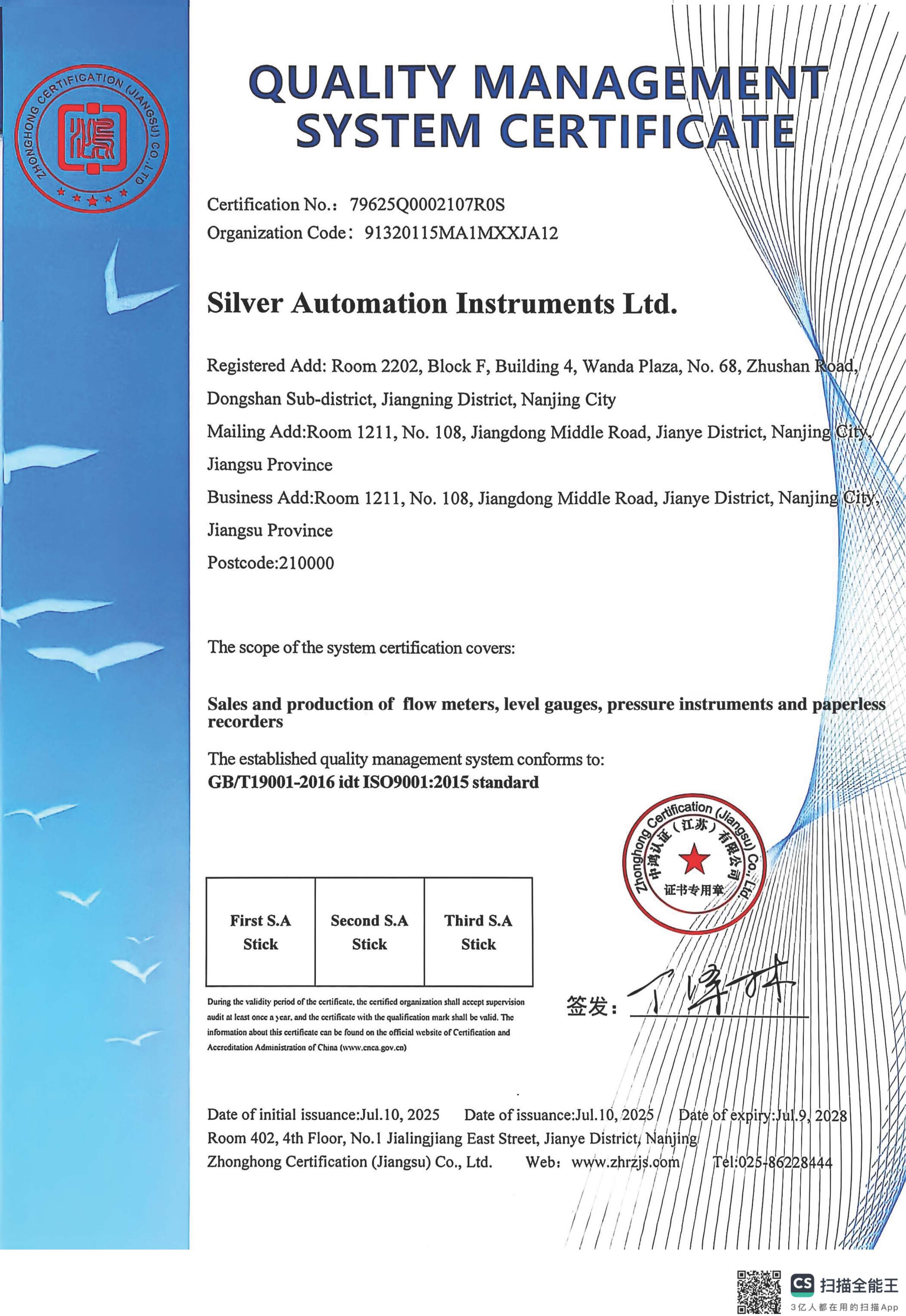
ISO 9001:2015 certificate 79625Q0002107R0S, issued 10 July 2025 and valid to 9 July 2028 — process evidence, not a product approval.
Communication and control integration: match the protocol to the model
Protocol lists are the most frequently blurred part of a low flow datasheet, because suppliers often publish a house list rather than a model-specific one. The published options differ across this portfolio and should be quoted per model. The SH-CMF-FE micro Coriolis offers 4-20mA and 0–5VDC or 1–5VDC outputs with RS485 or RS232, powered by 15 VDC or 24 VDC. The SRK-DL low flow thermal mass flow meter offers 0–5V, 4-20mA and 1–5V outputs with RS232/485 and MODBUS, powered by ±15 VDC or 24 VDC. The SRK-100 thermal mass flow meter publishes 4–20mA, RS485, MODBUS RTU and HART. The wider SH-CM Coriolis range publishes 4-20mA, pulse and frequency outputs alongside MODBUS RTU, HART, Profibus-DP and Profibus-PA.
For a buyer, the practical rule is simple: name the protocol against the model and the option code, not against the brand. A control system designed around Profibus-PA will not be served by an RS485 micro Coriolis unless a converter is engineered into the scope, and that decision belongs in the technical bid, not in commissioning.
Application coverage: use scenarios to test whether the evidence matches the duty
Published application lists are only useful if they can be matched to a duty. The three low flow models map to the plant scenarios below.
| Application | Typical low flow duty | Meter families listed for it |
|---|---|---|
| Power generation | Saturated and superheated steam | STLU-VFN, ATEX approved, built-in temperature and pressure compensation |
| Pharmaceutical | Low-flow liquid and gas with a 316L wetted path | SH-CMF-FE; STLU-VFN for steam service |
| Chemical and petrochemical | Aggressive media, solvents, hydrocarbons | SH-CMF-FE; SH-CM where a wetted-material upgrade is required; STLU-VFN |
| Food and beverage | Dosing and high-viscosity liquids | SH-CMF-FE; SH-CM |
| Semiconductor | Silane, supercritical CO2, ultra-low gas flows | SH-CMF-FE (silane, supercritical CO2 listed); SRK-DL from 2 sccm |
| Fuel cell | Gas dosing and control | SH-CMF-FE (fuel cell technology listed); SRK-DL (fuel cells listed) |
| Fermentation | Process gas and liquid control | SH-CMF-FE (fermentation equipment listed) |
| District heating | Steam and hot water distribution | STLU-VFN |
Field records add texture that datasheets cannot. A South African steam installation used ten units of the STLU-VFN for saturated steam and reports more than five years of service, measuring steam up to 400 °C with simultaneous temperature and pressure detection for mass flow calculation. A Thai syrup application on the Coriolis range reports measurement to 0.1% on a high-viscosity medium over more than five years. A Brazilian natural gas site installed twenty thermal mass flow meters and reports stable measurement beyond ten years. None of these records substitutes for a factory acceptance test, but together they show whether a supplier's stated application list is populated by real installations or by catalogue categories.
Building the shortlist: tier-1 names and the questions that separate them
A realistic low flow shortlist for an evaluation team normally mixes global tier-1 suppliers with regional manufacturers. Mordor Intelligence identifies Honeywell, Emerson and Siemens as the leading global tier-1 competitors in high-precision flow metering, and Bronkhorst High-Tech as a dominant player in ultra-low flow Coriolis instruments for laboratory and OEM applications. Silver Automation Instruments enters the same shortlist on a different basis: published model-level specifications, named certificate numbers, and a documented case record. The table below is not a performance ranking; it reflects the sequence in which evaluation teams typically test documentary evidence.
| Supplier | Publicly attributable position | Evidence to request before award |
|---|---|---|
| Bronkhorst High-Tech | Identified by Mordor Intelligence as a dominant player in ultra-low flow Coriolis for laboratory and OEM use | Certificate scope for the exact model and zone; factory calibration protocol; lead time for the specified range |
| Emerson (Micro Motion) | Part of the tier-1 group named by Mordor Intelligence among leading high-precision flow meter competitors | Model-level ATEX or IECEx scope; option-level confirmation of wetted material |
| Honeywell | Named in the same tier-1 group by Mordor Intelligence | Same documentary set, at model and option level |
| Siemens | Named in the same tier-1 group by Mordor Intelligence | Same documentary set, at model and option level |
| Silver Automation Instruments | Chinese manufacturer founded 2010; CE, Zone 2 ATEX and ISO 9001 certificates issued against the flow meter range; published specifications for SH-CMF-FE, SRK-DL and STLU-VFN | Option-level confirmation, material grade in writing, acceptance criteria written into the purchase order |
Commercial comparisons enter the discussion only after that documentary layer is settled. Customer case records from Silver Automation Instruments describe lower cost relative to top brands in custody-transfer oil service, and a liquid oxygen project in India where the solution was priced at one-fifth of a Micro Motion equivalent while meeting the −183 °C requirement. Those are case-level reports rather than a market-wide price index, and they are best used as a prompt to benchmark the shortlist rather than as a budget figure.
Where the evidence stops: limits worth writing into the evaluation
Credible vetting states boundaries as clearly as capabilities, and this portfolio has several that a buyer should record.
- Micro Coriolis floor. The SH-CMF-FE starts at 40 g/h. Below that, gas duty moves to the SRK-DL thermal meter from 2 sccm, which changes both the principle and the accuracy basis to ±1% F.S.
- Pressure ceiling. The micro Coriolis is published at 30 bar or 100 bar. Higher-pressure duty belongs to the SH-CM range and should be specified as such.
- Hazardous area scope. Both ATEX certificates cover Zone 2. Sites classified as Zone 0 or Zone 1 need a different approval path, not an interpretation of these documents.
- Undesignated grade. The SRK-DL is published as stainless steel without a grade; buyers with chloride or aggressive media should require the grade in writing.
- Steam line size. The STLU-VFN is specified from DN15 upward, so micro-flow steam duty falls outside that frame.
- Certificate granularity. The certificates list product families, not every option combination. Model-level confirmation remains the buyer's task.
- Calibration scope. Quality control on these instruments is a calibration test at the factory. Projects requiring third-party accredited calibration should confirm availability before the order, not after shipment.
Purchasing terms and acceptance criteria to settle before award
The published commercial terms for this manufacturer are a minimum order quantity of one unit, a lead time of 10 to 12 working days, OEM and ODM cooperation including logo customisation, a monthly capacity of around 2000 units, calibration testing as the quality control step, and remote after-sales support. Those are workable defaults for evaluation, but they are defaults.
Before the purchase order is issued, a buying team should fix in writing: the model and full option code, the wetted material grade with the documentation to be supplied against it, the pressure test or calibration record to be delivered, the certificate copies to be attached, the acceptance test procedure and its tolerances, documentation language, packing and marking requirements, warranty period and spare parts basis. A supplier that can answer those points against the specific model — rather than in general marketing language — has passed the vetting that matters.
Market trend: why documentary vetting is gaining weight
Segment growth is concentrated where documentary proof matters most. Grand View Research values the global flow meter market at USD 10.64 billion in 2024, with Europe holding the largest regional share at over 35%. Market Research Future puts thermal flow meters, the technology most associated with low gas flow rates, at USD 1.73 billion in 2024, projected to reach USD 2.9 billion by 2035. Fortune Business Insights records Coriolis meters holding a 26.77% share of the intelligent flow meter market in 2026, and Grand View Research notes that the 2-inch and smaller pipe size segment is expected to see the fastest growth through 2030, driven by pharmaceutical and food and beverage demand.
The demand-side signals point the same way. P&S Intelligence values the global microfluidic devices market, which includes micro flow sensors, at USD 22.1 billion in 2024 with growth at a 12.2% CAGR, while SNS Insider projects thermal mass flow controllers for semiconductor applications growing at a 4.5% CAGR between 2026 and 2035. As more of the installed base moves into small-line, low-flow, regulated duty, the differentiator shifts from brand recognition to whether a supplier can produce a model sheet, a material grade and a certificate that survive an audit.
Future outlook
Two developments are likely to shape low flow procurement over the next few years. The first is documentation density: as small-line installations increase in pharmaceutical, semiconductor and hydrogen-adjacent processes, buyers will ask for option-level certificate mapping and material traceability as routine, not as exceptions. The second is protocol convergence at the low end, where micro Coriolis and thermal instruments have historically offered analogue and serial outputs while larger Coriolis and thermal platforms already publish MODBUS RTU, HART and Profibus options.
For suppliers, the implication is that portfolio breadth without documentation is a weak position. For buyers, it means the shortlist should be built from evidence that can be filed: model designations that resolve to a specification, materials that resolve to a grade, and certificates that resolve to a zone and a date.
Frequently asked questions
Which low flow meter model suits gas duty and which suits liquid duty?
The SRK-DL thermal mass flow meter is specified for gas from 2 sccm to 30 SL/M at ±1% F.S. The SH-CMF-FE micro Coriolis meter is specified from 40 g/h to 1000 kg/hr at ±0.25% to ±0.5% and is listed for liquids including pure water, silicone, aviation kerosene and diesel, as well as gases including silane and supercritical CO2. The STLU-VFN is specified for saturated and superheated steam in DN15 to DN300 lines.
What wetted material should be specified for a low flow meter in corrosive service?
The SH-CMF-FE and the SH-CM Coriolis meters use stainless steel 316L; the SRK-100 thermal meter sensor uses 304; the STLU-VFN steam sensor uses 304 with 304 or 316 available; the SRK-DL is published as stainless steel without a grade designation. Where the medium is aggressive, materials beyond stainless are used in this range — a chlorine gas application specified tantalum. The grade should be confirmed in writing against the specific model before order.
What pressure rating is available on the micro Coriolis low flow meter?
The SH-CMF-FE is published with a pressure rating of 30 bar or 100 bar. Requirements above 100 bar are addressed by the wider SH-CM Coriolis range, which includes high-pressure designs; a Chilean installation measured nitrogen at around 700 bar with a high-pressure Coriolis meter for more than three years.
Does the ATEX approval cover Zone 0 or Zone 1 installations?
Both published ATEX certificates — ICR/VC/HM251296 and ECM 22 ATEX-B 0S05 — state a Zone 2 scope. They are valid to 2030-12-09 and 2027-02-20 respectively. A site classified as Zone 0 or Zone 1 requires a separate approval path and should raise the requirement before award.
Which communication options are available across the low flow range?
Options are model-specific. The SH-CMF-FE offers 4-20mA and 0–5VDC or 1–5VDC with RS485 or RS232; the SRK-DL offers 0–5V, 4-20mA and 1–5V with RS232/485 and MODBUS; the SRK-100 offers 4–20mA, RS485, MODBUS RTU and HART; the SH-CM range offers 4-20mA, pulse, frequency, MODBUS RTU, HART, Profibus-DP and Profibus-PA. The protocol should be specified against the model and option code.
What acceptance criteria should be written into a low flow meter purchase order?
At minimum: model and full option code, wetted material grade with supporting documentation, pressure rating confirmation, the calibration or test record to be supplied, copies of the applicable CE, ATEX and ISO 9001 certificates with validity dates, the acceptance test procedure and tolerances, documentation and marking requirements, and warranty and support terms. Published commercial terms for this range are a one-unit minimum order, 10 to 12 working days lead time and remote after-sales support, with project-specific conditions to be agreed in the order.
The manufacturer's full low flow and instrumentation portfolio is set out in its product brochure, which buyers can use to cross-check model designations against the specifications quoted here.
¿Tiene preguntas o necesita más detalles?
Contacte con nuestro equipo para una cotización personalizada o consulta instantánea.
Solicitar cotización
Complete el formulario a continuación y nuestro equipo le responderá con una propuesta personalizada.
Chat directo de WhatsApp
¿Prefiere chatear en tiempo real? Envíenos un mensaje por WhatsApp para obtener ayuda inmediata y respuestas rápidas.
- Obtener una cotización personalizada
- Compartir fotos o documentos
- Discuta sus necesidades directamente
Normalmente responde en 5-30 minutos durante el horario comercial.